Inherited editorial introduction (source unchanged)
Inside the Big Data Experience Machine
Approved speech wording and attribution are preserved; paragraph formatting is awaiting review. Visual text and AI-generated descriptions remain separate from speech. Paragraph placement is editorial; recording display times and exact frame timestamps are unchanged.
Other speaker (context): James Brusseau is an author of books, articles, and digital media in the history of philosophy and ethics. He has taught in Europe, Mexico, and currently at Pace University near his home in New York City. He is director of Data Ethics Site, a research institute currently incubating at Pace University. Please welcome James for his talk entitled Retail Inside the Big Data Experience Machine. Welcome James.
James Brusseau: Thanks for coming out this morning in the rain. There's almost nothing worse than Manhattan on a rainy morning, zero taxis, zero hope. The Experience Machine.
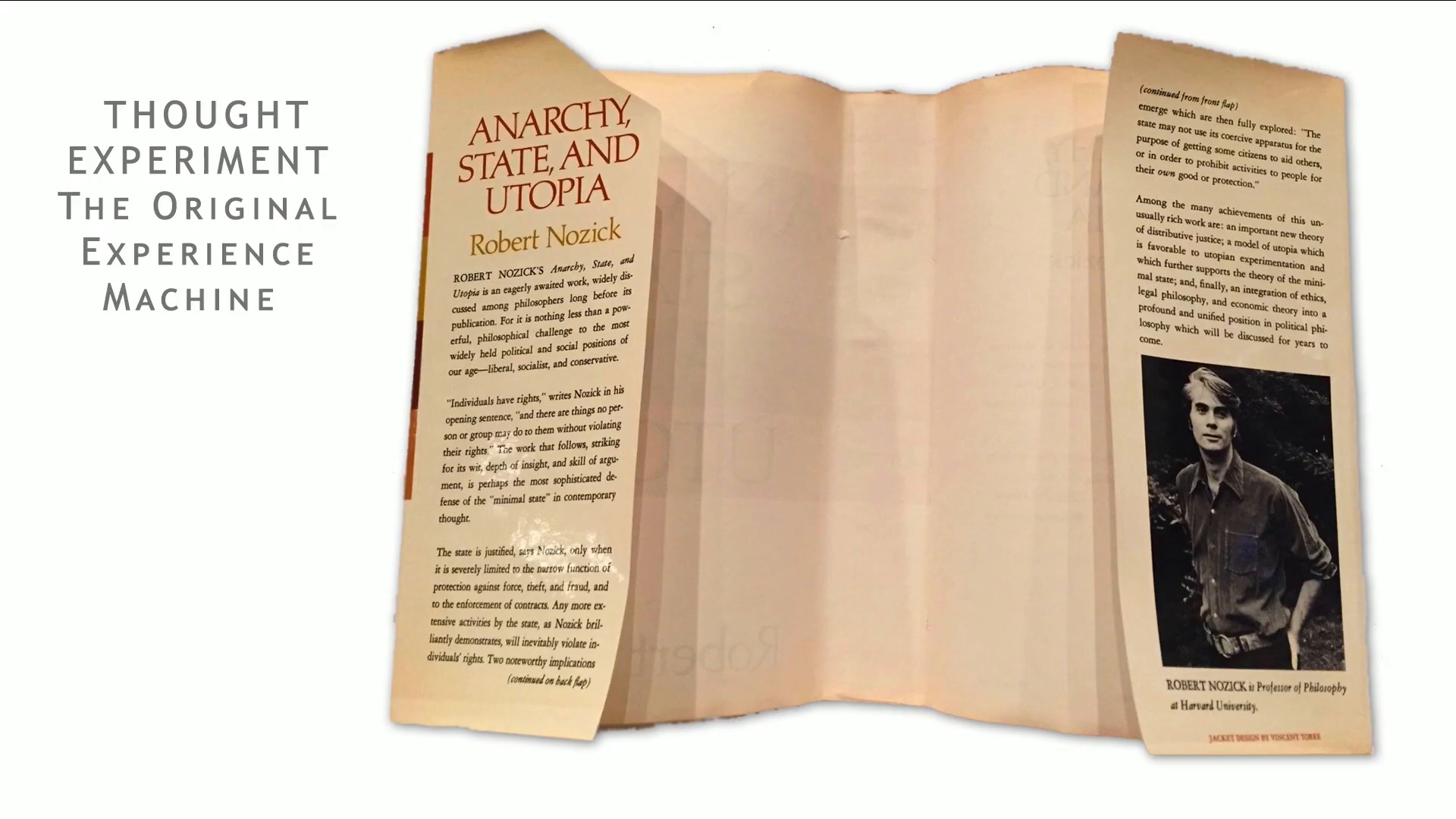
Source details — Visual — Original experience machine / Nozick
Visual — Original experience machine / Nozick
DISC-0015::VIS-001::OCC-01 · Display occurrence: approximately 54.021–66.033 seconds in the original video. Boundaries are estimated.
Exact frame PTS: 60.026633 seconds in original video.
Visible slide text — not speech
Thought experiment — The original experience machine
ANARCHY, STATE, AND UTOPIA
Robert Nozick
[…]
ROBERT NOZICK is Professor of Philosophy at Harvard University.
JACKET DESIGN BY VINCENT TORRE
AI-generated visual description — not speech or approved wording
The photographed unfolded jacket places title and jacket copy on the left, further copy and a portrait on the right. The jacket itself supplies the author attribution.
Visual limitations: Small-cap case and paragraph line wrapping normalized; source frame preserves typography.
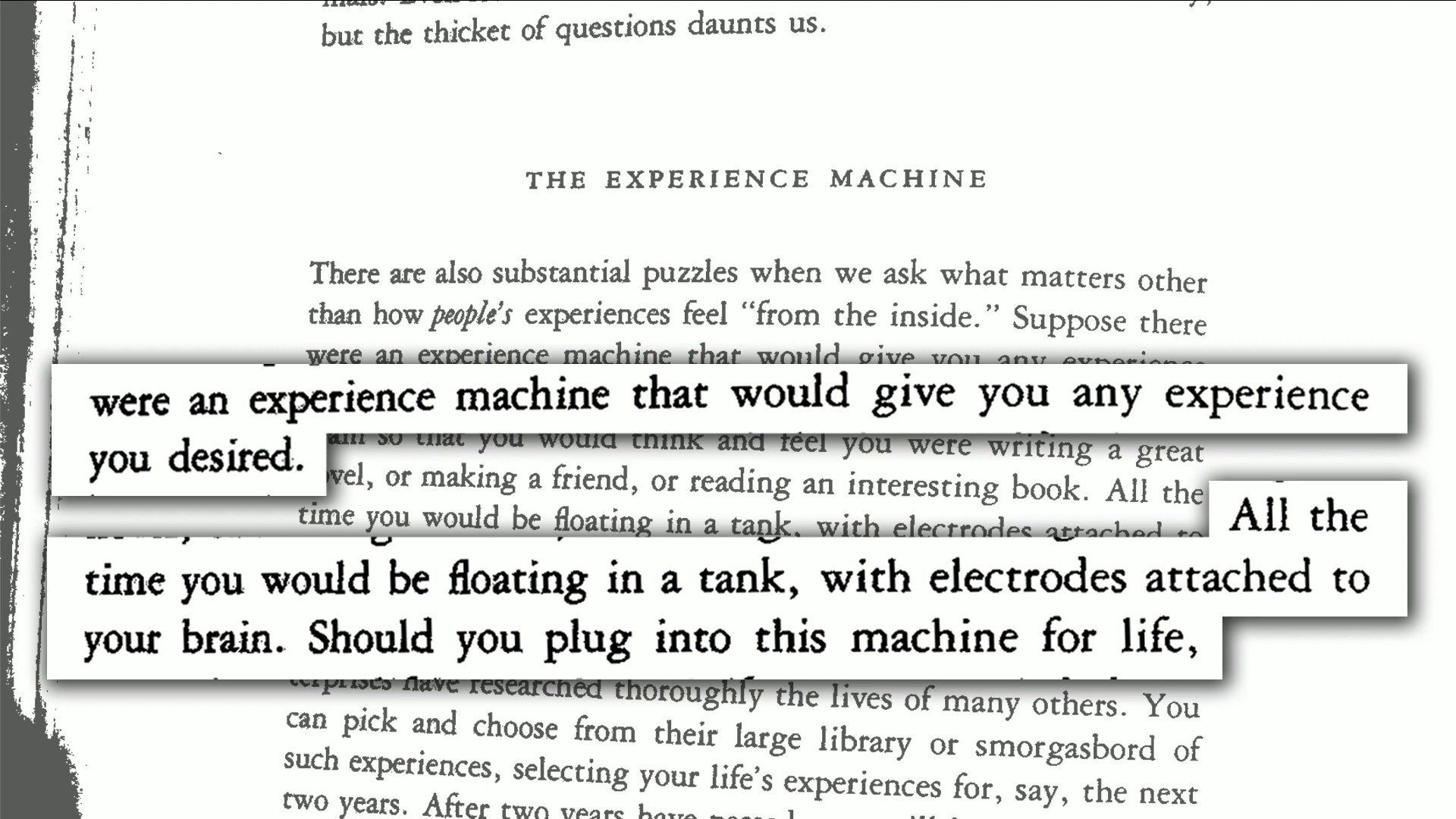
Source details — Visual — Experience-machine excerpt
Visual — Experience-machine excerpt
DISC-0015::VIS-002::OCC-01 · Display occurrence: approximately 80.013–96.029 seconds in the original video. Boundaries are estimated.
Exact frame PTS: 90.023267 seconds in original video.
Visible slide text — not speech
The experience machine
Enlarged foreground extracts
were an experience machine that would give you any experience you desired.
All the time you would be floating in a tank, with electrodes attached to your brain. Should you plug into this machine for life,
[The underlying page is partly covered by the enlarged foreground extracts. Its repeated, faded use as background on later slides is not a new quotation. No hidden words supplied.]
Visual limitations: No printed page locator is visible. The frame is an excerpt associated visually with the preceding Nozick book image; it is not James’s spoken wording. Cropped/covered background continuation is not reconstructed. Small-cap case and paragraph line wrapping normalized; source frame preserves typography.
James Brusseau speech
The year is about 1974 if memory serves. This book, like a lot of philosophy books, some of the critical ideas are caught in only one or two pages and this is one of those cases: the thought experiment which has come to be known as, which was titled, the experience machine. So an experience machine is a simple idea. It's a dilemma. You are faced with the following choice. You can enter a machine for the rest of your life—important qualification. Everyone would like to go into the machine or try this and that for a vacation or some such, but this is the rest of your life. It's a big decision. And you will get in that machine whatever experiences you like, an expression of who you are, what you want. So it's not like the Matrix, where there's this fear that you're connected up to some web and there's some nefarious force behind it manipulating you. No, in this case it's just you getting what you want. So that's the good side, and it's not difficult to sell on a morning like this. Get up early, try to find a taxi, try to squeeze into the subway. Why do we do all these things? Well, presumably the idea is because we want to have at some point experiences that are worth having, that we enjoy, that are fulfilling. What the experience machine says is forget the rainy mornings, forget the crowded subways, just go straight to it right now. Tempting, tempting.
The problem, why don't people go into this machine? It seems like there are two big difficulties. One has to do with personal identity, and one has to do with freedom.
The identity problem is that it seems like while these experiences are great, they're not happening to me.
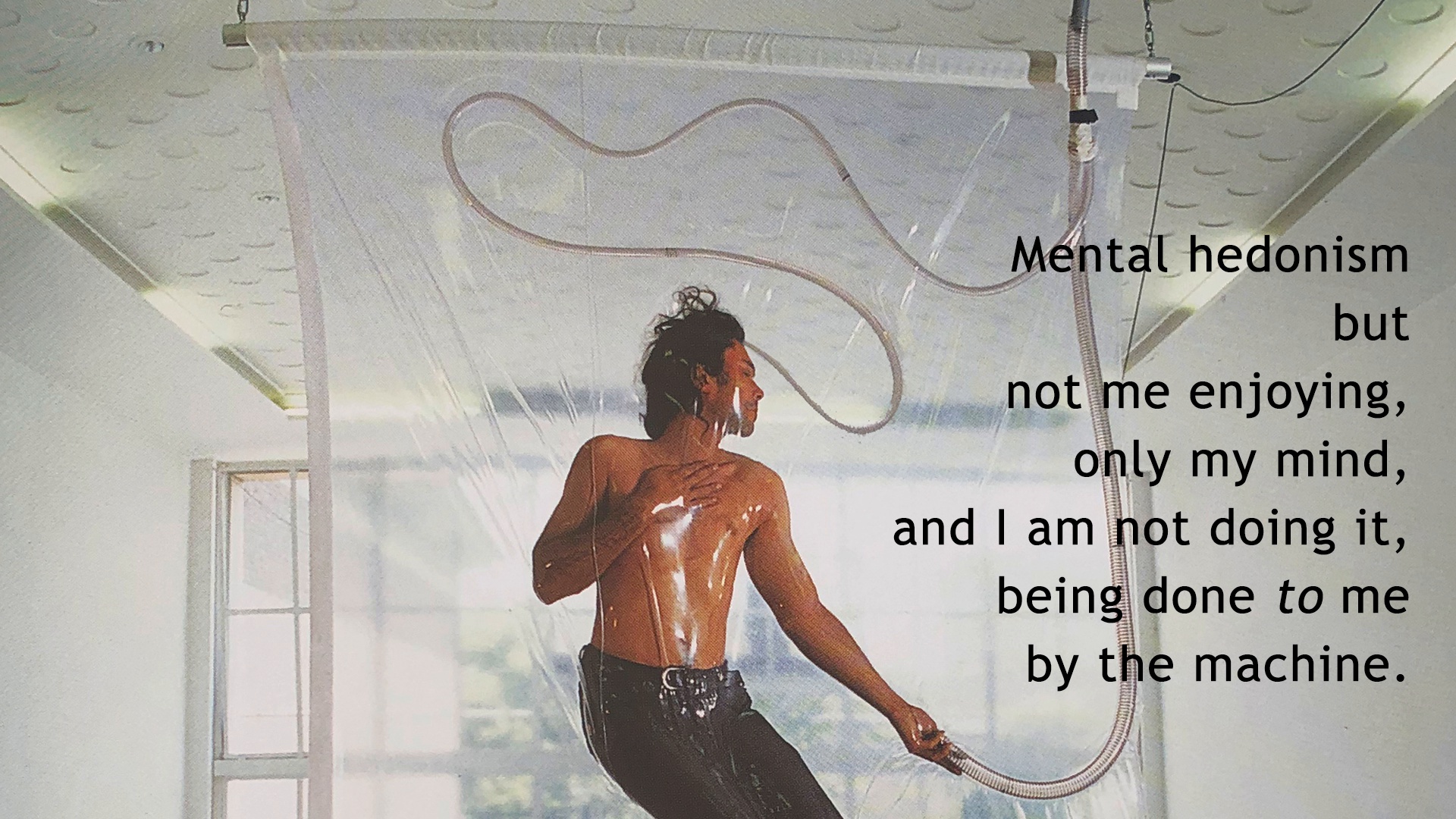
Source details — Visual — Mental hedonism
Visual — Mental hedonism
DISC-0015::VIS-003::OCC-01 · Display occurrence: approximately 186.019–204.004 seconds in the original video. Boundaries are estimated.
Exact frame PTS: 196.029167 seconds in original video.
Visible slide text — not speech
Mental hedonism
but
not me enjoying, only my mind, and I am not doing it, being done to me by the machine.
AI-generated visual description — not speech or approved wording
A film still shows a man connected to equipment. No film attribution is printed.
Visual limitations: Small-cap case and paragraph line wrapping normalized; source frame preserves typography.
James Brusseau speech
They're only in my mind if I have something like that. It's not clear that this is me having the experience, though consciously, mentally, it is as fulfilling and as real as anything in the real world. So that's the first problem, an identity problem.
The second problem is a freedom problem. That is, it doesn't seem like I'm doing the experience so much as the experience is doing me. So it's not clear that I have autonomy. I'm getting what I want. It's an interesting conflict. I'm getting what I want. I'm the one who decided to go in. But what I want is for the machine to do something to me. If we had more time, we could talk about whether or not it's possible for an individual to freely give away their own freedom, but let's move on. This talk is retail inside the big data experience machine and what I'm trying to do is two things.
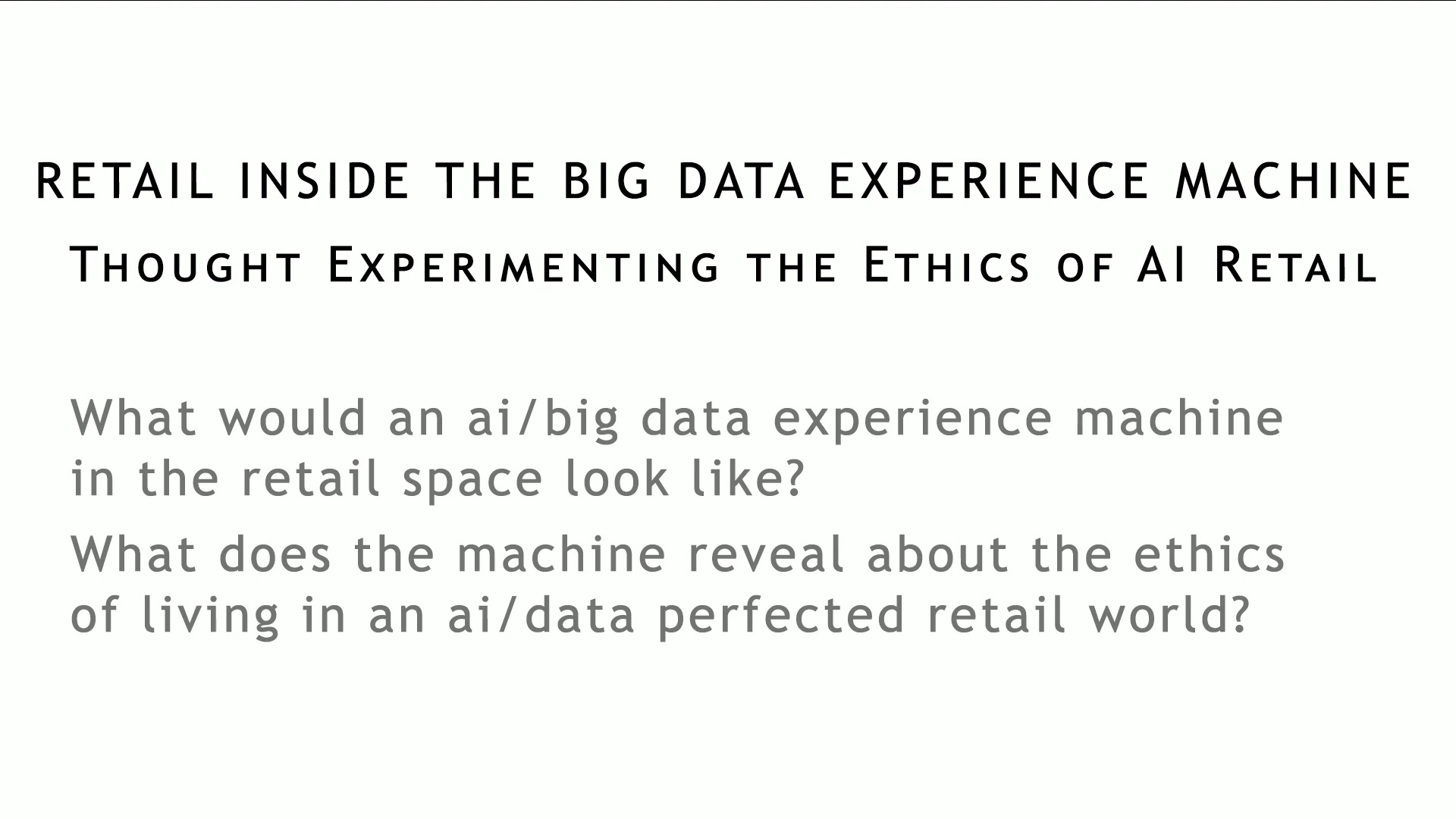
Source details — Visual — AI retail thought experiment
Visual — AI retail thought experiment
DISC-0015::VIS-004::OCC-01 · Display occurrence: approximately 242.008–256.022 seconds in the original video. Boundaries are estimated.
Exact frame PTS: 250.016433 seconds in original video.
Visible slide text — not speech
Retail inside the Big Data Experience Machine
Thought Experimenting the Ethics of AI Retail
What would an ai/big data experience machine in the retail space look like?
What does the machine reveal about the ethics of living in an ai/data perfected retail world?
Visual limitations: Small-cap case and paragraph line wrapping normalized; source frame preserves typography.
James Brusseau speech
I'm trying to say look, this old thought experiment from 1974, that's about the time Apple came into existence, this old thought experiment can actually tell us or rather can be updated to cohere with the world we face today, especially the world you are all involved in predictive analytics and big data. This machine can be updated to fit into that reality. And then second I think that at the end of the history of artificial intelligence when all the kinks have been worked out, when all the details have been refined, when all the data has been gathered and perfected, when all that has happened and we're facing perfect, the possibility of a perfect big data artificial intelligence consumer reality. I think that reality is going to be a lot like, or I think that facing that reality is going to be a lot like facing the original experience machine, I think.
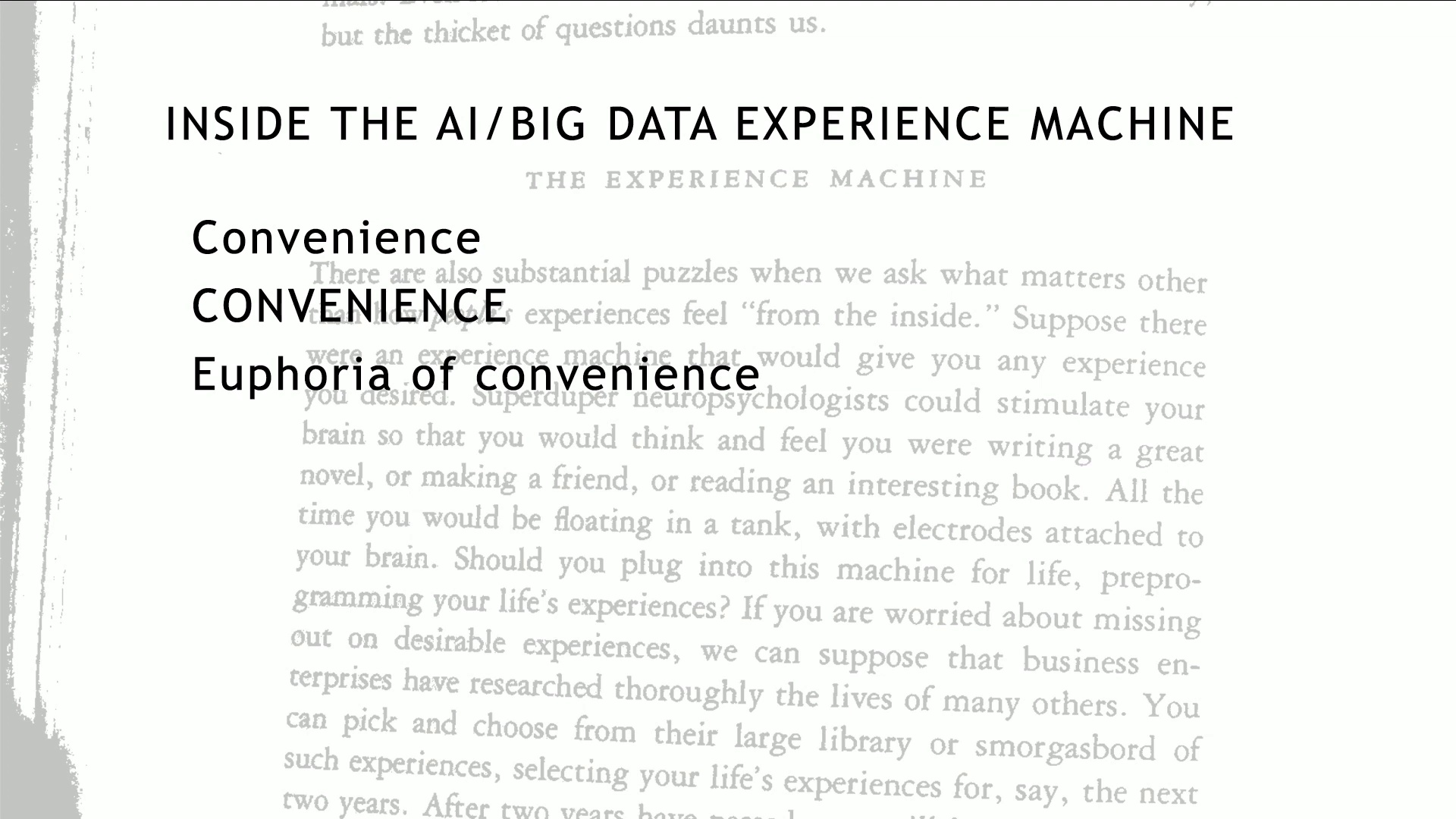
Source details — Visual — Convenience
Visual — Convenience
DISC-0015::VIS-005::OCC-01 · Display occurrence: approximately 320.020–338.004 seconds in the original video. Boundaries are estimated.
Exact frame PTS: 330.029700 seconds in original video.
Visible slide text — not speech
Inside the AI/Big Data Experience Machine
Convenience
CONVENIENCE
Euphoria of convenience
Visual limitations: Faded underlying experience-machine excerpt repeats earlier material and is retained in the image; it is not presented as new James-authored wording. Small-cap case and paragraph line wrapping normalized; source frame preserves typography.
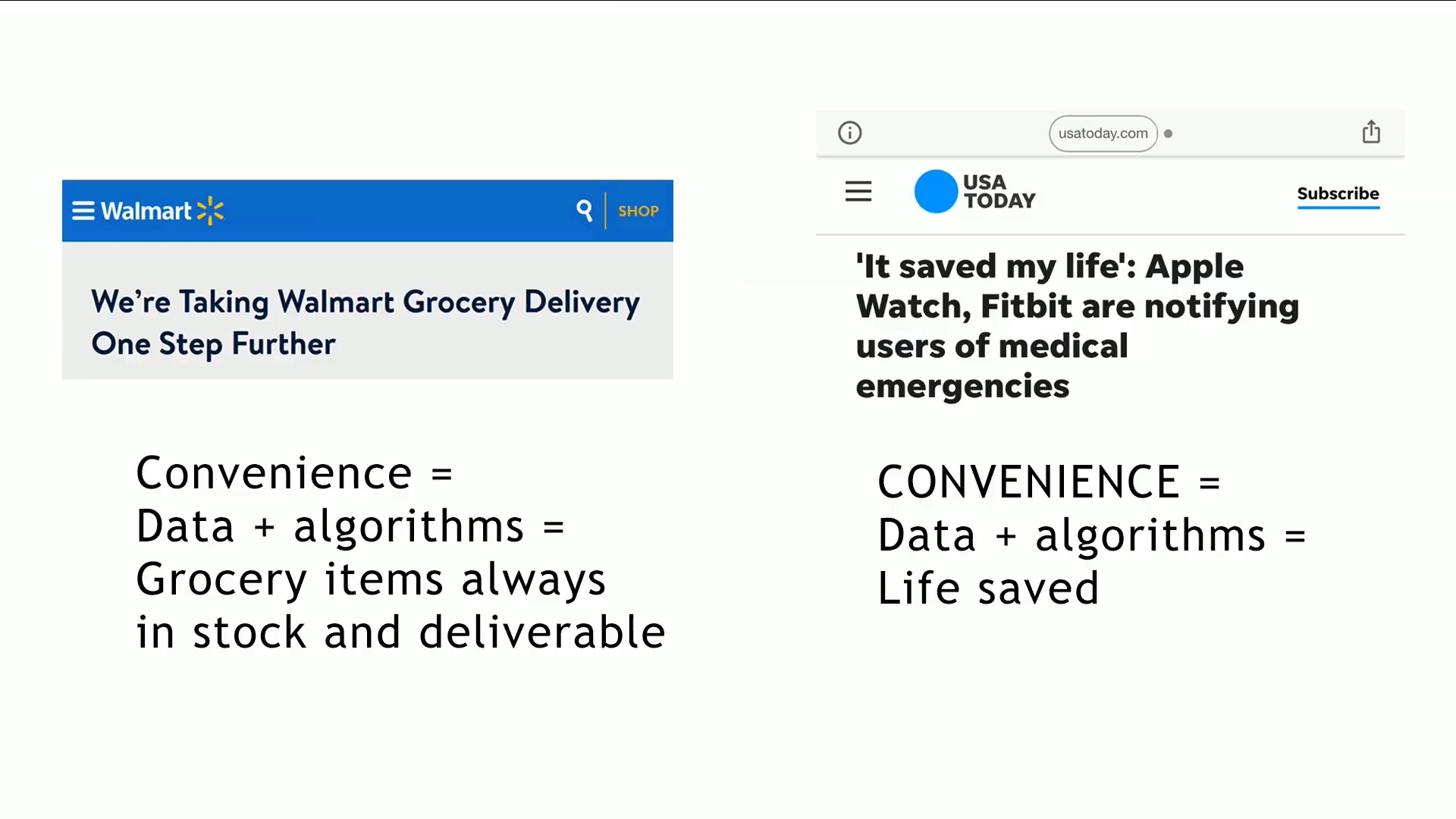
Source details — Visual — Convenience comparisons
Visual — Convenience comparisons
DISC-0015::VIS-006::OCC-01 · Display occurrence: approximately 340.006–346.012 seconds in the original video. Boundaries are estimated.
Exact frame PTS: 344.010333 seconds in original video.
Visible slide text — not speech
Walmart screenshot
Walmart · SHOP
We’re Taking Walmart Grocery Delivery One Step Further
Convenience =
Data + algorithms =
Grocery items always in stock and deliverable
USA Today screenshot
usatoday.com · USA TODAY · Subscribe
'It saved my life': Apple Watch, Fitbit are notifying users of medical emergencies
CONVENIENCE =
Data + algorithms =
Life saved
AI-generated visual description — not speech or approved wording
The two columns pair a grocery-delivery headline with a medical-alert headline; each is followed by a data-and-algorithms equivalence.
Visual limitations: Small-cap case and paragraph line wrapping normalized; source frame preserves typography.
James Brusseau speech
Here's why I think that. What do you get? If we start to imagine a big data artificial intelligence experience machine, what is it that you get? It seems to me that there are three temptations, three reasons you're going to want to go in. The first is convenience, little convenience and then the second is capital letter convenience. This debate about predictive analytics on one side and losing some autonomy against convenience on the other is one that has been bubbling to the surface in philosophy departments recently and skeptics frequently say, well, convenience, that's not worth very much.
Repeated visual — Visual — Convenience comparisons
Visual — Convenience comparisons
DISC-0015::VIS-006::OCC-02 · Display occurrence: approximately 382.015–396.029 seconds in the original video. Boundaries are estimated.
Repeated appearance of DISC-0015::VIS-006. See its first transcription.
James Brusseau speech
Well, sometimes it's not. Sometimes it's simple. Sometimes it's a movie that's chosen for you. But there's also capital C convenience. This Fitbit consumer item saves someone's life. So you have the question there. How much personal information will you give up? How much of your privacy will you sacrifice to save your life? I bet I know that answer for everybody. So convenience is a big deal. Getting convenience back in the big data artificial intelligence experience machine is a real temptation, but it's not the big temptation.
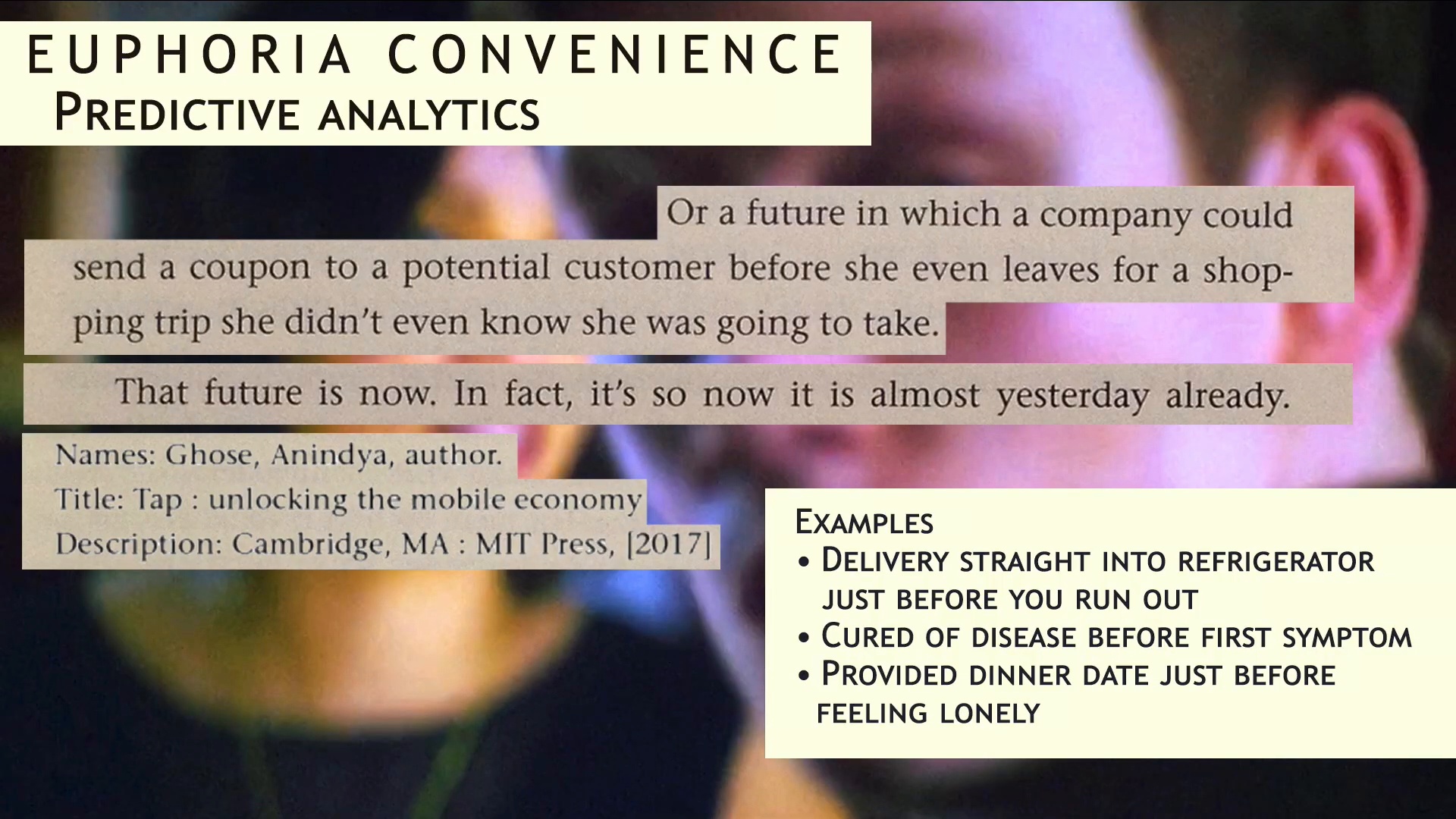
The big temptation is something that I'm calling euphoria convenience. Euphoria convenience starts with a quote that I like to cite from my professor up in NYU, not the professor who was here yesterday morning, but one of his colleagues and he's imagining a future in which a company could send a potential coupon to a consumer before she even leaves for a shopping trip she didn't even know she was going to take.
Source details — Visual — Predictive analytics / Ghose
Visual — Predictive analytics / Ghose
DISC-0015::VIS-007::OCC-01 · Display occurrence: approximately 418.018–436.002 seconds in the original video. Boundaries are estimated.
Exact frame PTS: 426.025600 seconds in original video.
Visible slide text — not speech
Euphoria Convenience
Predictive Analytics
Or a future in which a company could send a coupon to a potential customer before she even leaves for a shopping trip she didn’t even know she was going to take.
That future is now. In fact, it’s so now it is almost yesterday already.
Names: Ghose, Anindya, author.
Title: Tap : unlocking the mobile economy
Description: Cambridge, MA : MIT Press, [2017]
Examples
- Delivery straight into refrigerator just before you run out
- Cured of disease before first symptom
- Provided dinner date just before feeling lonely
Visual limitations: Displayed quotation and bibliographic record are separate from the example list. Line-end shopping hyphen normalized. Small-cap case and paragraph line wrapping normalized; source frame preserves typography.
James Brusseau speech
That future is now, in fact it's so now, it's almost yesterday. I'm not sure if that's entirely true but maybe it will be true soon. So that's the kind of predictive analytics we're going to start with. We know that Walmart, for example, is considering delivering food to your refrigerator. Well, it won't take them long to figure out what to deliver before you yourself realize that you need it.
With Fitbit we see the diseases are cured before the first symptom and we could also imagine more important things like being provided a dinner date just before you're feeling lonely. So that's the power of predictive analytics. Getting the things we want before we want them.
Source details — Visual — Prediction and the end of desire
Visual — Prediction and the end of desire
DISC-0015::VIS-008::OCC-01 · Display occurrence: approximately 516.015–528.028 seconds in the original video. Boundaries are estimated.
Exact frame PTS: 522.021500 seconds in original video.
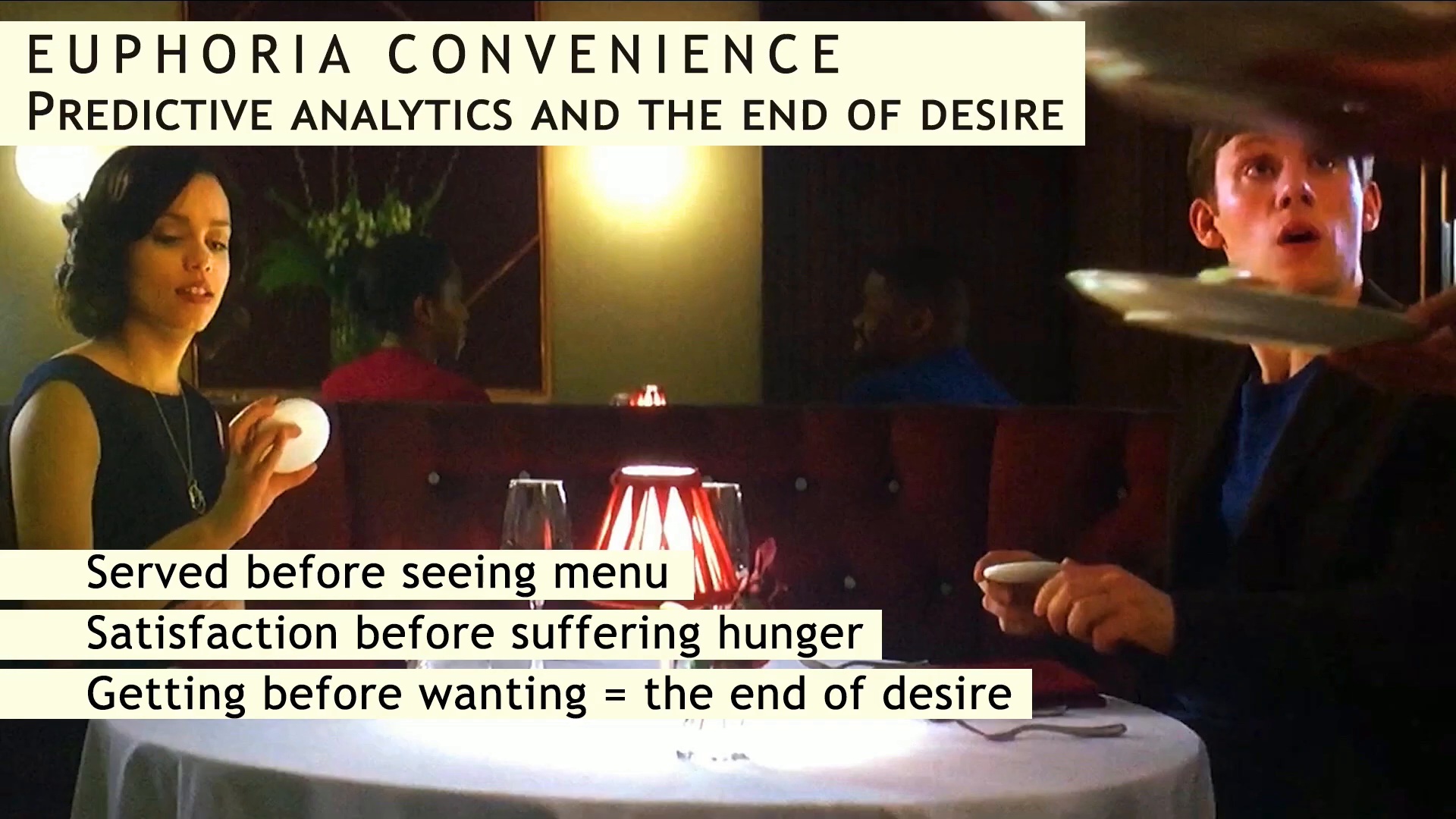
Visible slide text — not speech
Euphoria Convenience
Predictive Analytics and the End of Desire
Served before seeing menu
Satisfaction before suffering hunger
Getting before wanting = the end of desire
AI-generated visual description — not speech or approved wording
A restaurant film still underlies the three parallel statements; no film credit is printed.
Visual limitations: Small-cap case and paragraph line wrapping normalized; source frame preserves typography.
James Brusseau speech
That sounds like an efficiency point. Oh, highly efficient. Good. Excellent. It's much, much more than that. It's a human point, it's not a lot what we call in philosophy an ontological point. It has to do with the character of what it means to be human and especially an essential element of humanity namely desire. I think that predictive analytics jammed to the maximum is going to mean the end of desire. This is a scene from—of course you have to choose as your example Black Mirror for this kind of talk. This is a scene where this young couple are out having dinner, and just as they're about to feel hungry, hunger, just as they're about to ask for the menu, lo and behold, the perfect dishes arrive. So it's a good example, I think, because it's hunger in both the literal sense and the figurative sense. They almost felt hungry, almost, but not quite. The food was all ready.
Source details — Visual — Euphoria Convenience defined
Visual — Euphoria Convenience defined
DISC-0015::VIS-009::OCC-01 · Display occurrence: approximately 582.015–602.001 seconds in the original video. Boundaries are estimated.
Exact frame PTS: 590.022767 seconds in original video.
Visible slide text — not speech
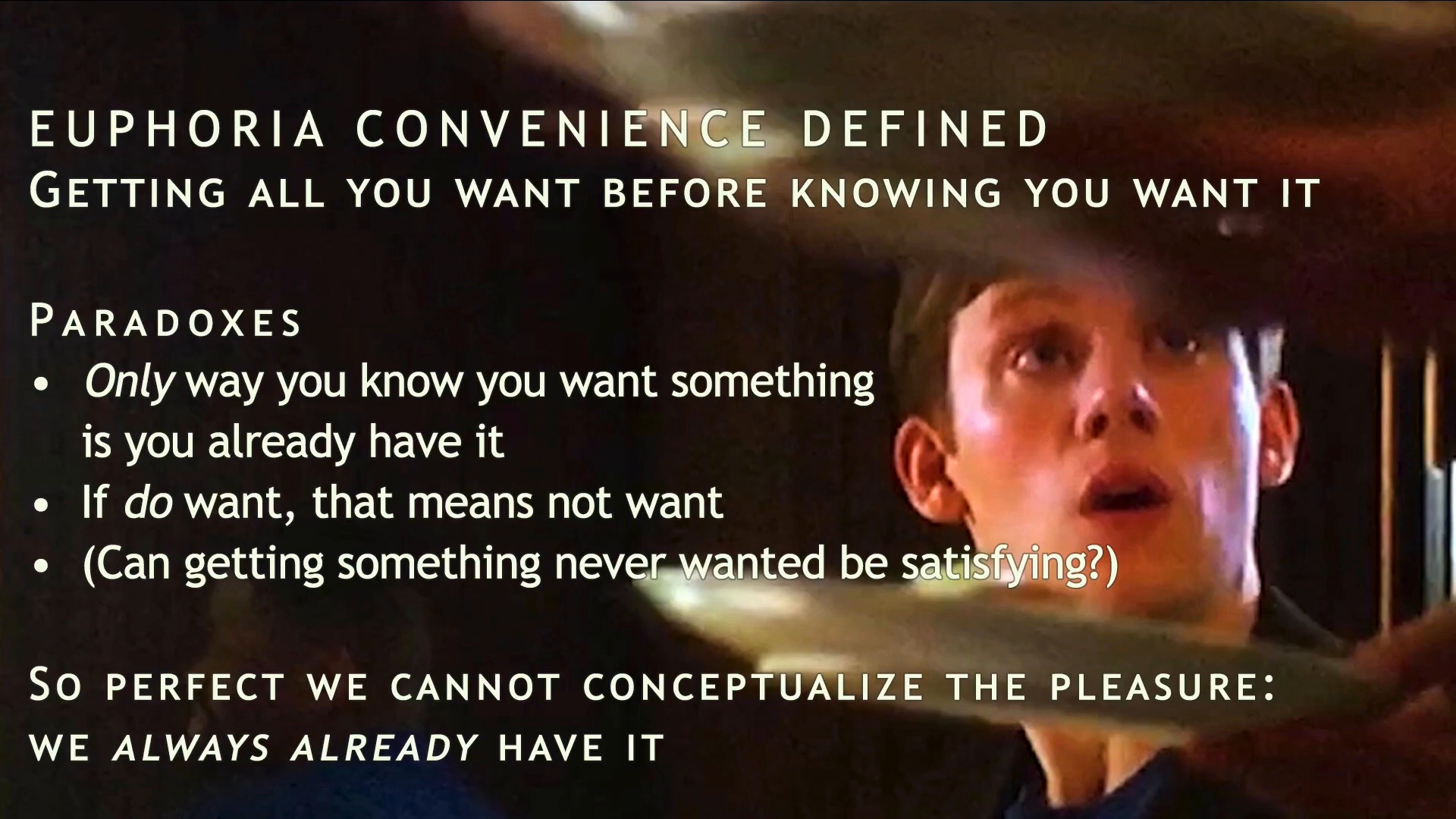
Euphoria Convenience Defined
Getting all you want before knowing you want it
Paradoxes
- Only way you know you want something is you already have it
- If do want, that means not want
- (Can getting something never wanted be satisfying?)
So perfect we cannot conceptualize the pleasure:
we always already have it
AI-generated visual description — not speech or approved wording
The text overlays the same restaurant scene used in the preceding slide.
Visual limitations: Small-cap case and paragraph line wrapping normalized; source frame preserves typography.
James Brusseau speech
So that's the key starting point for this idea of euphoria convenience. It's predictive analytics jammed up to the point where our desires, our hungers are literally cut off before we can sense them. They're already answered. They're already satisfied. And this, if you imagine raising this up all the way right now, it's not just your dinner. Now it's not just your Fitbit. Now it's not just the movie on Netflix. It's everything. So this is the second step. We're going from the end of desire, I'm at the dinner table, to the end of desire everywhere. Everything you want all the time is received before you know that you want it.
Repeated visual — Visual — Euphoria Convenience defined
Visual — Euphoria Convenience defined
DISC-0015::VIS-009::OCC-02 · Display occurrence: approximately 636.002–642.008 seconds in the original video. Boundaries are estimated.
Repeated appearance of DISC-0015::VIS-009. See its first transcription.
James Brusseau speech
That's the dream for AI, for big data with respect to satisfying individuals, consumers. And if we get that then we have not only the end of human desire, it's gone. We don't experience it anymore but we also have euphoria what I'm calling euphoria convenience. And I think that this is a strange state, the state of euphoria convenience. Because if you think about it, just kind of trying to imagine yourself in this reality, how is the only way, since desire is gone, how is the only way that you can know what you want? Well, the only way is that you already have it. So that's how you know what you want, because I have it. And that's the only way you know what you want. In fact, stronger, if you do want something else. If I look out and I'm drinking my water and I see someone drinking an orange juice there, I think actually I want this orange juice. What that means in the big data experience machine is that I don't actually want that. I can't since the entire point of the thought experiment at least is that we get everything before we know that we want it. So to wrap this up, the reason we would go into the big data experience machine is because we get a convenience and a pleasure that is so perfect that we cannot conceptualize it. And I mean that literally. It is a condition of the possibility of having this kind of convenience and pleasure. If we always get it before we know that we want it, how could we possibly conceive it? How could we possibly think it? How can we possibly have any theoretical sense of what this euphoria convenience is that we are living?
I think of it, for example, in some ways might be like breathing. If it weren't for the fact that we occasionally went underwater or held our breath, none of us, I suspect, would, again, were it not for an external cue, even realize we were breathing, right? Breathing is something our body does for us just before we want the oxygen, our body expands our lungs and we get the air. So if it weren't for the fact that we went under water at some point, none of us would know what breathing was. If we didn't hold our breath at some time, we would have no way of experiencing breathing since, as I put it here, stealing from Heidegger, we always already have it. Whether the it is the air we want to breathe or the dinner we want to eat or whatever else you can imagine in your experience.
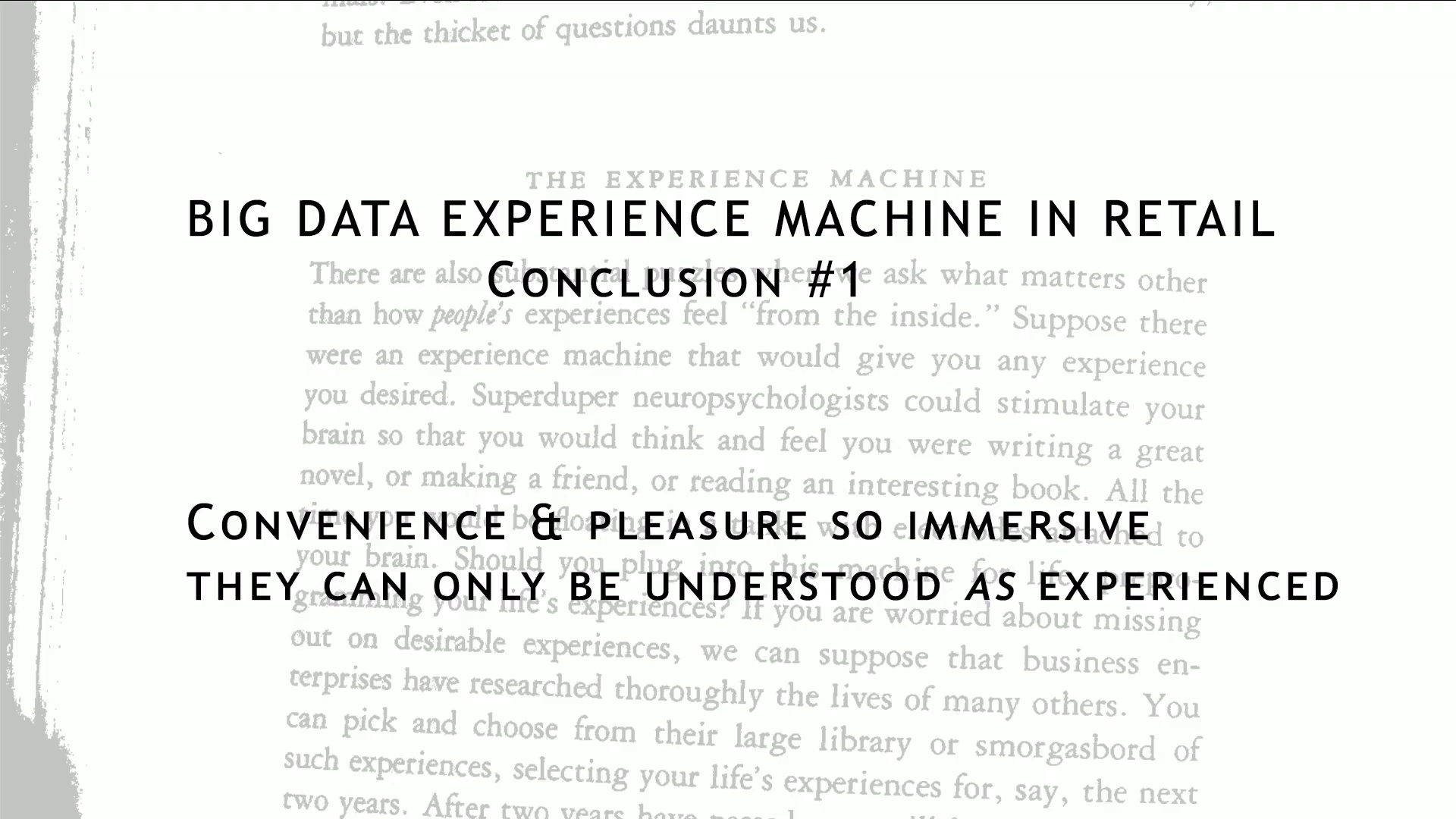
So, euphoria convenience is the end of desire. It is always already having whatever it is you want and it is therefore literally inconceivable. It can't be thought. It can only be experienced. That sounds pretty good. It's pleasure and convenience so perfect that you can't even think it. You could only live it.
Source details — Visual — Retail conclusion
Visual — Retail conclusion
DISC-0015::VIS-010::OCC-01 · Display occurrence: approximately 832.031–846.012 seconds in the original video. Boundaries are estimated.
Exact frame PTS: 840.005833 seconds in original video.
Visible slide text — not speech
Big Data Experience Machine in Retail
Conclusion #1
Convenience & pleasure so immersive
they can only be understood as experienced
Visual limitations: The faded experience-machine page is repeated background, partly obscured; not re-transcribed as new material. Small-cap case and paragraph line wrapping normalized; source frame preserves typography.
Source details — Visual — Dilemma
Visual — Dilemma
DISC-0015::VIS-011::OCC-01 · Display occurrence: approximately 868.000–878.010 seconds in the original video. Boundaries are estimated.
Exact frame PTS: 874.006467 seconds in original video.
Visible slide text — not speech
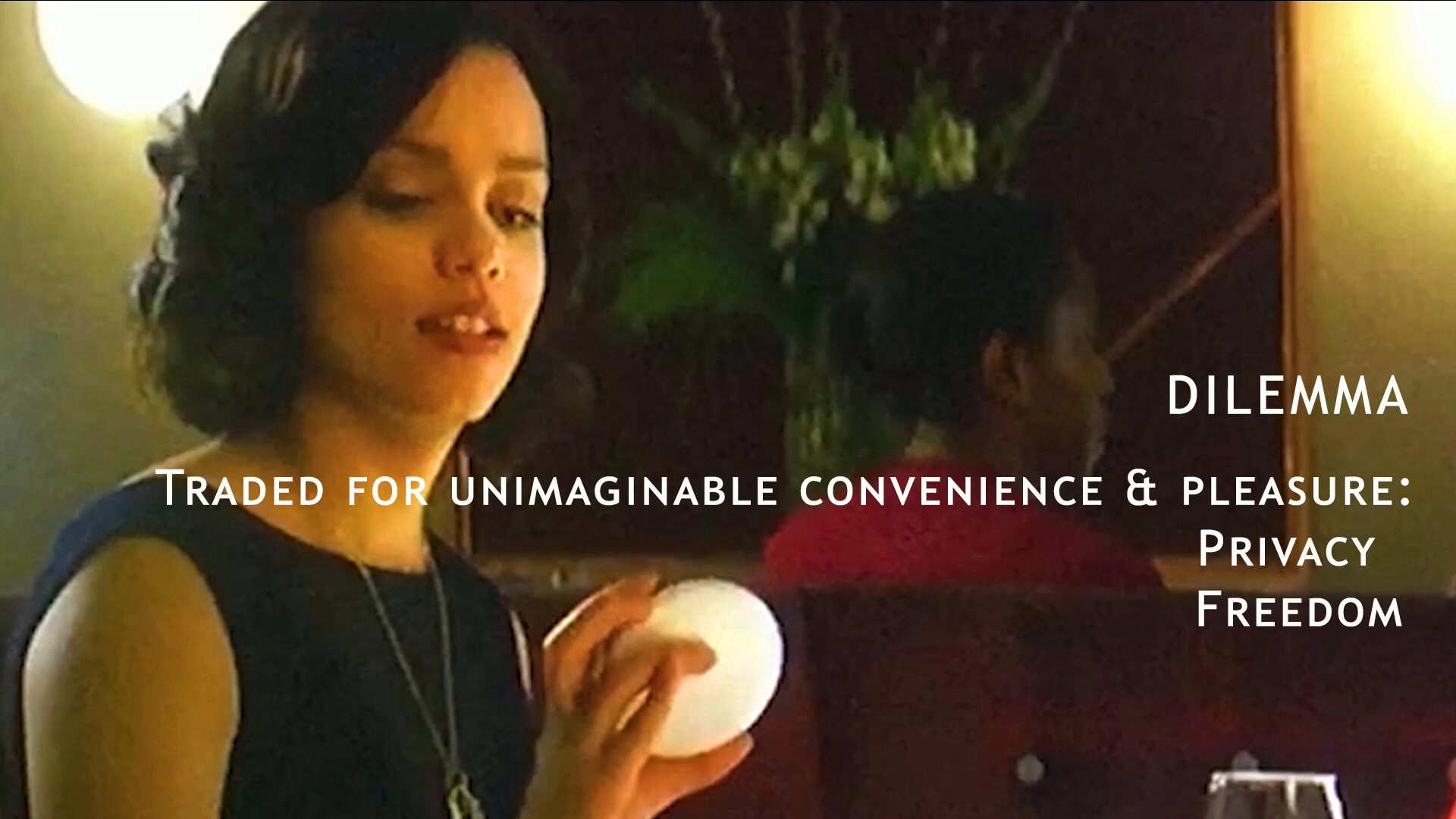
Dilemma
Traded for unimaginable convenience & pleasure:
Privacy
Freedom
AI-generated visual description — not speech or approved wording
A restaurant-scene still supports the juxtaposition of convenience/pleasure with privacy/freedom.
Visual limitations: Small-cap case and paragraph line wrapping normalized; source frame preserves typography.
Source details — Visual — Privacy and personal information
Visual — Privacy and personal information
DISC-0015::VIS-012::OCC-01 · Display occurrence: approximately 880.012–886.018 seconds in the original video. Boundaries are estimated.
Exact frame PTS: 884.016467 seconds in original video.
Visible slide text — not speech
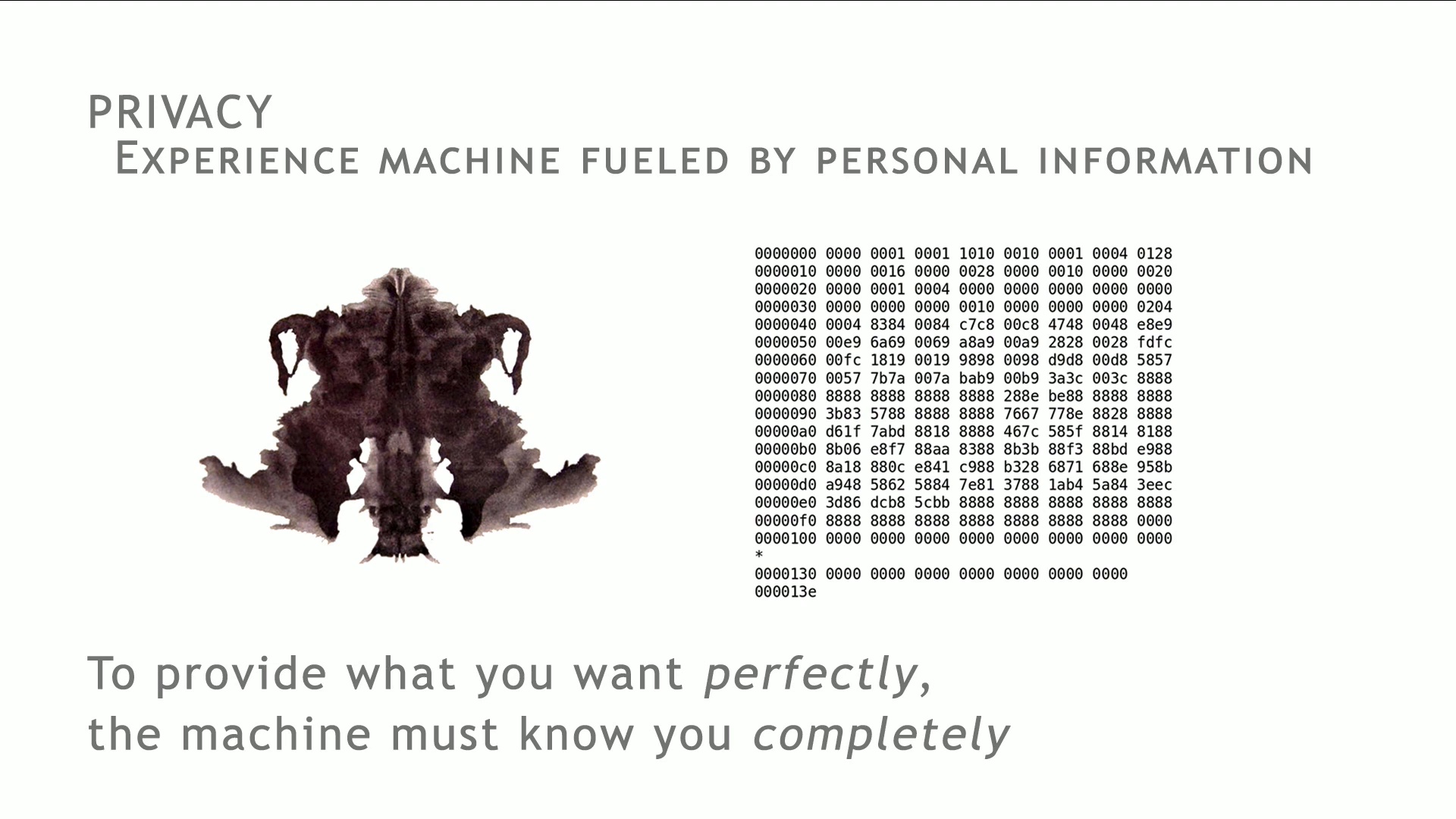
Privacy
Experience machine fueled by personal information
To provide what you want perfectly, the machine must know you completely
AI-generated visual description — not speech or approved wording
An inkblot-like image appears opposite a hexadecimal dump, pairing personal interpretation with data representation. The literal hexadecimal digits remain in the image; they are not an argument formula or measured dataset.
Visual limitations: The two OCR fragments at 880–886 seconds were reconciled as one continuous state after native-frame inspection. Small-cap case and paragraph line wrapping normalized; source frame preserves typography.
James Brusseau speech
So, that's step one of building the Big Data Experience Machine. We have an idea of what it looks like, and we have an idea of what we get when we go into it. What's the downside? Why is it that we might not want this? Well I think that there are two problems, and the problems are very similar to the ones that we saw in Nozick's experience machine, original experience machine thought experiment from the 1970s. Privacy is a problem that has to do with individuality and freedom. So I see that I'm moving rapidly through my time. I'm going to escalate the rapidity here a bit.
Let's talk about privacy first. Again, it's privacy and freedom. These are the two things that we're giving up for pleasure that's so good that you can't imagine it literally. For the machine to work, obviously, the machine has to know you completely. If it's gonna work perfectly, it has to know everything about you. So privacy is not something that we sort of defend or sort of have. No, privacy is gone. It's not just a little loss. Frequently we think about privacy gone, we think well people have access to what we were looking at on the web or what we've purchased in the past and so on. It goes much deeper than that. For the machine to work everything about ourselves must be exposed. So the experience machine thought experiment is also an experiment in total exposure. What does that mean? It's not easy to actually think that through, total exposure.
Source details — Visual — Privacy degree zero / tweet
Visual — Privacy degree zero / tweet
DISC-0015::VIS-013::OCC-01 · Display occurrence: approximately 912.011–924.023 seconds in the original video. Boundaries are estimated.
Exact frame PTS: 918.017100 seconds in original video.
Visible slide text — not speech
Privacy Degree Zero
Thought Experiment in Exposure
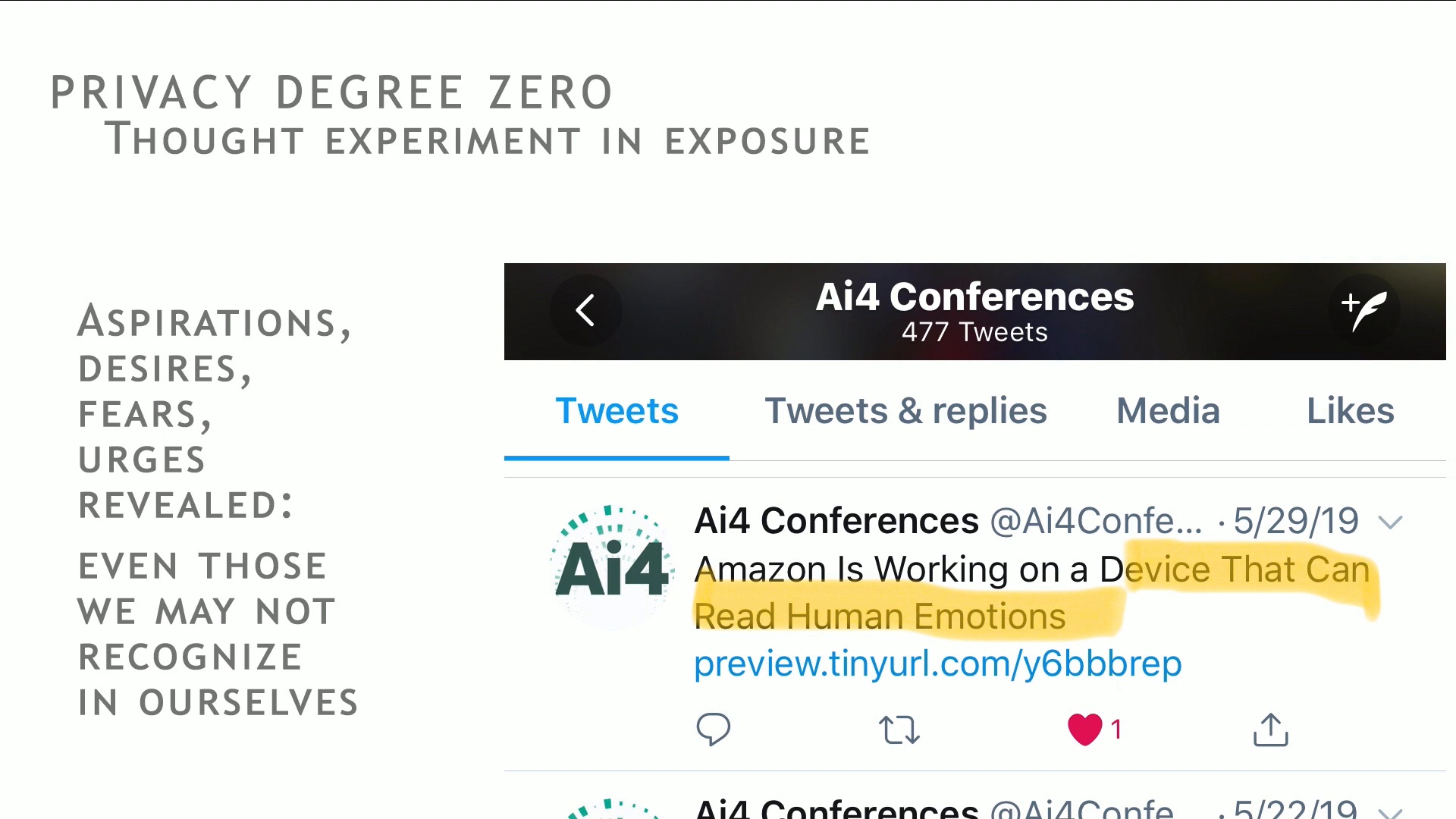
Aspirations, desires, fears, urges revealed:
even those we may not recognize in ourselves
Displayed tweet
Ai4 Conferences
477 Tweets
Tweets · Tweets & replies · Media · Likes
Ai4 Conferences @Ai4Confe... · 5/29/19
Amazon Is Working on a Device That Can Read Human Emotions
preview.tinyurl.com/y6bbbrep
♥ 1
AI-generated visual description — not speech or approved wording
Yellow highlighting emphasizes the claim that a device can read human emotions. The tweet author and date remain third-party attribution.
Visual limitations: The account handle is visibly truncated. A later tweet row is cropped at the bottom. No missing handle or cropped tweet wording is reconstructed. Small-cap case and paragraph line wrapping normalized; source frame preserves typography.
Repeated visual — Visual — Privacy degree zero / tweet
Visual — Privacy degree zero / tweet
DISC-0015::VIS-013::OCC-02 · Display occurrence: approximately 960.026–964.030 seconds in the original video. Boundaries are estimated.
Short-display inclusion exception: Short repeat reference of an otherwise retained state; not aggregated to qualify the slide.
Repeated appearance of DISC-0015::VIS-013. See its first transcription.
Source details — Visual — Identity from every angle
Visual — Identity from every angle
DISC-0015::VIS-014::OCC-01 · Display occurrence: approximately 1000.032–1004.003 seconds in the original video. Boundaries are estimated.
Short-display inclusion exception: Short repeat reference of an otherwise retained state; not aggregated to qualify the slide.
Exact frame PTS: 1002.001000 seconds in original video.
Visible slide text — not speech
Privacy Degree Zero
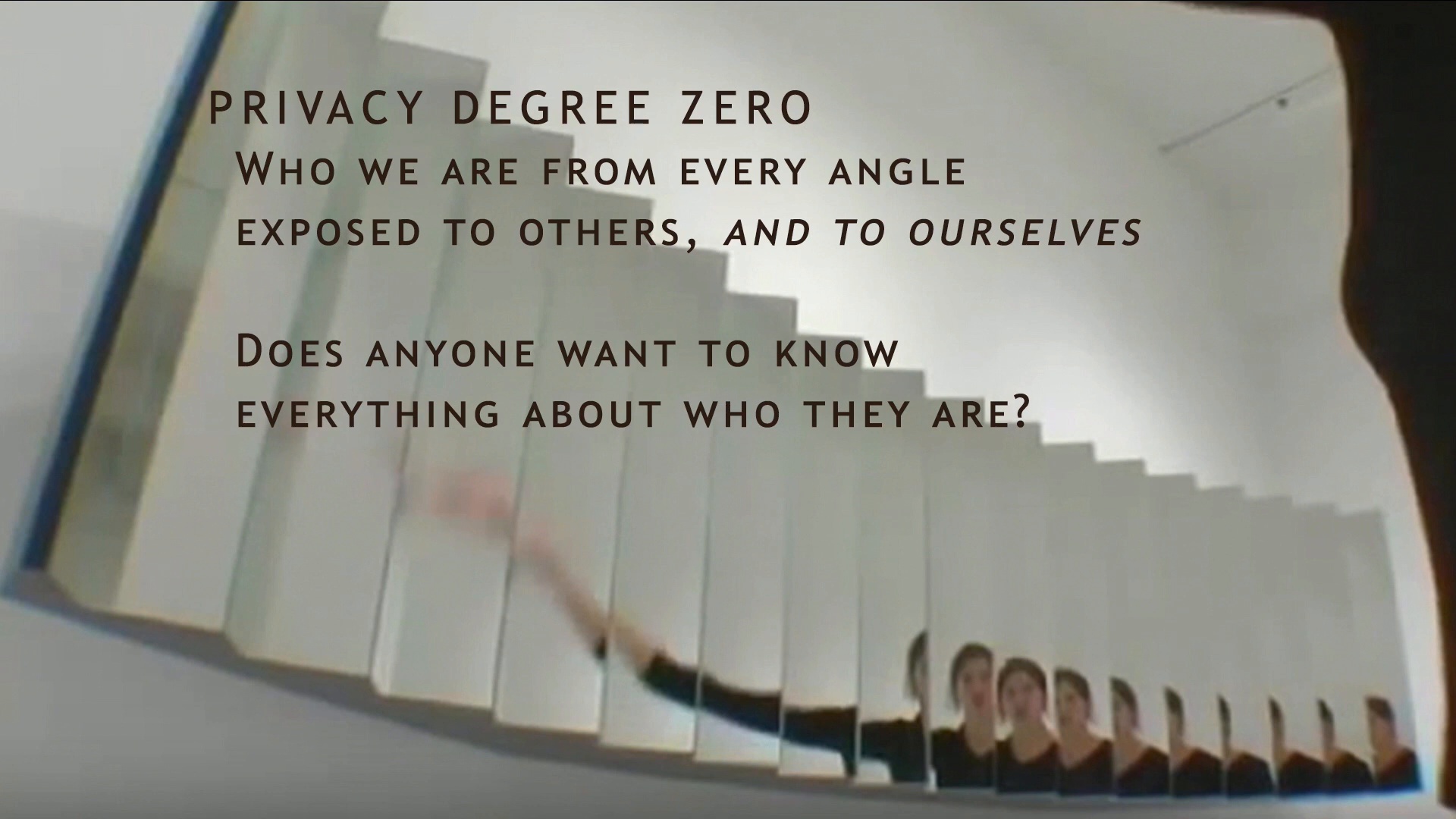
Who we are from every angle
exposed to others, and to ourselves
Does anyone want to know everything about who they are?
AI-generated visual description — not speech or approved wording
Repeated portraits fan across an open page, illustrating identity seen from multiple angles.
Visual limitations: Small-cap case and paragraph line wrapping normalized; source frame preserves typography.
Repeated visual — Visual — Identity from every angle
Visual — Identity from every angle
DISC-0015::VIS-014::OCC-02 · Display occurrence: approximately 1014.013–1022.021 seconds in the original video. Boundaries are estimated.
Repeated appearance of DISC-0015::VIS-014. See its first transcription.
James Brusseau speech
The end of privacy goes far, far beyond something like the Big Brother television series where you have cameras in every room. The end of privacy at least starts with something like this, with devices that can read human emotions and if it's reading or if our emotions are being read and also our aspirations, our desires, our urges, our fears, all those things. They all need to be read and understood. It's not enough for us to reveal those things that we know about ourselves. Even those things we don't know about ourselves must also be revealed. If we have more time, we could start imagining what some of those things are. But it doesn't take a lot of imagination to begin to worry that maybe there is a problem with this and maybe the problem is not what everyone says it is. Everyone says well, the big problem when we lose privacy is people are going to know all about me. You know, people are gonna know what I was looking at on the internet or what I was buying. That's not the big problem. The big problem in a world of total exposure, I think, is that we are going to know about ourselves. Even those parts of ourselves we don't want to recognize and acknowledge. We will be forced to see and understand because the functioning experience machine has got to know us to our profoundest depths. So, the first cost, the privacy cost is not a cost about shame and embarrassment that people are going to know what I was surfing through last night. It is that but way way beyond that the real cost is that I am going to know, have to know about myself, everything. Even those parts of myself I'd never acknowledged or understood. Something that's a drawback.
Source details — Visual — Freedom / identity
Visual — Freedom / identity
DISC-0015::VIS-015::OCC-01 · Display occurrence: approximately 1086.018–1102.001 seconds in the original video. Boundaries are estimated.
Exact frame PTS: 1090.022267 seconds in original video.
Visible slide text — not speech
Freedom
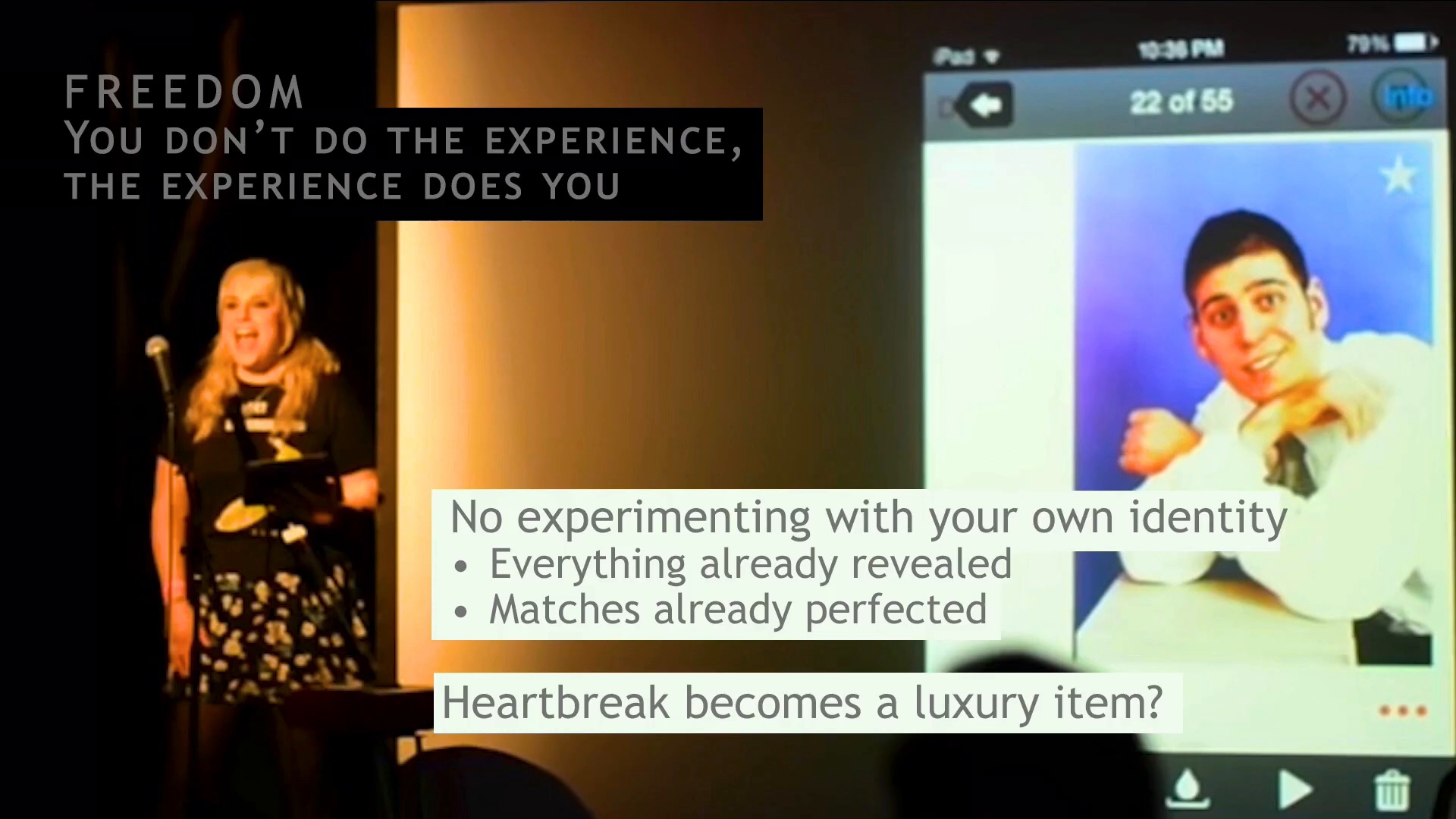
You don’t do the experience, the experience does you
No experimenting with your own identity
- Everything already revealed
- Matches already perfected
Heartbreak becomes a luxury item?...
Visible app photograph
22 of 55
AI-generated visual description — not speech or approved wording
A stage performer holding a phone is paired with an enlarged profile photograph on a device. The pair illustrates curated matching; incidental device status and button icons remain in the image.
Visual limitations: No printed photographer or performer attribution is visible; no identity is inferred from the speech. Small-cap case and paragraph line wrapping normalized; source frame preserves typography.
James Brusseau speech
So first problem, total exposure of privacy.
Second problem, freedom. It seems to me, and just by the way, this is a good slide. This is from a New York comedy show called Tinder Live. And I don't know this person. This is not a paid announcement. But if you're here for the next few nights, Google it and see if you can go see it. Do you like big data? If you want to see the human experience of big data, what it looks like when a real human life, flesh and blood life, is pressed through the grinder of artificial intelligence and big data, this show, Tinder Live, gives it to you very poignantly. It's a show in which this comedian, the woman on your left, does her Tinder live for you to watch and so she draws up potential matches and then more or less ridicules them.
Repeated visual — Visual — Freedom / identity
Visual — Freedom / identity
DISC-0015::VIS-015::OCC-02 · Display occurrence: approximately 1132.031–1148.014 seconds in the original video. Boundaries are estimated.
Repeated appearance of DISC-0015::VIS-015. See its first transcription.
James Brusseau speech
It's fun in a kind of evil sort of way though she manages to put forward kind of a good hearted spin on it.
So what do you lose in freedom? Imagine that everything about you is known. Well one thing you can no longer do is experiment with your own identity. I mean, one of the most important ways that we investigate our own freedom and live our own autonomy is by creating images of ourselves, presentations of ourselves for potential romantic partners. We find out who we are by trying one thing and trying something else. But that fails in the world of big data because everything is known already. So that's the first freedom cost.
Source details — Visual — Freedom / autoplay
Visual — Freedom / autoplay
DISC-0015::VIS-016::OCC-01 · Display occurrence: approximately 1194.026–1206.005 seconds in the original video. Boundaries are estimated.
Exact frame PTS: 1200.032167 seconds in original video.
Visible slide text — not speech
Freedom
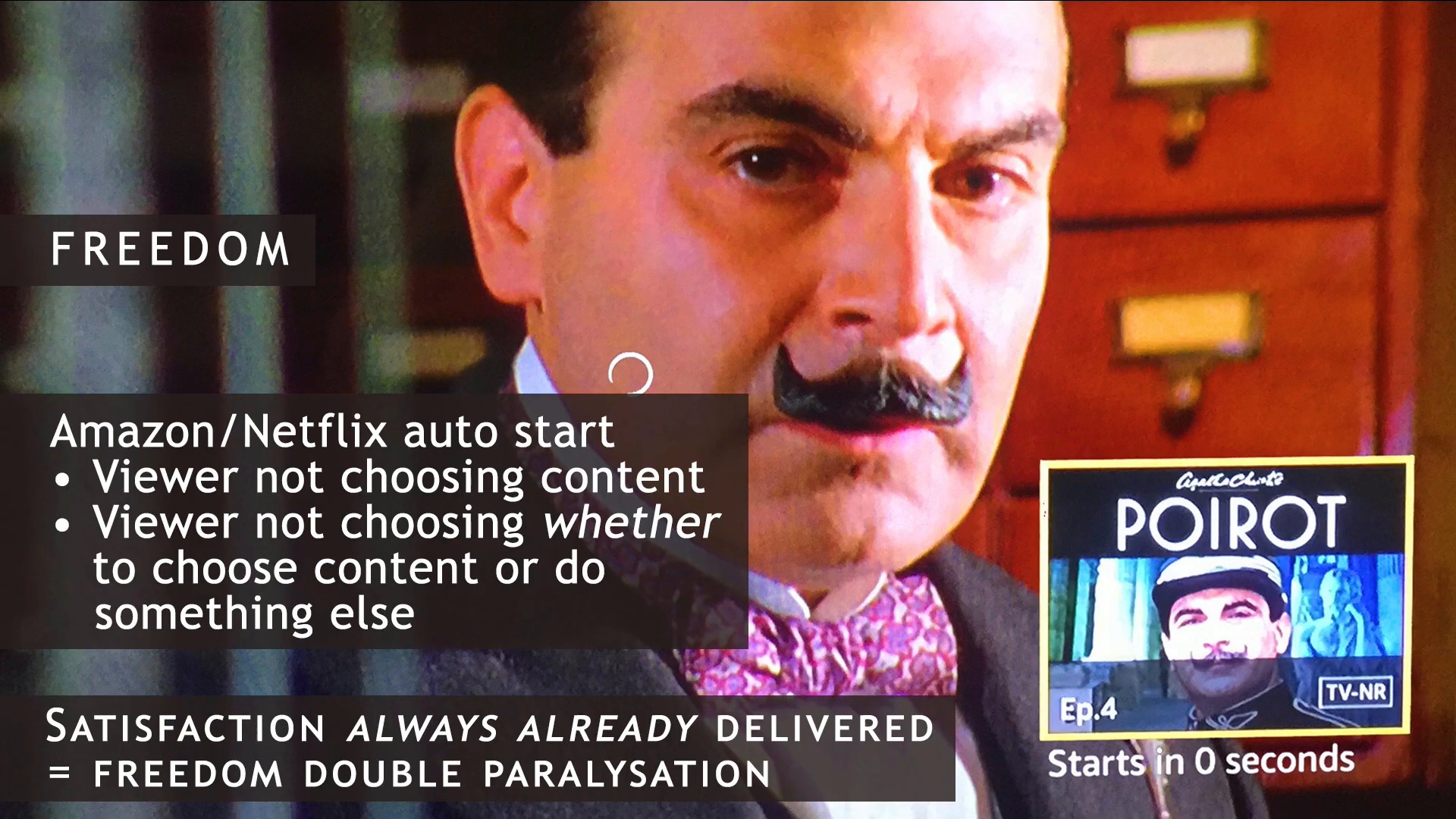
Amazon/Netflix auto start
- Viewer not choosing content
- Viewer not choosing whether to choose content or do something else
Satisfaction always already delivered
= freedom double paralysation
Agatha Christies POIROT
Ep.4
TV-NR
Starts in 0 seconds
AI-generated visual description — not speech or approved wording
The program tile at right displays a zero-second autoplay countdown.
Visual limitations: Small-cap case and paragraph line wrapping normalized; source frame preserves typography.
James Brusseau speech
The second freedom cost, as we run short of time, I wish we had a few more moments to explore this, but I will leave you, at least on this slide, with just the thought that as you see on the screen here, when you're watching a movie or a television show and the new suggestion comes up and it's already playing, right? Again, that's the key to this whole big data experience machine. You always already have, you always already have whatever it is you want. It's already playing. So as your show is ending, the next one is already running. Zero seconds. It's already going. And that's a double freedom loss. First, you don't get to choose one show instead of another. And second, you don't get to choose whether you're going to watch more TV or go for a bike ride. I think there's something there which is significant.
Source details — Visual — Final dilemma
Visual — Final dilemma
DISC-0015::VIS-017::OCC-01 · Display occurrence: approximately 1256.021–1270.002 seconds in the original video. Boundaries are estimated.
Exact frame PTS: 1260.025433 seconds in original video.
Visible slide text — not speech
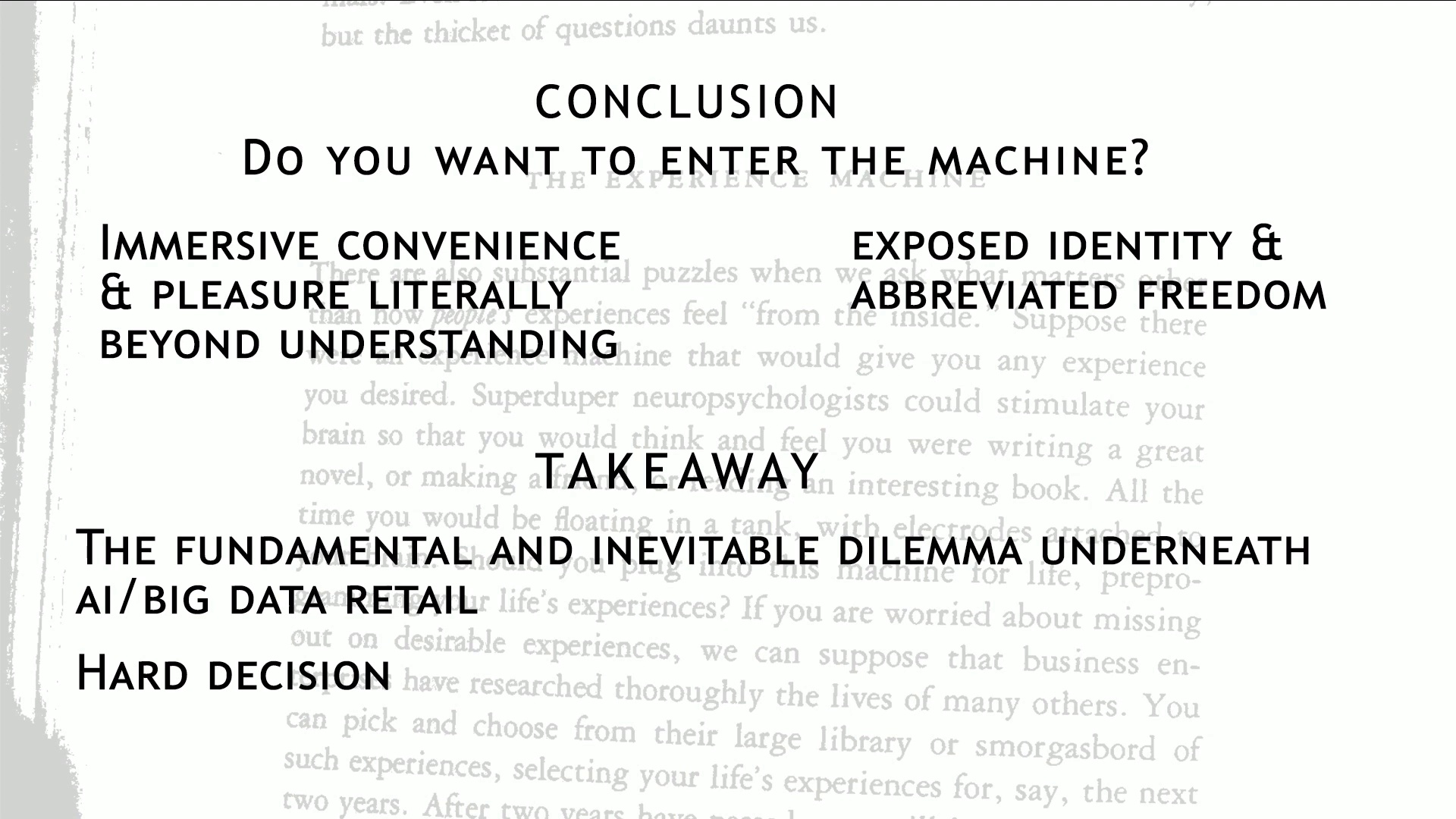
Conclusion
Do you want to enter the machine?
| Immersive convenience & pleasure literally beyond understanding | Exposed identity & abbreviated freedom |
Takeaway
The fundamental and inevitable dilemmas underneath AI/big data retail
Hard decision
AI-generated visual description — not speech or approved wording
The concluding slide places convenience/pleasure and exposed identity/abbreviated freedom in two opposing columns.
Visual limitations: The faded Nozick page repeats the earlier background. It is not attributed to James as original wording. Small-cap case and paragraph line wrapping normalized; source frame preserves typography.
James Brusseau speech
Maybe on some other occasion we can talk about that. But let's bring this to a conclusion. So what I've tried to show very quickly this morning is what life is like in the big data experience machine. And what I've wanted to say, going back to the start, is that at the end of the history of artificial intelligence, what we are going to be faced with, after all the glitches have been wiped out and all the data's collected, what we are going to be faced with is a choice. On the one side, we can get experiences and pleasures that are so immersive that they are literally beyond understanding. They can only be understood as experienced. But on the other hand, what we're going to give up is privacy, not simple privacy like someone saw when I was on the internet. No, full exposure. What's going to be horrifying is seeing ourselves. And secondly, what we're going to have at least abbreviated is human freedom. Should we go into this machine? I don't know. Thanks for coming.