Inherited editorial introduction (source unchanged)
Euphoria Convenience
Approved speech wording and attribution are preserved; paragraph formatting is awaiting review. Visual text and AI-generated descriptions remain separate from speech. Paragraph placement is editorial; recording display times and exact frame timestamps are unchanged.
Source details — Visual — Privacy questions
Visual — Privacy questions
DISC-0017::VIS-001::OCC-01 · Display occurrence: approximately 2.000–78.000 seconds in the original video. Boundaries are estimated.
Exact frame PTS: 10.000000 seconds in original video.
Visible slide text — not speech
Everyone says privacy is important, but why exactly? And, what is privacy?
(And, why is this talk titled Euphoria Convenience?)
Visual limitations: Small-cap headings and line wrapping normalized; presenter inset and event branding omitted.
James Brusseau speech
James Brusseau: What we are thinking about talking about this afternoon, and thanks for joining us, is euphoria convenience. But to get there, I want to first talk about privacy, which is, I suppose everyone has the quirks of their own profession. When I tell people that I'm a philosopher and I'm working on artificial intelligence and big data and predictive analytics and those kinds of things that many of you are working on at dinner parties and such I oh with surprising frequency I get exactly this question that I've put on this slide in fact part of the reason I made this presentation is because I have gotten this question so many times I just decided well why don't I just go ahead and make a presentation people ask about everyone is always talking about privacy, but what is it and why is it so important? But why do we want privacy? So those are the first things I thought I would talk about today. And then we'll get to the title of the paper which is Before Your Convenience and that will all make sense in about five or ten minutes after we get through some preliminary thoughts about privacy.
Source details — Visual — Privacy definition / Westin
Visual — Privacy definition / Westin
DISC-0017::VIS-002::OCC-01 · Display occurrence: approximately 80.000–128.000 seconds in the original video. Boundaries are estimated.
Exact frame PTS: 100.000000 seconds in original video.
Visible slide text — not speech
What is privacy?
ALAN F. WESTIN
PRIVACY AND FREEDOM
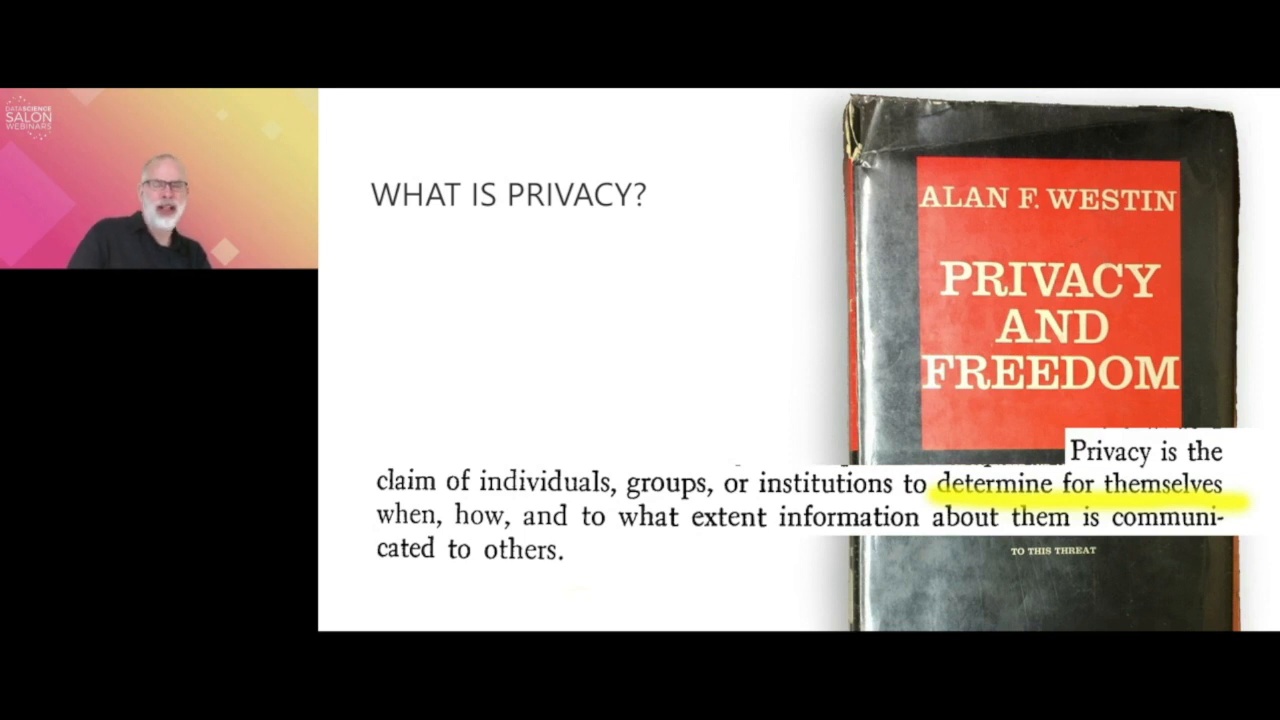
Privacy is the claim of individuals, groups, or institutions to determine for themselves when, how, and to what extent information about them is communicated to others.
[Further book-cover wording is partly covered by the excerpt and unreadable; not reconstructed.]
Visual limitations: Quotation appears over the displayed Westin book; no page number visible. Line-end hyphen in communicated normalized. Small-cap headings and line wrapping normalized; presenter inset and event branding omitted.
James Brusseau speech
So I am an academic philosopher so I do have to start with books. And this book is about as old as I am, I think. It was published in the mid-60s sometime. And it contains the central definition of privacy that we use today in a kind of long form. So in the book, privacy is the claim of individuals, groups, or institutions. Maybe we're really talking about individuals. So it's a claim of individuals, people like you and I, to determine for ourselves when and how and to what extent information about ourselves is communicated to others.
Source details — Visual — Control over access
Visual — Control over access
DISC-0017::VIS-003::OCC-01 · Display occurrence: approximately 130.000–290.000 seconds in the original video. Boundaries are estimated.
Exact frame PTS: 160.000000 seconds in original video.
Visible slide text — not speech
What is privacy?
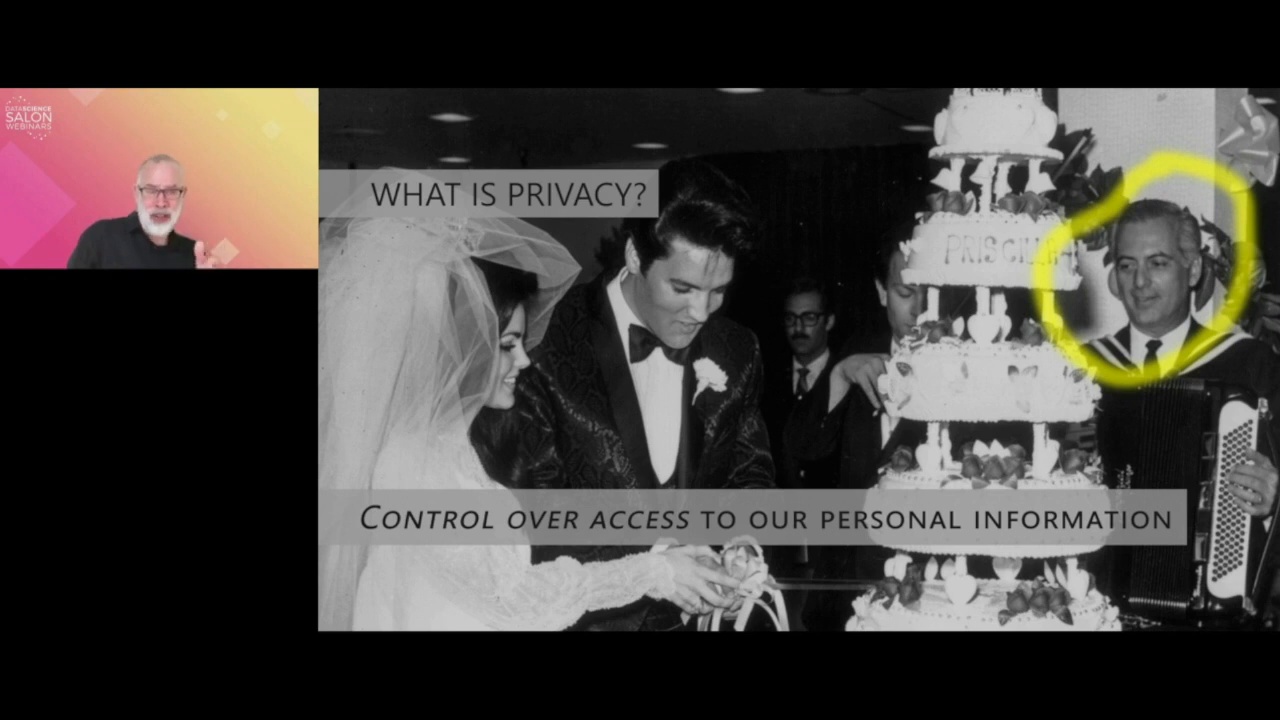
Control over access to our personal information
AI-generated visual description — not speech or approved wording
A wedding photograph accompanies the definition; a man at the right is circled in yellow. No image credit is visible.
Visual limitations: Small-cap headings and line wrapping normalized; presenter inset and event branding omitted.
James Brusseau speech
So, what does that mean? What that means is, don't quote me on this, I'm not sure that I'm right, but I believe that Elvis's wedding to Priscilla Presley, the soon-to-be Priscilla Presley which is here in this image I believe that that was kind of a sudden slapdash affair that is it wasn't planned with great anticipation in terms of time they just sort of went off in Las Vegas classically and decided to get married which means that they had in their wedding ceremony a fair number of people like this accordion player back here who presumably Elvis and Priscilla did not know personally so you have this situation where these two are to share one of the most intimate and personal moments of someone's life that is getting married in their first kiss and so on. And you have someone there at the ceremony watching over who's just essentially some guy off the street, some guy they've never met before.
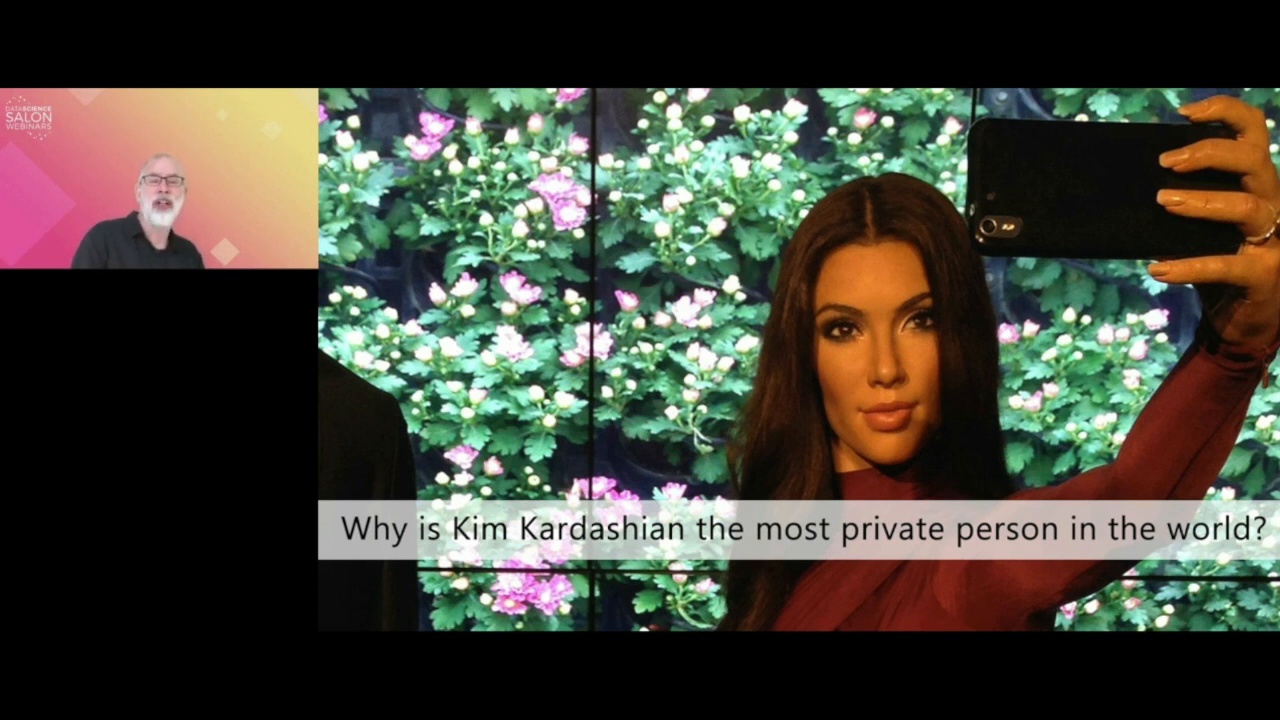
So the question here is thinking about that accordion player. The question is, well, is this still a private moment for this young couple Elvis and Priscilla, even though this guy is here or stated slightly differently? Does this guy violate the privacy of the wedding couple? And under the definition we looked at, the answer is no. It's not a privacy violation because Elvis and Priscilla decided he could be there. So what's important about privacy is this power to make decisions. Where privacy is in a sense, privacy is actually a verb, not a noun. It's something you do, not something you have. And the way you do privacy is by determining for yourself who gets to witness things like the cutting of your wedding cake and your first kiss as a married couple and so on. So that's what privacy is. And then the definition that we use sort of shortened from the textbook definition in the first slide. The definition we use is control over access to our personal information. That's typically how we define privacy today. And so then that leads to this question, which is why is Kim Kardashian the most private person in the world? I'm not sure if she's the most private person in the world, but under the definition, she's pretty close. And she's pretty close because she controls excessively and meticulously exactly how much information, personal information, intimate information about her is released.
Source details — Visual — Kim Kardashian question
Visual — Kim Kardashian question
DISC-0017::VIS-004::OCC-01 · Display occurrence: approximately 292.000–392.000 seconds in the original video. Boundaries are estimated.
Exact frame PTS: 320.000000 seconds in original video.
Visible slide text — not speech
Why is Kim Kardashian the most private person in the world?
AI-generated visual description — not speech or approved wording
A photograph of a woman holding a phone accompanies the printed question. No image credit is visible.
Visual limitations: Small-cap headings and line wrapping normalized; presenter inset and event branding omitted.
James Brusseau speech
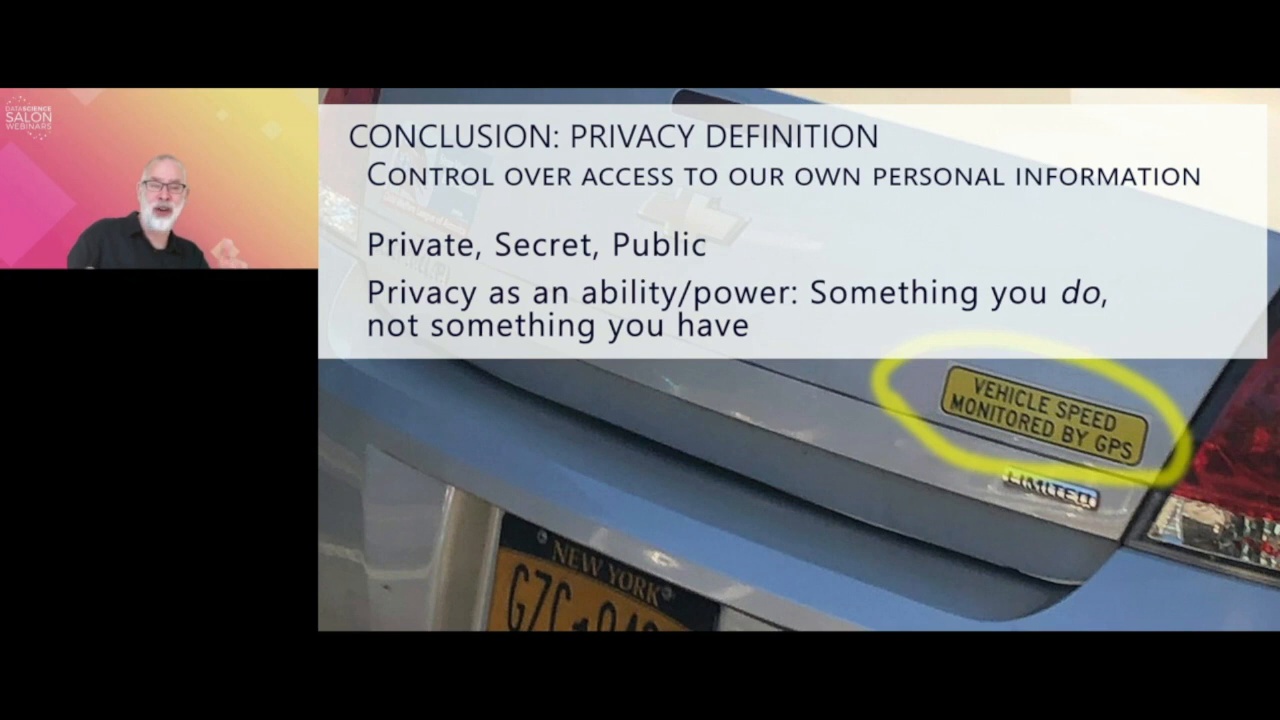
Now, it's true she is overexposed, right? She gives us much more information about herself than I suspect any of us want to hear or know about. But the fact that she is overexposed, the fact that we know much more about the most intimate and personal things of her life than we want to know, that does not mean that she somehow does not have privacy. Just the opposite is because she controls so well how much we know. It actually forces us to know more than we want to know. That's the proof that she controls her personal information. That's the truth that she is a kind of queen of privacy amongst many other things. So I think that in a certain sense of this question, why is Kim Kardashian the most private person in the world? I think when that question makes sense and when the answer is clear, I think that's when you know you have a good grip on what privacy is. And this idea that privacy is, as I put here in the concluding slide, is an ability or a power. It's something you do, not something you have. So I've circled this in this slide, the vehicle speed monitored by GPS.
Source details — Visual — Privacy as ability
Visual — Privacy as ability
DISC-0017::VIS-005::OCC-01 · Display occurrence: approximately 394.000–522.000 seconds in the original video. Boundaries are estimated.
Exact frame PTS: 420.000000 seconds in original video.
Visible slide text — not speech
Conclusion: Privacy definition
Control over access to our own personal information
Private, Secret, Public
Privacy as an ability/power: Something you do, not something you have
VEHICLE SPEED MONITORED BY GPS
AI-generated visual description — not speech or approved wording
The GPS-monitoring sticker on a car is circled in yellow beneath the definition. Incidental license-plate characters are retained only in the image.
Visual limitations: Small-cap headings and line wrapping normalized; presenter inset and event branding omitted.
James Brusseau speech
Well, so the privacy question there would be the fact that the GPS, the fact that the car can be monitored by this global positioning system, so it can be determined where you, the driver, are all the time. The fact that that exists is not a privacy violation. The privacy violation or the privacy challenge would come if you, the driver, do not have control over when this GPS system is connected and operating. As long as you have control, as long as you can turn it on or off, there is no privacy violation involved in this vehicle speed. I guess it's the vehicle speed. It's not where it is, but probably that too but it's how fast you're going there's no privacy violation in there as long as you the driver can turn the gps on or off but as soon as you lose that ability as soon as it's someone else who decides for you whether they know how fast you're driving then privacy is gone the last point private secret public is just worth quickly distinguishing so private is control over your personal information. The secret and the public, those are completely different kind of subjects. The secret and the public, those words define or concern how much information is known about you. Those are nouns, right? What is secret is known by very few or almost no one. What is public is or can be known by nearly anybody. But privacy, that's something different. That doesn't talk about how much could be known owner could not be known. Privacy, as opposed to the secret in public, is about who controls what is known. So that's step one of what I want to talk about. What is privacy? Step two is going to be, all right, why is privacy important? Why do we want control over our personal information?
Source details — Visual — Why do we want privacy?
Visual — Why do we want privacy?
DISC-0017::VIS-006::OCC-01 · Display occurrence: approximately 524.000–544.000 seconds in the original video. Boundaries are estimated.
Exact frame PTS: 530.000000 seconds in original video.
Visible slide text — not speech
Why do we want privacy?
Visual limitations: Small-cap headings and line wrapping normalized; presenter inset and event branding omitted.
Source details — Visual — Concealing personal information
Visual — Concealing personal information
DISC-0017::VIS-007::OCC-01 · Display occurrence: approximately 546.000–924.000 seconds in the original video. Boundaries are estimated.
Exact frame PTS: 600.000000 seconds in original video.
Visible slide text — not speech
Why do we want privacy?
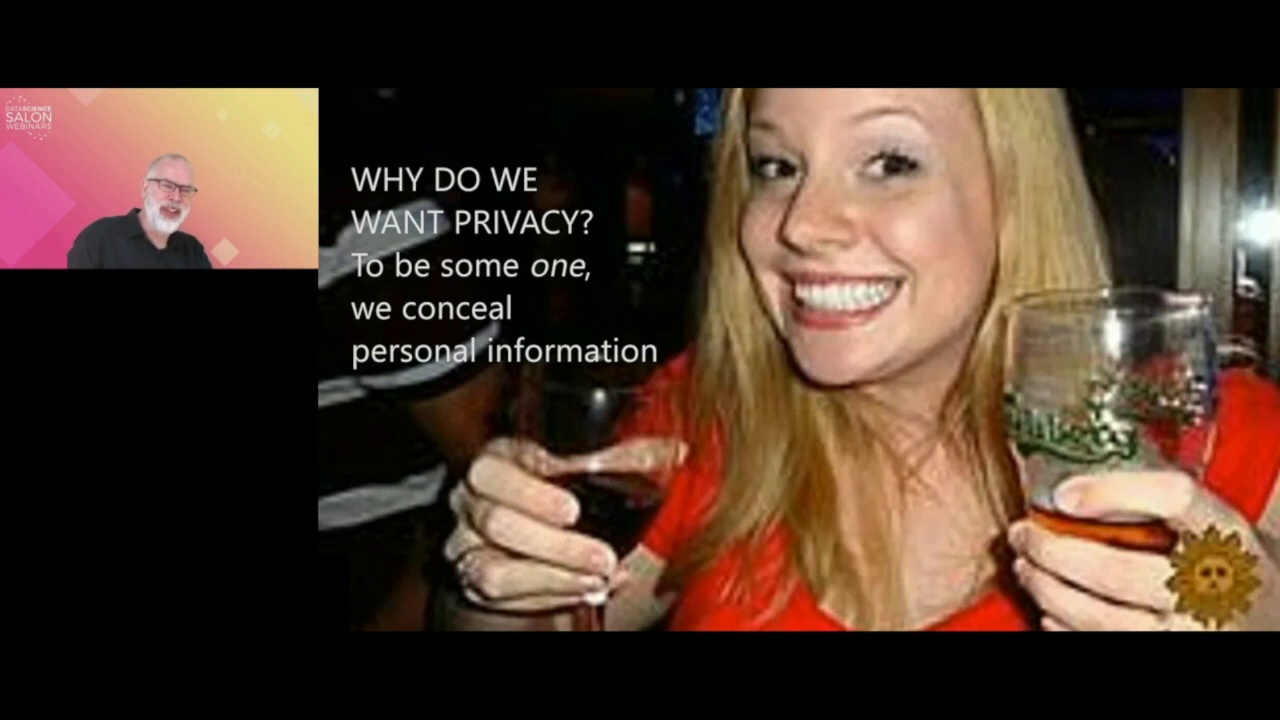
To be some one, we conceal personal information
AI-generated visual description — not speech or approved wording
The text overlays a photograph of a woman holding two glasses. No image credit is visible.
Visual limitations: Small-cap headings and line wrapping normalized; presenter inset and event branding omitted.
James Brusseau speech
And there are two closely related reasons for that. One is this. So, this person here is a woman named Ashley Payne, and she was an elementary school teacher at some school in the United States, and here she is on vacation, double fisting, doing what some people do on vacation, and 20 years ago and something like this happened someone would have taken a picture of her enjoying her vacation with beer and wine same time and she would gotten that picture throwing it in a drawer and then 40 years later she would find it and everyone would laugh about how much fun they had. That's not what happened to her though because of Facebook and what did in fact happen is that she made the mistake of posting, or maybe she didn't post it, but somebody posted the image on Facebook. And it spread from one connection to another to another and got back to her school where she works. I suppose this party happened in the Caribbean or something, right? So she's in Florida or the Bahamas and then it ends up back in, I think she might've lived in Georgia or Arkansas. But it made its way back to her hometown town and started circulating, of course, amongst her young students and then inevitably amongst the parents of her young students. And that led to some unhappiness at the school because of some parent's complaints. Eventually she lost her job. So what does this have to do with privacy?
This is privacy because when you have control over your personal information which includes things like what you do on vacation, if you like to double-fist beer and wine or whatever else. On your vacation, on your time, that information and those times, when privacy is in effect, stay under your control. Stay with you. The picture, it's almost like the picture itself, right? It's like when privacy is in effect, the experience is almost a physical a good picture that you can take out and look at and show to who you like and conceal from those others who you would prefer not to see. Facebook, because it breaks down that barrier, it breaks down your ability to control who finds out this information. Facebook is a privacy violator, in this case, at least, a very strong privacy violator. So she would have preferred obviously that these images would have maintained within a small part of her life and within a small group of friends but they spread to her school privacy was violated she lost her job and then you can take that one step further too and say well it's not just the way we are on vacation but it's the way we are all the time or in order to be who we are all the time We need to have privacy in the sense of control over our personal information.
Here's what I mean. I have two children, and just like any dad, I sometimes act in very goofy ways in front of my children. That's a lot of fun. But I would be appalled were those goofy experiences to be revealed to people who are, let's say, professionally as you all are. If I knew, for example, which is capturing me right now, was going to be running later on this evening when I'm talking with my children, then that's going to change my behavior completely. In fact, it's going to, to a significant extent, stop me from being a father because I'm going to be restrained. I'm not going to want to act like a father to a child when I know the people I barely know who are professional connections are watching this and they expect a comportment reasonably, which is like the one you see in front of you. Similarly we could say I have a set of behaviors with my children that I need to conceal from you all in order to be with them, but I also have a kind of behavior with you, a kind of seriousness and sobriety that I need to conceal from my children in order to be with them. So in order to be with you, I need to conceal the part of me which is with my children. In order to be with my children, I need to conceal the part of me which is with you. And of course we could expand that group. In order to be with my wife there are certain things and ways I am that I don't want other people to see, and other work colleagues, friends, relatives, parents. Every one of these sets of relationships that we have manifests in a certain sense a certain me, a certain James. But in order for that James to be, I must be who I am for that person or for those people but also hide all those other ways I am.
That's privacy in effect. That's control over your personal information and that's what it means to have control over your personal information. And when you lose that, when you can't control who sees what about you, what happens to you is the Ashley Payne problem. So you can just do a thought experiment to wrap this up. But if you imagine that this camera, which is recording me now, if I imagine, that it was following me all the time, every day, every moment, then I would not be able to be anybody because I wouldn't want my children to see me being one way and my wife to see me being another way and my colleagues to see me being another way. In all these ways, it would be impossible for me to do anything but just almost be like a robot, an automaton who had no personality. So the first reason we want privacy is in order to be someone, right? In order to be someone at a party on vacation like Ashley Payne or to be a dad with the children or to be a husband or to be someone who works with colleagues.
Source details — Visual — Anonymity research
Visual — Anonymity research
DISC-0017::VIS-008::OCC-01 · Display occurrence: approximately 932.000–1052.000 seconds in the original video. Boundaries are estimated.
Exact frame PTS: 960.000000 seconds in original video.
Visible slide text — not speech
Why do we want privacy?
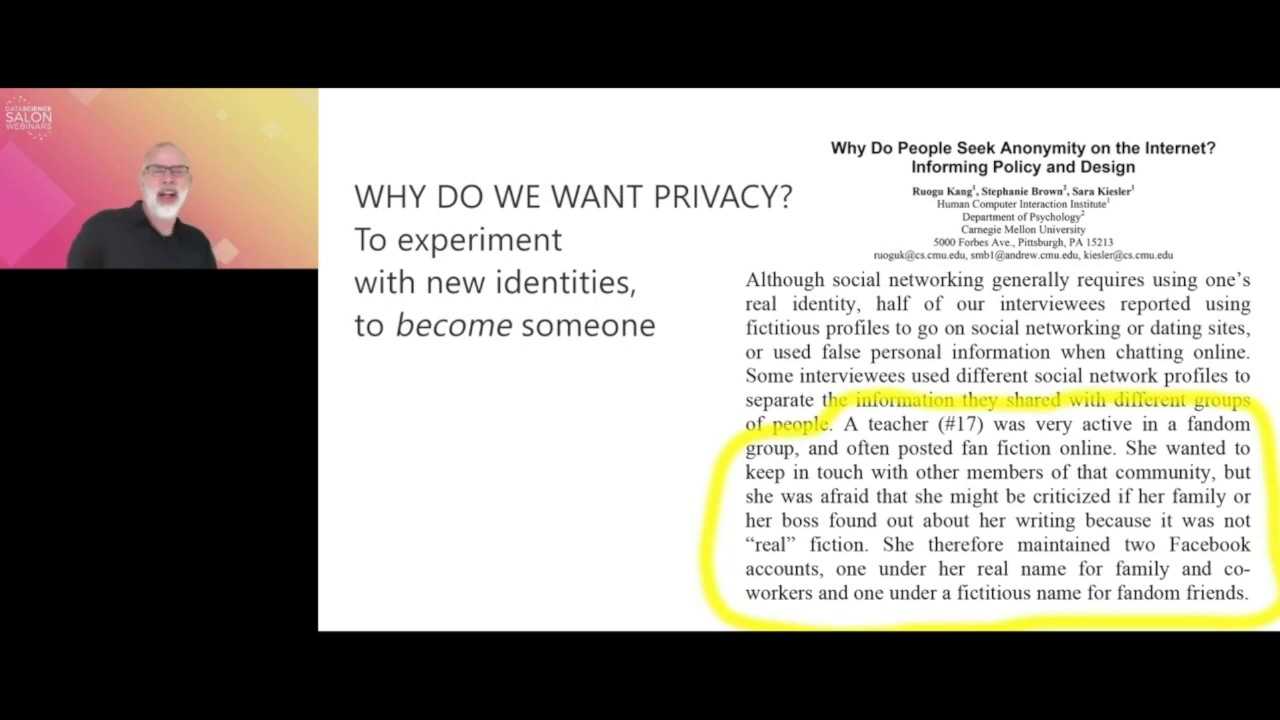
To experiment with new identities, to become someone
Displayed research excerpt
Why Do People Seek Anonymity on the Internet? Informing Policy and Design
Ruogu Kang¹, Stephanie Brown², Sara Kiesler¹
Human Computer Interaction Institute¹
Department of Psychology²
Carnegie Mellon University
5000 Forbes Ave., Pittsburgh, PA 15213
ruoguk@cs.cmu.edu, smb1@andrew.cmu.edu, kiesler@cs.cmu.edu
[…] Some interviewees used different social network profiles to separate the information they shared with different groups of people. A teacher (#17) was very active in a fandom group, and often posted fan fiction online. She wanted to keep in touch with other members of that community, but she was afraid that she might be criticized if her family or her boss found out about her writing because it was not “real” fiction. She therefore maintained two Facebook accounts, one under her real name for family and co-workers and one under a fictitious name for fandom friends.
AI-generated visual description — not speech or approved wording
A yellow outline emphasizes the teacher/fandom example in the displayed third-party research excerpt.
Visual limitations: Opening animation/build at 926–930 seconds precedes the stable complete state; transcription uses the complete 960-second frame. Superscript affiliation numbers and line wrapping normalized; quotation belongs to the named researchers. Small-cap headings and line wrapping normalized; presenter inset and event branding omitted.
James Brusseau speech
That's the first reason.
The second reason is this. We also want privacy in order to experiment with or be someone else. So the example from this—this is an academic paper actually from Carnegie Mellon University and it talks about something that's very common today in the internet world. This, it looks like a teacher, this is also a teacher, there's no reason why both examples are teachers, that just happens to be a coincidence. This is also a woman and she is, in this case what she's trying to do is she's trying to experiment with a new personality for herself which has to do with fandom and some fictional character. And she wants privacy because she wants to develop this character, this fandom existence outside of the eyes of her boss, right? Because she's afraid of what her boss will think of it. Well that's true all the time for all kinds of things we do.
Source details — Visual — Privacy conclusion
Visual — Privacy conclusion
DISC-0017::VIS-009::OCC-01 · Display occurrence: approximately 1054.000–1074.000 seconds in the original video. Boundaries are estimated.
Exact frame PTS: 1060.000000 seconds in original video.
Visible slide text — not speech
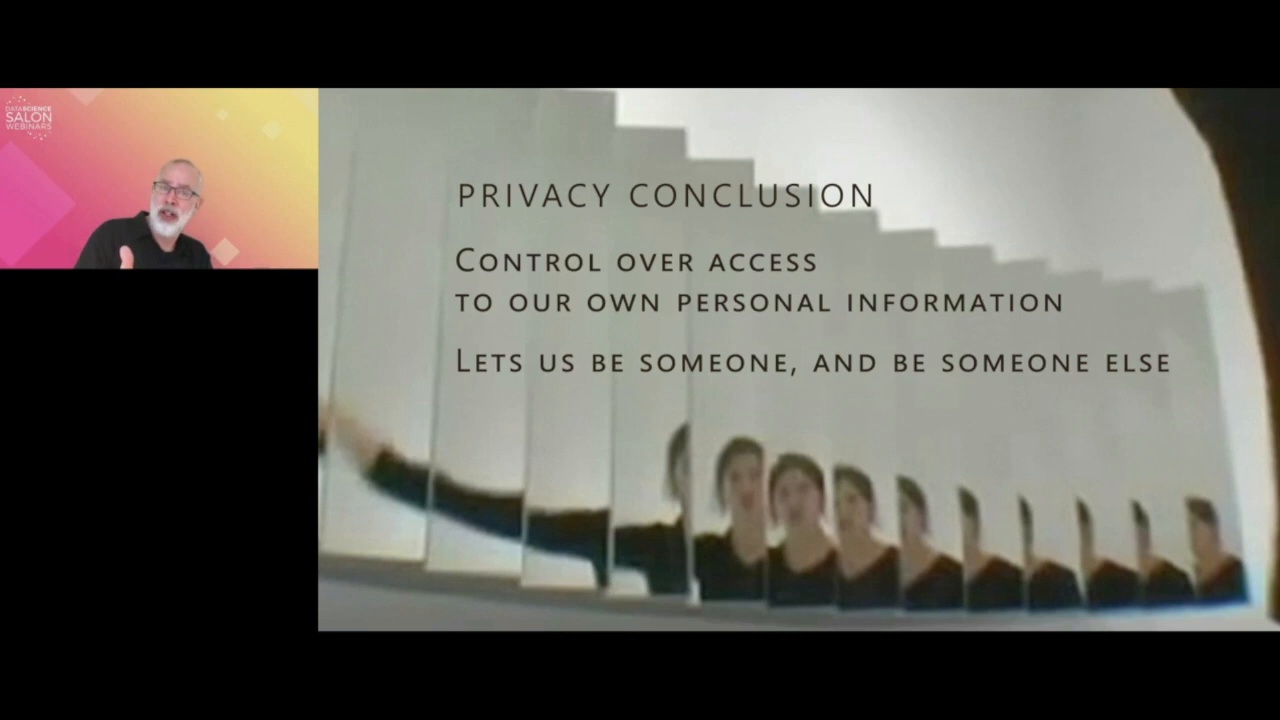
Privacy conclusion
Control over access to our own personal information
Lets us be someone, and be someone else
AI-generated visual description — not speech or approved wording
Repeated portraits are staggered behind the text, illustrating multiple presentations of identity.
Visual limitations: Small-cap headings and line wrapping normalized; presenter inset and event branding omitted.
James Brusseau speech
If I wanted to be... you can imagine that I woke up and had the idea that I could somehow be an opera singer or something. Unlikely, but were I to want to try that, it would be quite important to me that no one knew I was trying to do that, or only a very few people, because I wouldn't want to embarrass myself or shame myself. So privacy, again, our ability to control our personal information, in this case what your aspiration might be for a career, opera singer or fan fiction writer. Privacy is what allows us to experiment with these new identities, to try to live one way instead of another. If we were always being watched all the time, not very few of us would try new things.
So privacy conclusion. The definition of privacy, the dry academic definition, is control over access to your personal information, But the human definition, what makes privacy important and powerful is that it lets us be someone. And it also lets us be someone else, experiment with being someone else, okay? So that's privacy.
And what this conference is about or this talk is about in your world, in the world of media, advertising, entertainment, retail, I think that the most pressing ethical question fundamentally is going to be this question of privacy and what we lose when we turn over our personal information to Facebook, to Netflix, to an advertising company which is going to do programmatic ads, to retail so to Amazon so that we get product suggestions that we like. In all these ways what I'm trying to do in this presentation is talk a little bit about what that trade-off is at the core, I believe, at the core of your career.
Source details — Visual — Privacy or convenience
Visual — Privacy or convenience
DISC-0017::VIS-010::OCC-01 · Display occurrence: approximately 1076.000–1148.000 seconds in the original video. Boundaries are estimated.
Exact frame PTS: 1100.000000 seconds in original video.
Visible slide text — not speech
Euphoria Convenience
AI Media/Advertising/Entertainment/Retail
In human terms, this talk addresses the fundamental ethical dilemma of privacy or convenience in AI reality
DATASCIENCESALON
Visual limitations: Small-cap headings and line wrapping normalized; presenter inset and event branding omitted.
James Brusseau speech
If you're working in AI, media, advertising, entertainment, retail, the trade-off at the core of your career, the ethical trade-off, is privacy for convenience. And I've talked about what privacy is, so let's go on now to talk about convenience. And since I'm a philosopher and since we're talking theoretically, we're going to go all the way. And we're going to talk about euphoria convenience, which I mean almost perfect convenience.
Source details — Visual — What is Euphoria Convenience?
Visual — What is Euphoria Convenience?
DISC-0017::VIS-011::OCC-01 · Display occurrence: approximately 1150.000–1158.000 seconds in the original video. Boundaries are estimated.
Exact frame PTS: 1152.000000 seconds in original video.
Visible slide text — not speech
What is Euphoria Convenience?
Visual limitations: Small-cap headings and line wrapping normalized; presenter inset and event branding omitted.
Source details — Visual — True-you definition
Visual — True-you definition
DISC-0017::VIS-012::OCC-01 · Display occurrence: approximately 1160.000–1278.000 seconds in the original video. Boundaries are estimated.
Exact frame PTS: 1200.000000 seconds in original video.
Visible slide text — not speech
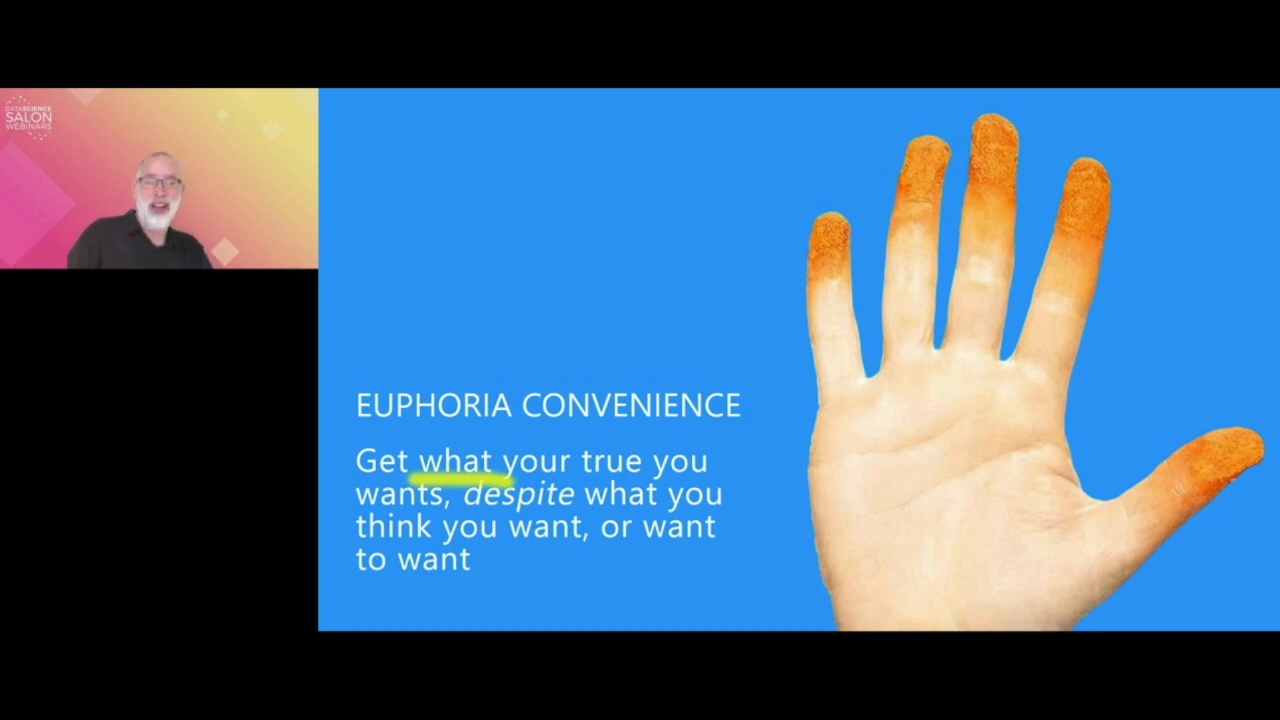
Euphoria Convenience
Get what your true you wants, despite what you think you want, or want to want
AI-generated visual description — not speech or approved wording
A hand with orange-dusted fingertips appears beside the definition; the displayed words “what your” are highlighted.
Visual limitations: Small-cap headings and line wrapping normalized; presenter inset and event branding omitted.
James Brusseau speech
So here's an example of that. This is an experiment that was done by Cheetos. And as we all know, when you eat Cheetos and Doritos and so on, you get the dust on your fingers. And everyone says, well, they hate that. You have to go wash your hands and that sort of thing. What someone did, though, is they wrapped some kind of brain sensor around some test subjects. And they discovered that despite what people say, which is that they don't like the dust, really and truly people, we are drawn to them. Part of the joy we find in eating Cheetos is for some reason sort of mischievous messiness. Perhaps it traces back to our crude caveman days, eating with our hands. Who knows? For whatever reason, we find some kind of joy in that crude messiness that's on our fingers when we eat. It sets off signals and releases dopamine or whatever the neurological explanation is. It makes us happy, it gives us joy. So the first thing I want to say about convenience and technology, this is not quite artificial intelligence, this is technology, is that it can give us things that we want that we did not even know we wanted. This is a little thing, Cheetos of course, this is irrelevant but I think if you think a little deeper you can imagine some other things too, right? But staying with this simple example.
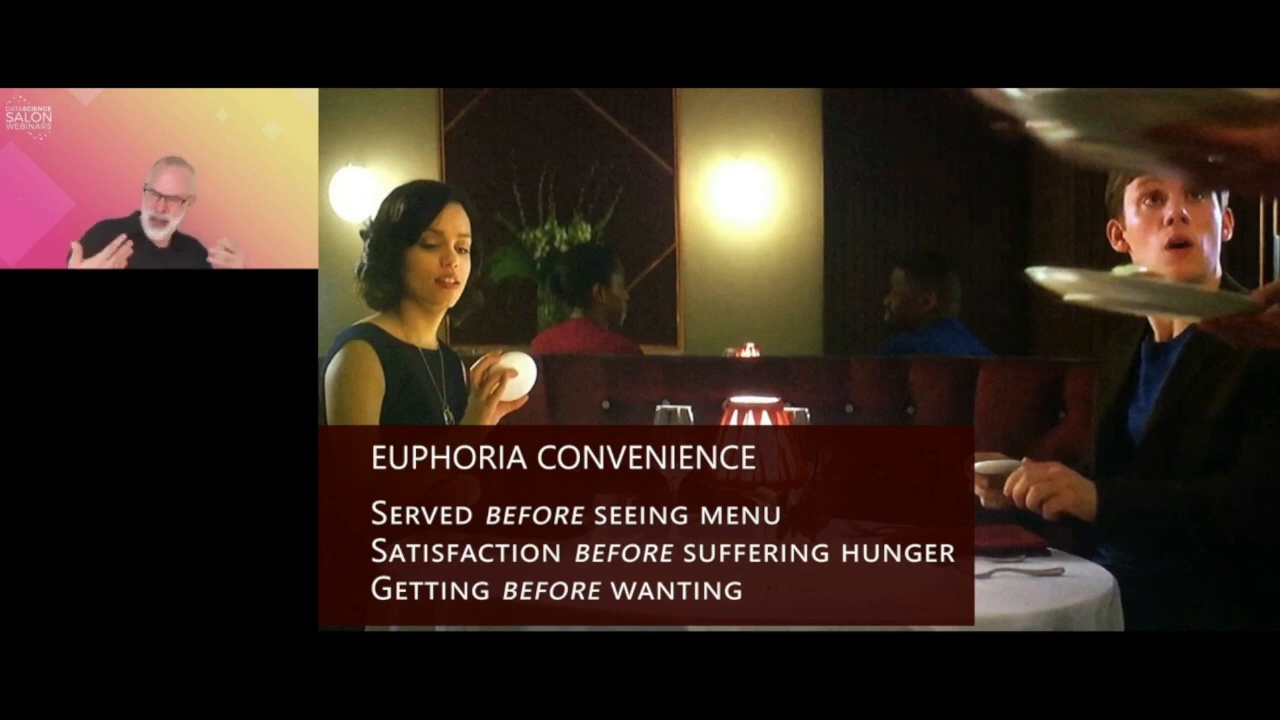
The first part of euphoria convenience, perfect convenience is this idea that you get what you want even those things that you did not and could not foresee wanting. What you want better than what you knew you wanted. Euphoria means that's what you want. There's also a second part which is the when you get it. Euphoria convenience means that you get what you want, like these characters in this scene.
Source details — Visual — Before wanting
Visual — Before wanting
DISC-0017::VIS-013::OCC-01 · Display occurrence: approximately 1280.000–1380.000 seconds in the original video. Boundaries are estimated.
Exact frame PTS: 1320.000000 seconds in original video.
Visible slide text — not speech
Euphoria Convenience
Served before seeing menu
Satisfaction before suffering hunger
Getting before wanting
AI-generated visual description — not speech or approved wording
A film still shows people at a restaurant table. The source does not print a film title or credit.
Visual limitations: Small-cap headings and line wrapping normalized; presenter inset and event branding omitted.
James Brusseau speech
Now, this scene, this slide, this is a slide from the TV show or the TV series Black Mirror. And what's happening here is that these two young people just out on a date. Just at the moment they're going to say it to themselves or they're saying to each other, you know, I think we should look at the menu. I think I'm starting to get hungry. Just at that moment, just as it occurs to them that they might feel hunger, their food is delivered on these plates. That's why if you see, if you look at the expression of the guy, he has sort of a surprised look. It's because just as he was thinking that he would like to get something to eat, the plates appear.
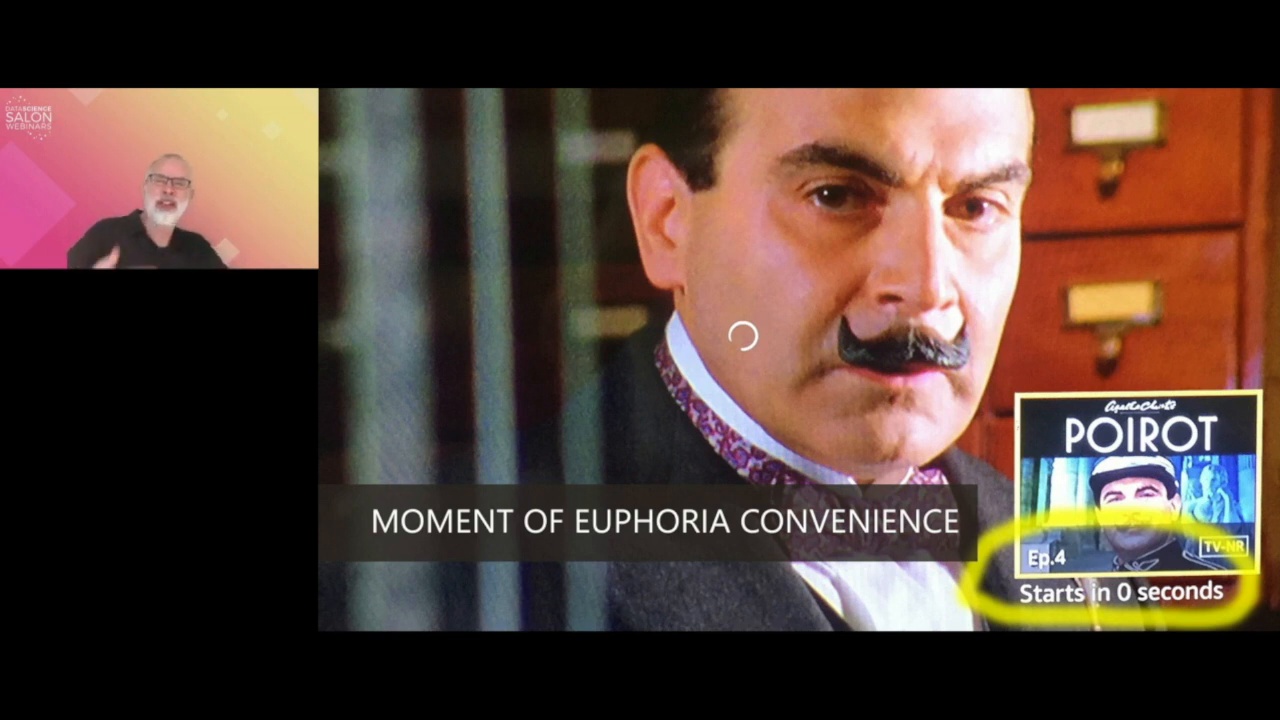
Now this is Black Mirror, so there's some explanation for it. But for euphoria convenience, first of all, there's this idea of what you get has to be perfect, even better than what you might want yourself. And two, when you get it has to be perfect too. If the convenience is perfect, you get it even before you realize that you want it just like happens in this, just as happens in this picture. So, two ideas make euphoria a convenience. One, you get what you want regardless of what you think you want until you get it at the perfect moment, even before you want it. And I have an example of that, the moment of euphoria convenience. It's very common and I think we've all had this experience.
Source details — Visual — Autoplay example
Visual — Autoplay example
DISC-0017::VIS-014::OCC-01 · Display occurrence: approximately 1382.000–1500.000 seconds in the original video. Boundaries are estimated.
Exact frame PTS: 1400.000000 seconds in original video.
Visible slide text — not speech
Moment of Euphoria Convenience
Agatha Christies POIROT
Ep.4
TV-NR
Starts in 0 seconds
AI-generated visual description — not speech or approved wording
The autoplay countdown in the lower-right program tile is circled in yellow. The photograph depicts a screen, not a live software demonstration.
Visual limitations: Small-cap headings and line wrapping normalized; presenter inset and event branding omitted.
James Brusseau speech
It happens on Netflix when predictive analytics are used to start streaming the next movie or video or a program or whatever to start streaming the next one in zero seconds, just as the last one is ending. So there's this moment when you could stop and you could say, huh, you know, this show just ended. What do I want? What do I want to do now? But that moment is cut off. It's ruined. It's cut off. It's terminated by the euphoria convenience, which gives you what you want the perfect next program next movie even before you know that you want it right at that moment when it starts running you don't have time to stop and think well do I want to do something else now do I want to go play tennis or do I want to go to sleep all that is cut off you don't have time to ask yourself what do I want what do I want to do next you can't because you're already satisfied. You're already getting what you want, which is the perfectly chosen next program.
Source details — Visual — End of desire
Visual — End of desire
DISC-0017::VIS-015::OCC-01 · Display occurrence: approximately 1502.000–1544.000 seconds in the original video. Boundaries are estimated.
Exact frame PTS: 1530.000000 seconds in original video.
Visible slide text — not speech
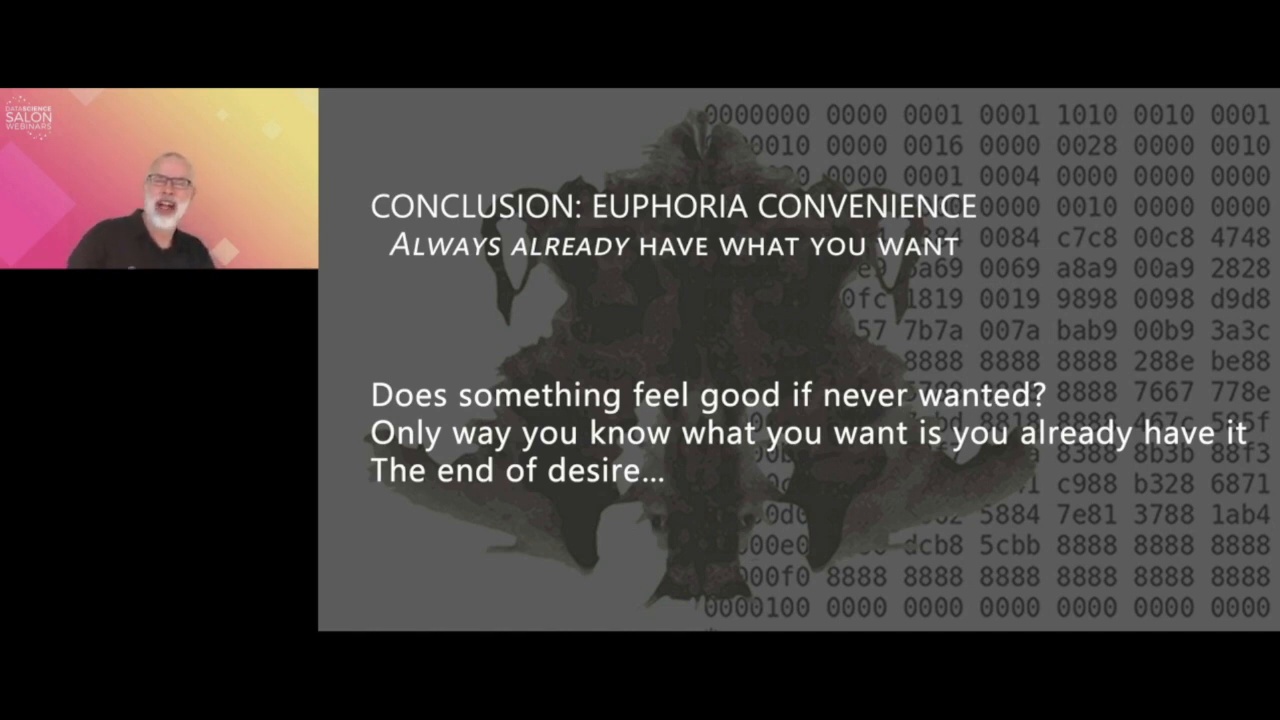
Conclusion: Euphoria Convenience
Always already have what you want
Does something feel good if never wanted?
Only way you know what you want is you already have it
The end of desire...
AI-generated visual description — not speech or approved wording
A map-like silhouette and rows of hexadecimal-style characters form a background. These are not a quantitative chart or formula.
Visual limitations: Decorative background digits are retained in the source frame, not transcribed as argument text. OCR fragmentation caused by the background was reconciled as one slide. Small-cap headings and line wrapping normalized; presenter inset and event branding omitted.
James Brusseau speech
Now of course, Netflix is not perfect. Sometimes they give you a bad program, right? But it does happen sometimes that you have this moment and that's the moment of euphoria convenience. Euphoria convenience is that moment where you get what you want perfectly. Something perhaps you didn't even know you wanted and you get it even before you feel an urge for it as happens for all of us commonly sometimes right when the Netflix next film starts rolling just as the last one is ending okay so we're coming now to I see that we're running just a little bit over limit but we're coming now to rounding the corner toward our conclusion what I want to say is that euphoria convenience is always already having what you want that would be the definition just like control of access to your personal information is the privacy definition and there are some questions we could ask if we had more time like does something actually feel good if you never wanted it I mean I'm not sure maybe you need to feel a desire for something or in order to feel pleasure and satisfaction in getting it that's a question for a different day What I want to do instead is say, first, there's this takeaway.
Source details — Visual — Takeaway
Visual — Takeaway
DISC-0017::VIS-016::OCC-01 · Display occurrence: approximately 1546.000–1610.000 seconds in the original video. Boundaries are estimated.
Exact frame PTS: 1560.000000 seconds in original video.
Visible slide text — not speech
Takeaway
Privacy versus convenience dilemma is the AI human condition
Visual limitations: Small-cap headings and line wrapping normalized; presenter inset and event branding omitted.
James Brusseau speech
The takeaway is that the fundamental dilemma in the professions that you are concerned with in AI, retail, entertainment, and media and advertising is privacy versus convenience in the ways that we have talked about it here. And that dilemma can be theoretical in the sense that we say, look, it's our personal identity, our ability to determine freely for ourselves who we are on one side versus perfect satisfaction. The convenience which is so attuned to our existence that it gives us the kind of happinesses like the Cheetos that we didn't even know we wanted and it gives it to us perfectly. That's the theoretical approach and so that's I think what's going on in the background ethically of your lives.
Source details — Visual — Apple Watch example
Visual — Apple Watch example
DISC-0017::VIS-017::OCC-01 · Display occurrence: approximately 1616.000–1720.000 seconds in the original video. Boundaries are estimated.
Exact frame PTS: 1660.000000 seconds in original video.
Visible slide text — not speech
Real world example
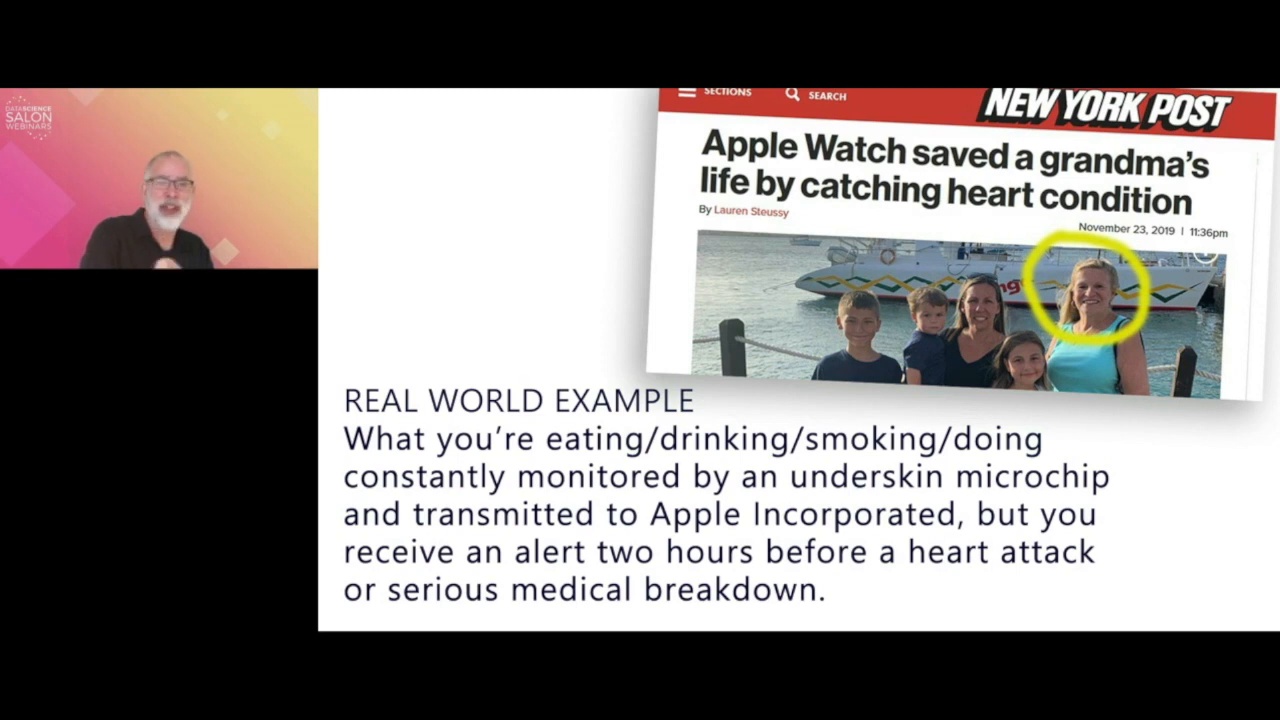
What you’re eating/drinking/smoking/doing constantly monitored by an underskin microchip and transmitted to Apple Incorporated, but you receive an alert two hours before a heart attack or serious medical breakdown.
Displayed news screenshot
NEW YORK POST
Apple Watch saved a grandma’s life by catching heart condition
By Lauren Steussy
November 23, 2019 | 11:36pm
AI-generated visual description — not speech or approved wording
A woman in the news photograph is circled. The news headline is distinct from the explanatory scenario on the slide.
Visual limitations: Incidental “Sections”/“Search” website navigation omitted. The printed scenario is transcribed as displayed, without validating its medical or factual claims. Small-cap headings and line wrapping normalized; presenter inset and event branding omitted.
James Brusseau speech
The actual existence I think that there are some examples and I've got three here very quickly we will do real-world examples where this tension between privacy and perfect convenience comes forward the first is in medical care which is a very important field so this woman was saved by her Apple watch and that leads to the following question imagine that you could and then you can actually. You can have a chip embedded into your body which constantly sends health information to a medical or healthcare center, revealing things like your heartbeat and other sorts of personal information. And in exchange for that, you will get an alert as happened in this case with the Apple Watch before you get a heart attack. So think about that carefully.
You need to think about that carefully, right? What information is this chip providing your heart rate? Think about what someone could figure out about your life. If they always know exactly what your heart rate is, they can watch it going up and down. Other kinds of information too could be discerned about you. The question, privacy versus convenience. Would you give up that information to have this convenience. And if you do give it up, how much of your ability to control who you are and to be who you are, how much of that is being lost? Or on the other side, if you don't give it up, right? What is the convenience? I mean, this is euphoria convenience. You get the healthcare service that is an alert to go to the hospital even before you feel the heart attack. So that's privacy versus euphoria convenience.
Source details — Visual — LinkedIn example
Visual — LinkedIn example
DISC-0017::VIS-018::OCC-01 · Display occurrence: approximately 1722.000–1804.000 seconds in the original video. Boundaries are estimated.
Exact frame PTS: 1750.000000 seconds in original video.
Visible slide text — not speech
Real world example
Your academic/work history and psychological profile processed by LinkedIn to assign a gratifying job. But, entering the system reveals your data to employers, so companies won’t offer other types of positions. Consequently, you get the right job, but you’re chained to it: you can’t try anything else.
LinkedIn™
Connect to Opportunity™
AI-generated visual description — not speech or approved wording
A black X strikes through “Opportunity” in the LinkedIn slogan.
Visual limitations: Small-cap headings and line wrapping normalized; presenter inset and event branding omitted.
James Brusseau speech
Here's another example. LinkedIn. Again, it converts into a kind of a thought experiment. If you imagine that LinkedIn is grabbing all of your information and recommending the perfect job for you, what is good about that? What is convenient? Well, you're getting an excellent career opportunities perfectly attuned to who you are. But because LinkedIn is aiming you down that path and saying, you're perfectly set for this kind of job, let's say, in my case, philosophy professor. Because of that, no one will hire me for anything else. So if I wanted to try my luck at being a computer programmer or an accountant or a lawyer, I can't get that job. So privacy, that is my ability to determine for myself who I want to be, do I want to be a professor, a lawyer, an accountant. I lose that because LinkedIn has all this information about me, but what I gain is the perfect job, presumably. There's no right or wrong answer to these questions, but they're examples of this fundamental trade between privacy and my ability to determine my own identity and can in perfect satisfaction.
Source details — Visual — Smart glasses example
Visual — Smart glasses example
DISC-0017::VIS-019::OCC-01 · Display occurrence: approximately 1806.000–1870.000 seconds in the original video. Boundaries are estimated.
Exact frame PTS: 1840.000000 seconds in original video.
Visible slide text — not speech
Real world example
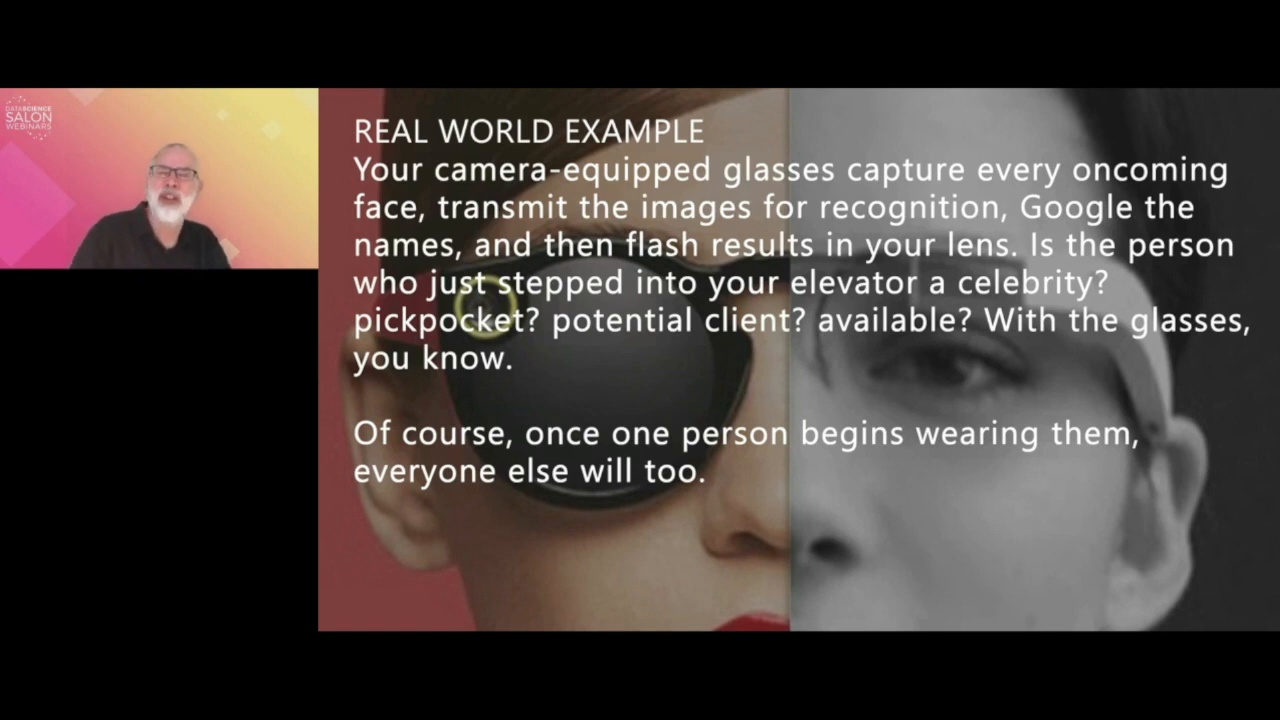
Your camera-equipped glasses capture every oncoming face, transmit the images for recognition, Google the names, and then flash results in your lens. Is the person who just stepped into your elevator a celebrity? pickpocket? potential client? available? With the glasses, you know.
Of course, once one person begins wearing them, everyone else will too.
AI-generated visual description — not speech or approved wording
A split portrait pairs a woman wearing a camera-like eyepiece with a grayscale face. No image credit is visible.
Visual limitations: Small-cap headings and line wrapping normalized; presenter inset and event branding omitted.
James Brusseau speech
And then last example, which I sort of like, we're seeing more and more people with these cameras. And so the case is on the one hand, the convenience is if you're wearing the camera and your face are recognizing other people, then you can find out everything there is to know about the people you walk by in the street. That'd be very convenient. It would be nice to know everything about the person in the elevator with you and so on. But on the other hand, privacy, they know the same thing about you. So that's going to change the way you act.
We're heading over our limits I'm going to stop it there but those are three real-world examples of this fundamental dilemma between privacy, our control over our personal information and our ability to determine who we are and convenience. This kind of euphoria of hope or aspiration to get pleasures and satisfactions that are so perfect that we didn't even know we wanted them and we get them even before feeling the urge for them. So, that's what we have for today. Thank you for joining us.