Inherited editorial introduction (source unchanged)
The AI Human Condition
Approved speech wording and attribution are preserved; paragraph formatting is awaiting review. Visual text and AI-generated descriptions remain separate from speech. Paragraph placement is editorial; recording display times and exact frame timestamps are unchanged.
Source details — Visual — Wanting and wanting to want
Visual — Wanting and wanting to want
DISC-0025::VIS-001::OCC-01 · Display occurrence: approximately 6.000–182.000 seconds in the original video. Boundaries are estimated.
Exact frame PTS: 100.000000 seconds in original video.
Visible slide text — not speech
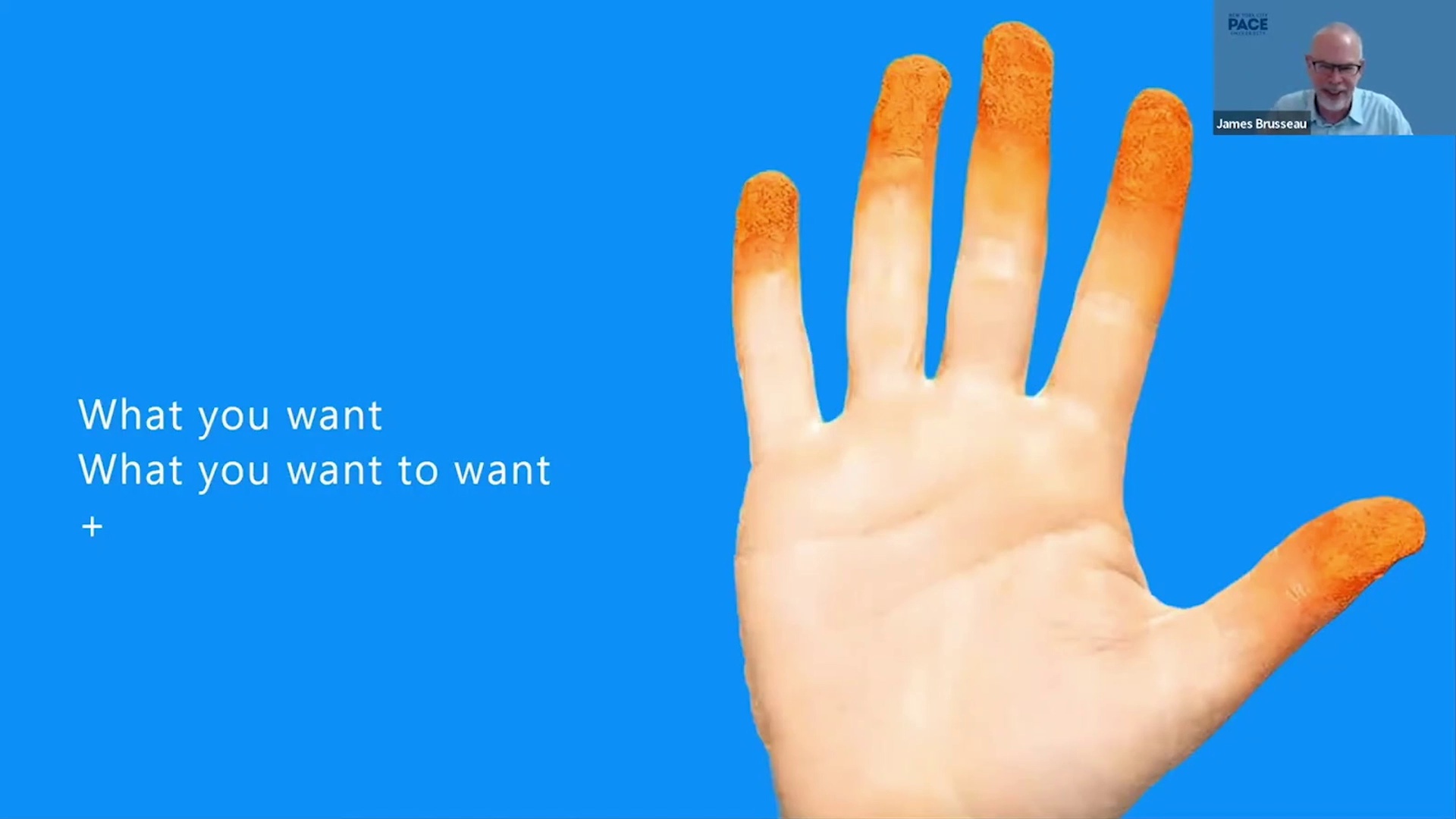
What you want What you want to want +
AI-generated visual description — not speech or approved wording
A hand with orange-coated fingertips fills the blue background.
James Brusseau speech
James Brusseau: I thought we would just jump right in. This first slide is sort of a curious experiment, or it comes from a curious experience a few years ago, and it has to do with this snack food called Cheetos, which is the kind of the yellow, almost popcorn-like stuff you pop in your mouth and eat. And this company, one thing they heard from their consumers was that people hated getting that sort of dust on their fingers that you see here in the picture. They said, we love eating Cheetos, but we hate having these messy fingers. And so the company, they invested all kinds of money in trying to invent some kind of dust to put on the Cheetos, which would not stick to their fingers. And in the midst of doing all this, they also started doing some neurological research on people's reactions to the dust in their fingers to see really how much they hated this dust.
And what they found was that it was the opposite. In fact, when you check out the neurological reaction that people have to this dust on their fingers, in fact, they love it. They crave it. They want it. It appeals to some, I'm not sure what to call it, some sort of darker mischievous side of our personalities. And so what the company finally ended up doing is instead of making the dust to not stick on their fingers they reversed course completely and made it to stick even more which is a curious story in advertising in marketing consumer products but it's a more interesting story I think in terms of simply what it means to be a person because in this case it's not like let's just imagine it's me here. It's not as though it's me who likes hamburgers and me who likes pizza, which are two things which you can have one or have the other. Instead, it's on the one side, people said, look, I don't want this dust, or in some sense, I don't want to want the dust. But then on the other side, underneath that, some other part of them did want it. So what's curious is that it's this conflict, right? You have these two parts of yourself that cannot go together, right? One side just is very aggressively, I don't want to want this. The other side aggressively does want it. So this is something that philosophers in various contexts have been thinking about for quite some time. What do we do with those parts of ourselves that seem to conflict with ourselves right it's different than having multiple aspects or multiple sides to myself I like philosophy I like computer science well that's fine those things go together but when it's I like the dust on my fingers and I don't like it right that's where it's interesting you have that conflict And so basically there are two ways that we deal with this. One way, as you could say associate with Freud, is we say, look, somehow, someway, all of these various sides of our personality, they are reconciled. They come together.
Source details — Visual — One or many: Freud contra Deleuze
Visual — One or many: Freud contra Deleuze
DISC-0025::VIS-002::OCC-01 · Display occurrence: approximately 184.000–316.000 seconds in the original video. Boundaries are estimated.
Exact frame PTS: 196.000000 seconds in original video.
Visible slide text — not speech
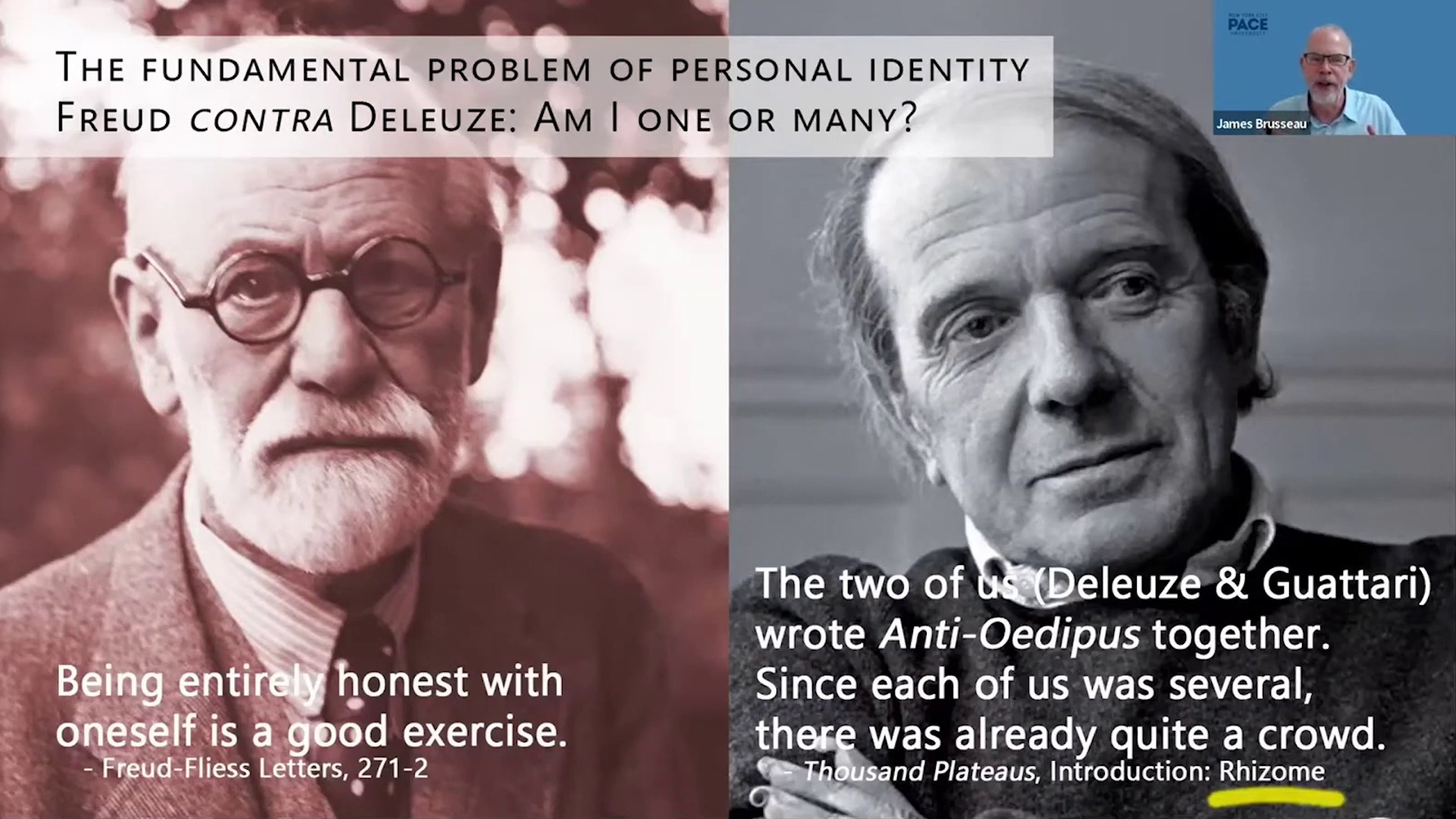
THE FUNDAMENTAL PROBLEM OF PERSONAL IDENTITY FREUD CONTRA DELEUZE: AM I ONE OR MANY?
Being entirely honest with oneself is a good exercise.
— Freud-Fliess Letters, 271-2
The two of us (Deleuze & Guattari) wrote Anti-Oedipus together. Since each of us was several, there was already quite a crowd.
— Thousand Plateaus, Introduction: Rhizome
AI-generated visual description — not speech or approved wording
Two portraits are juxtaposed beneath the contrasting quotations. No separate photograph credit is visible.
James Brusseau speech
So Freud said that there's the libido, kind of our animal part. And there's our superego, which is a very rational part. Then there's the ego, which brings that together. So there's sort of one me with different sides, even if it seems like they're conflicting. Then the other idea, and the one that I'm going to be sort of exploring today, is the opposite. It's the idea that, in fact, none of us are one person. None of us are a single identity. Instead, all of us are collections of conflicting identities and aspirations to desires and fears. And these things are not unified in any intrinsic way. So despite appearances, as Deleuze puts it, he's not one person, he is many people. The idea that James Brusseau, me, is one person is a kind of illusion. And the truth is that I am many. Whereas for Freud, it's the opposite. The truth is we're one person and the illusion is I am many. You know we could talk about this we won't but we could talk about this for an entire semester but because I'm a philosopher I will go for a quick sort of way to wrap this idea up and philosophers always go for when we're looking for a quick explanation we frequently talk about trees and forests and sounds and falling and that stuff and so for identity I think you can say, look, there's sort of two possibilities.
Source details — Visual — Forest and trees
Visual — Forest and trees
DISC-0025::VIS-003::OCC-01 · Display occurrence: approximately 318.000–412.000 seconds in the original video. Boundaries are estimated.
Exact frame PTS: 350.000000 seconds in original video.
Visible slide text — not speech
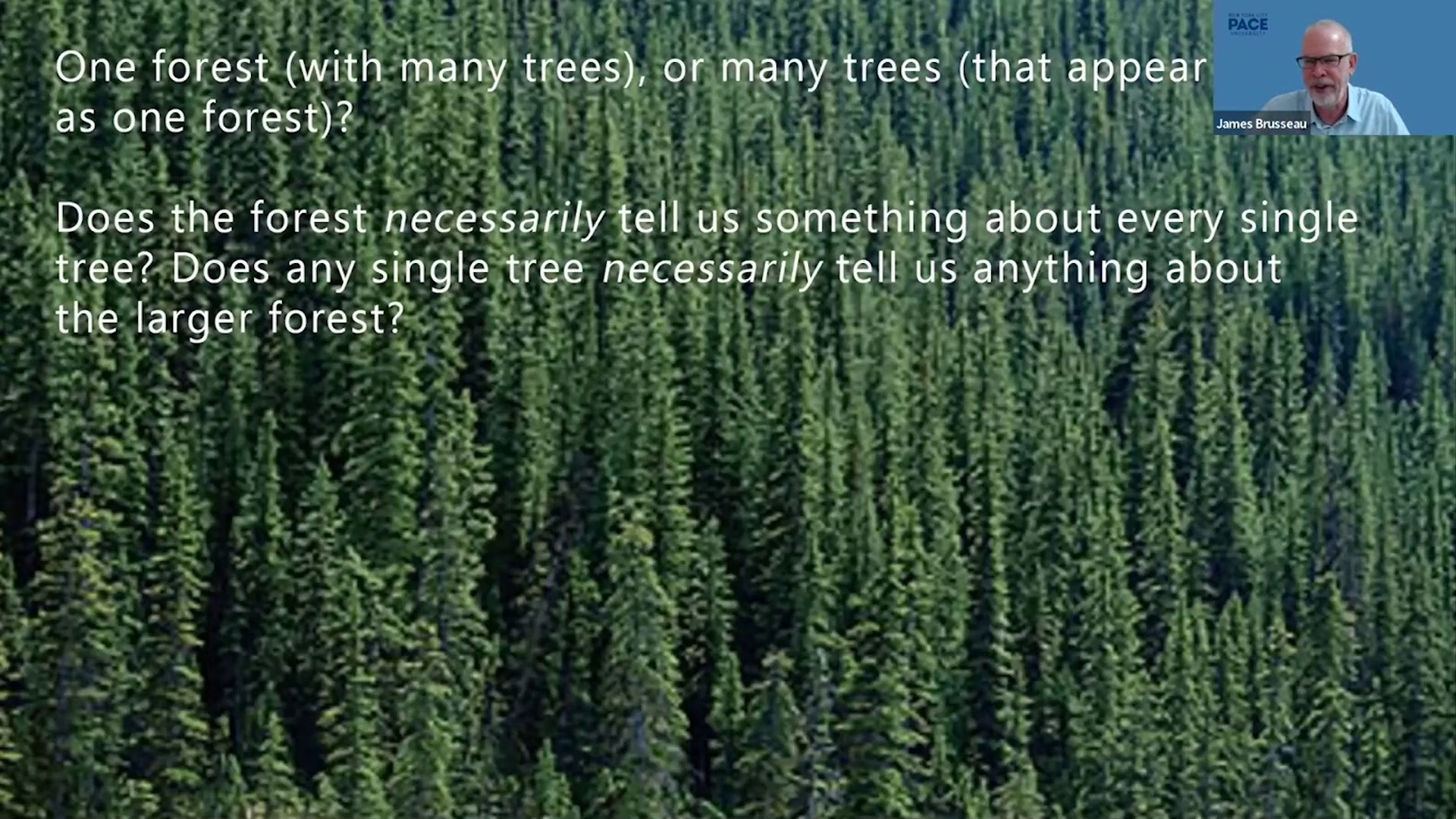
One forest (with many trees), or many trees (that appear as one forest)?
Does the forest necessarily tell us something about every single tree? Does any single tree necessarily tell us anything about the larger forest?
AI-generated visual description — not speech or approved wording
An aerial view of many trees forms the background.
James Brusseau speech
Either there's what you're looking at here is one forest that has a lot of trees. It's like one person with many different identities. Or by contrast, you can go the other way and say, look, well, what we see here is many different trees that appear to be one forest. There's no way to distinguish—or let me put that differently, there's no way to prove that one is right or wrong. There's no way to prove that one is better or worse. But what I want to do in this presentation is take these two ideas about what it means to be me and then show how they lead to different effects in the world of the ethics of information, engineering, and sciences.
Source details — Visual — AI chatbot behavior-change article
Visual — AI chatbot behavior-change article
DISC-0025::VIS-004::OCC-01 · Display occurrence: approximately 414.000–518.000 seconds in the original video. Boundaries are estimated.
Exact frame PTS: 450.000000 seconds in original video.
Visible slide text — not speech
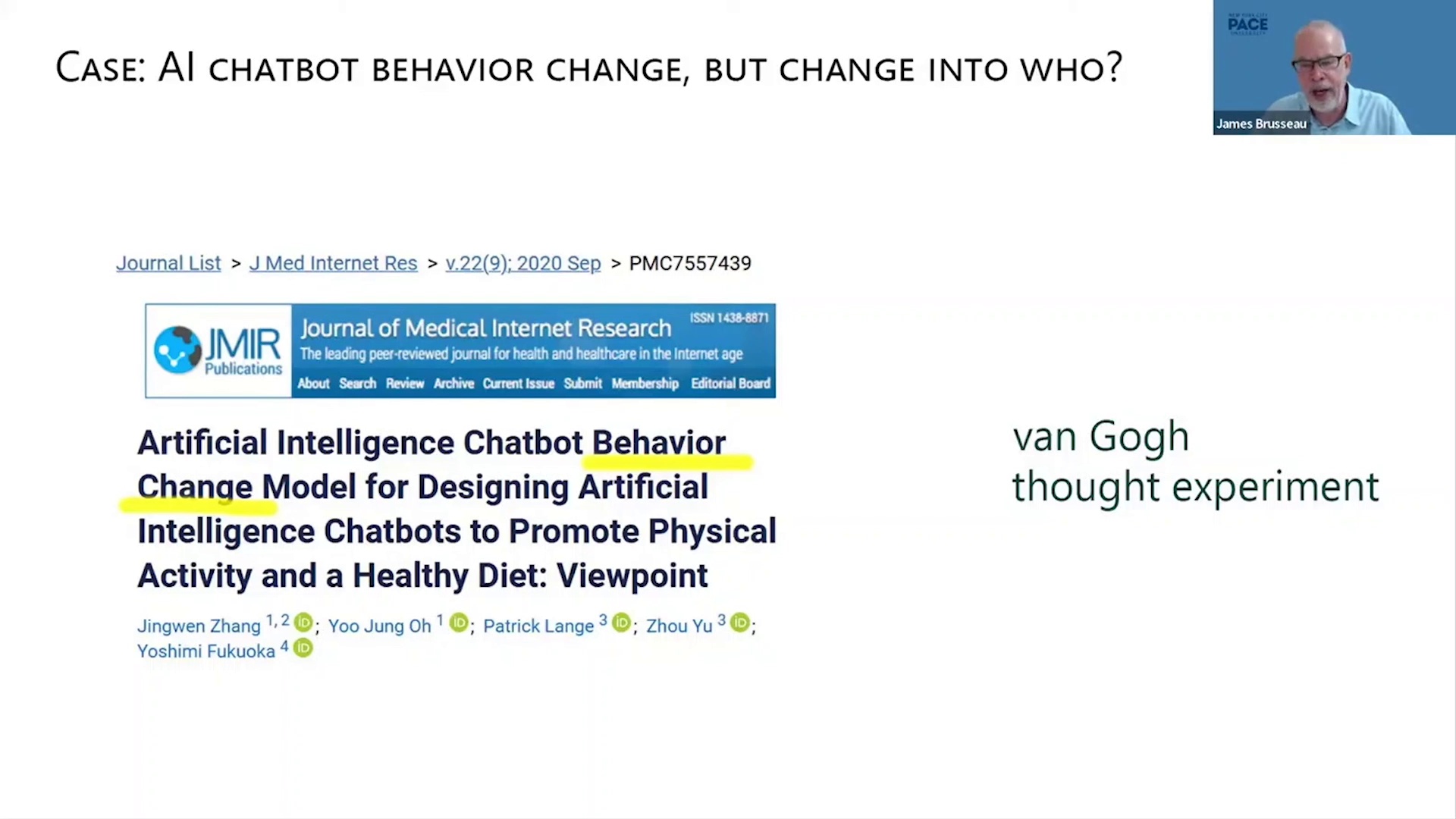
CASE: AI CHATBOT BEHAVIOR CHANGE, BUT CHANGE INTO WHO?
Journal List > J Med Internet Res > v.22(9); 2020 Sep > PMC7557439
JMIR Publications Journal of Medical Internet Research ISSN 1438-8871 […]
Artificial Intelligence Chatbot Behavior Change Model for Designing Artificial Intelligence Chatbots to Promote Physical Activity and a Healthy Diet: Viewpoint
Jingwen Zhang¹,²; Yoo Jung Oh¹; Patrick Lange³; Zhou Yu³; Yoshimi Fukuoka⁴
van Gogh thought experiment
AI-generated visual description — not speech or approved wording
The article screenshot is paired with “van Gogh thought experiment”; “Behavior” and “Change” in the title are underlined in yellow.
James Brusseau speech
So that's the roadmap. Start with this idea and now start to extend it toward information engineering and sciences, which we will do here with a case. This is a thought experiment case. The true part is the idea of chatbots being used in medical and psychological settings or conversational agents, you might call them. In this article, they call this medical aid a chatbot. So that's what I will call it. And what they're proposing in this article here from the Journal of Medical Internet Research is that the chatbot will be used to change patient or individual behavior. And what I want to add, or what I want to question about that is, okay, I want to say, if you're going to change someone's behavior, or nudge their behavior, or influence their behavior, we better ask beforehand, or maybe we have no choice but to ask beforehand, who am I trying to nudge this person toward? Who are we trying to make this person be? And I think that that question, who is it we are trying to, if we're trying to change someone's behavior, who are we trying to make them be? Who will be the person who emerges on the other side? I think that that's a little bit more complicated and maybe a little more interesting and knotted than it sometimes is taken to be. So just to begin thinking about that, I thought we could use an extreme case, which are the extreme cases are always the most illuminating or generally.
Source details — Visual — Diet and self: facts and suppositions
Visual — Diet and self: facts and suppositions
DISC-0025::VIS-005::OCC-01 · Display occurrence: approximately 520.000–740.000 seconds in the original video. Boundaries are estimated.
Exact frame PTS: 600.000000 seconds in original video.
Visible slide text — not speech
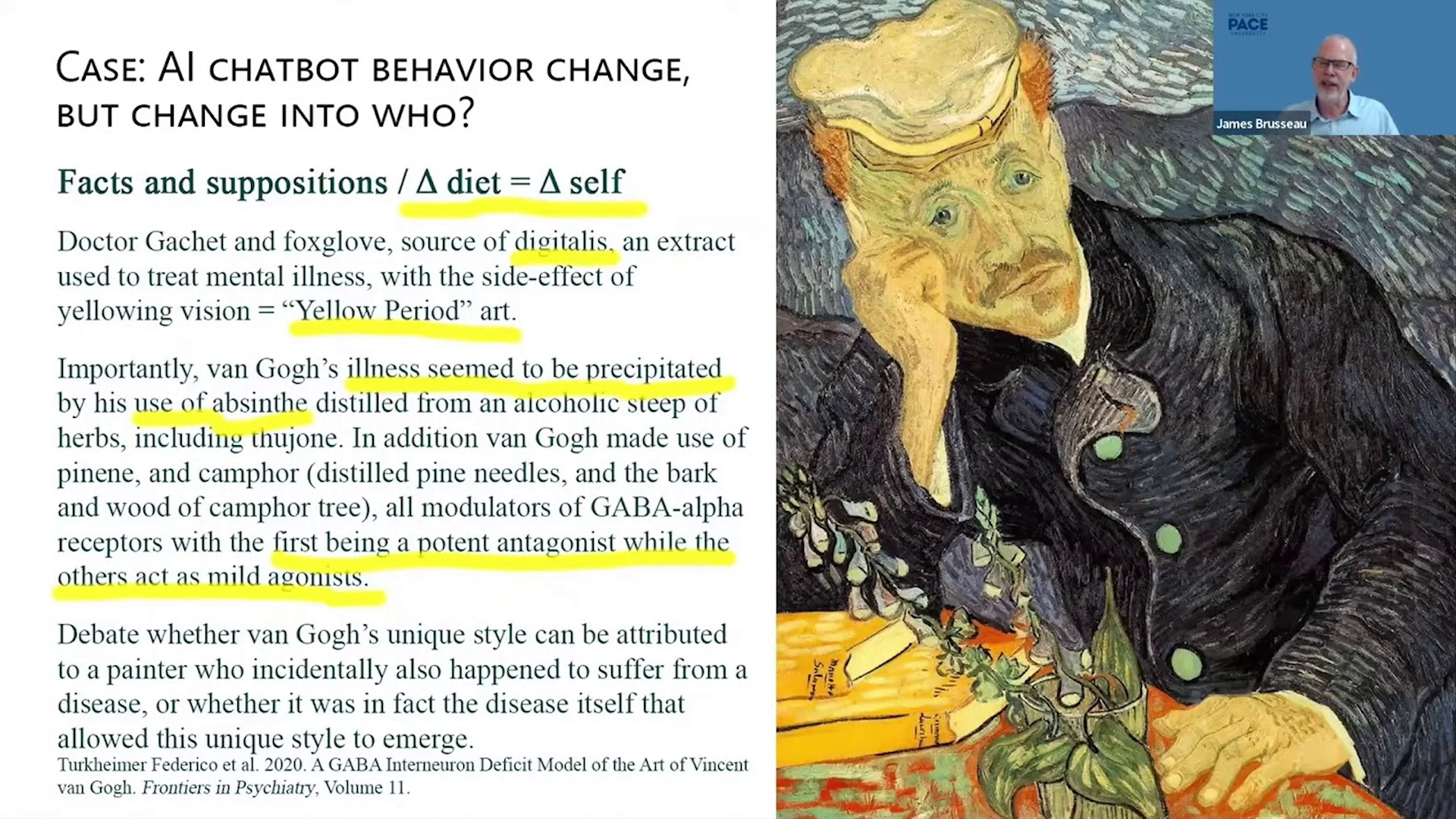
CASE: AI CHATBOT BEHAVIOR CHANGE, BUT CHANGE INTO WHO?
Facts and suppositions / Δ diet = Δ self
Doctor Gachet and foxglove, source of digitalis, an extract used to treat mental illness, with the side-effect of yellowing vision = “Yellow Period” art.
Importantly, van Gogh’s illness seemed to be precipitated by his use of absinthe distilled from an alcoholic steep of herbs, including thujone. In addition van Gogh made use of pinene, and camphor (distilled pine needles, and the bark and wood of camphor tree), all modulators of GABA-alpha receptors with the first being a potent antagonist while the others act as mild agonists.
Debate whether van Gogh’s unique style can be attributed to a painter who incidentally also happened to suffer from a disease, or whether it was in fact the disease itself that allowed this unique style to emerge.
Turkheimer Federico et al. 2020. A GABA Interneuron Deficit Model of the Art of Vincent van Gogh. Frontiers in Psychiatry, Volume 11.
AI-generated visual description — not speech or approved wording
A painted portrait of a man resting his head on his hand, with plants and books below, occupies the right half. Yellow marks emphasize selected claims. The medical and art-history statements above are displayed claims, not independent verification.
James Brusseau speech
And that's the case of Vincent Van Gogh, the artist. And here this painting is a painting called Dr. Gachet by Van Gogh. And Gachet was Van Gogh's doctor at the end of his life when his painting was the best, and at the same time when he was decaying into insanity. And what we believe now, somewhat speculatively, with some substantial foundation facts, is that his behavior, his psyche, almost everything about him, Van Gogh, was being significantly shifted by his diet, especially by what he was drinking. And he was drinking a lot of concoctions that people like Dr. Gachet were recommending. One of them in this painting, the doctor has a kind of a plant in front of him. That plant is called Foxglove. And from Foxglove, you can distinguish... a kind of element which is called subsequently digitalis. And then you can drink that and there are all kinds of results. It's a kind of a slightly—well, it's not alcoholic exactly, but it is a kind of intoxicating ingestion. But it also has another effect, and that effect is, if you use this drink repeatedly over a long period of time, everything starts to appear yellow. So Van Gogh's period of late art is called the yellow period. And we think that might be at least partially or maybe significantly because of what his diet was, what he was drinking, again, what he was taking in. So besides foxglove, which Dr. Gachet was providing for him, he was also drinking absinthe, which is alcohol, but then he would mix in that other kinds of distillates from the camphor, which is the bark and the wood of the camphor trees, and other, for our purposes, I don't think it matters exactly what the diet changes were. What matters are the effects. He was drinking absinthe and so on, had kind of happiness and normal sort of drunken happiness. But he also had presumably, we believe, a kind of insanity that resulted from this mix of things he was taking in. And then there's the question, as you see below, that they've asked in this research paper that I've cited, which is a hot hot topic of debate in art history, is to what degree this insanity created his art along with the digitalis which created the color.
Source details — Visual — Change into whom?
Visual — Change into whom?
DISC-0025::VIS-006::OCC-01 · Display occurrence: approximately 742.000–788.000 seconds in the original video. Boundaries are estimated.
Exact frame PTS: 850.000000 seconds in original video.
Visible slide text — not speech
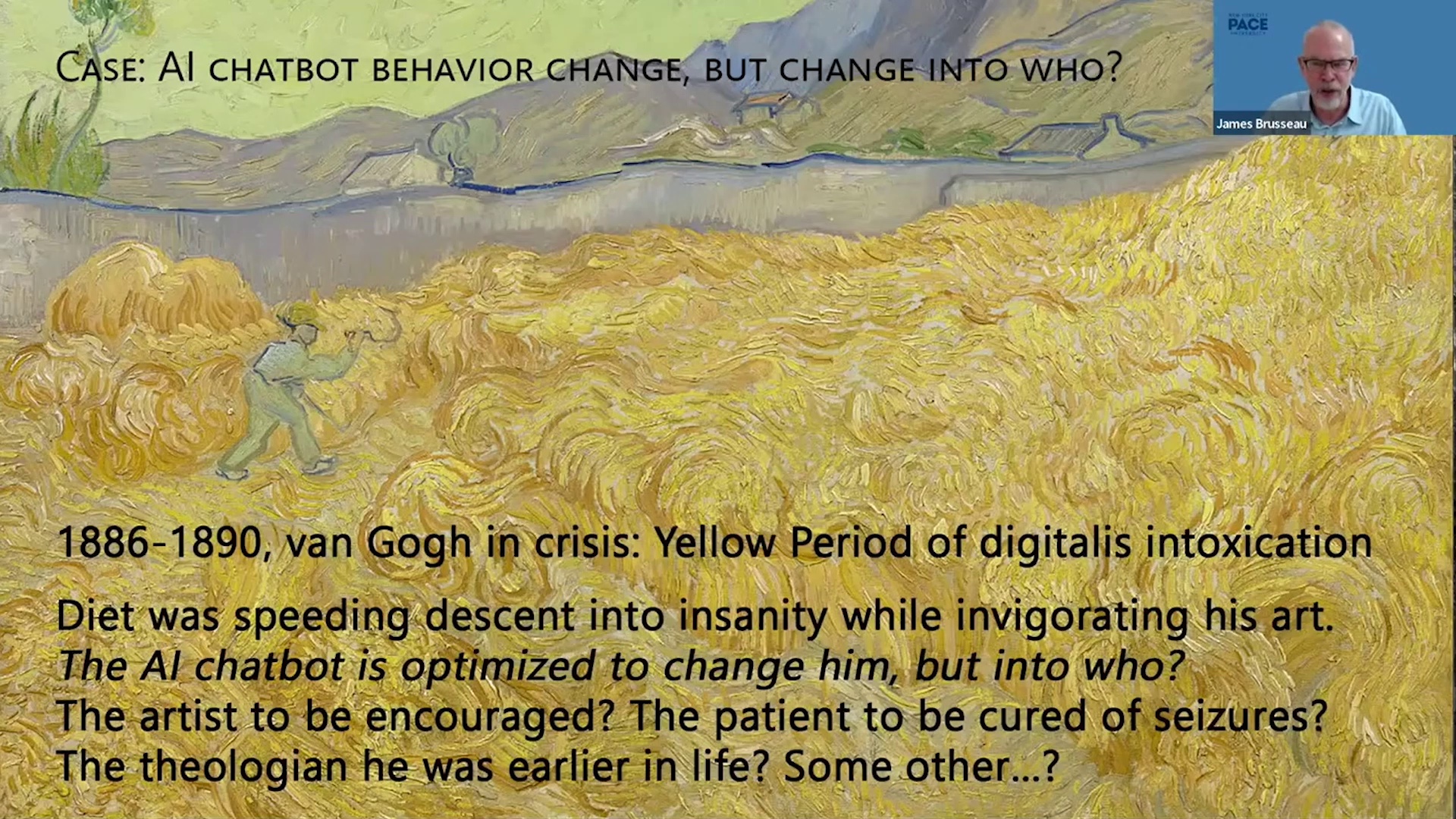
CASE: AI CHATBOT BEHAVIOR CHANGE, BUT CHANGE INTO WHO?
1886-1890, van Gogh in crisis: Yellow Period of digitalis intoxication
Diet was speeding descent into insanity while invigorating his art. The AI chatbot is optimized to change him, but into who? The artist to be encouraged? The patient to be cured of seizures? The theologian he was earlier in life? Some other...?
AI-generated visual description — not speech or approved wording
A yellow field painting with a small worker figure forms the background. These are the slide’s claims; no extra medical interpretation is added.
James Brusseau speech
And then we have his physical health, right? He was having physical seizures and some of these dietary adjustments were helping protect against those seizures so the result of all this is that we have here in this late painting this is the reaper this is one of his standard one of his most admired late paintings from the yellow period everything is yellow you see that hand the strokes which are very bold he is declining mining into insanity at the same time his art is improving, and all of these things are wrapped through his diet, what he's eating.
Repeated visual — Visual — AI chatbot behavior-change article
Visual — AI chatbot behavior-change article
DISC-0025::VIS-004::OCC-02 · Display occurrence: approximately 790.000–794.000 seconds in the original video. Boundaries are estimated.
Short-display inclusion exception: Short substantive build, reference, or contact content; retained explicitly despite normal five-second threshold. No durations aggregated.
Repeated appearance of DISC-0025::VIS-004. See its first transcription.
Repeated visual — Visual — Change into whom?
Visual — Change into whom?
DISC-0025::VIS-006::OCC-02 · Display occurrence: approximately 798.000–908.000 seconds in the original video. Boundaries are estimated.
Repeated appearance of DISC-0025::VIS-006. See its first transcription.
James Brusseau speech
And so there's a question here, which is if you are going to, now this is a thought experiment, if you are going to design a chatbot for Van Gogh, which will influence his behavior in the way that they discuss in this journal by changing in his diet, changing what he's taking in. Well, which Van Gogh are you going to be interested in encouraging or helping? Do you want to bring out the yellow period artist? This is high art. This is the most significant thing that he did in his life, I believe. Or would you rather bring out the person who was suffering from physical seizures and cure that person? You could do that, but that would require a different diet. That will require a separate way of modifying the person's behavior with their chatbot.
And then there are other aspects of Van Gogh's personality too, or his identity, which go back further in the past. He was for some time a devout theologian studying the Bible. And there are other things we could discuss, but just take those three, right? There's the yellow period artist. There's the patient suffering seizures. There's the man in the past who was a quiet theologian and diet can direct him to one of those three. So which one, how do you make that decision? That decision has to be made if you are going to start creating an artificial intelligence chatbot for Van Gogh. You can't avoid that decision Because if you're going to modify his behavior, you have to modify it one way or another, right? So those are three choices for Van Gogh. And it seems to me those are very difficult choices, right? I mean, you could say that his artistic skill is the best part of him. So we should encourage that. But you could also say that he should be physically whole. He should not be suffering seizures.
Source details — Visual — Two decision models
Visual — Two decision models
DISC-0025::VIS-007::OCC-01 · Display occurrence: approximately 910.000–1080.000 seconds in the original video. Boundaries are estimated.
Exact frame PTS: 1000.000000 seconds in original video.
Visible slide text — not speech
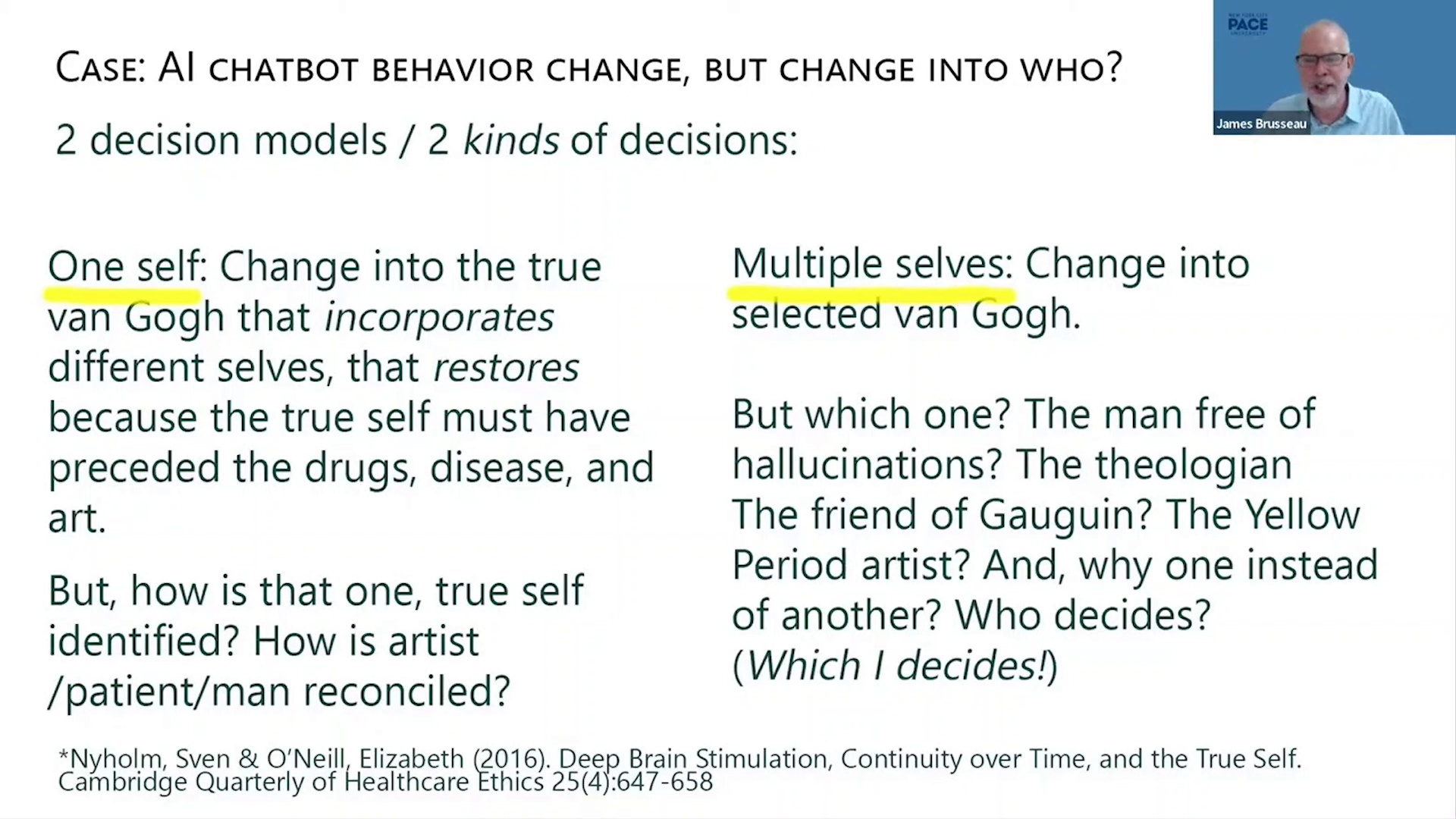
CASE: AI CHATBOT BEHAVIOR CHANGE, BUT CHANGE INTO WHO?
2 decision models / 2 kinds of decisions:
| One self | Multiple selves |
|---|---|
| Change into the true van Gogh that incorporates different selves, that restores because the true self must have preceded the drugs, disease, and art. | Change into selected van Gogh. |
| But, how is that one, true self identified? How is artist /patient/man reconciled? | But which one? The man free of hallucinations? The theologian The friend of Gauguin? The Yellow Period artist? And, why one instead of another? Who decides? (Which I decides!) |
*Nyholm, Sven & O’Neill, Elizabeth (2016). Deep Brain Stimulation, Continuity over Time, and the True Self. Cambridge Quarterly of Healthcare Ethics 25(4):647-658
AI-generated visual description — not speech or approved wording
The slide contrasts restoration of one self with selection among multiple selves in two columns.
James Brusseau speech
So what's the answer? I don't know what the answer is to that question. I don't know who we should create or change Van Gogh into, but I do know that the two models of identity that we have make this into two very different kinds of decisions. So going back to the start, if we want to say that what it means to be me or what it means to be Van Gogh is just one thing, that there's one person who is Van Gogh, then what we will need to do, what we will need to do, it seems to me, is design the AI chatbot to incorporate those different selves that Van Gogh is. And not only the different selves that he is now, the artist and the patient, but also the person he was before the insanity that came at the very end of his life. Because whoever Van Gogh is now, if he's only one person, then he was also that person back then. So if you're going to say that what it means to be a person is to just be one person with different sides or different aspects, then you've got to find a way to incorporate and bring together all of the various ways that Van Gogh lived as an artist, as a patient, as a theologian.
Whereas by contrast, if you're going to go the Deleuzian direction, the multiple selves direction, if you're going to say that all anyone is, is just a group of multiple mes, what it means to be James Brusseau is not one thing, but many things. Well, then you have a kind of a license. Then you can choose. You can say, look, Van Gogh should be the yellow period master painter. If that means he suffers seizures, that's what it means. If that means he ultimately commits suicide, maybe that's what it means. You can make that case. I'm not making that case, but you could make that case if you go this second direction.
Source details — Visual — Three conclusions
Visual — Three conclusions
DISC-0025::VIS-008::OCC-01 · Display occurrence: approximately 1082.000–1196.000 seconds in the original video. Boundaries are estimated.
Exact frame PTS: 1100.000000 seconds in original video.
Visible slide text — not speech
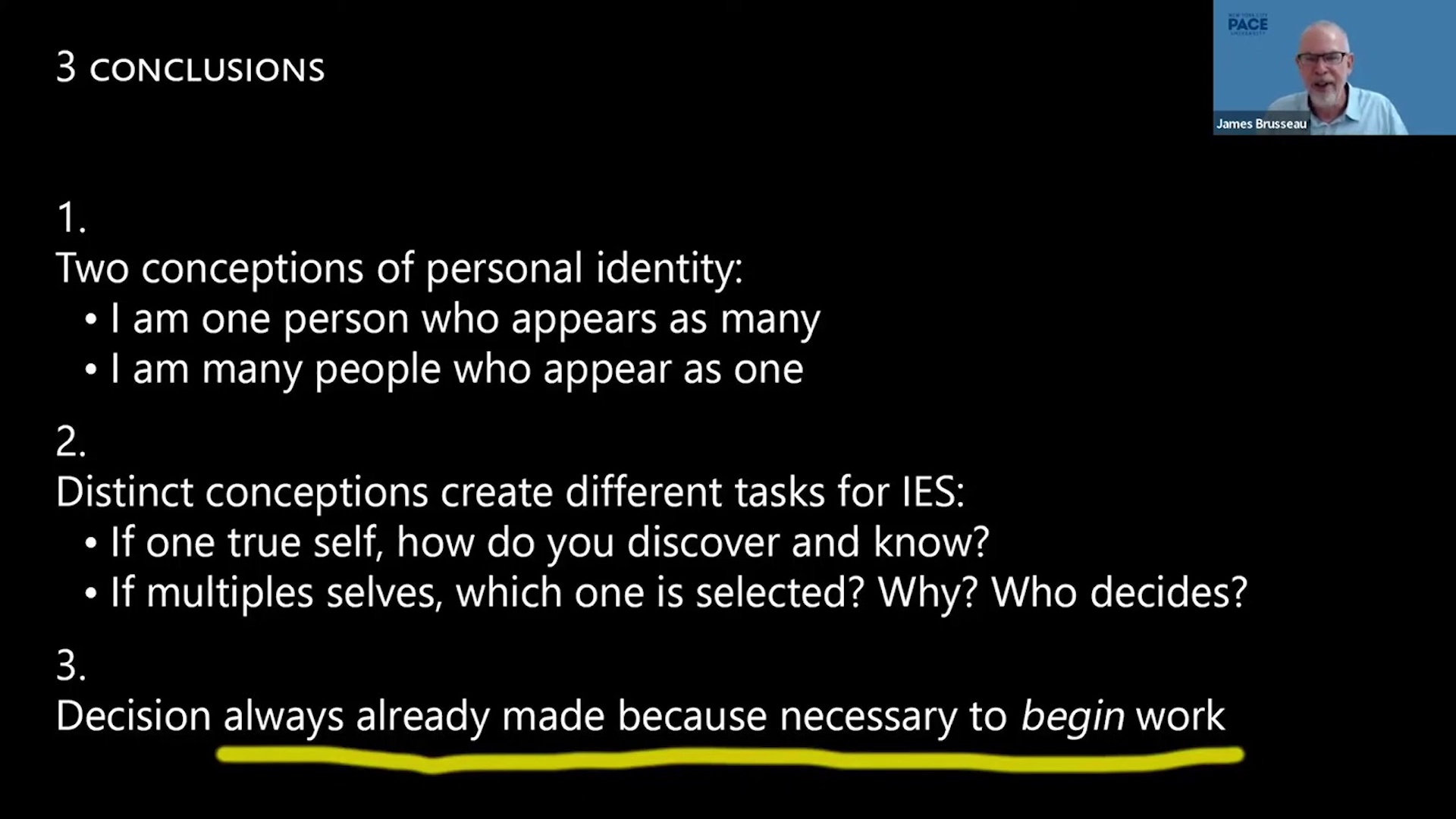
3 CONCLUSIONS
- Two conceptions of personal identity:
- I am one person who appears as many
- I am many people who appear as one
- Distinct conceptions create different tasks for IES:
- If one true self, how do you discover and know?
- If multiples selves, which one is selected? Why? Who decides?
- Decision always already made because necessary to begin work
James Brusseau speech
So what I want to say with this example of Van Gogh is that the design of an AI chatbot, which is going to change our behavior necessarily invokes this question about well who are we designing for one person or many and the way we are going to nudge or influence or change their behavior differs at least potentially radically depending upon whether we use one or the other way of thinking about what it means to be me. So that's the first of three things that I want to say this afternoon in Italy, this morning in New York. It is that there are two conceptions of personal identity, that I can be one person who appears as many or many people who appear as one. And then I want to say second, that there are two kinds of activities for information and engineering science, depending upon this view. If there's one self, like just one Van Gogh, then you have to try and find out who that one self is and figure out how I can know that one self. How do I determine who Van Gogh is? And how do I make it all work together?
Repeated visual — Visual — Three conclusions
Visual — Three conclusions
DISC-0025::VIS-008::OCC-02 · Display occurrence: approximately 1200.000–1534.000 seconds in the original video. Boundaries are estimated.
Repeated appearance of DISC-0025::VIS-008. See its first transcription.
James Brusseau speech
By contrast, if you go for multiple selves, then you've got to decide something very different. You've got to decide, I want this van Gogh, or I want that one. And then the last point and the most important point is that this decision, I'm insisting, is always already made because you have to already have made that decision, maybe not consciously, but you have to have made that decision just to begin work in the first place. If you're going to define an AI chatbot to modify someone's behavior then you already have to have made an assumption about who that person is and what behavior in what way you're going to modify the behavior are you going to try and discover who the real person is and make them like that or are you going to select part of who that person is and encourage that to bring that out two very very different projects okay so that's part one of three of what's going to be three ideas.
And I thought maybe I could stop just for a moment to see if there's anything that I have not been clear about or that could be further defined, because this idea we have here is what we will use and build upon for the next one. So I will just give it a second if anyone would like to pose a question. Sure, Flavia, yeah.
Other speaker (context): Hi very interesting talk so far I'm just wondering if you're maybe a bit optimistic as to how much we can mold or change people's behavior I mean this would be a dream to just change the diet and change someone's interests for instance I mean the van gogh case is an extreme case because he was effectively on drugs that were altering his perception and whatnot however do you think it's really that easy to just modify someone's interests with a chatbot or diet or whatever? And is it really fair to talk about multiple selves? All of us have multiple interests at different points in time. You know, you might have a, I don't know, languages phase, then you might have a sports phase, then you might have whatever. Is this really multiple selves or just different interests?
James Brusseau: Thank you. Right. Terrific question. And I think that the question, well, there are two parts to the question as I heard it. And I will answer the second part first, which is I think that the question is its own answer. What I'm trying to do is raise the ambiguity itself between the possibility that I am one person with different elements of my identity or I am simply fundamentally different people. I don't think that we can choose one or the other. Other philosophers have been trying to choose for 2,500 years can't do it. But the difference, I wanted to say, does change the way we think about how we design a chatbot. That was the second question as I heard Flavio ask. And the first question was the practical question, was, okay, can you really do any of this? And I think the answer is no and yes. Of course, in real life, we cannot just shift people one way or the other. However, I do believe that this way of thinking will, in fact, change significant things in people's lives in different parts of their experience.
For example, let's think, we're going to come to this at the end, but I will jump ahead quickly now. Let's think of a real problem we're facing today, the problem of the filter That is, the problem that people are constantly being drawn into interactions with others who are just simply very similar to themselves. So there's an aspect of our lives which is closing down, let's say, on social media if we get involved with, let's just say, a political group, which is on one extreme or the other. When we're looking at that experience right which is really an AI online experience of how our conversations are being nudged and pushed toward one group of people or another when we look at that we can say that there are two ways of approaching that reality one way is to say that maybe possibly if there is one self that I am, then either that self that I'm involved in with this group is not me, or if it is me, then maybe we should allow people to be focused and to be trapped in a kind of filter bubble because that's who they are. I'm not sure why we would say that people should escape that filter bubble if it authentically represents their own interests, their own aspirations, fears, and so on.
Whereas by contrast, if you are an AI designer and you go with the multiple personality view, then you might say, look, I have a justification. And I'm going to get to why it's an ethical justification. That's next. But you say, I might have a justification here for providing people with possible conversational partners who have completely different ideas, because that will appeal to a different possible identity they have. So I think that there's an ethical difference in the way you approach just something concrete like a filter bubble. There are people being trapped with others who are just talking and repeating the same things they say. If you believe in the one self model, it's very difficult to justify pulling them out of that.
Source details — Visual — Authenticity and multiplying selves dilemma
Visual — Authenticity and multiplying selves dilemma
DISC-0025::VIS-009::OCC-01 · Display occurrence: approximately 1536.000–1596.000 seconds in the original video. Boundaries are estimated.
Exact frame PTS: 1550.000000 seconds in original video.
Visible slide text — not speech
3
THE DILEMMA BETWEEN THE AUTHENTICITY OF ONE SELF, AND THE FREEDOM OF MULTIPLYING SELVES
James Brusseau speech
Whereas by contrast, if you believe in the multiple self model, you have an ethical justification. You can say, look, I'm going to appeal to a different self that this person has. I know that answer is a little hazy right now, but it's going to become clearer with the next step. That was a very good question because it leads perfectly naturally into the next step. And so maybe we should continue. What is going to happen here is I'm going to fill in the middle area between what I first said about the two ways of thinking about personal identity and the answer I just provided. And the way I'm going to fill that in is with a thought experiment, as you've seen from my discussion of Van Gogh, I tend to go to the extreme cases. That's the way philosophers work. That's the way we produce knowledge. We don't produce knowledge by gathering large numbers of cases and studying the data, we produce knowledge by going to the extreme possible case and saying okay what happens way out on the edges of experience? So that's what we're going to do now. We're going to take that idea of the two selves and think about the two kinds of selves and think about that in ethical terms. And this is another thought experiment. This is a thought experiment by a guy named Derek Parfit, who's one of the important philosophers of just the previous generation. This is from a 1984 book, Reasons in Persons.
Source details — Visual — Authenticity and the teletransporter
Visual — Authenticity and the teletransporter
DISC-0025::VIS-010::OCC-01 · Display occurrence: approximately 1598.000–1816.000 seconds in the original video. Boundaries are estimated.
Exact frame PTS: 1700.000000 seconds in original video.
Visible slide text — not speech
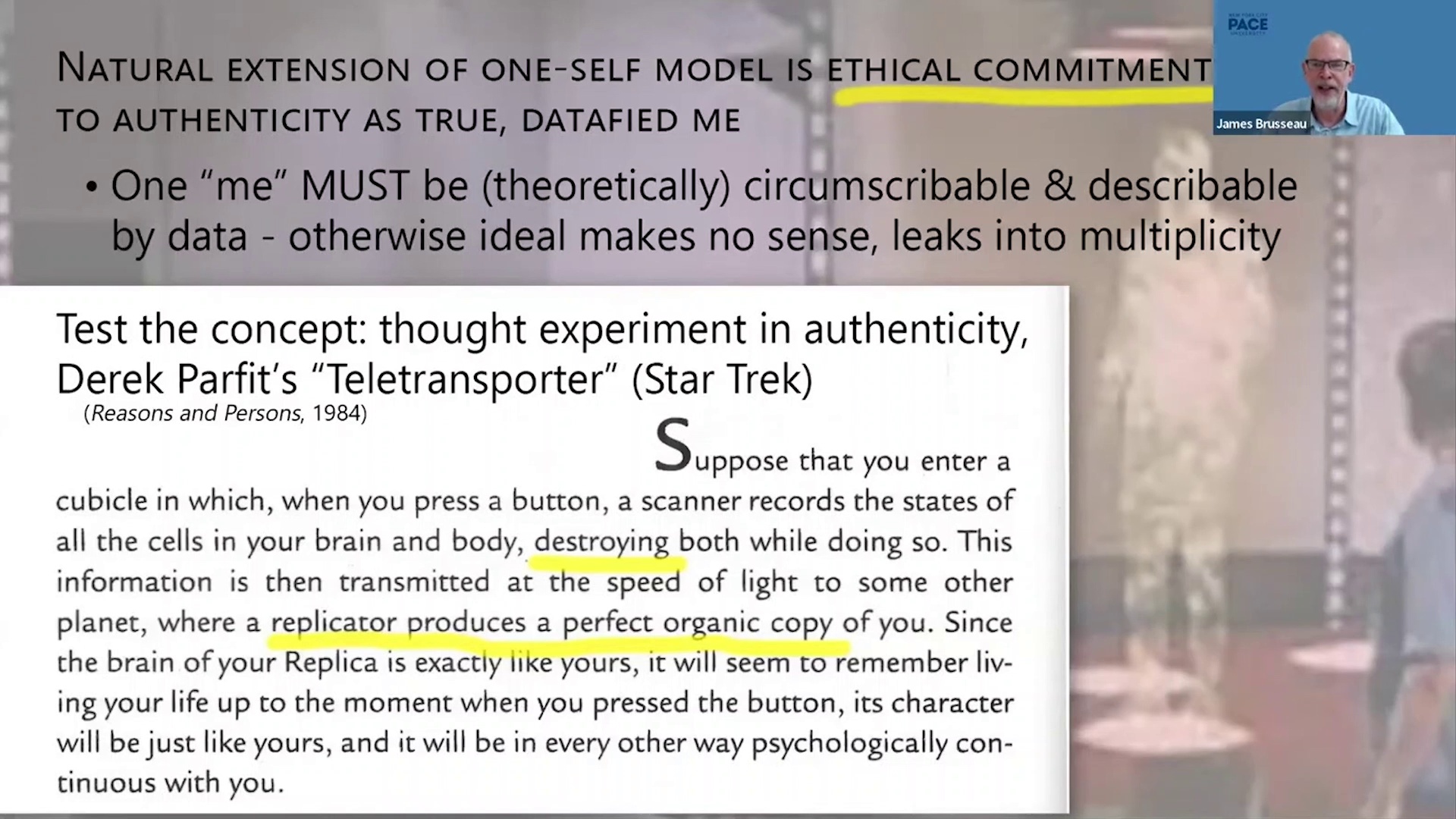
NATURAL EXTENSION OF ONE-SELF MODEL IS ETHICAL COMMITMENT TO AUTHENTICITY AS TRUE, DATAFIED ME
- One “me” MUST be (theoretically) circumscribable & describable by data - otherwise ideal makes no sense, leaks into multiplicity
Test the concept: thought experiment in authenticity, Derek Parfit’s “Teletransporter” (Star Trek) (Reasons and Persons, 1984)
Suppose that you enter a cubicle in which, when you press a button, a scanner records the states of all the cells in your brain and body, destroying both while doing so. This information is then transmitted at the speed of light to some other planet, where a replicator produces a perfect organic copy of you. Since the brain of your Replica is exactly like yours, it will seem to remember living your life up to the moment when you pressed the button, its character will be just like yours, and it will be in every other way psychologically continuous with you.
AI-generated visual description — not speech or approved wording
The quotation overlays a faded science-fiction scene. Yellow marks emphasize ethical commitment, destruction, and replication.
James Brusseau speech
And what he was interested in, what Parfit was interested in, was the continuity of identity through time. We're going to be interested in something slightly different, but let me tell you what his experiment was. He obviously had watched the television show Star Trek and I'm not sure if everyone here has watched it. Hopefully you can sort of see the slide and it sort of rings a bell. On the show what happens is, and in the movies too, people can stand in one place and then they are magically, well not magically, they are technologically transported to a different place and so part of it he took that seriously and he said okay well let's think about that let's think about this really happening and he goes through the details of the transfer and he says look what's actually going on in Star Trek or he calls it the teletransporter what's actually going on is that my physical and biological and everything about me is being destroyed in one place. It's being changed into data and then it is being recreated in another place. And the question he asks is, okay, if it's really true that we do this jump, is the person who arrives at the other end, at the extreme, is that person the same person who left? I mean, it seems to me intuitively, it doesn't feel that way. But what's significant for our purposes is that if that is true if you can do that then that means that what it means to be me is at least theoretically extreme case circumscribable and describable by data why because when you start with the me who's here and then you recreate the me over there, some other place, some other planet. You need to have the information required to recreate me. According to the experiment, my physical self here is destroyed and my new self there is created. That means if I am the same person there as here, that means that you can fully data-fy me. You can create me entirely from data. And if that's true, then there is an authentic me which corresponds with the single me that Freud talked about. There is an identity of James Brusseau, which you can capture in data and then send it somewhere else. That's what's at stake in this thought experiment for me. I'm changing a little bit what the reason he's doing the experiment.
And if that's true, then we can jump back to the Van Gogh case and say, okay, we know everything about Van Gogh. So when we have this question about what kind of diet we should provide for him, how we should nudge his behaviors. Well, we know because we know what it means to be Van Gogh. We've got all the data. We understand him perfectly. There's no reason to choose. There's no reason to make any decisions. Just take the data, the identity we have of him, and that will tell us how we should nudge him, how we should direct him, because we know who he is.
Source details — Visual — Authenticity and personal freedom
Visual — Authenticity and personal freedom
DISC-0025::VIS-011::OCC-01 · Display occurrence: approximately 1818.000–1914.000 seconds in the original video. Boundaries are estimated.
Exact frame PTS: 1850.000000 seconds in original video.
Visible slide text — not speech
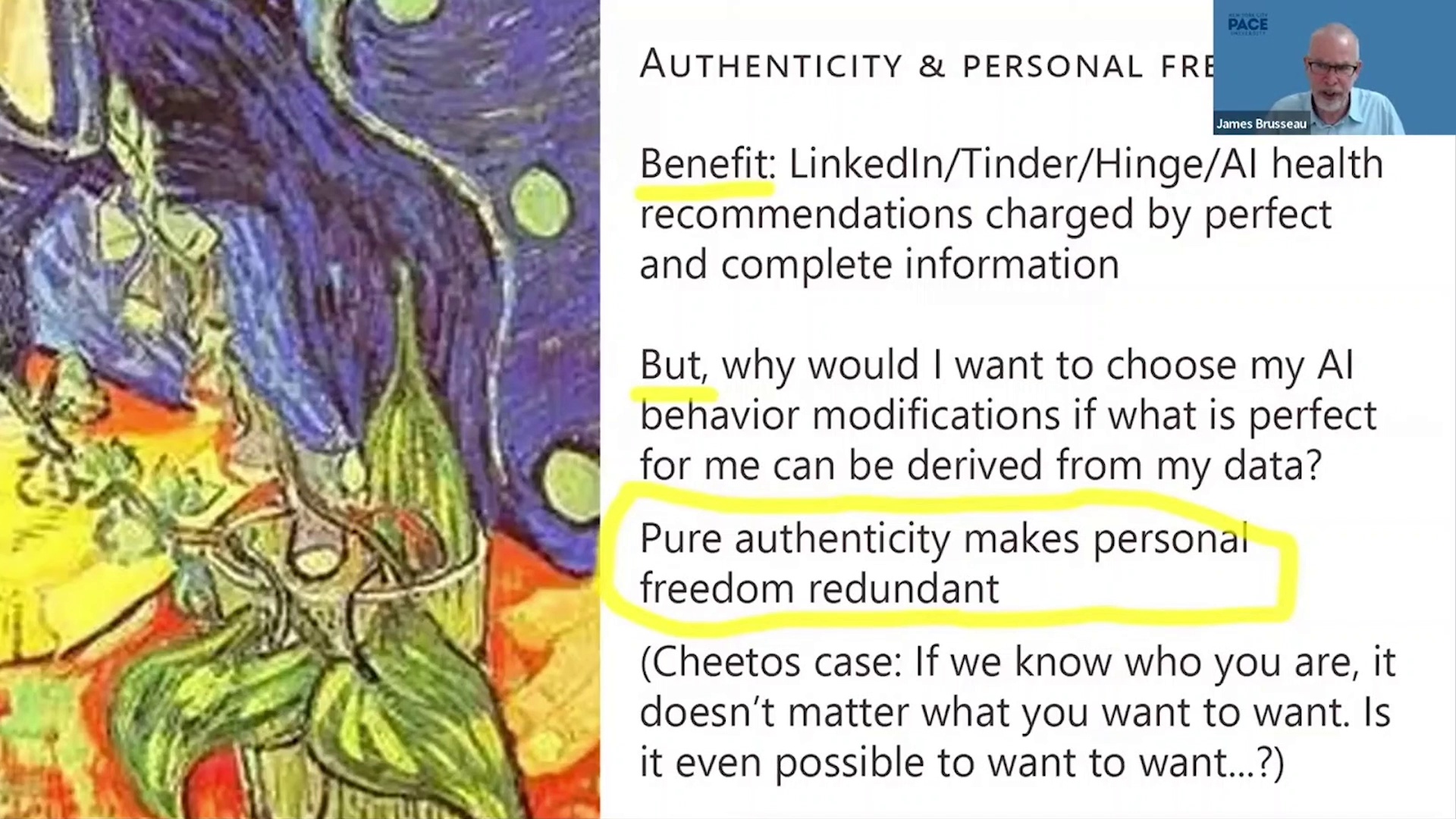
AUTHENTICITY & PERSONAL FRE[remainder obscured by video inset]
Benefit: LinkedIn/Tinder/Hinge/AI health recommendations charged by perfect and complete information
But, why would I want to choose my AI behavior modifications if what is perfect for me can be derived from my data?
Pure authenticity makes personal freedom redundant
(Cheetos case: If we know who you are, it doesn’t matter what you want to want. Is it even possible to want to want...?)
AI-generated visual description — not speech or approved wording
A cropped painted detail occupies the left; the claim about redundancy is circled in yellow.
Visual limitations: The upper-right inset persistently covers the end of the heading in inspected appearances.
James Brusseau speech
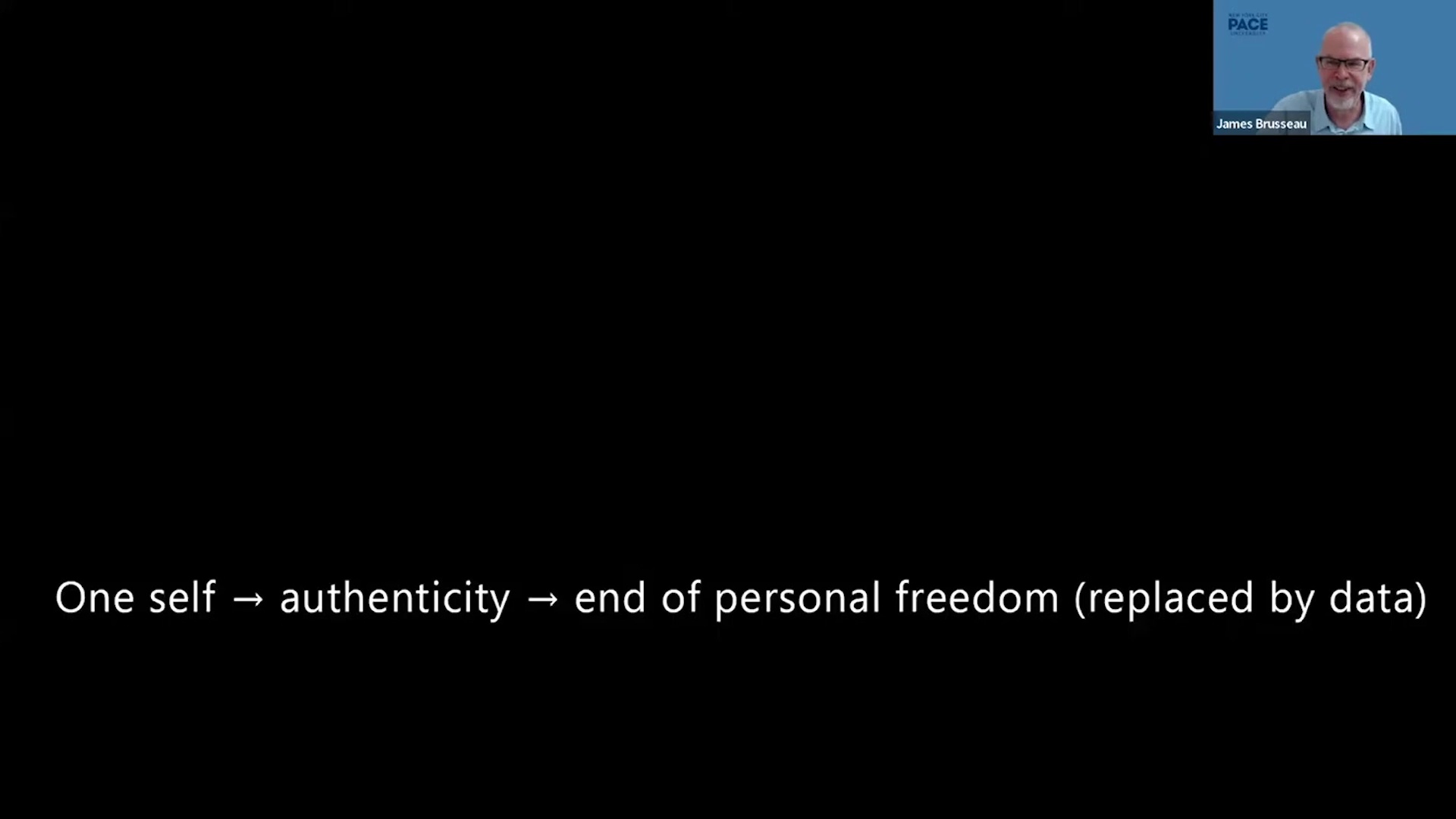
So that's sort of one part of the thought experiment. And then I note as a last point here, if we do that, if we can fully capture an individual in data, then individual freedom, I don't need to be free anymore, because whether I want Cheetos that make my hands dirty or not, all that is already a part of my identification. It's part of my data. So I don't need to choose. It's chosen for me by who I am. So freedom doesn't matter anymore. So that's the first of two ideas in this part, that we now have a kind of authentic person who is created from their data, but that person no longer has need for freedom because all the decisions will be made by who they are. And they can even be made by medical chatbot, presumably, theoretically. Okay? And then we can rearrange that experiment and send it the other way and say, okay, can this experiment be about the multiple identity person?
Source details — Visual — One-self consequence
Visual — One-self consequence
DISC-0025::VIS-012::OCC-01 · Display occurrence: approximately 1916.000–1918.000 seconds in the original video. Boundaries are estimated.
Short-display inclusion exception: Short substantive build, reference, or contact content; retained explicitly despite normal five-second threshold. No durations aggregated.
Exact frame PTS: 1916.000000 seconds in original video.
Visible slide text — not speech
One self → authenticity → end of personal freedom (replaced by data)
Source details — Visual — Freedom and multiple selves
Visual — Freedom and multiple selves
DISC-0025::VIS-013::OCC-01 · Display occurrence: approximately 1920.000–2026.000 seconds in the original video. Boundaries are estimated.
Exact frame PTS: 1970.000000 seconds in original video.
Visible slide text — not speech
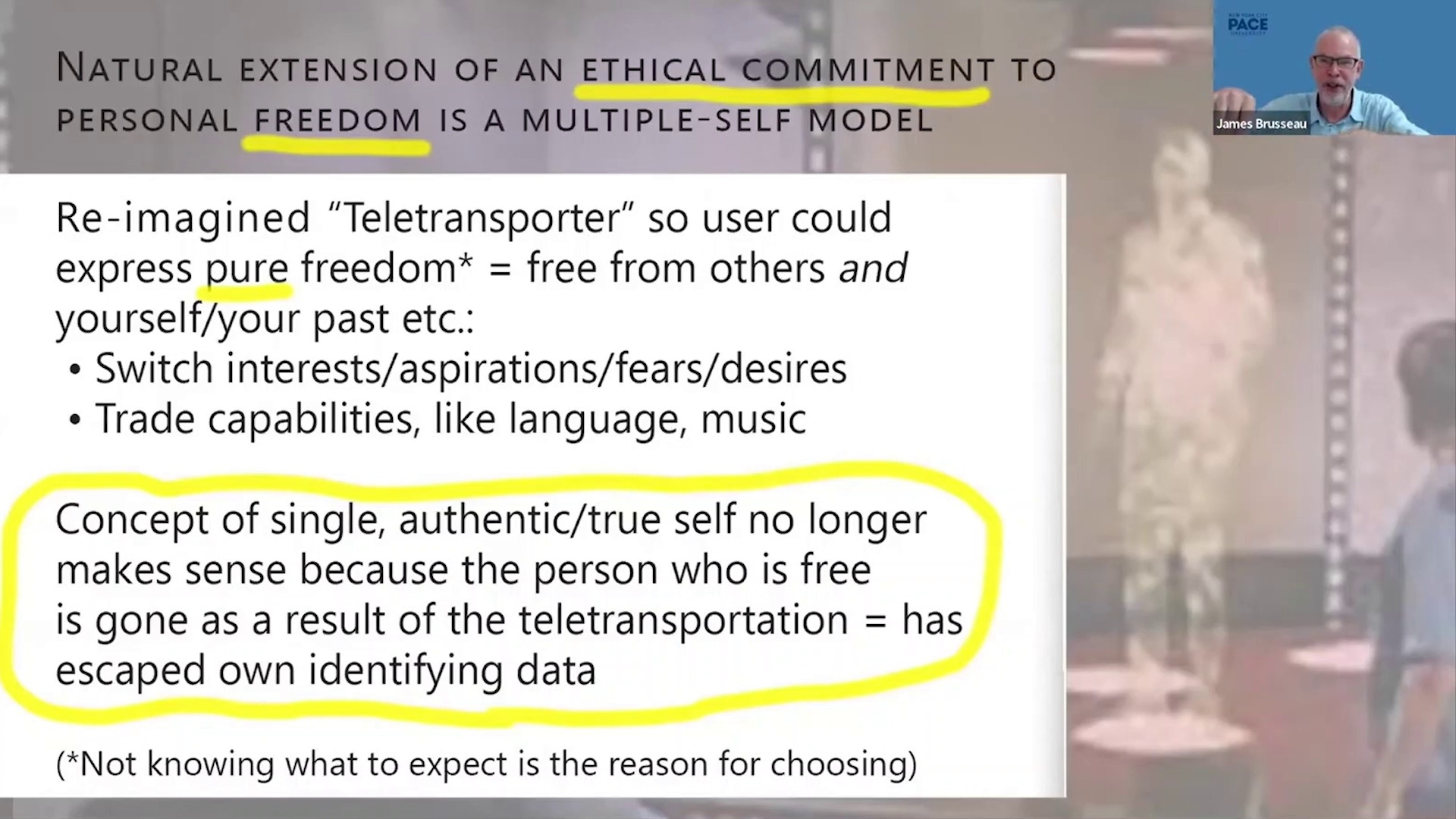
NATURAL EXTENSION OF AN ETHICAL COMMITMENT TO PERSONAL FREEDOM IS A MULTIPLE-SELF MODEL
Re-imagined “Teletransporter” so user could express pure freedom = free from others and* yourself/your past etc.:
- Switch interests/aspirations/fears/desires
- Trade capabilities, like language, music
Concept of single, authentic/true self no longer makes sense because the person who is free is gone as a result of the teletransportation = has escaped own identifying data
(*Not knowing what to expect is the reason for choosing)
AI-generated visual description — not speech or approved wording
The argument overlays the same faded science-fiction image; its final consequence is circled in yellow.
James Brusseau speech
Can this experiment be about the person who has potentially infinite number of selves? And I think, yes, it can be. And it can be by reimagining the experiment in the following way. When I jump from one place to another, I arrange to have some basic facts about me switched or changed. Like, for example, now, today, I work in philosophy. But maybe when I'm shifted to another place, I work instead in computer science or I work instead in anthropology. I think something like that is a very pure kind of freedom because I am free not only from others, I'm making things up for myself, but I'm also free from myself. If I give directions to have my capabilities and my interests changed when I arrive at the new place, then I think I'm a new person within this thought experiment. So in this case, within the thought experiment, we have maximum freedom, but we have no authenticity. There is no true self because the self is changing radically. So here's an example. I gave an example of the one self.
Source details — Visual — Freedom and anonymity research
Visual — Freedom and anonymity research
DISC-0025::VIS-014::OCC-01 · Display occurrence: approximately 2028.000–2186.000 seconds in the original video. Boundaries are estimated.
Exact frame PTS: 2100.000000 seconds in original video.
Visible slide text — not speech
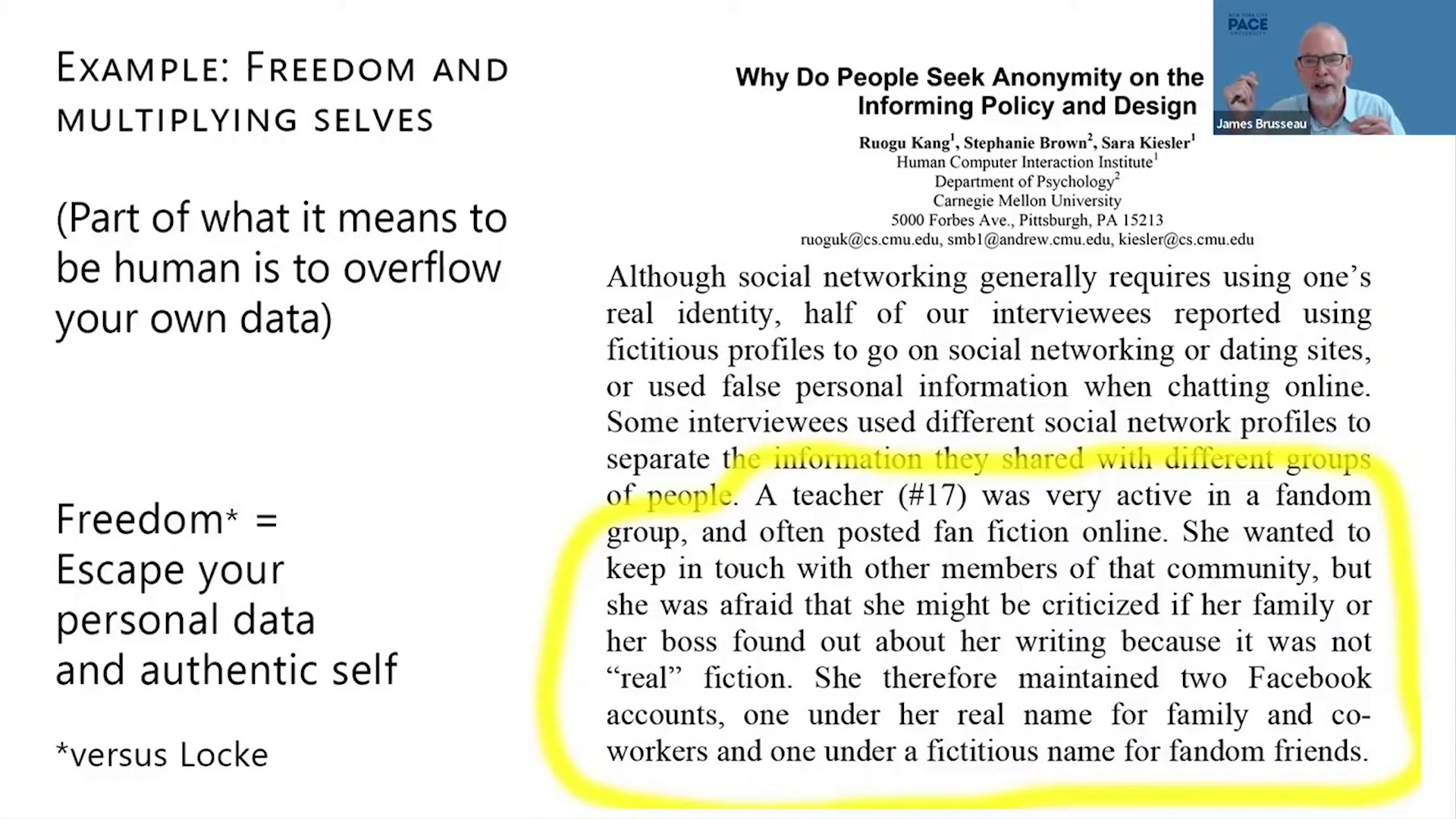
EXAMPLE: FREEDOM AND MULTIPLYING SELVES
(Part of what it means to be human is to overflow your own data)
Freedom* = Escape your personal data and authentic self
*versus Locke
Why Do People Seek Anonymity on the [title remainder obscured] Informing Policy and Design
Ruogu Kang¹, Stephanie Brown², Sara Kiesler¹ Human Computer Interaction Institute¹ Department of Psychology² Carnegie Mellon University 5000 Forbes Ave., Pittsburgh, PA 15213 ruoguk@cs.cmu.edu, smb1@andrew.cmu.edu, kiesler@cs.cmu.edu
[…] Some interviewees used different social network profiles to separate the information they shared with different groups of people. A teacher (#17) was very active in a fandom group, and often posted fan fiction online. She wanted to keep in touch with other members of that community, but she was afraid that she might be criticized if her family or her boss found out about her writing because it was not “real” fiction. She therefore maintained two Facebook accounts, one under her real name for family and co-workers and one under a fictitious name for fandom friends.
AI-generated visual description — not speech or approved wording
The research excerpt is paired with the freedom statement; the example of separate profiles is circled in yellow.
Visual limitations: The video inset covers the end of the article title. No missing title words were supplied from another recording.
James Brusseau speech
Here's an example of the multiple self, and this sort of responds a little bit, I think, to the question we had already. It's an example from a paper, a recent paper about anonymity online, and what it shows is that what it discusses is how people create a distinct, create a new self for themselves online. In this case, a person on Facebook who wants to be interested in a different kind of writing than she is professionally, she creates a new anonymous personality on Facebook and then uses that to spring out and create a whole new identity. I think something like this happening when you set up an anonymous identity on Facebook book and then create a reality around it, something like that is not too far removed from the transporter experiment where you just change part of yourself and suddenly arrive at a new place. Or stated slightly differently, I think this is not too far removed from the idea that we can develop an entirely new self for ourselves, and information technology helps us do it. And it's not terribly difficult. Going back again to the question, I think there's something here which really is practically achievable. That is, you could set up an anonymous online identity with a new interest or a new religious belief or a new career aspiration, and you could gain friends and connections in this new world, and gradually, or maybe not so gradually, shift your entire identity into this new one. It seems to me that's possible now, the ability to create a fake identity which becomes the true one. And if that happens, if that happens, then there is no such thing as one true self. If that happens, then the Deleuzian vision is the right one, the one where we are multiple selves and maybe there are more selves coming.
Source details — Visual — Conclusion: authenticity and freedom
Visual — Conclusion: authenticity and freedom
DISC-0025::VIS-015::OCC-01 · Display occurrence: approximately 2188.000–2290.000 seconds in the original video. Boundaries are estimated.
Exact frame PTS: 2250.000000 seconds in original video.
Visible slide text — not speech
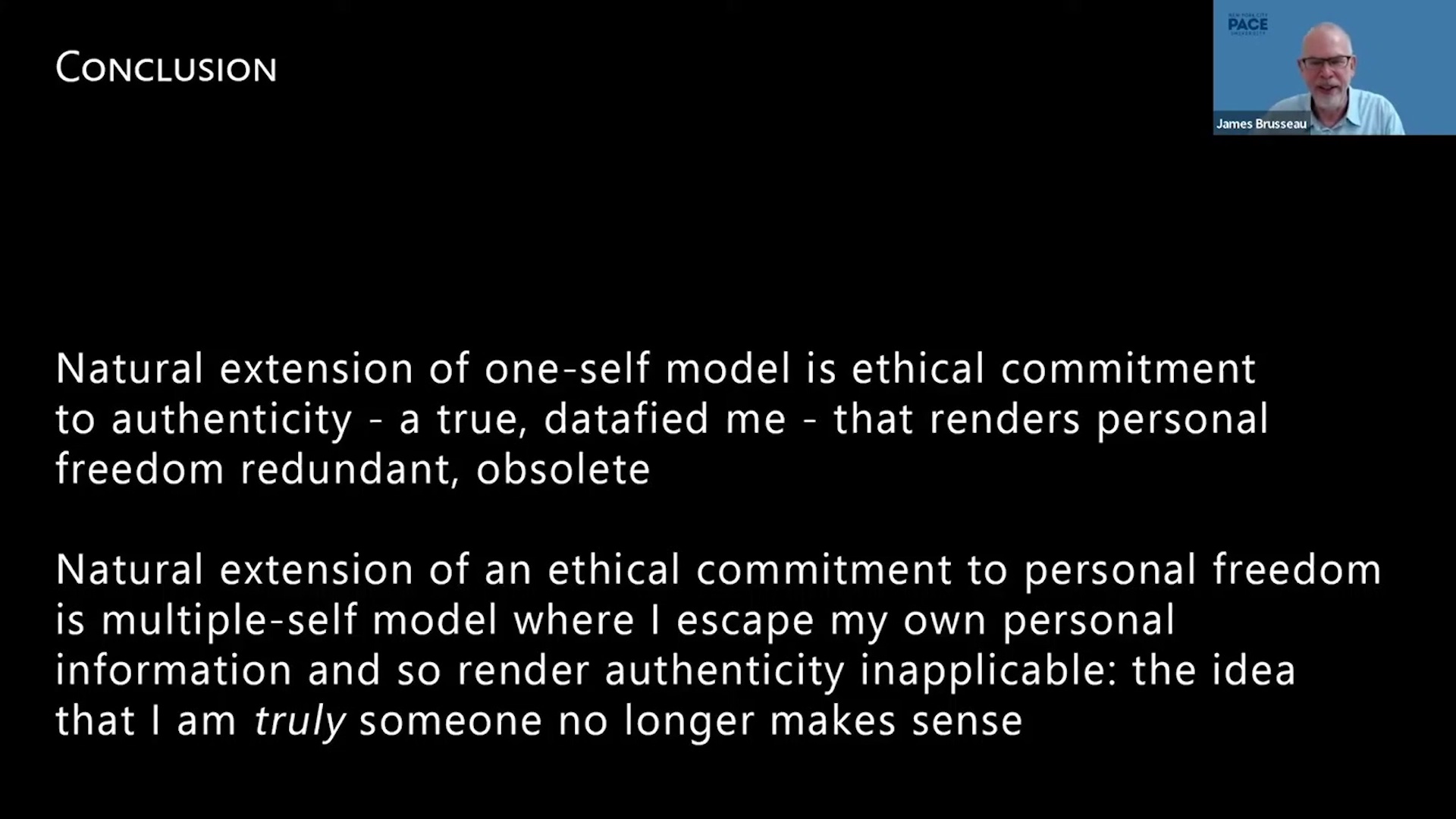
CONCLUSION
Natural extension of one-self model is ethical commitment to authenticity - a true, datafied me - that renders personal freedom redundant, obsolete
Natural extension of an ethical commitment to personal freedom is multiple-self model where I escape my own personal information and so render authenticity inapplicable: the idea that I am truly someone no longer makes sense
James Brusseau speech
So that's the second part of what I wanted to present. I want to connect the visions of an individual with ethical ideas about authenticity and freedom. And I wanted to say that at the extreme, if we really are one person, then it is at least theoretically possible for who we are to be captured fully in data. And then that answers the questions about how an AI chatbot should be designed to nudge patients. That tells us everything, at least theoretically. Though the cost, the cost of that is that we're no longer free because we can't make decisions for ourselves since there's no reason to do that. Since we already know perfectly what we want, why choose? Why be free to choose? That's one vision.
The other vision is the idea that we can privilege freedom and say that we should use technology as a way to create new selves, themselves new ways of living so we just saw the case on Facebook where you maybe you develop a new interest in writing as an anonymous user you develop that interest and then you reveal that well it's really James Brusseau there but I've become that new person and then going back to the Van Gogh case I don't think so I'm again kind of answering Flavia's question I don't think that what we see in this Facebook example where this woman just takes an anonymous identity and develops a new form of writing with it, I don't think that that's very far away from what I was hypothesizing as happening to Van Gogh. That is, that we choose that one part of his personality, the yellow period artist, let's say, and we develop that and bring that out. And say that that is him, that there is no general larger sense of him. Instead, we're just going to take this one part and make that what our work focuses on.
Repeated visual — Visual — Freedom and anonymity research
Visual — Freedom and anonymity research
DISC-0025::VIS-014::OCC-02 · Display occurrence: approximately 2292.000–2362.000 seconds in the original video. Boundaries are estimated.
Repeated appearance of DISC-0025::VIS-014. See its first transcription.
James Brusseau speech
So I think then, sort of to conclude both my answer to Flavia's question and this part, it seems to me that it is possible to use things like AI chatbots to significantly redirect not just who we are, but how we are. That is, do we think of ourselves and are we one person or are we many?
Source details — Visual — Identity comparison table
Visual — Identity comparison table
DISC-0025::VIS-016::OCC-01 · Display occurrence: approximately 2364.000–2494.000 seconds in the original video. Boundaries are estimated.
Exact frame PTS: 3306.000000 seconds in original video.
Visible slide text — not speech
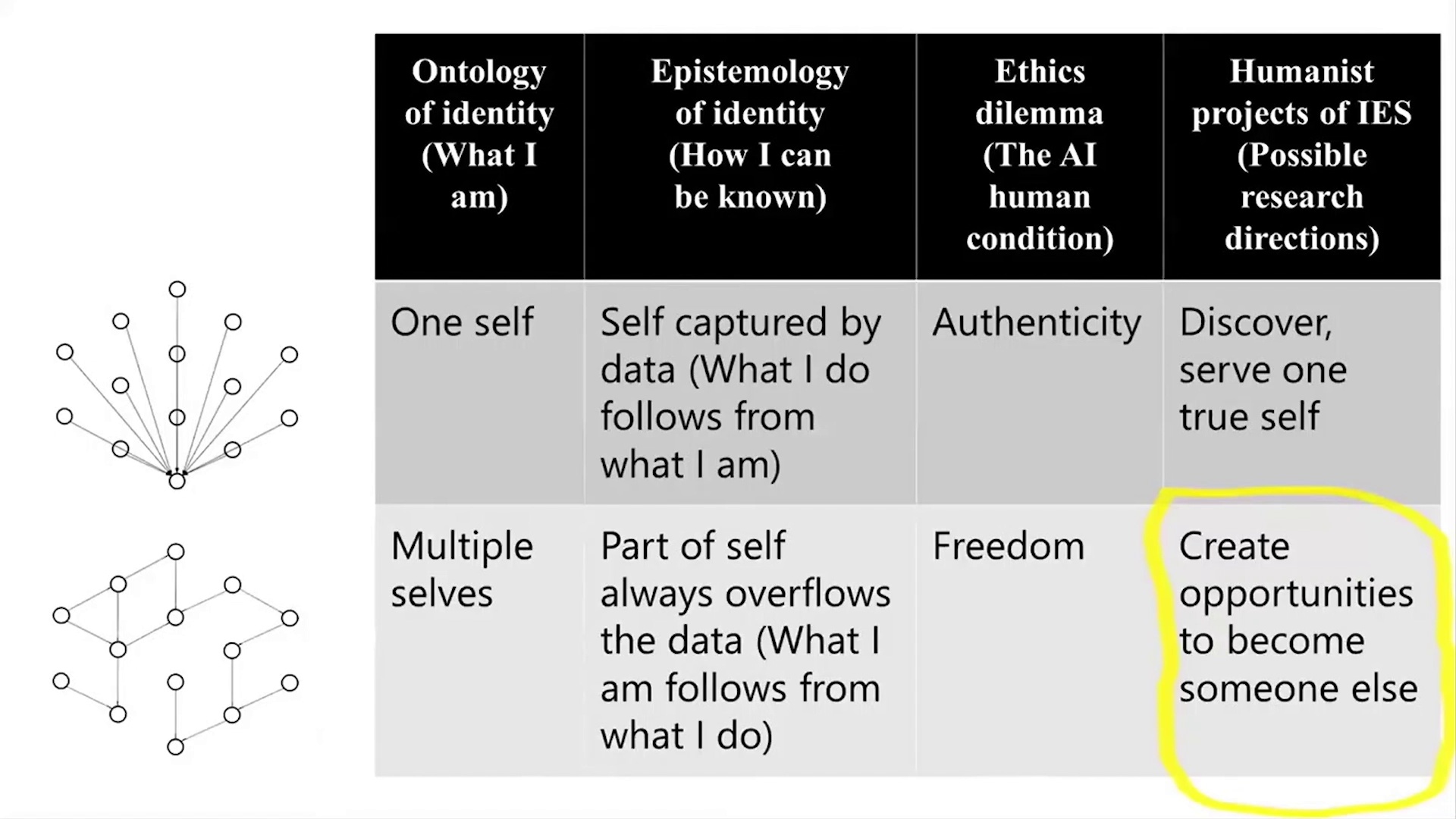
| Ontology of identity (What I am) | Epistemology of identity (How I can be known) | Ethics dilemma (The AI human condition) | Humanist projects of IES (Possible research directions) |
|---|---|---|---|
| One self | Self captured by data (What I do follows from what I am) | Authenticity | Discover, serve one true self |
| Multiple selves | Part of self always overflows the data (What I am follows from what I do) | Freedom | Create opportunities to become someone else |
AI-generated visual description — not speech or approved wording
Beside the table, an upper network converges on one node; a lower network has distributed linked branches. The lower-right cell is circled in yellow.
Visual limitations: The unobstructed selected frame is from a later recurrence of the same table; earlier insets hide part of its last heading.
James Brusseau speech
Okay, so that's part two. Part three is very quick. It really is just kind of a summary. And unfortunately, I've got this for you here. And so let me just go through this very quickly and then we will open the floor for questions. I'm sorry that I have gone on so long. I did not plan to. What I have said. Basically, there is an idea of whether or not I am one self or multiple selves. And then I've said, there are two ways that we can know who I am. We can say that I am one self who is captured at least theoretically by my data, or we can say, look, if I have multiple selves, there's going to be some part of me that always overflows the data. That part may be very small. It may be just a potential to change, but it's still something.
And then I want to move there to the ethics and say, look, there are two different ethical approaches or two different ethical ways of understanding these realities. If we are one person, then there's a kind of an ethical duty to be authentic, to discover who that one person is and be that person. Whereas by contrast, if we're fundamentally multiple, then authenticity doesn't make sense anymore. And there's a kind of responsibility to investigate and become different kinds of people.
And then to conclude, I want to say that what all this means for information and engineering and sciences, the reason for all this is I want to say that there are two kinds of projects that you can be involved in some areas. One project is this project of discovering who a user is or who a patient is, and then bending their personality into that oneself. The other project, this is a very different project, I believe, is to help users become different people. And I think that second project is underappreciated in your world today and I think that there's a lot of potential for work there and I talk about here I've talked already about filter bubbles but I'll just mention again we could have there's quite a bit of work being done now in the area of filtered bubbles and we could in breaking them especially this first paper on top it's really very good this one bursting scientific filter bubbles is very close to what I was talking about today I think what they are doing is they are trying to say in that paper, I think, that we can divide individuals into different selves.
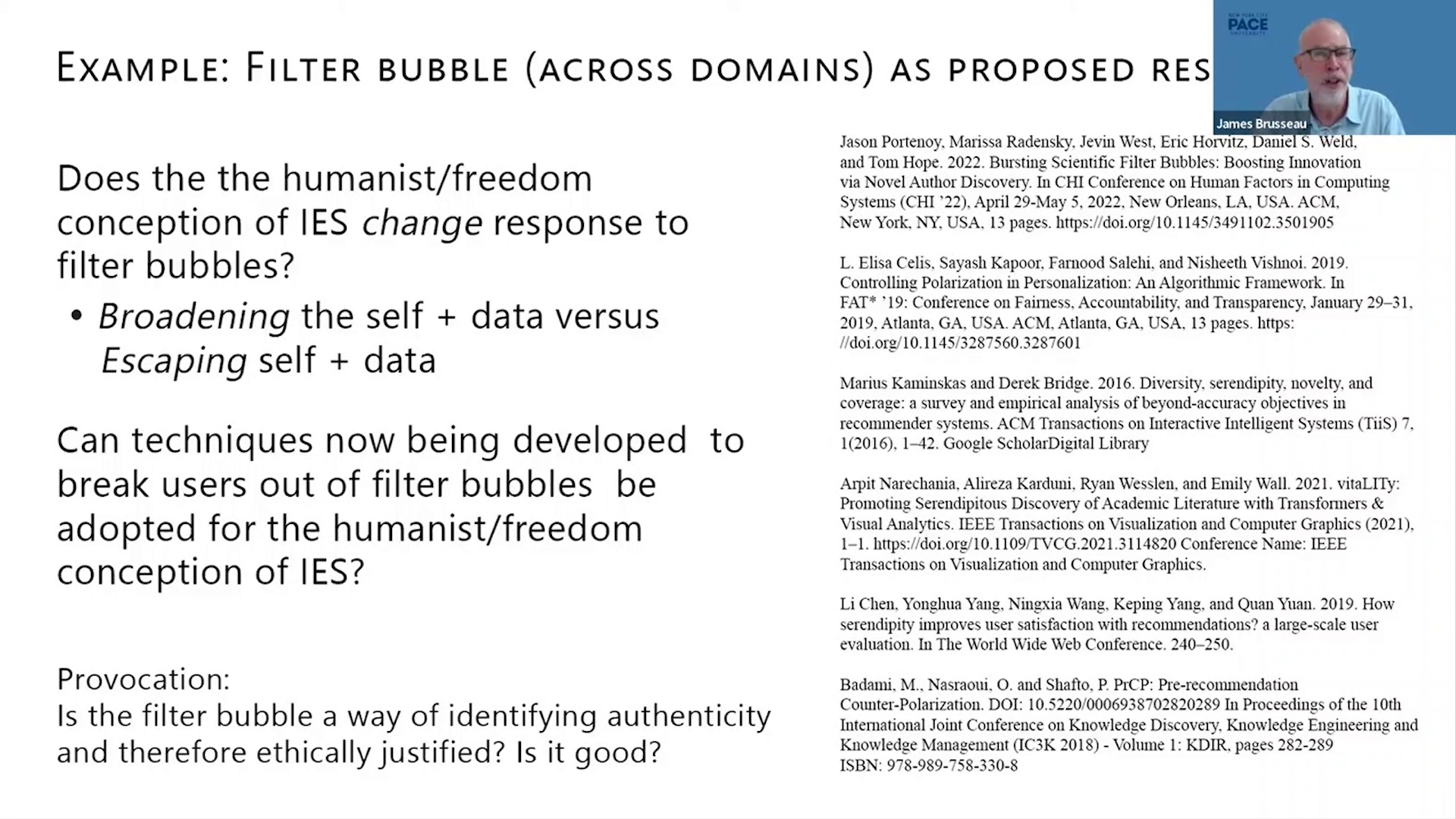
Source details — Visual — Filter bubbles as proposed research
Visual — Filter bubbles as proposed research
DISC-0025::VIS-017::OCC-01 · Display occurrence: approximately 2496.000–2620.000 seconds in the original video. Boundaries are estimated.
Exact frame PTS: 2550.000000 seconds in original video.
Visible slide text — not speech
EXAMPLE: FILTER BUBBLE (ACROSS DOMAINS) AS PROPOSED RES[remainder obscured]
Does the the humanist/freedom conception of IES change response to filter bubbles?
- Broadening the self + data versus Escaping self + data
Can techniques now being developed to break users out of filter bubbles be adopted for the humanist/freedom conception of IES?
Provocation: Is the filter bubble a way of identifying authenticity and therefore ethically justified? Is it good?
Displayed references
Jason Portenoy, Marissa Radensky, Jevin West, Eric Horvitz, Daniel S. Weld, and Tom Hope. 2022. Bursting Scientific Filter Bubbles: Boosting Innovation via Novel Author Discovery. In CHI Conference on Human Factors in Computing Systems (CHI ’22), April 29-May 5, 2022, New Orleans, LA, USA. ACM, New York, NY, USA, 13 pages. https://doi.org/10.1145/3491102.3501905
L. Elisa Celis, Sayash Kapoor, Farnood Salehi, and Nisheeth Vishnoi. 2019. Controlling Polarization in Personalization: An Algorithmic Framework. In FAT* ’19: Conference on Fairness, Accountability, and Transparency, January 29–31, 2019, Atlanta, GA, USA. ACM, Atlanta, GA, USA, 13 pages. https://doi.org/10.1145/3287560.3287601
Marius Kaminskas and Derek Bridge. 2016. Diversity, serendipity, novelty, and coverage: a survey and empirical analysis of beyond-accuracy objectives in recommender systems. ACM Transactions on Interactive Intelligent Systems (TiiS) 7, 1(2016), 1–42. Google ScholarDigital Library
Arpit Narechania, Alireza Karduni, Ryan Wesslen, and Emily Wall. 2021. vitaLITy: Promoting Serendipitous Discovery of Academic Literature with Transformers & Visual Analytics. IEEE Transactions on Visualization and Computer Graphics (2021), 1–1. https://doi.org/10.1109/TVCG.2021.3114820 Conference Name: IEEE Transactions on Visualization and Computer Graphics.
Li Chen, Yonghua Yang, Ningxia Wang, Keping Yang, and Quan Yuan. 2019. How serendipity improves user satisfaction with recommendations? a large-scale user evaluation. In The World Wide Web Conference. 240–250.
Badami, M., Nasraoui, O. and Shafto, P. PrCP: Pre-recommendation Counter-Polarization. DOI: 10.5220/0006938702820289 In Proceedings of the 10th International Joint Conference on Knowledge Discovery, Knowledge Engineering and Knowledge Management (IC3K 2018) - Volume 1: KDIR, pages 282-289 ISBN: 978-989-758-330-8
Visual limitations: The video inset covers the end of the slide heading. Citation spellings and apparent source typos are preserved as displayed.
James Brusseau speech
And then instead of saying, look, I'm going to recommend a scientific paper to you which is similar to your interests, I'm going to recommend a scientific paper to you which is in some ways the same, but in some ways completely different. And those two things are both positive. It's both the same and different. And we want extremes like that. Instead of similarities, we should look for identities and pure differences. I think something like that is very similar to the notion of multiple identity that I have discussed up to now.
Now there are other things I wanted to add, but I've gone on for a long time. So why don't I stop here and open the floor and say, first, thank you for joining us this afternoon. And second, to allow anyone who would like to ask a question to please do so.
Other speaker (context): Yes, thank you very much James. You have questions here in the room or online of course? Maybe I try to add a couple of comments rather than really questions but we may want to react which could be complicating a little bit the already complex painting that you have done.
Repeated visual — Visual — Identity comparison table
Visual — Identity comparison table
DISC-0025::VIS-016::OCC-02 · Display occurrence: approximately 2622.000–2904.000 seconds in the original video. Boundaries are estimated.
Repeated appearance of DISC-0025::VIS-016. See its first transcription.
Other speaker (context) speech
The first one, the first comment is that, you know, the different vision of identity, one self, multiple selves.
Other speaker (context): And it looks to me that if we consider what we could call an operational concept, the ones we use in daily life for normal activities, then we continuously move between one and the other. So there are different kinds of situations, different times of the day, possibly, different contexts in which we behave like we have a very defined one self identity. There are other situations in which we consider to be multiple facets, multiple different selves.
Other speaker (context): So it's a kind of depending on the context. And then the other point I want to comment on is about nudging, about the fact that, you know, you were correctly questioning which kind of behavior is the nudging application, the nudging chatbot trying to promote, to induce. And I think that's a very interesting example, but it's not necessarily the only situation which is interesting to reflect on because it seems to me that nudging is the area in which the impact of technology on behavior of users is considered as intentional.
Other speaker (context): But as you were more or less saying when you were discussing the bubble effect, in all technology, all technology is influencing changes in human behavior. If you want to look at very, very simple examples like the relationship between us and maps and territory today with respect to say five years ago, 10 years ago, our behavior is different. And that was not intentionally designed, it's not nudging, but still the question is whenever we create a technology, is it a fork or is it an app? Other speaker (context): We introduce some change in how human will behave by the use of that technology. And that's an interesting question in terms of ethical issues that can be addressed. Thank you.
James Brusseau: Right. And then I would want to say, that's certainly true. Every time we have a new technology, there is a fork. But then what happens after that is that we come along and we try to understand what that fork is. And I think that we only understand what is happening afterwards to a certain extent. And one of the things I'm trying to present here is I'm trying to say that we can now see sort of afterwards, after we've already begun to make serious advances in using data to influence the way people live. We can now see that this old question in philosophy has been underneath that activity the whole time, even though maybe we haven't seen it clearly. And this old question in philosophy is whether we are trying to, in some sense, restore or make people who they are, discover who they are, define that and help them be that way. Or instead, are we trying to find ways to help people create new identities, new ways of living?
I don't think that we have been phrasing the reality quite that distinctly so far, but I think that reality has been with us the whole way. And then again, I will go back to the example. I think this is really a very telling example of the way that technology or big data can be used to give someone an opportunity to become a different person, someone who's almost unrelated to the person they were before.
Repeated visual — Visual — Freedom and anonymity research
Visual — Freedom and anonymity research
DISC-0025::VIS-014::OCC-03 · Display occurrence: approximately 2908.000–2940.000 seconds in the original video. Boundaries are estimated.
Repeated appearance of DISC-0025::VIS-014. See its first transcription.
Repeated visual — Visual — Filter bubbles as proposed research
Visual — Filter bubbles as proposed research
DISC-0025::VIS-017::OCC-02 · Display occurrence: approximately 2944.000–3010.000 seconds in the original video. Boundaries are estimated.
Repeated appearance of DISC-0025::VIS-017. See its first transcription.
James Brusseau speech
So I think that catches well, Vincenzo, with your point. The fork is there and we've had this question underneath. It's only now that it's coming to the surface it's only now that we're beginning to see it and we can begin to deal with it and one place as I say going back here one place where just in regular life we're beginning to see this is in the question of the filter bubble and whether or not people want to get out of it and how they get out of it what does it mean to change myself and if I'm listening to the same music all the time or having the same conversations all the time. Do I want to change that? And if I do, how do I change it by becoming a different person? And how do I do that? I think that these are very new questions on an explicit level. But again, they've been with us for the last 20 or 30 years just quietly waiting to come out.
Other speaker (context): Okay. It would be nice to hear other comments or questions from the audience. Clarification needed.
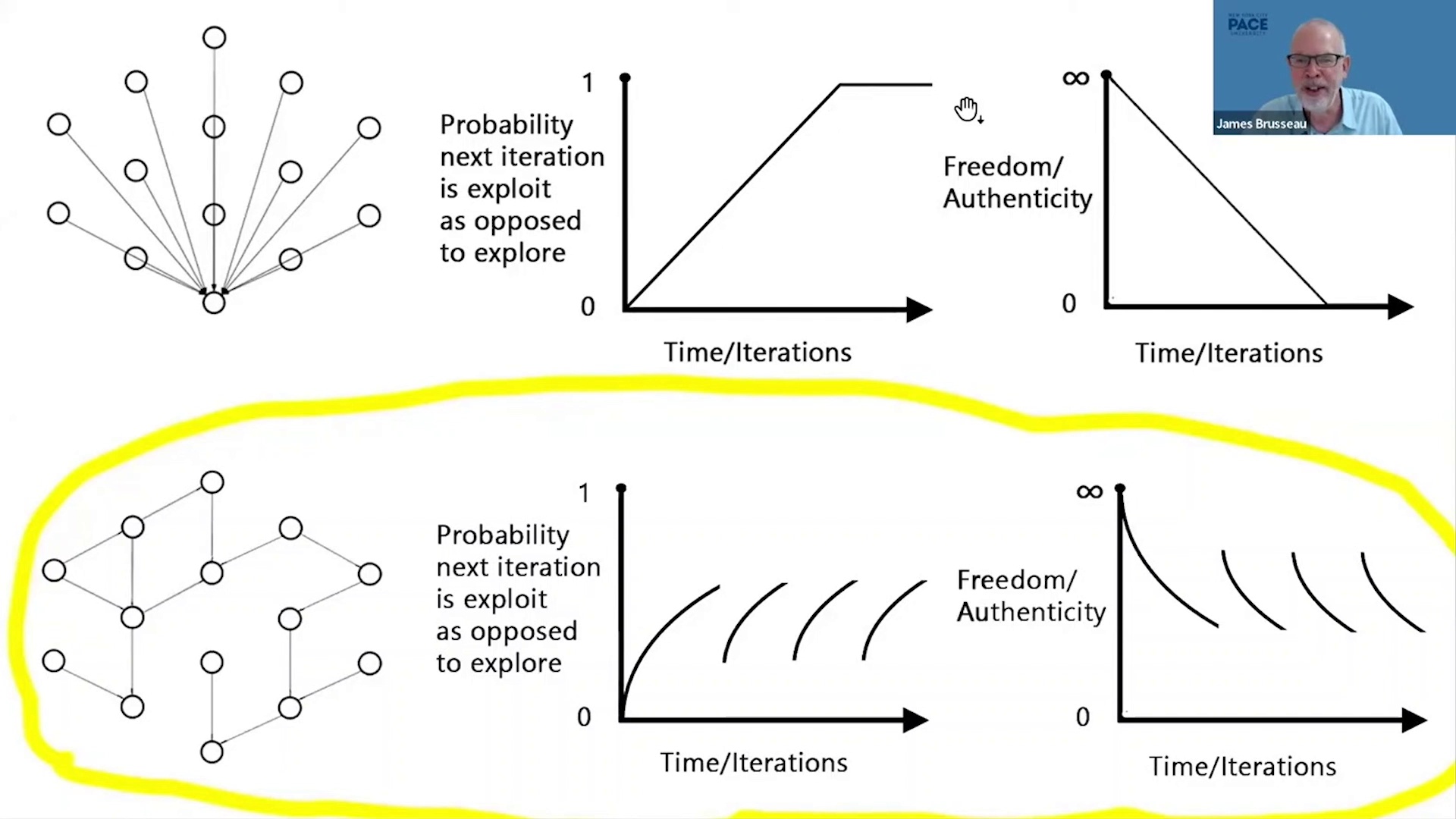
Source details — Visual — Exploration and exploitation diagrams
Visual — Exploration and exploitation diagrams
DISC-0025::VIS-018::OCC-01 · Display occurrence: approximately 3014.000–3050.000 seconds in the original video. Boundaries are estimated.
Exact frame PTS: 3030.000000 seconds in original video.
Visible slide text — not speech
[Upper graphs] Probability next iteration is exploit as opposed to explore Vertical endpoints: 0, 1 Time/Iterations
Freedom/Authenticity Vertical endpoints: 0, ∞ Time/Iterations
[Lower graphs repeat the same axis labels and endpoints.]
AI-generated visual description — not speech or approved wording
The upper row pairs a network converging on one node with exploitation rising to a plateau and freedom/authenticity falling to zero. The yellow-circled lower row pairs a distributed network with repeated rising exploitation arcs and repeated descending freedom/authenticity arcs. The schematic graphs contain no measured point data.
James Brusseau speech
James Brusseau: I can show you, here's just another slide I sort of have of the idea of representing this idea, in some sense, in terms of predictive analytics, right? The idea that over time you want to create, get the perfect prediction versus, in a sense, creating—here we're creating new people continuously in order to give them, try to give them new experiences, different music or different social groups or different political views and so on. That would be another example of what I am discussing. Well, I think we're coming to the end of our time, so it's, I think it's just about 11.30.
Repeated visual — Visual — Identity comparison table
Visual — Identity comparison table
DISC-0025::VIS-016::OCC-03 · Display occurrence: approximately 3054.000–3094.000 seconds in the original video. Boundaries are estimated.
Repeated appearance of DISC-0025::VIS-016. See its first transcription.
James Brusseau speech
Somebody, Luca, raise?
Speaker uncertain: Yes, thank you.
James Brusseau: Can you show again the last slide,
Other speaker (context): The extra slide that you were showing us? Just one second.
James Brusseau: The first or the...
Other speaker (context): No, the last one with the charts of... Yes, this one, okay.
Repeated visual — Visual — Exploration and exploitation diagrams
Visual — Exploration and exploitation diagrams
DISC-0025::VIS-018::OCC-02 · Display occurrence: approximately 3098.000–3292.000 seconds in the original video. Boundaries are estimated.
Repeated appearance of DISC-0025::VIS-018. See its first transcription.
Other speaker (context) speech
Other speaker (context): So I was thinking about, this does not only apply to engineering, to computer science. I think this also has an interesting effect on the market usage of such systems. If you manage, for example, the thing about listening to music to create new selves, because each time you start liking a different music, you find that your self is changing, you get stuck into the loop of keeping using this kind of service, let's say it's Spotify, for example. While, on the other hand, what if you reach to be like the perfect self? And in this case I'm thinking maybe about a fitness app. At one point you will stop because you're just, okay, this is my true expression of myself and I don't need it anymore. Does it also have an effect on the way companies could make this principle into their own business models and markets? Other speaker (context): Maybe I'm going a bit out of topic here, but you enlightened me with the last slide. Well
James Brusseau: Well, curiously, actually, I had this discussion with someone who was in the ethics class two years ago. And he said that curiously I think that he had a music recommender service I mean he was actually had this he and a few people made this little company it was like a Spotify that failed and he said that the biggest problem they had was that when people found the music that they truly liked you know, when their variety really narrowed to a very slim set of recommendations. Then he said, they stopped listening to music. So they just went away. They just disappeared from his entire platform. And it wasn't, he felt like it wasn't because they were bored so much of the music is instead that they were sort of bored of being that person. He said, the sense he got was that people just decided to do other things to not listen to music anymore more in a certain sense music had been conquered or music had been known right that they understood who they were on that level and they were not bored of the music but bored of themselves tired of just being stuck listening to this music even though they liked it so that experience that he had that he shared with me I think fits very well with the question you're asking that maybe a company should, to be successful, a company will need to find ways to help people become different people as opposed to discover who the real person is and serve that person.
Those are two very different activities. And as I say, I think that it's only now that we're beginning to sort of pull them apart, especially in the area of filter bubbles, beginning to pull them apart and see how different these activities are.
Repeated visual — Visual — Filter bubbles as proposed research
Visual — Filter bubbles as proposed research
DISC-0025::VIS-017::OCC-03 · Display occurrence: approximately 3296.000–3304.000 seconds in the original video. Boundaries are estimated.
Repeated appearance of DISC-0025::VIS-017. See its first transcription.
James Brusseau speech
Does that answer your question a little bit?
Repeated visual — Visual — Identity comparison table
Visual — Identity comparison table
DISC-0025::VIS-016::OCC-04 · Display occurrence: approximately 3306.000–3428.000 seconds in the original video. Boundaries are estimated.
Repeated appearance of DISC-0025::VIS-016. See its first transcription.
Other speaker (context) speech
Other speaker (context): Yes, I think it's very interesting that you get bored about your true self in that kind of way. Yes, thank you very much.
Other speaker (context): Do we have more questions or comments? It was very interesting the last one. So, James, do you want to add something as a closing statement?
Other speaker (context): No,
James Brusseau: No, I think that we have circumscribed sort of an area of ethical and technological thought, which is interesting, which there's a lot of work to be done in the future in this era.
Other speaker (context): All right. So thank you very much, Dan. And that was very interesting. And well, I hope to see some of the people who were here or online next year in the course that we will run next spring edX for computer science and engineering where we will touch possibly something connected to what was said today but with a much more time I would say yeah okay so thank you again and thank you everyone for participating especially for James to be online so far away travel.
Other speaker (context): Your data were traveling so long, so far.
James Brusseau: There you go, right. They changed me on the way.
Other speaker (context): Possibly yes.
Other speaker (context): Okay. Yes, thank you everybody, yes. Okay, thank you, bye-bye, thank you.