Inherited editorial introduction (source unchanged)
What is Big Data Vandalism?
Approved speech wording and attribution are preserved; paragraph formatting is awaiting review. Visual text and AI-generated descriptions remain separate from speech. Paragraph placement is editorial; recording display times and exact frame timestamps are unchanged.
James Brusseau: Okay well thanks for coming out this early afternoon what I am going to talk about is the intersection of philosophy and ethics with AI big data especially in the area of predictive analytics. And I'm going to want to try and do two things. The first is, I want to talk a little bit about privacy and freedom and individual identity. And I want to talk about how our ways of expressing those things is affected or detoured by artificial intelligence, big data, and again, especially predictive analytics. What we usually don't do in the philosophy and ethics of AI and big data. What we usually don't do is sort of set up lines, acceptable, not acceptable. That's a misconception. Generally, we consider our job to be one to delineate what the kinds of trade-offs are as we enter a big data world, what we get, what we gain, what we get back, and what we sacrifice for those things. So that's what I'm going to try to do today in the first part of my talk I'm going to try and talk a little bit about the kinds of pleasures and conveniences and safety that artificial intelligence can offer and then talk about how we give up some of our ability to define our personal identity some of our autonomy and freedom some of our privacy so that'd be the first thing and then the second thing we'll see if we get to it we'll go as long as we can. The second thing is, we will also discuss sort of a strategy for what I call big data vandalism. That is a way that you can act within a big data reality to try to recover a little bit of the freedom and identity that you've lost. It's just one thing you can do.
Source details — Visual — Acroyoga, risk, and insurance
Visual — Acroyoga, risk, and insurance
DISC-0062::VIS-001::OCC-01 · Display occurrence: approximately 166.033–212.012 seconds in the original video. Boundaries are estimated.
Exact frame PTS: 180.013167 seconds in original video.
Visible slide text — not speech
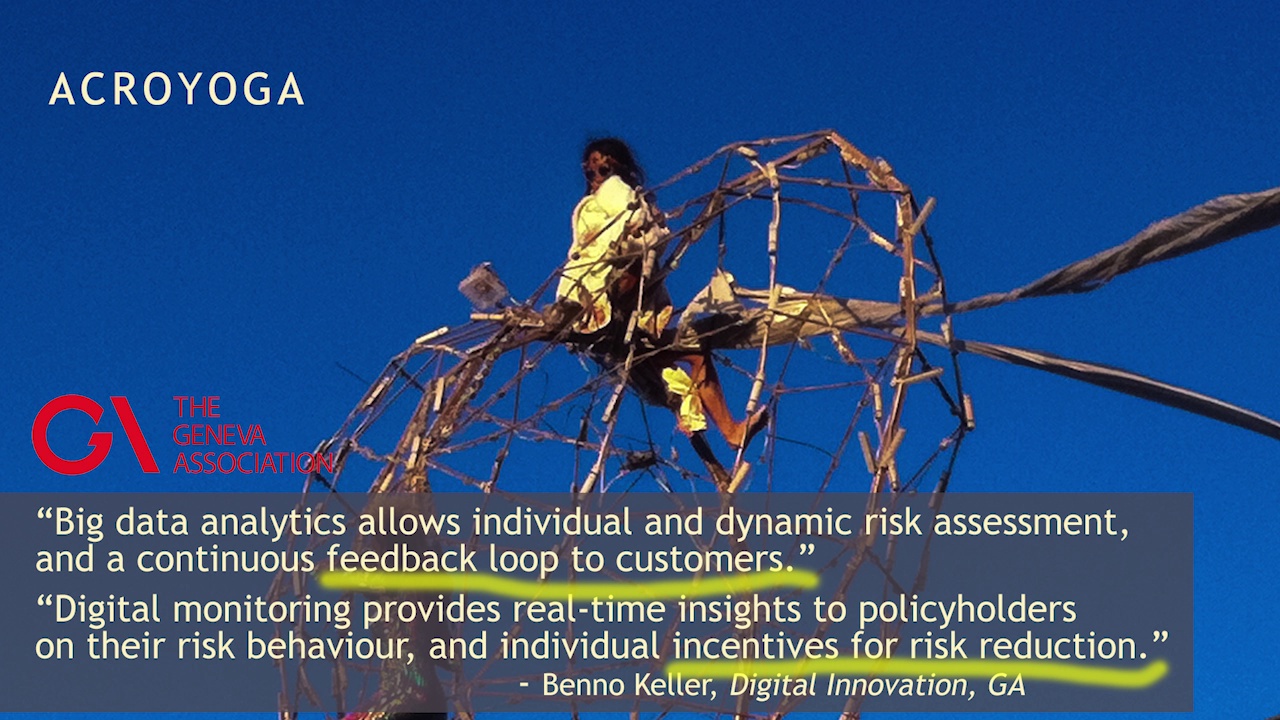
ACROYOGA THE GENEVA ASSOCIATION
“Big data analytics allows individual and dynamic risk assessment, and a continuous feedback loop to customers.”
“Digital monitoring provides real-time insights to policyholders on their risk behaviour, and individual incentives for risk reduction.”
— Benno Keller, Digital Innovation, GA
AI-generated visual description — not speech or approved wording
An acroyoga performer balances on a large open-frame structure. Yellow marks emphasize feedback and incentives. Closing attribution: Peretz Partensky, Robot Heart Dancers, CC BY SA.
James Brusseau speech
It's not a prescription. It's not a suggestion. It's just a possibility opportunity. But we'll get to that, we'll see. To start though, what I was most interested in is trying to see how big data technology intersects with the human experience. And so I've been looking at this publication by the Geneva Association. This is a think tank in Europe. What they're interested in now, especially in the area of big data, is two things. First, this idea of a feedback loop to consumers. That is the idea that instead of the insurance companies issuing you a policy and then asking you to live within those rules, they have the possibility of creating a fluid policy which shifts or changes with your behaviors and your activities. So that's on one side. On the other side, more importantly, they want to incentivize you to change and shift your behaviors. It doesn't do any good for them to know what you shouldn't do. What they're trying to find are ways to get underneath the way you think and influence the way you will act.
Source details — Visual — Acroyoga injury search result
Visual — Acroyoga injury search result
DISC-0062::VIS-002::OCC-01 · Display occurrence: approximately 244.010–250.016 seconds in the original video. Boundaries are estimated.
Exact frame PTS: 246.012433 seconds in original video.
Visible slide text — not speech
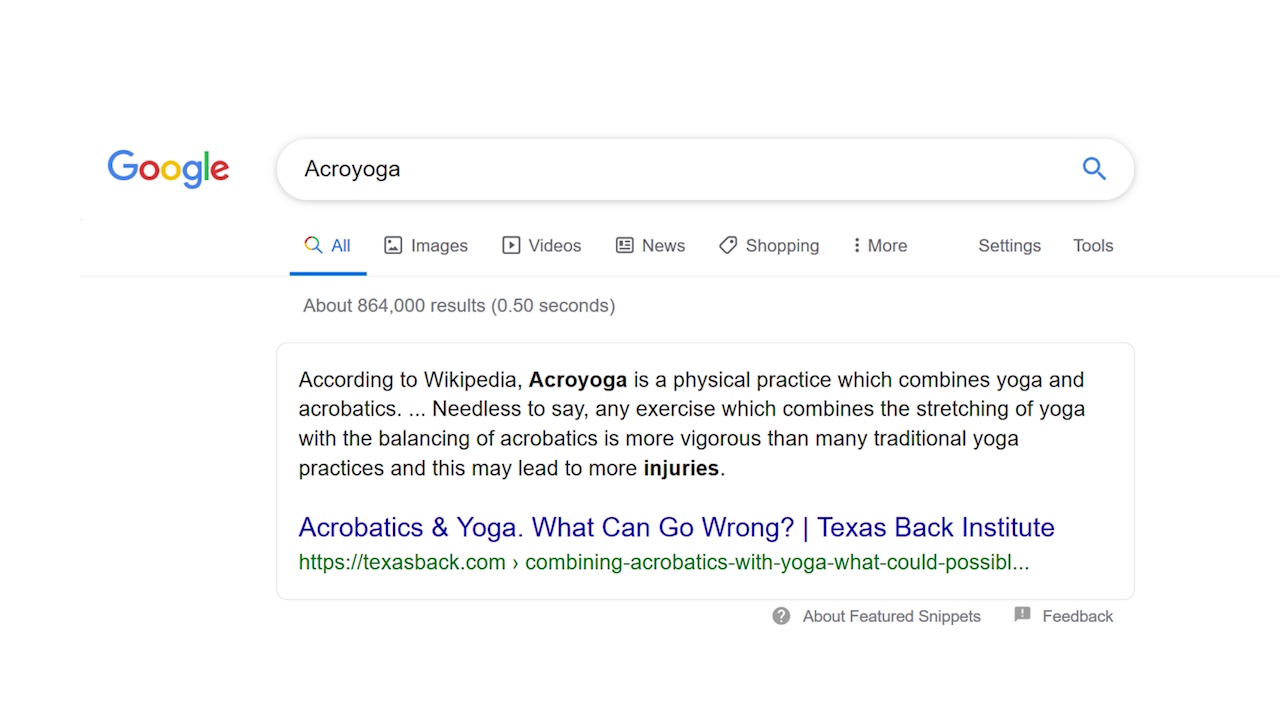
Google Acroyoga All · Images · Videos · News · Shopping · More · Settings · Tools About 864,000 results (0.50 seconds)
According to Wikipedia, Acroyoga is a physical practice which combines yoga and acrobatics. ... Needless to say, any exercise which combines the strength of yoga with the balancing of acrobatics is more vigorous than many traditional yoga practices and this may lead to more injuries.
Acrobatics & Yoga. What Can Go Wrong? | Texas Back Institute https://texasback.com › combining-acrobatics-with-yoga-what-could-possibl... About Featured Snippets · Feedback
James Brusseau speech
So those are the two things I was looking at, the feedback loop and then the behavioral nudging. And while I was reading through that, I came across this work that just mystifies me completely. So I did what any good red-blooded person does. I Googled it and discovered that it's one of those things, what can go wrong sort of things. So this is why this word acroyoga kept coming up in this discussion from the Geneva Association, because it combines acrobatics with yoga. And the appropriate title here is, well, what could go wrong? Obviously, quite a bit. So, acroyoga, which apparently, I don't know, but I've been told it's a big thing at Burning Man. Acro Acroyoga is a perfect example of the kind of place where an insurance company might want to intervene and nudge or push or influence your behavior.
Source details — Visual — Wearables and insurance rewards
Visual — Wearables and insurance rewards
DISC-0062::VIS-003::OCC-01 · Display occurrence: approximately 304.004–318.018 seconds in the original video. Boundaries are estimated.
Exact frame PTS: 310.009700 seconds in original video.
Visible slide text — not speech
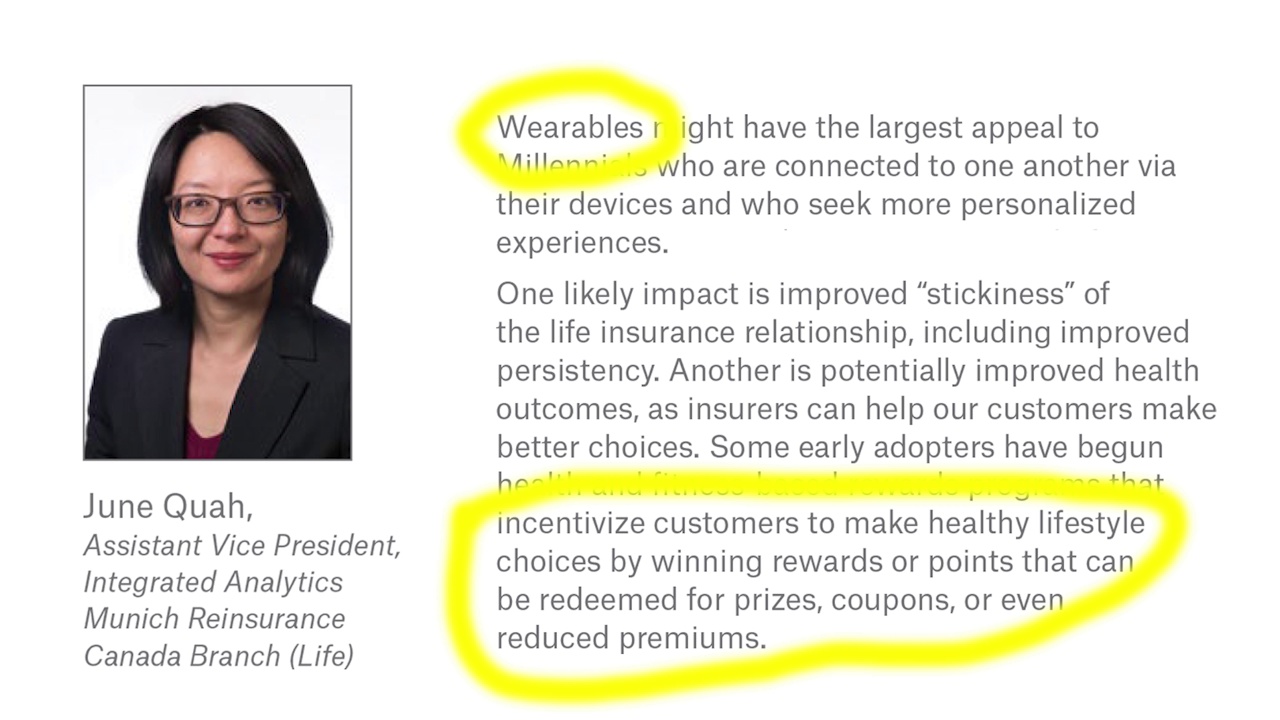
June Quah, Assistant Vice President, Integrated Analytics Munich Reinsurance Canada Branch (Life)
Wearables might have the largest appeal to Millennials who are connected to one another via their devices and who seek more personalized experiences.
[…] Some early adopters have begun health and fitness based rewards programs that incentivize customers to make healthy lifestyle choices by winning rewards or points that can be redeemed for prizes, coupons, or even reduced premiums.
AI-generated visual description — not speech or approved wording
A portrait accompanies the attributed text; yellow highlighter emphasizes wearables and rewards.
Visual limitations: Yellow marks cross portions of “Millennials” and “health and fitness based rewards programs”; read these against the saved frame before quotation.
James Brusseau speech
Simply to say, maybe don't try that. Maybe it doesn't work very well.
So, how are they going to do this? Well, wearables. And the kinds of wearables that are being developed now allow insurance companies to understand immediately in real time all kinds of activities that you might be involved in. What I want to say is the technology of wearables is coming together with the ability to create feedback loops for consumers to create a reality where in real time, very quickly, insurance companies are going to be able to dissuade you from dangerous behavior.
Source details — Visual — AI insurance paradox
Visual — AI insurance paradox
DISC-0062::VIS-004::OCC-01 · Display occurrence: approximately 342.008–348.014 seconds in the original video. Boundaries are estimated.
Exact frame PTS: 344.010333 seconds in original video.
Visible slide text — not speech
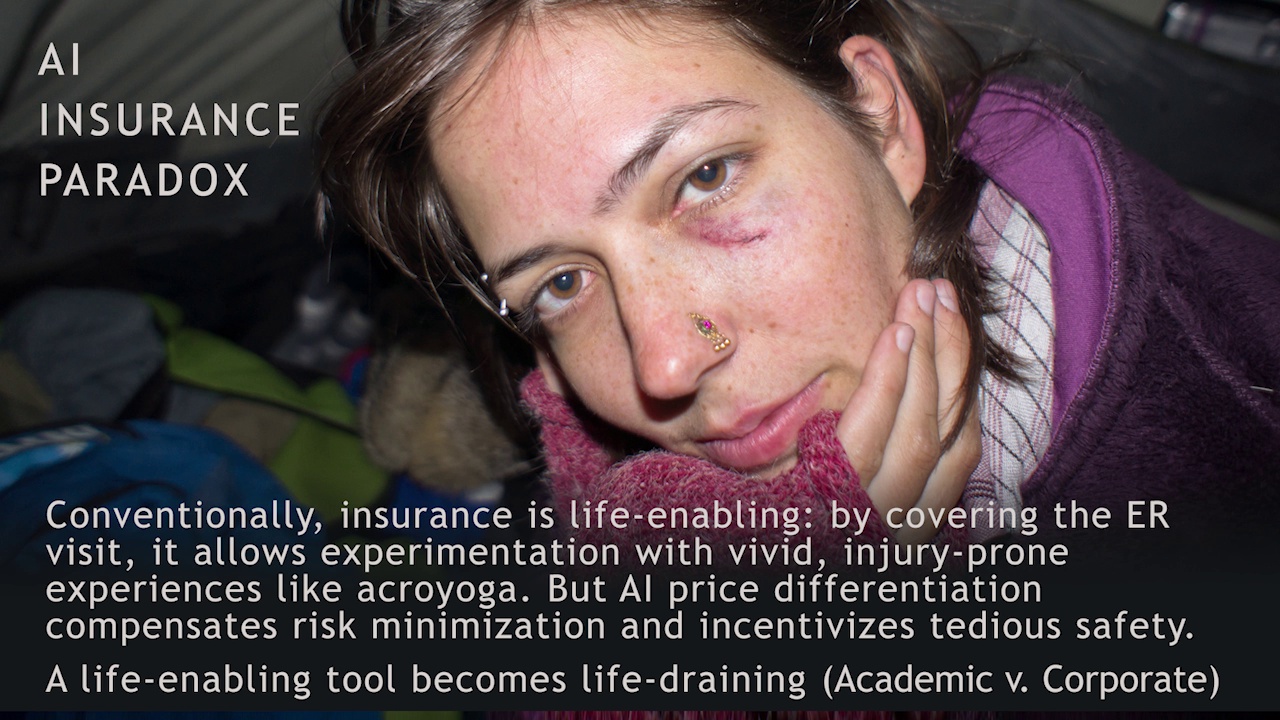
AI INSURANCE PARADOX
Conventionally, insurance is life-enabling: by covering the ER visit, it allows experimentation with vivid, injury-prone experiences like acroyoga. But AI price differentiation compensates risk minimization and incentivizes tedious safety.
A life-enabling tool becomes life-draining (Academic v. Corporate)
AI-generated visual description — not speech or approved wording
A close-up photograph shows a person with a bruised eye. Closing attribution: Peretz Partensky, Acroyoga Injury, CC BY SA. The two separate slide displays are recorded without combining their durations.
James Brusseau speech
Which leads to this, the AI insurance paradox. It is. The reason that we started having insurance in the first place is because it would allow us to do things which implied some kind of risk, right? The reason you do Acra Yoga is because you know you've got an insurance policy which will pay for the emergency room if you need it. So that's what insurance gives you. It vivifies. It gives you life. But now the polarities are shifting. If insurance companies continue in this direction, then what gave life is threatening to take it away. Every time you get up to go on to the acrobatic yoga contraption, you get on your wearable a little beep saying, uh-oh, your premiums just went up. So that's a completely different relationship that the insurance companies have with the consumers, and that's driven by artificial intelligence.
Repeated visual — Visual — AI insurance paradox
Visual — AI insurance paradox
DISC-0062::VIS-004::OCC-02 · Display occurrence: approximately 394.027–402.002 seconds in the original video. Boundaries are estimated.
Repeated appearance of DISC-0062::VIS-004. See its first transcription.
James Brusseau speech
And this is also a good place to start, I think, because I give about half of my talks to corporate, about half to academic. And they always say, the corporate always says, well, the academics have nothing for us. Academics always, they're not interested in the corporate. Well, right here these things come together. This is an academic point about this paradox, this human experience paradox, but this is also a business point. If you are aware of this coming up, that's a branding problem. That's a business problem that you can solve. Step one.
Source details — Visual — Predict and prevent: time
Visual — Predict and prevent: time
DISC-0062::VIS-005::OCC-01 · Display occurrence: approximately 448.014–468.001 seconds in the original video. Boundaries are estimated.
Exact frame PTS: 458.024233 seconds in original video.
Visible slide text — not speech
PREDICT AND PREVENT AND TIME THE GENEVA ASSOCIATION
“Big data analytics and AI enabled insurance evolves from understand and protect to predict and prevent.”
NOT FAST/EFFICIENT, BUT: INJURY CURED BEFORE HAPPENED
ALWAYS ALREADY CURED...
James Brusseau speech
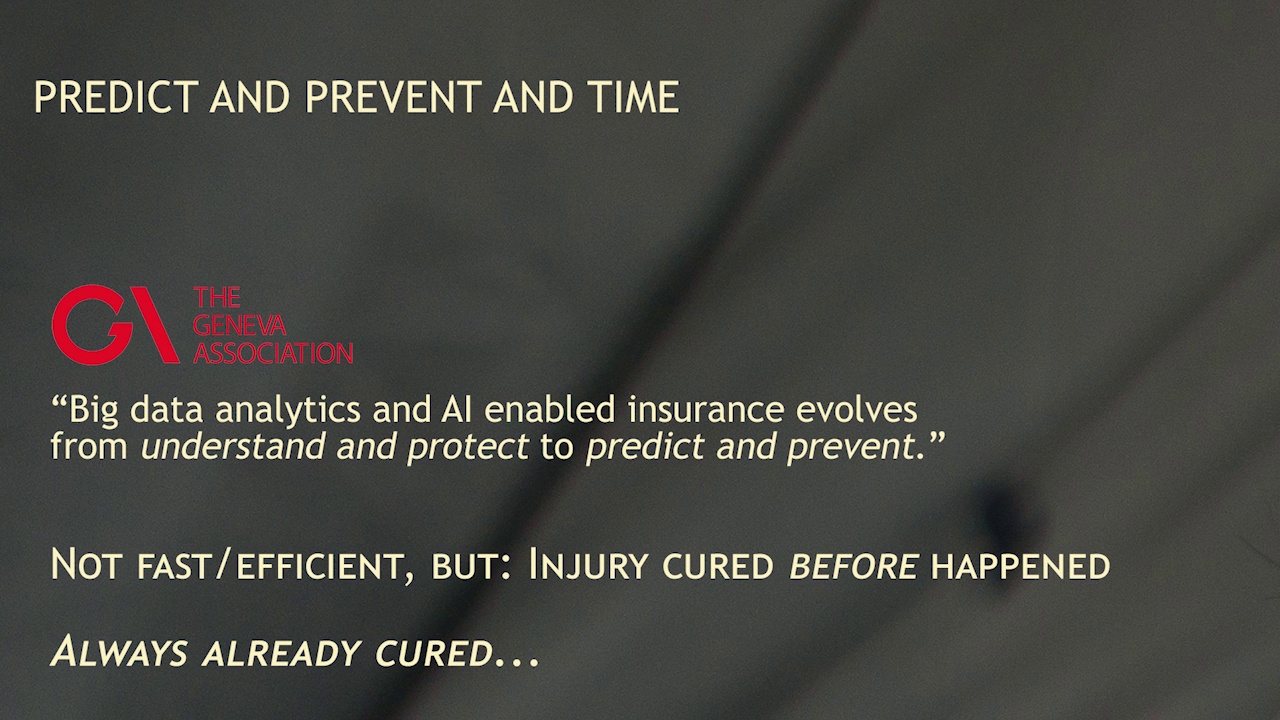
Now I want to move on to a philosophical idea. I want to talk about time within the reality of big debt. And I want to say, starting with this case of insurance, the kind of time that we're starting to build is remarkable because what does insurance do when it is an insurance that will predict and prevent? When it is an insurance that will see you're on the acroyoga contraption and you've got to get off that thing because you're going to hurt yourself. What insurance is doing is curing your ill, fixing your broken leg, fixing your black eye, whatever it is. It's fixing those things before they happen. The cure exists before the disease. So I'm calling that the always already. You're always already cured.
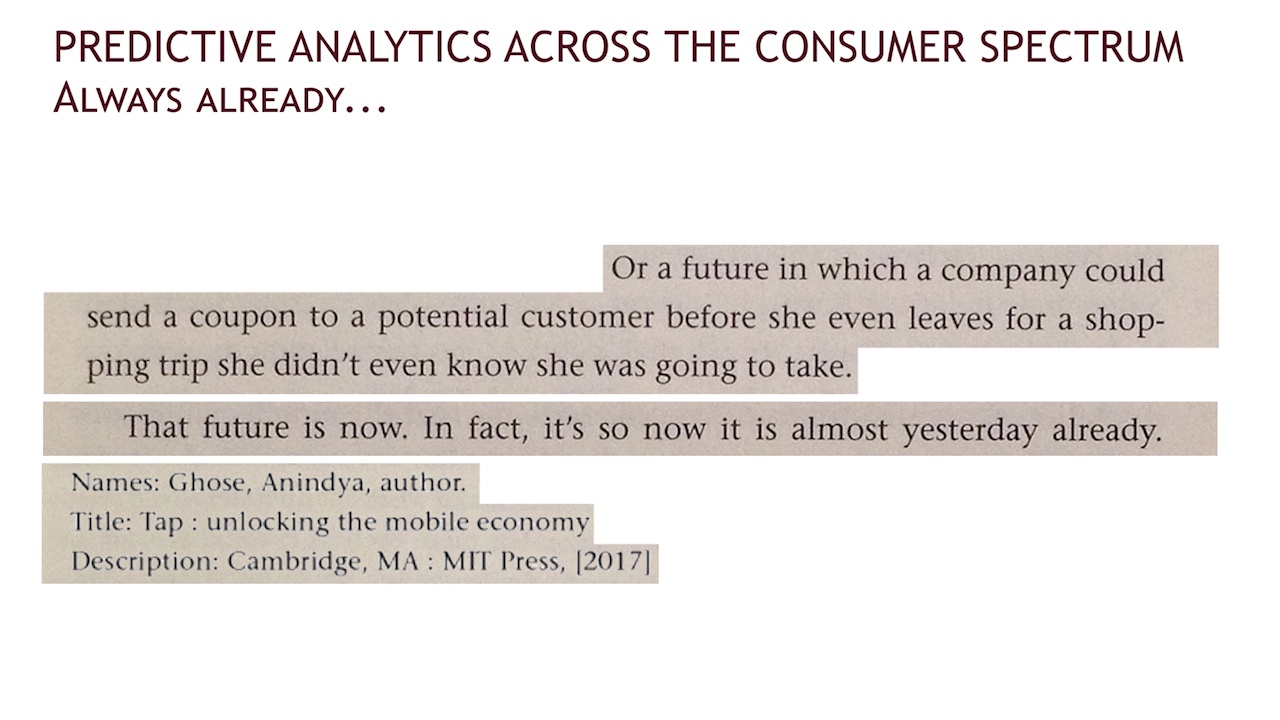
Now, you can see this in other ways too. And for example, in disease outbreaks, you can hit people with a vaccine. But I think it goes beyond that. There's something deeper in this idea that big data will allow, in some regions of our experience, for us to create a relationship with time wherein the safety we find, we get before we wanted it. Before we wanted it. And we'll see across the consumer spectrum, this is a professor at NYU. He likes of a future in which a company could send a coupon to a potential customer before she even leaves for a shopping trip she didn't even know she was going to take.
Source details — Visual — Consumer prediction quotation
Visual — Consumer prediction quotation
DISC-0062::VIS-006::OCC-01 · Display occurrence: approximately 548.014–564.030 seconds in the original video. Boundaries are estimated.
Exact frame PTS: 554.020133 seconds in original video.
Visible slide text — not speech
PREDICTIVE ANALYTICS ACROSS THE CONSUMER SPECTRUM ALWAYS ALREADY...
Or a future in which a company could send a coupon to a potential customer before she even leaves for a shopping trip she didn’t even know she was going to take.
That future is now. In fact, it’s so now it is almost yesterday already.
Names: Ghose, Anindya, author. Title: Tap : unlocking the mobile economy Description: Cambridge, MA : MIT Press, [2017]
James Brusseau speech
That future is now. In fact, it's so now, it's almost yesterday. That's that always already time in the consumer realm.
Source details — Visual — Satisfaction always already delivered
Visual — Satisfaction always already delivered
DISC-0062::VIS-007::OCC-01 · Display occurrence: approximately 574.007–586.019 seconds in the original video. Boundaries are estimated.
Exact frame PTS: 578.010767 seconds in original video.
Visible slide text — not speech
SATISFACTION ALWAYS ALREADY DELIVERED
AMAZON/NETFLIX AUTO START
- Viewer not choosing content
- Viewer not choosing whether to choose content or do something else
WANTING ANNIHILATED (COUCH POTATO)
[Autoplay tile] Agatha Christie’s POIROT Ep.4 TV-NR Starts in 0 seconds
AI-generated visual description — not speech or approved wording
A paused television image and autoplay tile accompany the two claims about choosing. Closing credit: Poirot, Author, CC SA.
James Brusseau speech
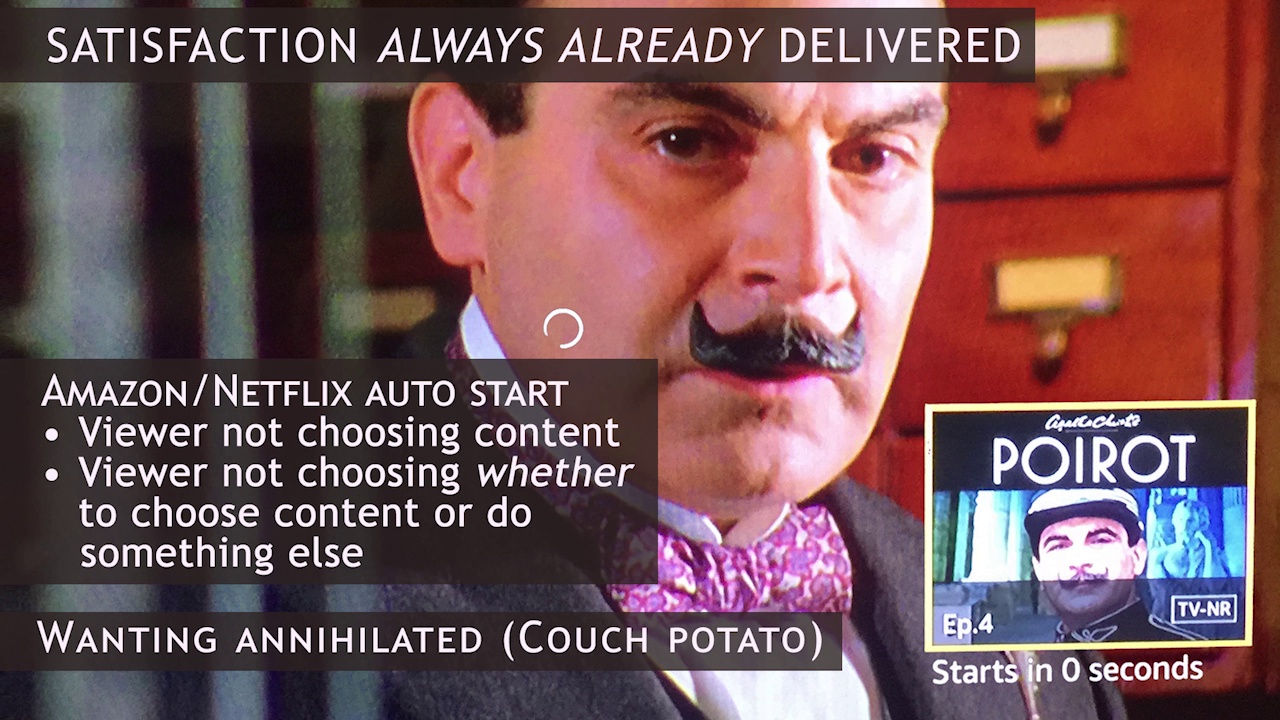
Now let me give you a simple example. We've all done this. Yes, we've all known this. We've all been watching a TV show. This is Polaroid. Agatha Christie, Mystery. And Netflix and Amazon. And before the show ends, the next one is already going. It's not a suggestion anymore. Forget that.
Repeated visual — Visual — Satisfaction always already delivered
Visual — Satisfaction always already delivered
DISC-0062::VIS-007::OCC-02 · Display occurrence: approximately 604.003–616.015 seconds in the original video. Boundaries are estimated.
Repeated appearance of DISC-0062::VIS-007. See its first transcription.
James Brusseau speech
It's already running. It's at zero seconds. It's starting right now, before the last one ended.
Repeated visual — Visual — Satisfaction always already delivered
Visual — Satisfaction always already delivered
DISC-0062::VIS-007::OCC-03 · Display occurrence: approximately 634.000–652.018 seconds in the original video. Boundaries are estimated.
Repeated appearance of DISC-0062::VIS-007. See its first transcription.
James Brusseau speech
That's always already satisfaction because you're getting it before you wanted it. Just like in the insurance company, they healed you before you had the injury. Here, you're getting satisfaction. You're getting pleasure. It's a minor pleasure. It's viewing pleasure but it's pleasure. You're getting it before you wanted it and that happens in two ways. It happens first in the sense that you're getting this particular show, Perrault, instead of some other show. And then on a level above that, you're getting to watch TV instead of going golfing or something. So it's on two levels that this is happening. You're getting satisfaction in terms of what you're watching and you're getting satisfaction in the sense that you're watching instead of doing something else. That's satisfaction on two levels that you get before you wanted anything. That's always already time in the consumer world. Just like in health care, so too in front of the TV. It's not—I really want to stress this—it's not that your desires and wants are being satisfied. It's not that you want something, then you get it. No, it's that you're getting before you want it. Wanting is being annihilated in this case. It's a very delicate mix, right? They have to hit you with the show in exactly the moment where the wanting would appear. If they get you too early and then it interrupts the last show, you say, well, wait a minute, don't interrupt my show. If they get you too late, there's this break and you ask yourself, okay, that show is over, what do I want? They find the perfect spot, the zero spot. The zero spot is the place where you're just about ready to say, what do I want? But you can't ask, you're cut off by the program which is proposed for you by the big data. Always already wanting is the annihilation of—excuse me—always already having is the annihilation of wanting, the annihilation of desire.
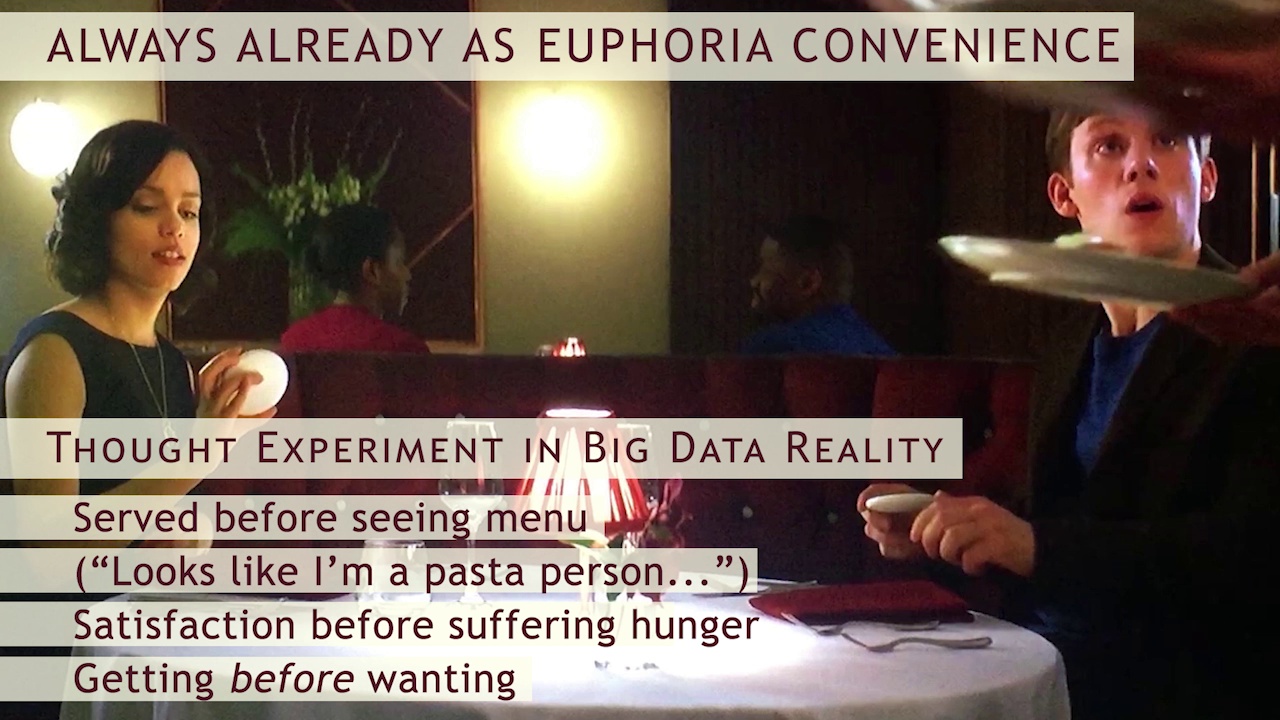
All right, so that's an introduction. Now let's flip it up a conceptual level beyond simply the movie or the insurance. There's also a kind of thought experiment you can do. You can imagine a world experience in general, the whole thing, everything from morning to night, which is like the experience of always already getting the movie you want. And I'm calling that euphoria convenience. And so I'm saying, look, of course this isn't true. This isn't happening today, this week, this month, this year, but we can think it through. We can imagine it. That everything that happened, happened just like that TV show. At the moment, just at the moment you were thinking of wanting, you get whatever it is you want. Everything.
Source details — Visual — Euphoria convenience thought experiment
Visual — Euphoria convenience thought experiment
DISC-0062::VIS-008::OCC-01 · Display occurrence: approximately 752.018–776.009 seconds in the original video. Boundaries are estimated.
Exact frame PTS: 764.029933 seconds in original video.
Visible slide text — not speech
ALWAYS ALREADY AS EUPHORIA CONVENIENCE
THOUGHT EXPERIMENT IN BIG DATA REALITY
Served before seeing menu (“Looks like I’m a pasta person...”) Satisfaction before suffering hunger Getting before wanting
AI-generated visual description — not speech or approved wording
A restaurant scene shows a plate arriving before two diners. Closing credit: Black Mirror, Author, CC SA.
Source details — Visual — Euphoria convenience defined
Visual — Euphoria convenience defined
DISC-0062::VIS-009::OCC-01 · Display occurrence: approximately 818.017–842.008 seconds in the original video. Boundaries are estimated.
Exact frame PTS: 830.029200 seconds in original video.
Visible slide text — not speech
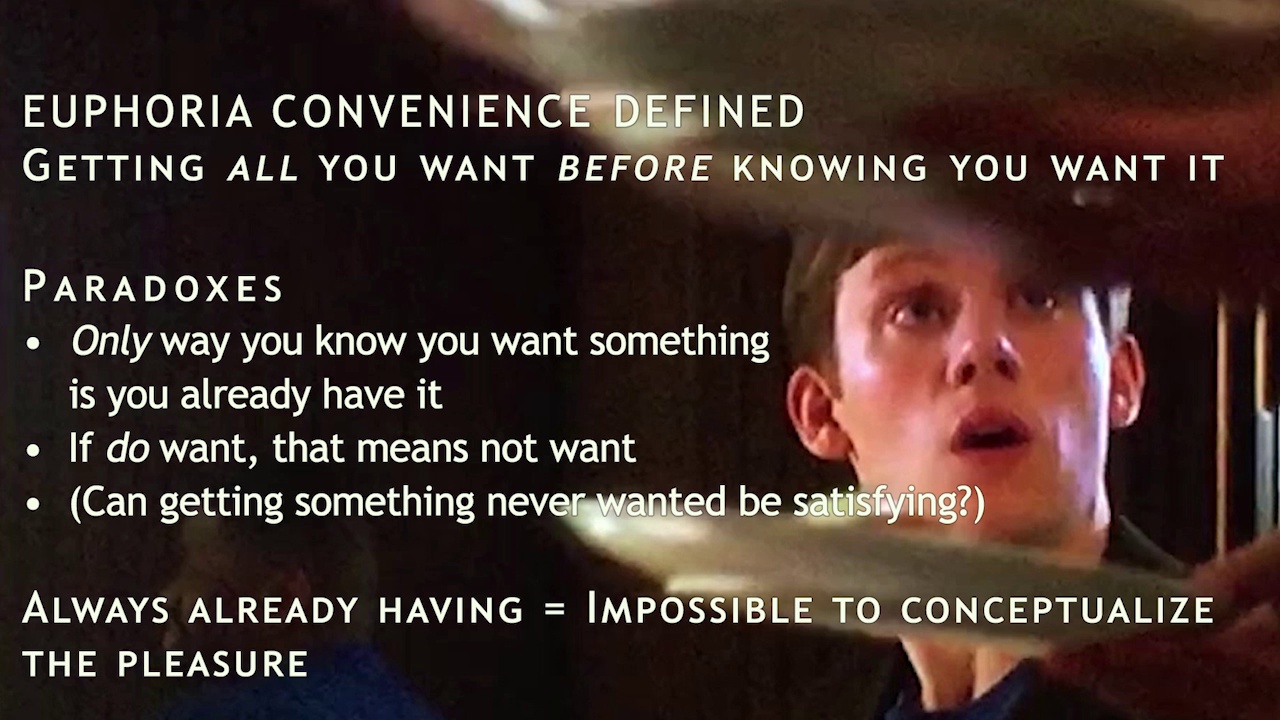
EUPHORIA CONVENIENCE DEFINED GETTING ALL YOU WANT BEFORE KNOWING YOU WANT IT
PARADOXES
- Only way you know you want something is you already have it
- If do want, that means not want
- (Can getting something never wanted be satisfying?)
ALWAYS ALREADY HAVING = IMPOSSIBLE TO CONCEPTUALIZE THE PLEASURE
AI-generated visual description — not speech or approved wording
A closer restaurant still remains behind the text; credit is the same Black Mirror attribution.
James Brusseau speech
Imagine that across all experience. I'm calling that euphoria convenience. And this euphoria convenience is a mess of paradoxes. The first paradox is the only way you know you want something is that you already have it that's how you know you want something since remember within this thought experiment you're getting always getting everything just at the moment before you want so how do you know you want something you never have the feeling right I mean you never say I want a candy bar I want to go to a movie no that feeling never happens always already happened so how do you know what you want well it's just what you have that's it and that's the only way you can know. And then going further, or going the other way rather, if you do physically feel a sense that you want something, well what does that mean? Well within this experiment, what it must mean, what it can only mean, is that you don't actually want it, since the entire thought experiment is built upon the idea that we always already have whatever we want.
So concluding point here, and I'm speaking very positively, what artificial intelligence in the area of predictive analytics is promising is a kind of safety with insurance and a kind of pleasure, maybe simple things, kind of satisfaction. Maybe simple things like TV or maybe not so simple things. I don't know. But whatever it is, it's a kind of safety, pleasure, and convenience that is so good, so pure, so perfect, that you cannot think it. It's not possible to think it because you can't ever get away from it and look at it. You always already have it. That's what artificial intelligence and big data are selling. It sounds pretty good. Pleasure is so perfect, you cannot think it. You can only live it. So that's the first conclusion to the thought experiment. So we went from real-world stuff, the insurance and the television to something we can imagine trajectory.
Source details — Visual — Conclusion one: immersion
Visual — Conclusion one: immersion
DISC-0062::VIS-010::OCC-01 · Display occurrence: approximately 966.032–978.010 seconds in the original video. Boundaries are estimated.
Exact frame PTS: 972.004367 seconds in original video.
Visible slide text — not speech
CONCLUSION #1 THE EUPHORIA OF BIG DATA AND AI
SAFETY, CONVENIENCE & PLEASURE SO IMMERSIVE THEY CAN ONLY BE UNDERSTOOD AS EXPERIENCED
James Brusseau speech
Yeah
Other speaker (context): Can I raise a counterpoint? The way I understand the story of the Garden of Eden is that the curse of the snake is that its food is always near it. In contrast to the people who have to pray for rain in which case they get a relationship with that which is to say that the always having it is the curse of the snake and the blessing of people is not having it. James Brusseau: Right and so in what way does the snake suffer from this I mean if this is a curse it sounds like a good curse to me
Other speaker (context): So I think we're going to find that out next number of years as these things advance what is that right because the curse of for example never being hungry means you don't appreciate food in the same way. If you have a spouse and you're always with the spouse, never have the longing for the spouse. And also regarding the free will to be with a person or not be with a person] is fundamental to being able to form a relationship. Enjoying the ability to be with God or not believe in God provides a relationship between us and closeness.
James Brusseau: That makes a lot of sense to me. And that's where we're going to go next.
Other speaker (context): Well, I'll let you go there. So I was just going to add to your question, what is the curse? The curse would be lack of appreciation, right?
Speaker uncertain: So if you never want things, then you don't appreciate them as much when you have them. So to me, since that thought experience was euphoria, my thought was actually there would be no euphoria.
Other speaker (context): It would be very dull if you don't have the longing and then the satisfaction when you get to them.
Source details — Visual — The tradeoff dilemma
Visual — The tradeoff dilemma
DISC-0062::VIS-011::OCC-01 · Display occurrence: approximately 1090.022–1104.003 seconds in the original video. Boundaries are estimated.
Exact frame PTS: 1098.030267 seconds in original video.
Visible slide text — not speech
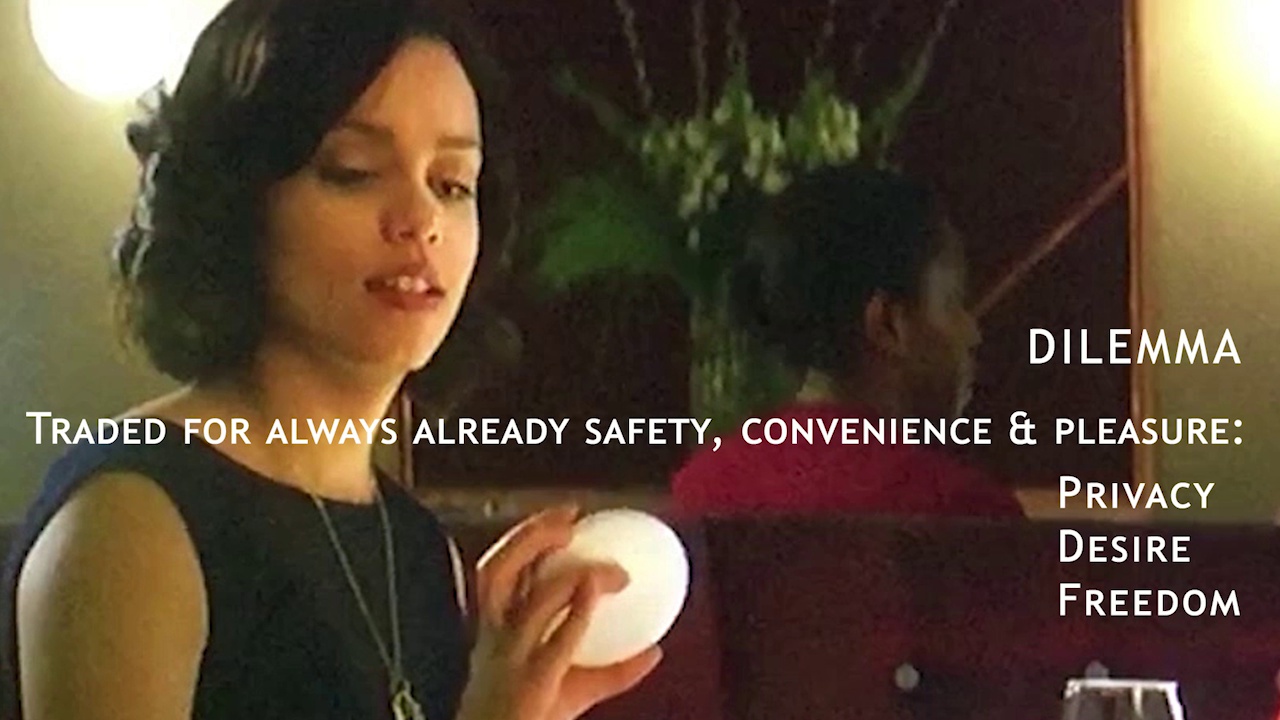
DILEMMA
TRADED FOR ALWAYS ALREADY SAFETY, CONVENIENCE & PLEASURE:
PRIVACY DESIRE FREEDOM
AI-generated visual description — not speech or approved wording
The restaurant still is reused behind the dilemma statement.
James Brusseau speech
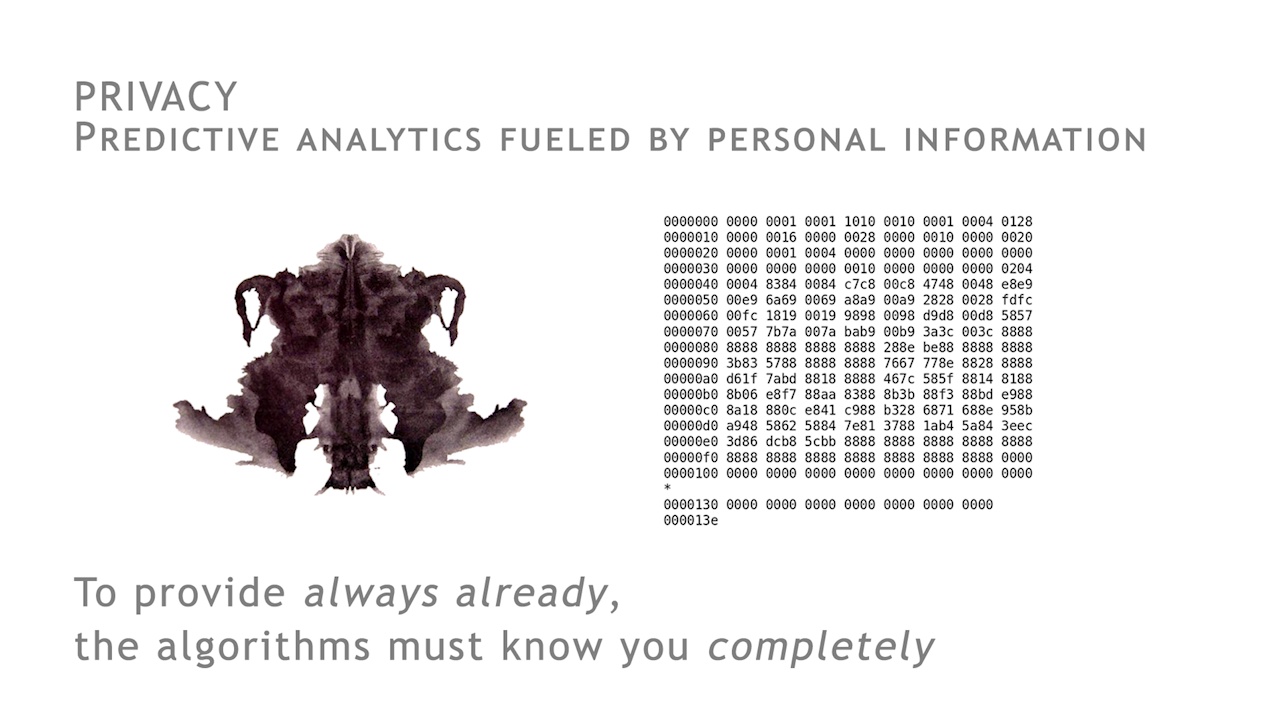
James Brusseau: Right. So I think all of those are going to be hit at one or another point in these three. The way I'm tracing the three costs is in terms of privacy, desire, and freedom. And I think I'm going to come back to each of you. So just to summarize, what we're saying is we've outlined this notion of a thought of experiment of a presumably or possibly perfect reality. But now we're having some objections. There's some costs, maybe not perfect. And these are three ways of thinking about those imperfections, privacy, desire, and freedom. And privacy, first things first. If the machine is going to provide for you perfectly, it must know you completely. It's not enough to know quite a bit about you. It's not enough to know 99%. It's got to know everything. If the convenience is perfect, the knowledge must be complete.
Source details — Visual — Personal information and complete knowledge
Visual — Personal information and complete knowledge
DISC-0062::VIS-012::OCC-01 · Display occurrence: approximately 1158.024–1164.030 seconds in the original video. Boundaries are estimated.
Exact frame PTS: 1162.027533 seconds in original video.
Visible slide text — not speech
PRIVACY PREDICTIVE ANALYTICS FUELED BY PERSONAL INFORMATION
To provide always already, the algorithms must know you completely
[Illustrative hexadecimal display]
0000000 0000 0001 0001 1010 0010 0001 0004 0128
0000010 0000 0016 0000 0028 0000 0010 0000 0020
0000020 0000 0001 0004 0000 0000 0000 0000 0000
0000030 0000 0000 0000 0010 0000 0000 0000 0204
0000040 0004 8384 0084 c7c8 00c8 4748 0048 e8e9
0000050 00e9 6a69 0069 a8a9 00a9 2828 0028 fdfc
0000060 00fc 1819 0019 9898 0098 d9d8 00d8 5857
0000070 0057 7b7a 007a bab9 00b9 3a3c 003c 8888
0000080 8888 8888 8888 8888 288e be88 8888 8888
0000090 3b83 5788 8888 8888 7667 778e 8828 8888
00000a0 d61f 7abd 8818 8888 467c 585f 8814 8188
00000b0 8b06 e8f7 88aa 8388 8b3b 88f3 88bd e988
00000c0 8a18 880c e841 c988 b328 6871 688e 958b
00000d0 a948 5862 5884 7e81 3788 1ab4 5a84 3eec
00000e0 3d86 dcb8 5cbb 8888 8888 8888 8888 8888
00000f0 8888 8888 8888 8888 8888 8888 8888 0000
0000100 0000 0000 0000 0000 0000 0000 0000 0000
*
0000130 0000 0000 0000 0000 0000 0000 0000
000013e
AI-generated visual description — not speech or approved wording
An inkblot is paired with a block of hexadecimal characters. The graphic contrasts an interpretive image with encoded data.
Visual limitations: The two OCR candidate groups are one continuous slide, 1158.024–1164.030; the hexadecimal block is illustrative and its smallest glyphs merit review.
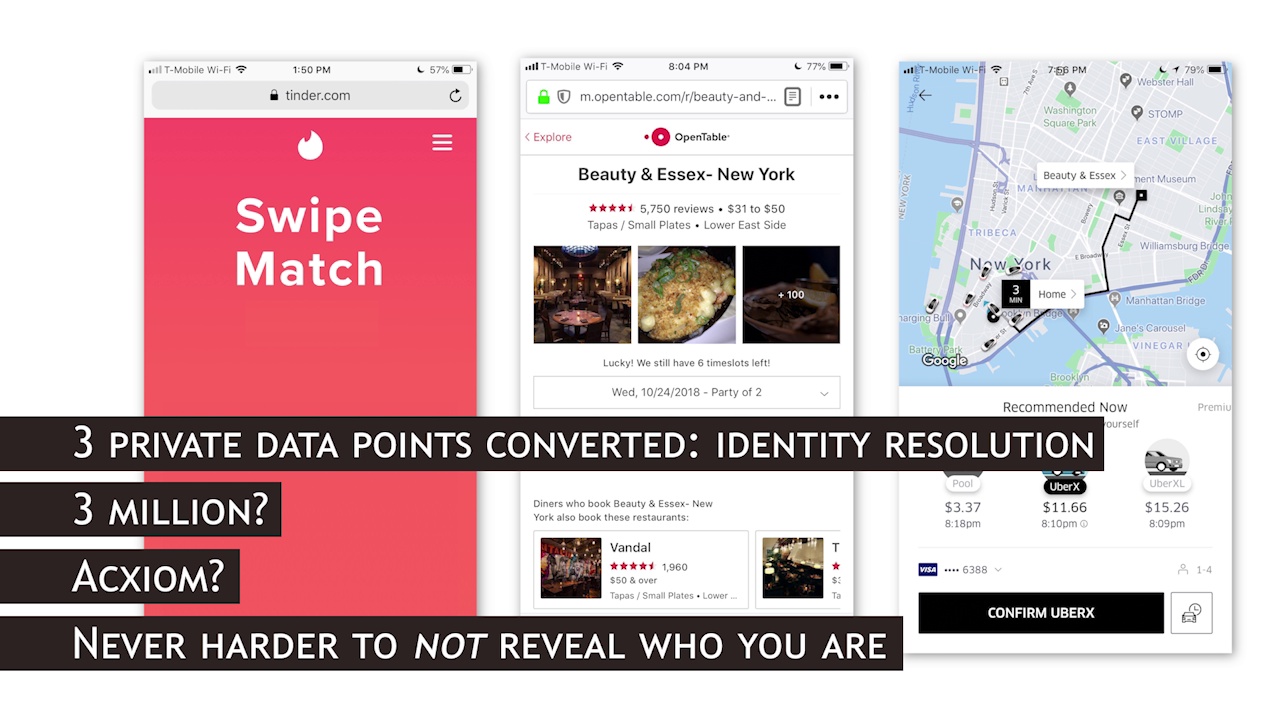
Source details — Visual — Private points and identity resolution
Visual — Private points and identity resolution
DISC-0062::VIS-013::OCC-01 · Display occurrence: approximately 1166.032–1192.024 seconds in the original video. Boundaries are estimated.
Exact frame PTS: 1180.012167 seconds in original video.
Visible slide text — not speech
3 PRIVATE DATA POINTS CONVERTED: IDENTITY RESOLUTION 3 MILLION? ACXIOM? NEVER HARDER TO NOT REVEAL WHO YOU ARE
[Left screenshot] tinder.com Swipe Match
[Middle screenshot] OpenTable Explore Beauty & Essex- New York 5,750 reviews · $31 to $50 Tapas / Small Plates · Lower East Side +100 Lucky! We still have 6 timeslots left! Wed, 10/24/2018 - Party of 2 Diners who book Beauty & Essex- New York also book these restaurants: Vandal · 1,960 · $50 & over Tapas / Small Plates · Lower ...
[Right screenshot] Google Beauty & Essex Home · 3 MIN Recommended Now Pool $3.37 8:18pm UberX $11.66 8:10pm UberXL $15.26 8:09pm CONFIRM UBERX
[Readable map labels] New York; Brooklyn; East Village; Tribeca; Washington Square Park; Webster Hall; STOMP; Williamsburg Bridge; Manhattan Bridge; Brooklyn Bridge; Battery Park; Jane’s Carousel
AI-generated visual description — not speech or approved wording
Three screenshots show matching, restaurant reservations, and a ride route, with the identity-resolution argument across them.
Visual limitations: Overlay text covers some booking times and ride information; small map streets and cropped tiles are not reconstructed.
James Brusseau speech
So privacy is no longer something that we can defend or want to defend if we want this euphoria. And then this is just a good slide, though. We're with experts here. We don't need to talk about it too much. But just here, these are three data points pulled from a phone. Just those three points tell you an extraordinary amount about the person behind this phone. And that's just three. That's three points. So imagine what happens with $3 million worth of company like Axia. So in the real world and theoretically, privacy needs to disappear. Not be threatened, not be jeopardized, not be diminished. It needs to go for the euphoria to exist. And that means that we collectively are going to find out things about ourselves that maybe we didn't even know. Again, for the service to be perfect, privacy must be non-existent.
Source details — Visual — Privacy degree zero: emotions
Visual — Privacy degree zero: emotions
DISC-0062::VIS-014::OCC-01 · Display occurrence: approximately 1212.011–1224.023 seconds in the original video. Boundaries are estimated.
Exact frame PTS: 1218.016800 seconds in original video.
Visible slide text — not speech
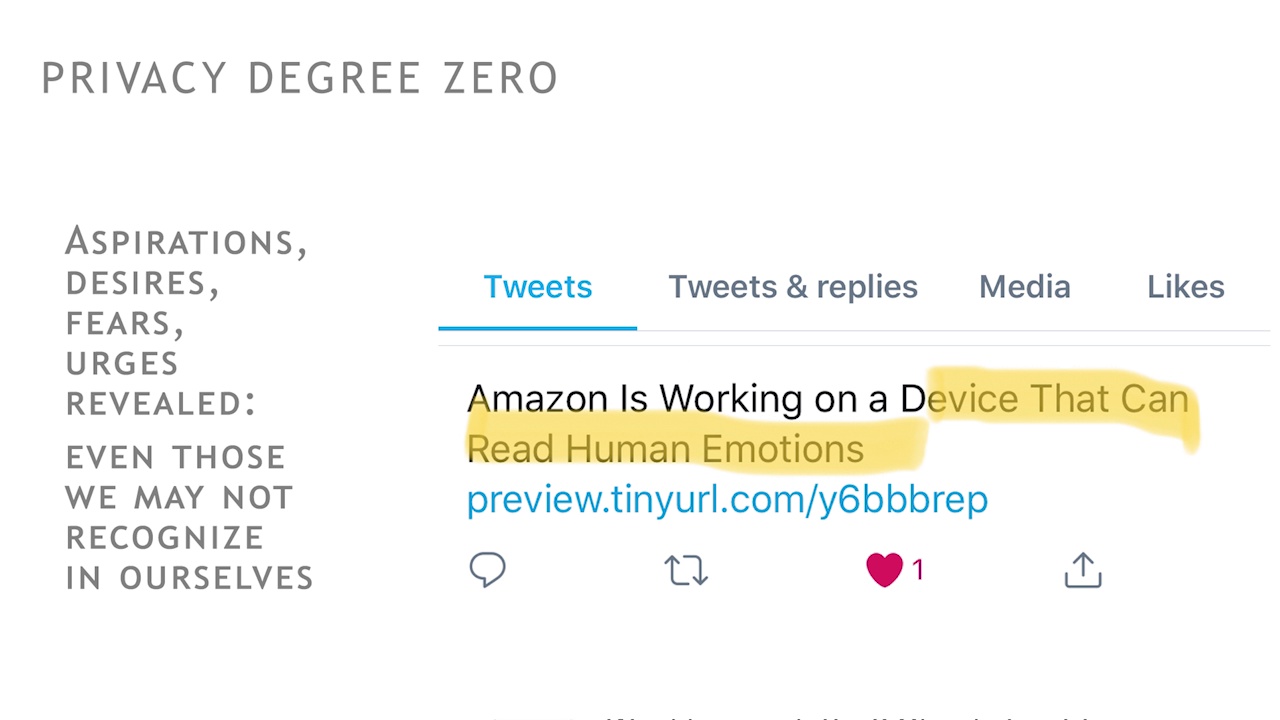
PRIVACY DEGREE ZERO
ASPIRATIONS, DESIRES, FEARS, URGES REVEALED: EVEN THOSE WE MAY NOT RECOGNIZE IN OURSELVES
[Tweet excerpt] Tweets · Tweets & replies · Media · Likes
Amazon Is Working on a Device That Can Read Human Emotions preview.tinyurl.com/y6bbbrep ♥ 1
AI-generated visual description — not speech or approved wording
Yellow marks emphasize the emotion-reading device headline. The screenshot is cropped above its author and date; neither is inferred from another recording.
James Brusseau speech
That means we must know everything about ourselves. And then this brings me to the next point. And it is that frequently when we think about privacy being lost, we think that if someone victimizing me, like someone is taking my information from me, but I don't think that's the problem. I think that the problem with privacy lost is that I will be forced to find out about myself and each as well, each of you. So I'm not sure. And this is the first question I want to ask against euphoria convenience, I'm not sure if everyone wants to know everything about who they are.
Source details — Visual — Privacy degree zero: exposure
Visual — Privacy degree zero: exposure
DISC-0062::VIS-015::OCC-01 · Display occurrence: approximately 1266.031–1282.014 seconds in the original video. Boundaries are estimated.
Exact frame PTS: 1274.006067 seconds in original video.
Visible slide text — not speech
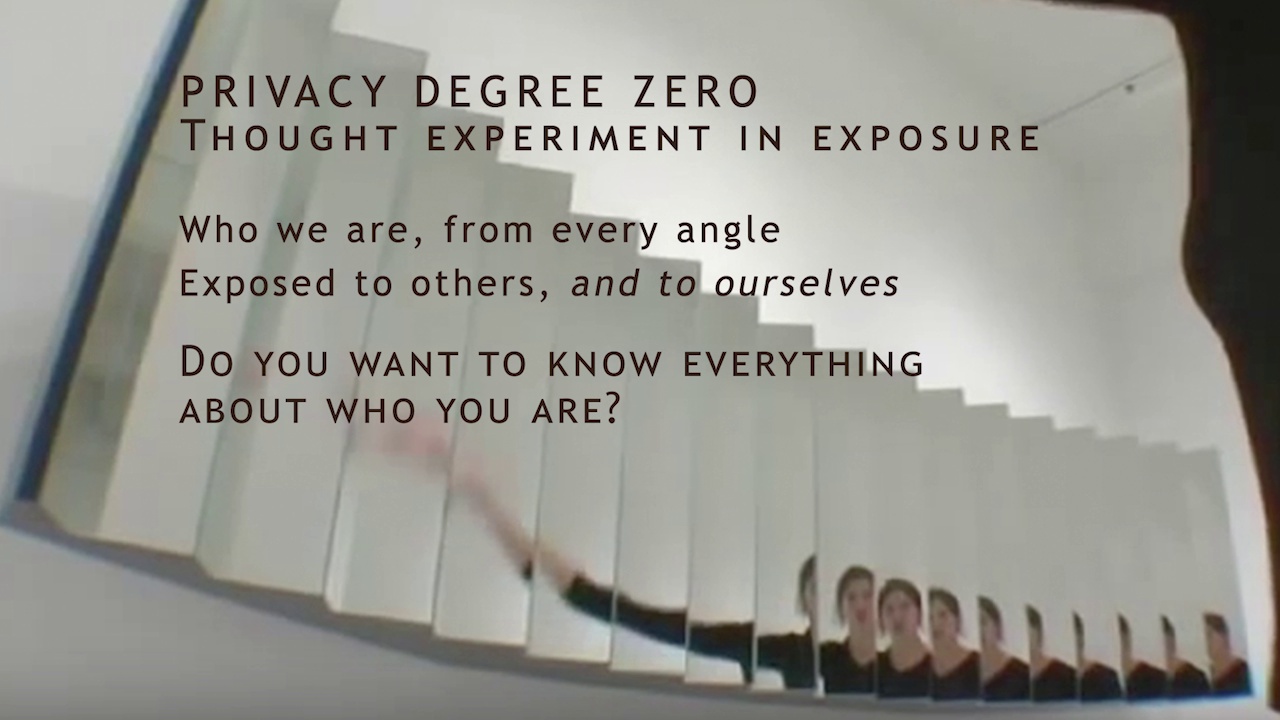
PRIVACY DEGREE ZERO THOUGHT EXPERIMENT IN EXPOSURE
Who we are, from every angle Exposed to others, and to ourselves
DO YOU WANT TO KNOW EVERYTHING ABOUT WHO YOU ARE?
AI-generated visual description — not speech or approved wording
A cascade of mirrors shows repeated views of one person. Closing credit: Owen Byrne, Multiple Personality Disorder, CC BY.
James Brusseau speech
Do you really want to know yourself? That question starts to build up a counterbalance against this idea of euphoria convenience.
Other speaker (context): Question. Yeah. If, for example, Netflix can determine what we're going to watch before we watch it and we're 100% satisfied with it, it means it has perfect knowledge of what we in fact will watch. And likewise if you could have an infinite satisfier on everything that we might do, it will have essentially infinite knowledge about us, whether or not we have that knowledge. And so it's not data that is. It doesn't even need to collect the data anymore because it already has in the model.
Source details — Visual — Desire and never wanting
Visual — Desire and never wanting
DISC-0062::VIS-016::OCC-01 · Display occurrence: approximately 1342.007–1346.011 seconds in the original video. Boundaries are estimated.
Short-display inclusion exception: Short substantive build, reference, or contact content; retained explicitly despite normal five-second threshold. No durations aggregated.
Exact frame PTS: 1344.009333 seconds in original video.
Visible slide text — not speech
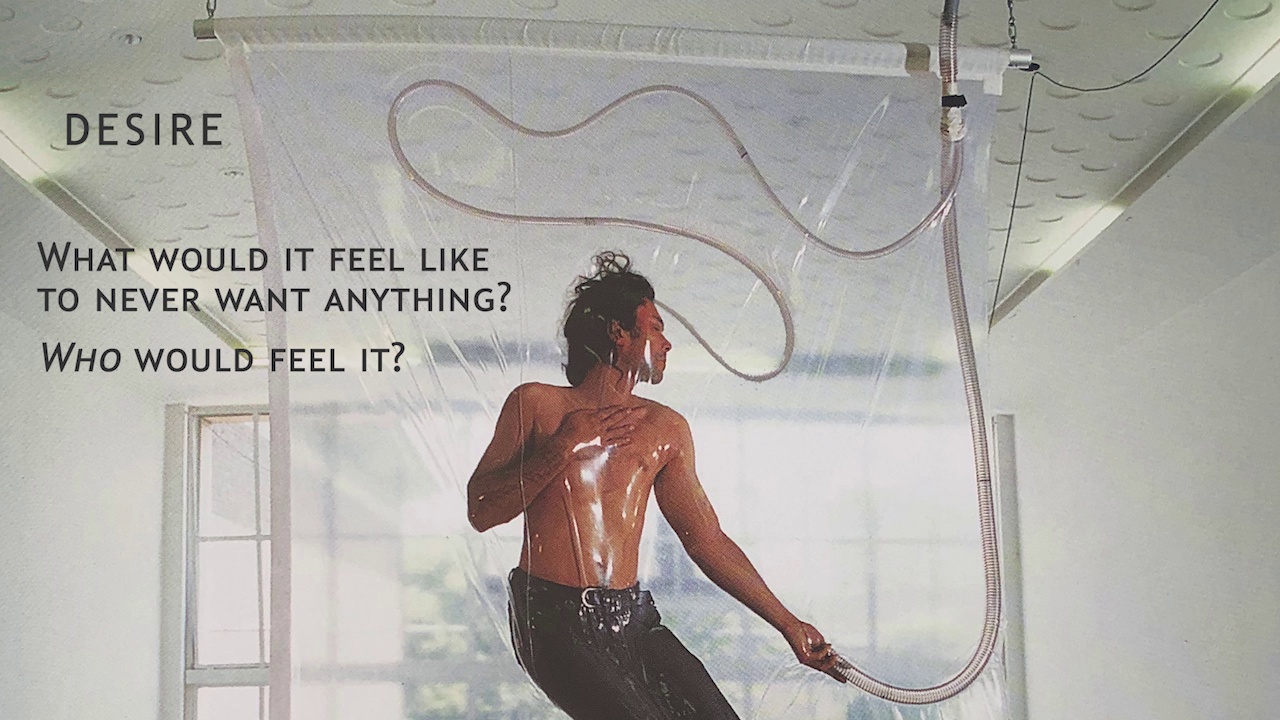
DESIRE
WHAT WOULD IT FEEL LIKE TO NEVER WANT ANYTHING?
WHO WOULD FEEL IT?
AI-generated visual description — not speech or approved wording
A person stands within a transparent plastic enclosure with tubing. Closing credit: Shrinkwrap man, Author, CC SA. The first short appearance is retained as an early display of the same substantive question, later displayed for six seconds.
Repeated visual — Visual — Desire and never wanting
Visual — Desire and never wanting
DISC-0062::VIS-016::OCC-02 · Display occurrence: approximately 1364.029–1370.002 seconds in the original video. Boundaries are estimated.
Repeated appearance of DISC-0062::VIS-016. See its first transcription.
James Brusseau speech
James Brusseau: Right. And then to complete that is we learned about what we want because of what we get, not because of what we feel the urge to have, which would go back to the point you originally made. So the circle kind of closes there. And then here is where I am trying to get the point that you made. The point that the two of you were making, what would it feel like to never want anything, right? And exactly. I proposed originally that that feeling would be euphoria. It would be tremendous, great. But you can ask just like you guys did. I'm not sure. Then there's also a related question and that is who would feel it? Because part of the way that we define who we are in the world, part of the way I know who I am is through the things that I want and through making decisions oh I want to go to Hawaii but I also want to be able to pay my rent so I guess I will go to work today instead of going to the airport this is the way we go through life defining ourselves let's our simple decisions like that someone more serious about people we want to be with careers we want to undertake it's not so much that we are somebody and then we do things out in the world it's that we do things out in the world and that's how we learn about But that's how we define who we are for ourselves. That's how we make an identity for ourselves. But if we're always satisfied immediately, we never have that opportunity. So there's the two points. There's the point which both of them made already perceptively that it's not clear if the experience would be great or not and it's not clear that I'm there to have the experience.
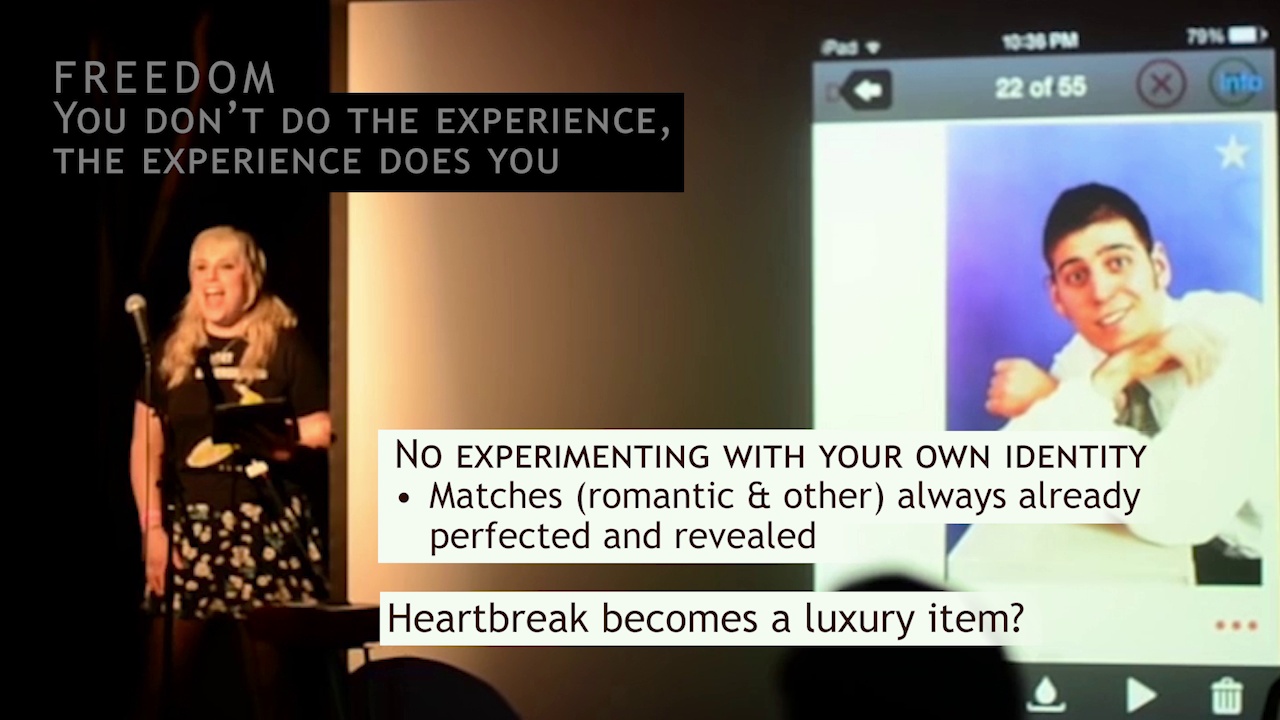
Source details — Visual — Freedom and perfected matches
Visual — Freedom and perfected matches
DISC-0062::VIS-017::OCC-01 · Display occurrence: approximately 1440.005–1452.017 seconds in the original video. Boundaries are estimated.
Exact frame PTS: 1446.011233 seconds in original video.
Visible slide text — not speech
FREEDOM YOU DON’T DO THE EXPERIENCE, THE EXPERIENCE DOES YOU
NO EXPERIMENTING WITH YOUR OWN IDENTITY
- Matches (romantic & other) always already perfected and revealed
Heartbreak becomes a luxury item?
[Projected interface] 22 of 55 Info
AI-generated visual description — not speech or approved wording
A performer stands beside a projected profile portrait. Closing credit: Tinder Live With Lane Moore feat. the cast of Orange Is The New Black!, YouTube screenshot.
Repeated visual — Visual — Freedom and perfected matches
Visual — Freedom and perfected matches
DISC-0062::VIS-017::OCC-02 · Display occurrence: approximately 1470.002–1488.020 seconds in the original video. Boundaries are estimated.
Repeated appearance of DISC-0062::VIS-017. See its first transcription.
James Brusseau speech
And then finally, it's not just that we define ourselves through our choices but that's also the way we express human freedom what it means to be free is to experiment freedom is the ability to try this and try that and then decide but that's evaporating within a perfect artificial intelligence big data real And then this is a show called tinder live this lay more the woman on her left she does her tinder live in a theater at night and it's a very interesting experience as she goes through and says well I like this man for this reason, I want to connect with him. Don't like this man. And then she tries to connect and then they message and you're seeing on the screen all the messaging going back and forth. So you see happening live what it looks like for someone to define themselves through a potential romantic partner. You ask yourself, well do I? So the guy writes back, well I like going to motocross races. Well that forces you to say, well am I that kind of person? Do I like going to motocross races I don't know that's what happens on this show though you see people finding out who they are oh you see her like more finding out who she is
So what I wanted to say is that there is the potential within big data AI reality for safety that was the insurance pile example convenience and pleasure which is so perfect it's euphoria but the costs are privacy our desire, and then maybe connected with that the point you made like feeling good. Maybe we don't feel good getting everything we want.
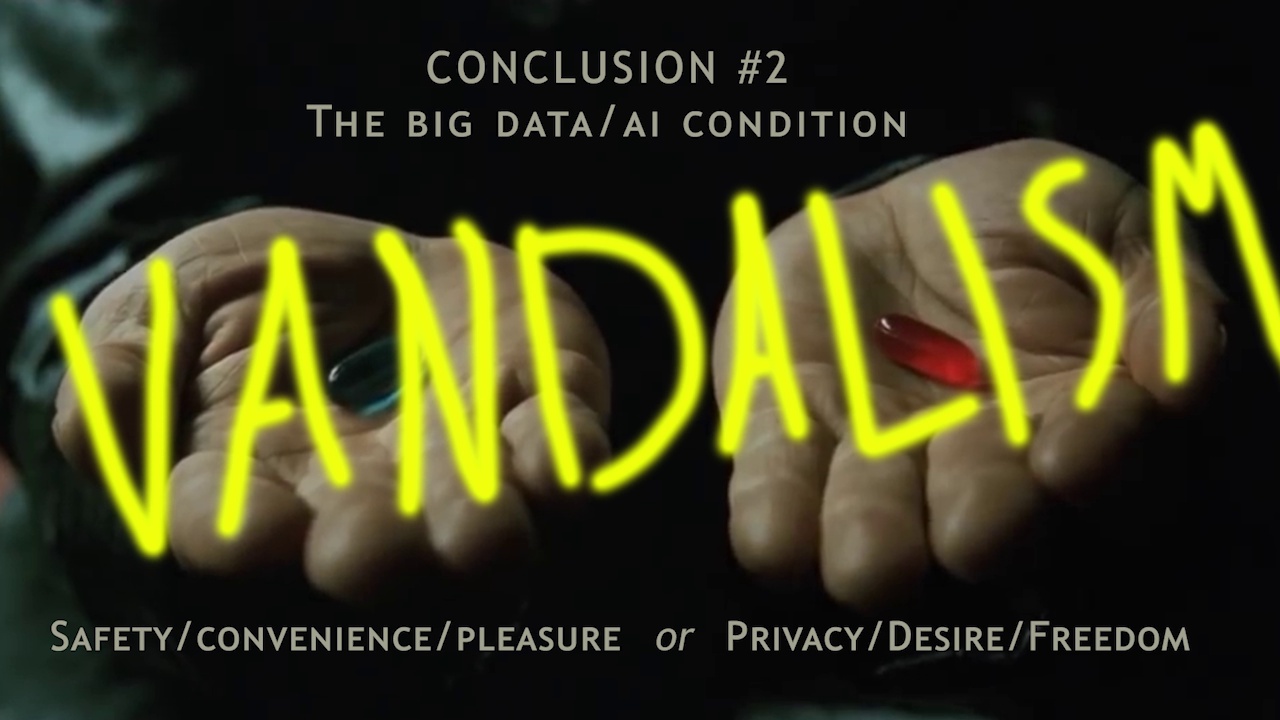
Source details — Visual — Conclusion two: big data condition
Visual — Conclusion two: big data condition
DISC-0062::VIS-018::OCC-01 · Display occurrence: approximately 1522.021–1540.005 seconds in the original video. Boundaries are estimated.
Exact frame PTS: 1530.028500 seconds in original video.
Visible slide text — not speech
CONCLUSION #2 THE BIG DATA/AI CONDITION
VANDALISM
SAFETY/CONVENIENCE/PLEASURE or PRIVACY/DESIRE/FREEDOM
AI-generated visual description — not speech or approved wording
Two hands hold blue and red capsules behind a large yellow “VANDALISM” annotation.
James Brusseau speech
I want to come back to you on that. I mean, isn't this the couch potato, that experience? I mean, isn't that the experience of getting exactly what you want just at the moment you want it? I mean, not all the time, but sometimes, right? You're just laying there. Does that feel good? No. Why are you asking me? I'm asking, I'm asking, I'm asking the world, I'm asking reality. I mean it doesn't, I'm thinking this through right now, right now. I mean afterwards it doesn't feel good, right? I mean afterwards you feel like, jeez I just wasted the evening, but especially intense with that when you get that show you want and it just hits you right when you're done. So you have no escape, but it feels good that you've got no I don't know. I'm not sure. I think that the feeling you have when you say you don't like it comes after you leave. If you never had to get up from the TV, you had an infinite supply of Doritos and just constant shows, I'm not sure that would not be euphoria. I'm not sure. I think that might be a kind of euphoria. I think the snake might be happy. I think God might be wrong about this one there's Doritos for this infinite infinite infinite Doritos right right
so that's all right I want to say that for those of us who work in the philosophy and ethics of AI and big data in general the kinds of contributions we can make and the kinds of things we can say occur somewhere in this area. There are different takes on it, different kinds of questions that get raised, but most of them reduce to something like this with the exception of quick footnote, with the exception of debates about fairness and accuracy in machine learning. Those are more statistical ethical questions about what fairness is. These are more humanistic ethical questions. Good, so are we good with this?
Other speaker (context): The thing about privacy. Different cultures hold privacy in different levels of importance. I read an article somewhere that in Asia, some countries, they do not care much about privacy. All they want is everything instantaneous. Whereas in the Western world, they care definitely. So, any thoughts on that?
James Brusseau: Yeah. First, a good academic answer. There's a great book by a guy named Weston called Freedom and Privacy in which he discusses exactly that. And it was written in 1965 or something. And he talks about different places in the world and different visions of privacy. So there is actually literature on this question.
My response is somewhat weak. What I'm going to do is I'm going to retreat from your question by saying, look, even if you have people living in a one-room house, they have no privacy. The whole family's in a one-room house. Like the stove is here and they sleep here and there's no walls, nothing. Even there, there's information they have about themselves that they don't know. Even there, there are things that even if they wanted to share, they couldn't. There's a kind of privacy loss which goes beyond what you can expose. There's the privacy loss that is the things that you yourself can't expose because you don't know them. So I think that's the only way I can get out of that question, because that's a very good question to push me back and say, well, maybe privacy is not like that. Maybe privacy is just a cultural construct. It just matters to us here in the U.S. in western europe and forget the rest but I don't think so because I think there's that second level of privacy that exists everywhere I think
Other speaker (context): For example I mean just depending on what he said I don't want to jump onto that, but I want to give an example of what that means. In China, I was watching a Wall Street video call saying that they're using artificial intelligence in research in schools where students are wearing EEG helmets
Other speaker (context): I saw that. Has the light done it?
Speaker uncertain: Yeah, three days ago, yeah. So concentration levels of students, whether they're paying attention or not, and those data, that's tracking real time, and that data is sent to their parents every 10 minutes so they can compare between every student's performance and what's being mentioned in government. So that's a level of privacy which would not be acceptable in the western culture, but over there it's appreciated because students are performing better and the competition is so high that people want to just get better from... I guess it's basically because of the level of competition that they don't have to talk about those privacy levels. So I think that's how I wanted to understand it.
James Brusseau: Also, there's a woman who works at J.P. Morgan and Carnegie Mellon, who has a good point about this. And I've had this discussion with her. And she's an old, older woman, but very vivid and has lived with artificial intelligence from the very beginning, right? So she is the history. Her first name is Manuela. And she's from Portugal. So you maybe know her. Her last name escapes me, but she's Manuela from Portugal. And she basically makes your point. And she says that, look, we're just going to get used to living without privacy. It'll take a generation, but little by little we'll get used to it and then we won't be concerned about it anymore. And it'll be sort of like she said, look, it's sort of like people learning to live with dishwashers. I mean, when you first got the dishwasher, people said, well, how does this thing work? It can't really clean clothes. Like it doesn't clean the way we're used to. We know that it should. But she says eventually people got used to the dishwasher being like that and they live like that and that's it. So she thinks, I disagree with her, but she thinks, and she's a serious mind, she thinks that your direction is the right direction and that privacy will just evaporate with time through things like this experiment in China.
Other speaker (context): Is that even going on?
James Brusseau: I don't know.
Good, so we're set with that then. If this is the big data AI condition, it seems to me that right now as human beings this is the kind of dynamic that we live in. Most of the decisions that we face are decisions that in one way or another will get us some safety get us some convenience get us some pleasure and we'll have to give up a little bit of privacy a little bit of desire a little bit of freedom and I want to add that identity the idea that we define our identity for ourselves as opposed to having it defined and then we'll go into vandals
Other speaker (context): If we each give up a little bit of freedom I'll only end up without any freedom as a collective.
James Brusseau: That seems correct to me. However, then at that point you would ask, well why would I want freedom? Because I'm getting everything I want. If I'm getting everything that I want, I'm getting it. Then what good is freedom?
Other speaker (context): There are some societies that believe that.
James Brusseau: Yeah, maybe ours will be one of them, I'm not sure, but that's the response, right? So you would say, look we give up freedom and it's worth it, that's the deal. So it's not going back to the start. It's not so much that this is about one decision is the right or the wrong decision. Not at all. There is no right or wrong decision, but there are better and worse understandings of what one or the other decision entails. And that's kind of what we're up to.
Source details — Visual — Big data vandalism graphic
Visual — Big data vandalism graphic
DISC-0062::VIS-019::OCC-01 · Display occurrence: approximately 2044.009–2052.017 seconds in the original video. Boundaries are estimated.
Exact frame PTS: 2050.014633 seconds in original video.
Visible slide text — not speech
WHAT IS BIG DATA VANDALISM?
JAMES BRUSSEAU Philosophy Department, Pace University, NYC Director, AI Ethics Site
[Wall stencil] BY ORDER NATIONAL HIGHWAYS AGENCY THIS WALL IS A DESIGNATED GRAFFITI AREA PLEASE TAKE YOUR LITTER HOME [Small final reference line unclear]
AI-generated visual description — not speech or approved wording
A stencil depicts an officer walking a dog beside a mock official graffiti designation. Closing credit: Pedro Belleza, “This wall is a designated graffiti area” - Banksy, CC BY.
James Brusseau speech
And now we're up to vandalism. There are some things that it seems like you can do when faced with this kind of reality, and what I'm trying to do with vandalism is I am trying to create or present a strategy for frustrating, no, thwarting the predictive analytics that are, to my mind, the core of the AI big data condition, and what makes the whole thing work, No, it's not true. What makes the whole thing work is data. But what intersects it with the human experience, that's it, what intersects it with the human experience is predictive analytics. So if human beings are going to have some sort of resistant interaction with this stuff, that's where it's going to happen at the interface with predictive analytics. So vandalism is about interacting with predictive analytics in the following way. With respect to big data platforms I By which I mean just simple things.
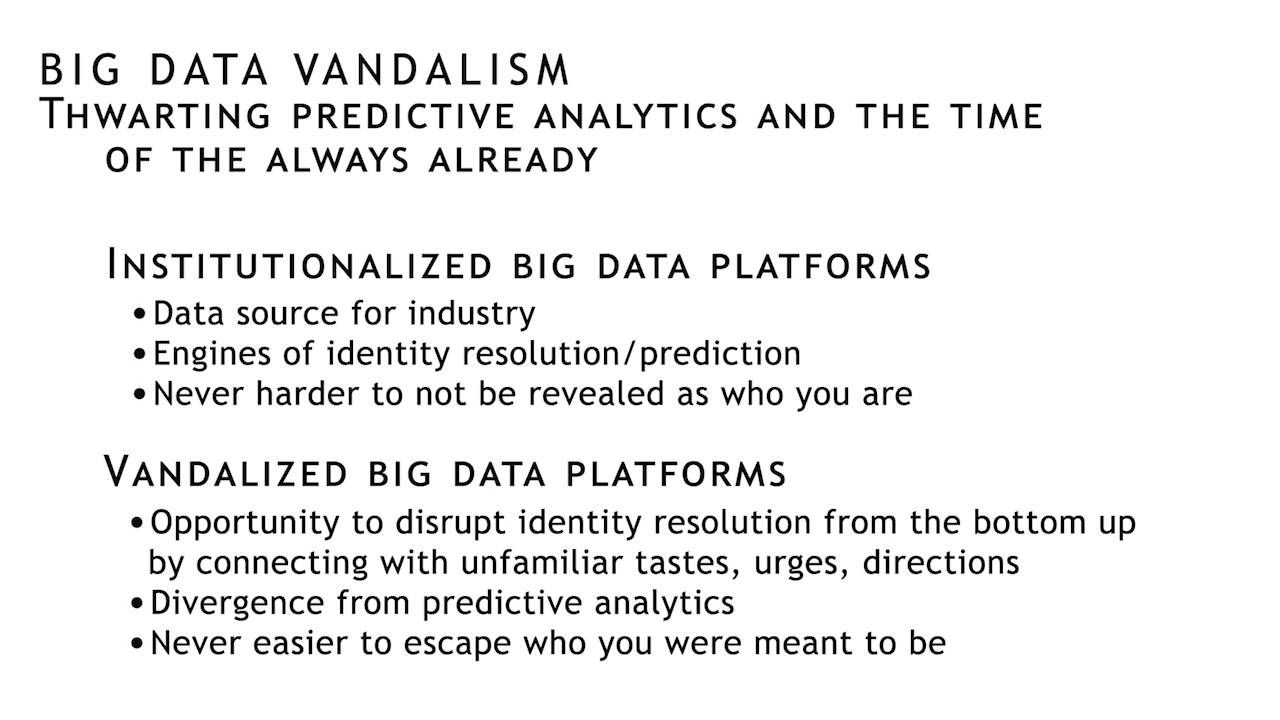
Source details — Visual — Institutionalized and vandalized platforms
Visual — Institutionalized and vandalized platforms
DISC-0062::VIS-020::OCC-01 · Display occurrence: approximately 2106.004–2130.028 seconds in the original video. Boundaries are estimated.
Exact frame PTS: 2118.015900 seconds in original video.
Visible slide text — not speech
BIG DATA VANDALISM THWARTING PREDICTIVE ANALYTICS AND THE TIME OF THE ALWAYS ALREADY
INSTITUTIONALIZED BIG DATA PLATFORMS
- Data source for industry
- Engines of identity resolution/prediction
- Never harder to not be revealed as who you are
VANDALIZED BIG DATA PLATFORMS
- Opportunity to disrupt identity resolution from the bottom up by connecting with unfamiliar tastes, urges, directions
- Divergence from predictive analytics
- Never easier to escape who you were meant to be
James Brusseau speech
LinkedIn, Tinder, respective big data platforms. The institutionalized use is data is gathered, your identity is resolved, which means you are defined even better than you know yourself, and then you are revealed and a prediction can be made. Vandalize the big data platform. What you try to do is you take those same platforms, LinkedIn, Tinder, etc., and try to turn them against themselves. That is, this is not a revolutionary kind of thing. It's not against big data. It's taking the tools of big data reality and twisting them a little bit in order to thwart the predictive analytics that drive the entire mechanism. And that's what I want to show you now.
I have three examples. We'll skip to second, but we'll do two examples quickly.
Source details — Visual — Vandalism example one: job post
Visual — Vandalism example one: job post
DISC-0062::VIS-021::OCC-01 · Display occurrence: approximately 2168.033–2196.027 seconds in the original video. Boundaries are estimated.
Exact frame PTS: 2180.011167 seconds in original video.
Visible slide text — not speech
BIG DATA VANDALISM: EXAMPLE #1 ELEMENTS OF THE UNPREDICTED/IRRESOLVABLE IDENTITY
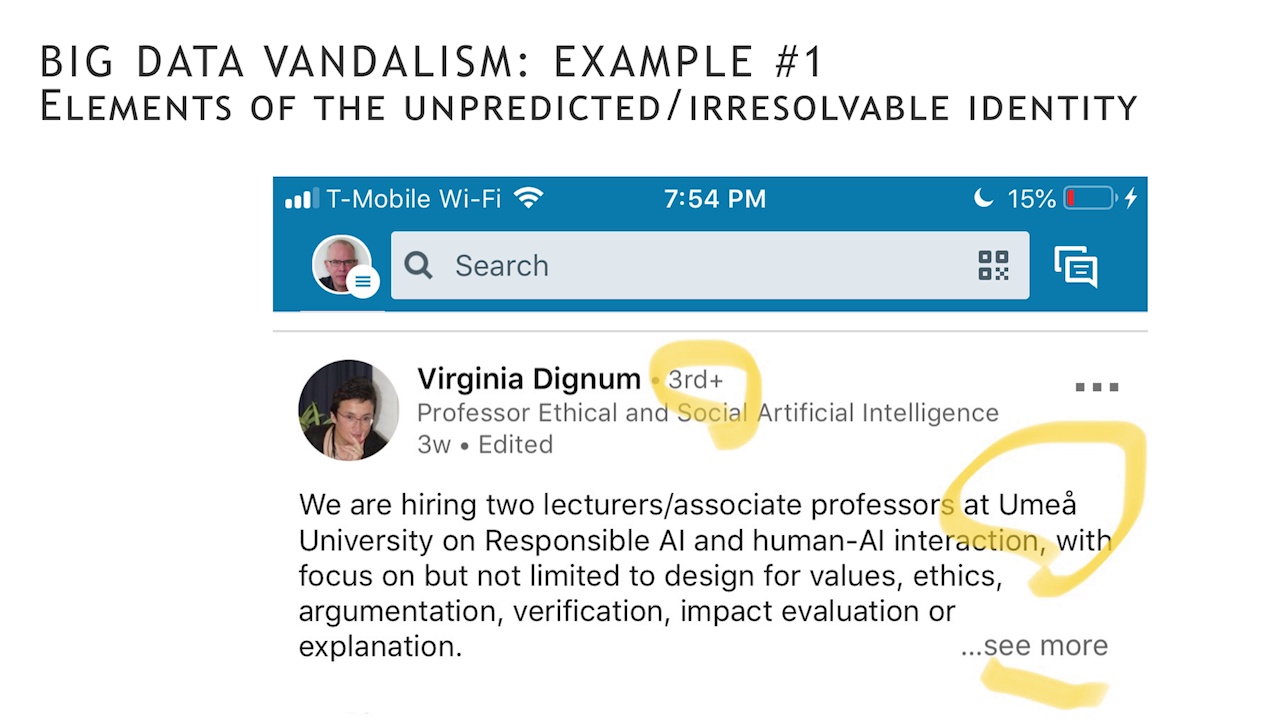
[LinkedIn screenshot] Search Virginia Dignum · 3rd+ Professor Ethical and Social Artificial Intelligence 3w · Edited
We are hiring two lecturers/associate professors at Umeå University on Responsible AI and human-AI interaction, with focus on but not limited to design for values, ethics, argumentation, verification, impact evaluation or explanation.
...see more
AI-generated visual description — not speech or approved wording
Yellow marks emphasize third-degree connection, Umeå, and the continuation link.
James Brusseau speech
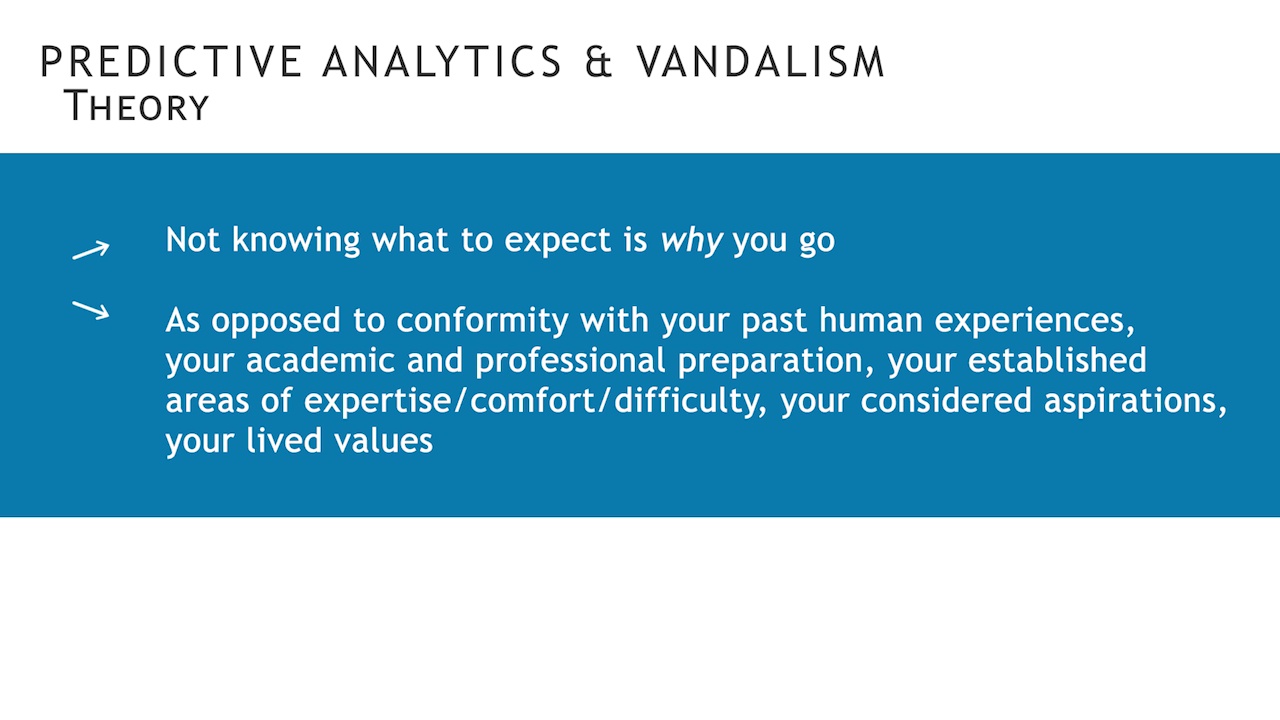
First example, what we're trying to do is vandalize the big data experience machine and here is a LinkedIn part of feed that came into my phone and it is this ad for a job which kind of relates to me we're looking for two lectures associated with you with your university I'm in university with responsible AI human AI interaction yeah that's what I do I could go for that job I could do that but this comes to me from someone I've never heard of, Virginia Dignam. That's the third connection. That means she's not someone I know, not someone I know I know, not someone I know I know I know, but someone I know. And she's at UMEA. I don't know what UMEA is. I've never heard of UMEA. So this is a really interesting case. Something via predictive analytics comes into my reality, into my life. It's the opportunity for a job in a place I've never heard of. She can have language which I probably don't know with cultures and customs cultures and norms and behaviors that are foreign to me and I can go I could take this job maybe I can just go for it if I go then I am breaking the predictive analytics machine I'm taking this mechanism which what does what is LinkedIn supposed to do LinkedIn is supposed to learn your past your academic and professional past lock you on to a line get you onto the next career step and the next and the next. But this opportunity comes in, and I just get on an airplane and go to EMEA, wherever that is. I have to Google it. That's using predictive analytics to break predictive analytics. That's taking a machine which wants to know who I am and lock me on a career path in accordance with that identity, and I use that machine instead to create a new identity. Get on an airplane and go. Learn a new language, meet new people, new customs, religions. I don't know what I'm going to find. But whatever it is, it's going to be a different identity, a different me. The machine which creates and imprisons your identity is used to create a new identity. The theoretical point here is the reason you go is because you don't know what to expect. That's really important for this. It won't work otherwise. You only go because you don't know what to expect. So as opposed to conformity with your past human experiences, your academic and professional preparation, your established expertise, you find something where you can't know what to expect. Like a job in Umea, wherever that is.
Source details — Visual — Vandalism theory
Visual — Vandalism theory
DISC-0062::VIS-022::OCC-01 · Display occurrence: approximately 2326.024–2354.018 seconds in the original video. Boundaries are estimated.
Exact frame PTS: 2338.002333 seconds in original video.
Visible slide text — not speech
PREDICTIVE ANALYTICS & VANDALISM THEORY
Not knowing what to expect is why you go
As opposed to conformity with your past human experiences, your academic and professional preparation, your established areas of expertise/comfort/difficulty, your considered aspirations, your lived values
AI-generated visual description — not speech or approved wording
Two white arrows branch toward the contrasting statements.
Source details — Visual — Vandalism example three: profile
Visual — Vandalism example three: profile
DISC-0062::VIS-023::OCC-01 · Display occurrence: approximately 2362.026–2388.019 seconds in the original video. Boundaries are estimated.
Exact frame PTS: 2374.004967 seconds in original video.
Visible slide text — not speech
BIG DATA VANDALISM: EXAMPLE #3 ELEMENTS OF THE UNPREDICTED/IRRESOLVABLE IDENTITY
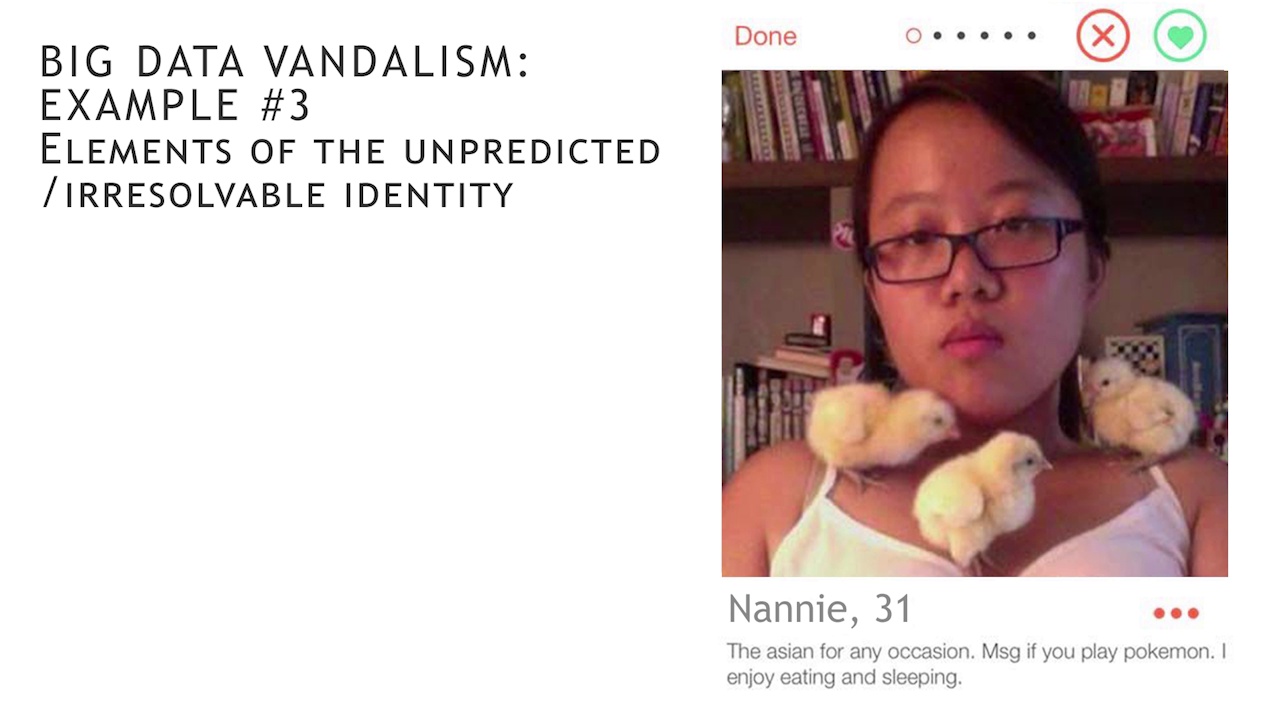
[Profile screenshot] Done Nannie, 31 The asian for any occasion. Msg if you play pokemon. I enjoy eating and sleeping.
AI-generated visual description — not speech or approved wording
A profile photograph shows a woman wearing glasses with three chicks resting around her shoulders and chest. A cross and heart appear at the top. Closing credit: Tinder screenshot, Author, CC SA.
James Brusseau speech
Another example, Tinder. There it is. This did not, of course I'm married, this did not come across my Tinder, but imagine me. This is a real Tinder. I've changed a few little things so I didn't involve any real person. Not much though this is pretty close to a real thing nanny 31 message if you play Pokemon I enjoy eating and sleeping I don't know about you but for me this woman would be a reality unlike any other I have known it would be a complete trip connect with her and see where it goes. What Tinder is supposed to do is identify women that cohere with the kind of woman I've always had, right? Because what does Tinder know? Tinder knows the dates I've had before. So they've learned he likes brunettes, not blondes. He likes intellectuals, not sport women. He likes da-da-da. And Tinder goes down and identifies the right woman for me. But then this comes up, this is a completely different world, a completely different reality. And all of us know from our couplings that anytime we couple with someone it's not just a new experience, it's not just a new person, it's a new ourselves. We become new too, right? And different. So here too Tinder or any online matchmaking device which tries to learn who we are to get us funneled and focused right to the perfect mate is instead exploited to find some completely different experience. And it's not because, I mean, this is critical. It's not because we're against big data. It's not because we're trying to ruin the machine. No, none of that. We're just using the machine to create for ourselves a different reality. If you go, if I went with Nanny, I wouldn't be doing that because I want to ruin Tinder. I wouldn't be doing that because Speaker uncertain: I'm against AI or big data. No, I'm just vandalizing it. It's a little thing for me.
Source details — Visual — Rules of big data vandalism
Visual — Rules of big data vandalism
DISC-0062::VIS-024::OCC-01 · Display occurrence: approximately 2500.031–2512.010 seconds in the original video. Boundaries are estimated.
Exact frame PTS: 2506.003500 seconds in original video.
Visible slide text — not speech
RULES OF BIG DATA VANDALISM
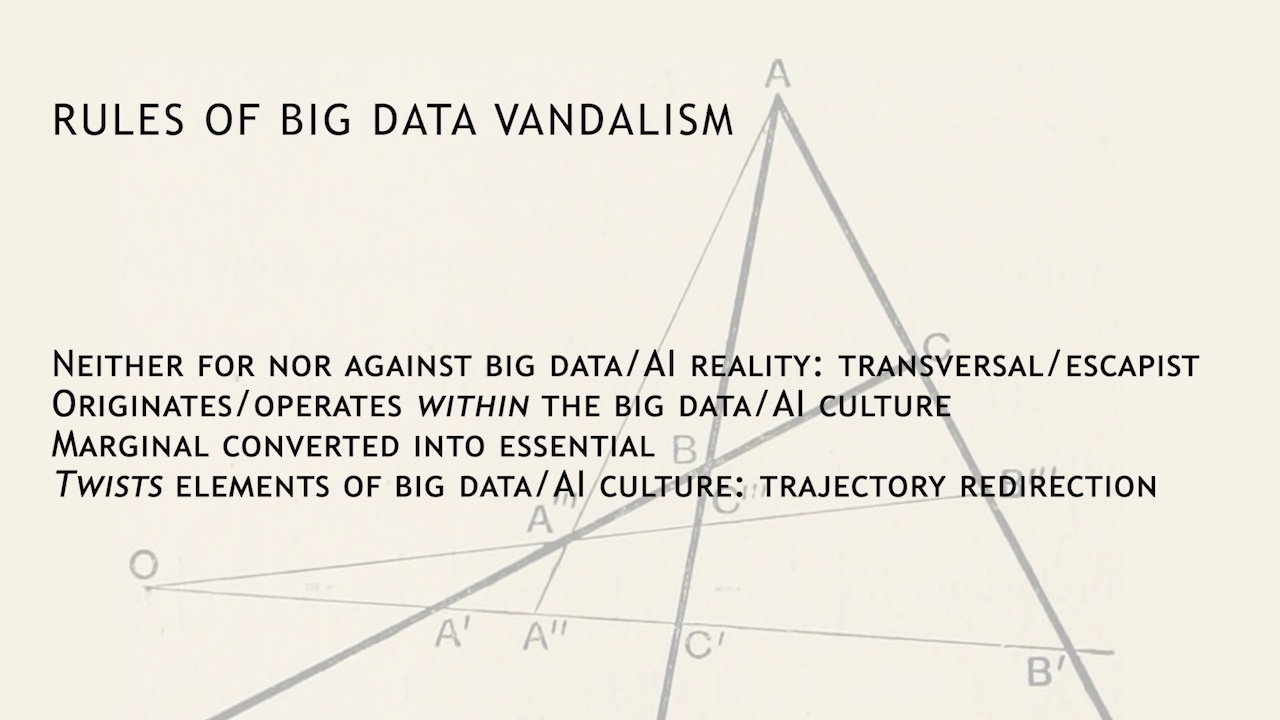
NEITHER FOR NOR AGAINST BIG DATA/AI REALITY: TRANSVERSAL/ESCAPIST ORIGINATES/OPERATES WITHIN THE BIG DATA/AI CULTURE MARGINAL CONVERTED INTO ESSENTIAL TWISTS ELEMENTS OF BIG DATA/AI CULTURE: TRAJECTORY REDIRECTION
[Visible diagram labels] O; A; A′; A″; B; B′; C; C′
AI-generated visual description — not speech or approved wording
Faint geometric lines connect labeled points, with two rays extending from O through the figure. Text obscures parts of the diagram; no additional theorem or relationship is inferred.
James Brusseau speech
James Brusseau: Good. So the rules of big data vandalism, neither for nor against it, but operates within big data and AI culture and twists the elements in order to create a different opportunity for your identity. What I've wanted to say today is two things. First, I've tried to give a look at what the philosophy and ethics of AI and big data looks like. And as frequently people talk, they say, well, privacy, we don't want to lose privacy. But rarely does someone say, why don't we want to lose privacy? Well, this is why. This is why we don't want to lose privacy.
Source details — Visual — Takeaway
Visual — Takeaway
DISC-0062::VIS-025::OCC-01 · Display occurrence: approximately 2536.000–2554.018 seconds in the original video. Boundaries are estimated.
Exact frame PTS: 2546.010133 seconds in original video.
Visible slide text — not speech
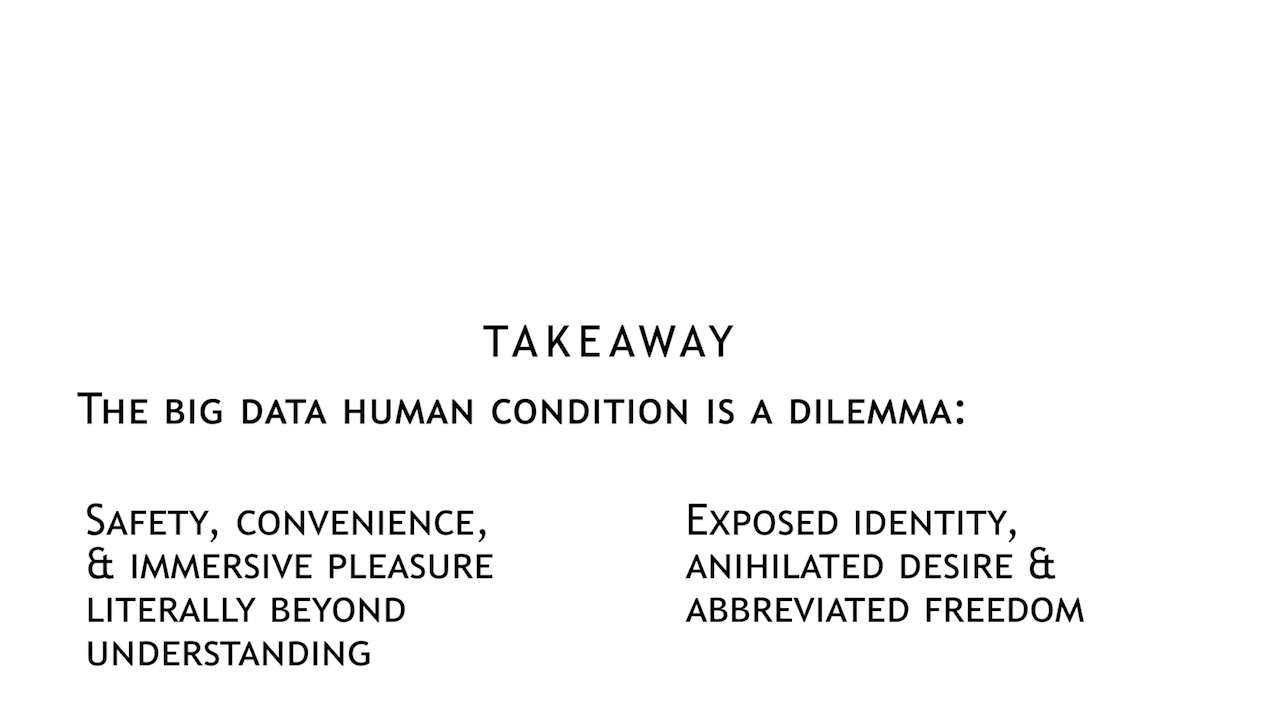
TAKEAWAY THE BIG DATA HUMAN CONDITION IS A DILEMMA:
| Left column | Right column |
|---|---|
| SAFETY, CONVENIENCE, & IMMERSIVE PLEASURE LITERALLY BEYOND UNDERSTANDING | EXPOSED IDENTITY, ANIHILATED DESIRE & ABBREVIATED FREEDOM |
Visual limitations: The displayed spelling “ANIHILATED” is preserved.
James Brusseau speech
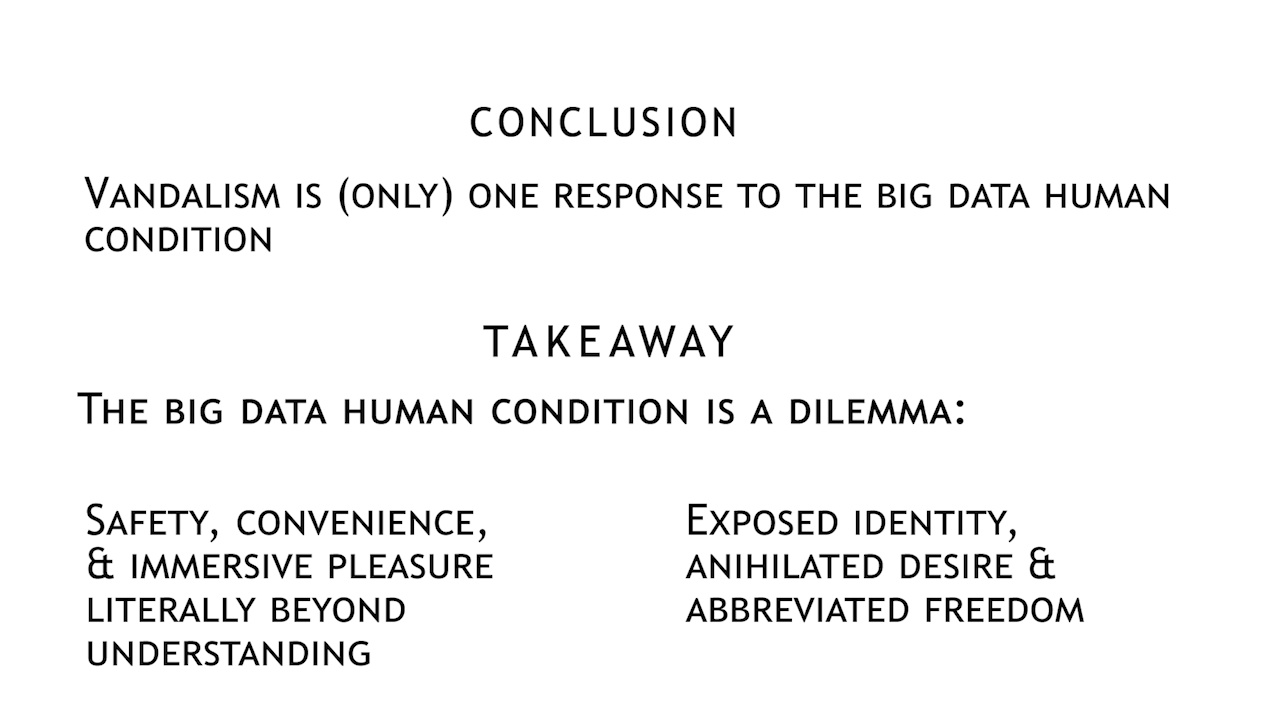
So I tried to give a sense of what happens, privacy, identity, freedom, safety, convenience, pleasure, how all those things are involved in this trade-off that hopefully we can come to understand a little better as we continue working through AI and big data reality. That's the first thing I did. Then the second thing I did is I said, it's not just an either or choice. It's not just either embrace AI big data reality or go off the grid. No, there's all kinds of other possibilities that are out there between those two extremes, which imply accepting some parts and not accepting other parts. Okay? Terrific. Thanks for coming.
Source details — Visual — Conclusion build
Visual — Conclusion build
DISC-0062::VIS-026::OCC-01 · Display occurrence: approximately 2562.026–2572.003 seconds in the original video. Boundaries are estimated.
Exact frame PTS: 2568.032133 seconds in original video.
Visible slide text — not speech
CONCLUSION VANDALISM IS (ONLY) ONE RESPONSE TO THE BIG DATA HUMAN CONDITION
TAKEAWAY THE BIG DATA HUMAN CONDITION IS A DILEMMA:
| Left column | Right column |
|---|---|
| SAFETY, CONVENIENCE, & IMMERSIVE PLEASURE LITERALLY BEYOND UNDERSTANDING | EXPOSED IDENTITY, ANIHILATED DESIRE & ABBREVIATED FREEDOM |
Visual limitations: This meaningful build adds the conclusion above the earlier takeaway; displayed spelling is preserved.
Source details — Visual — Third-party visual credits
Visual — Third-party visual credits
DISC-0062::VIS-027::OCC-01 · Display occurrence: approximately 2594.025–2596.027 seconds in the original video. Boundaries are estimated.
Short-display inclusion exception: Short substantive build, reference, or contact content; retained explicitly despite normal five-second threshold. No durations aggregated.
Exact frame PTS: 2596.026767 seconds in original video.
Visible slide text — not speech
Acroyoga Peretz Partensky Robot Heart Dancers CC BY SA
The insurance paradox Peretz Partensky Acroyoga Injury CC BY SA
Poirot Author CC SA
Black Mirror Author CC SA
Cascade mirror Owen Byrne Multiple Personality Disorder CC BY
Shrinkwrap man Author CC SA
Tinder: Live Lane Moore Tinder Live With Lane Moore feat. the cast of Orange Is The New Black! YouTube screenshot: https://www.youtube.com/watch?v=oCPHvoHlFi0
What is big data vandalism? Pedro Belleza “This wall is a designated graffiti area” - Banksy CC BY
Tinder screenshot Author CC SA
Visual limitations: Short credit display retained to preserve third-party attribution. Generic “Author” credits are transcribed without inventing an identity. Final URL glyph 0/O is uncertain at source resolution.