Inherited editorial introduction (source unchanged)
AI Human Impact: Updating ESG Investing for AI-Intensive Companies
Accepted speech wording, attribution and paragraph presentation are preserved. The combined edition’s slide content and placements are accepted; stages 1–7 are complete in this edition’s selected scope. Stage 8 remains pending; retrieval is inactive. Visual text and AI-generated descriptions remain separate from speech. Paragraph placement is editorial; recording display times and exact frame timestamps are unchanged.
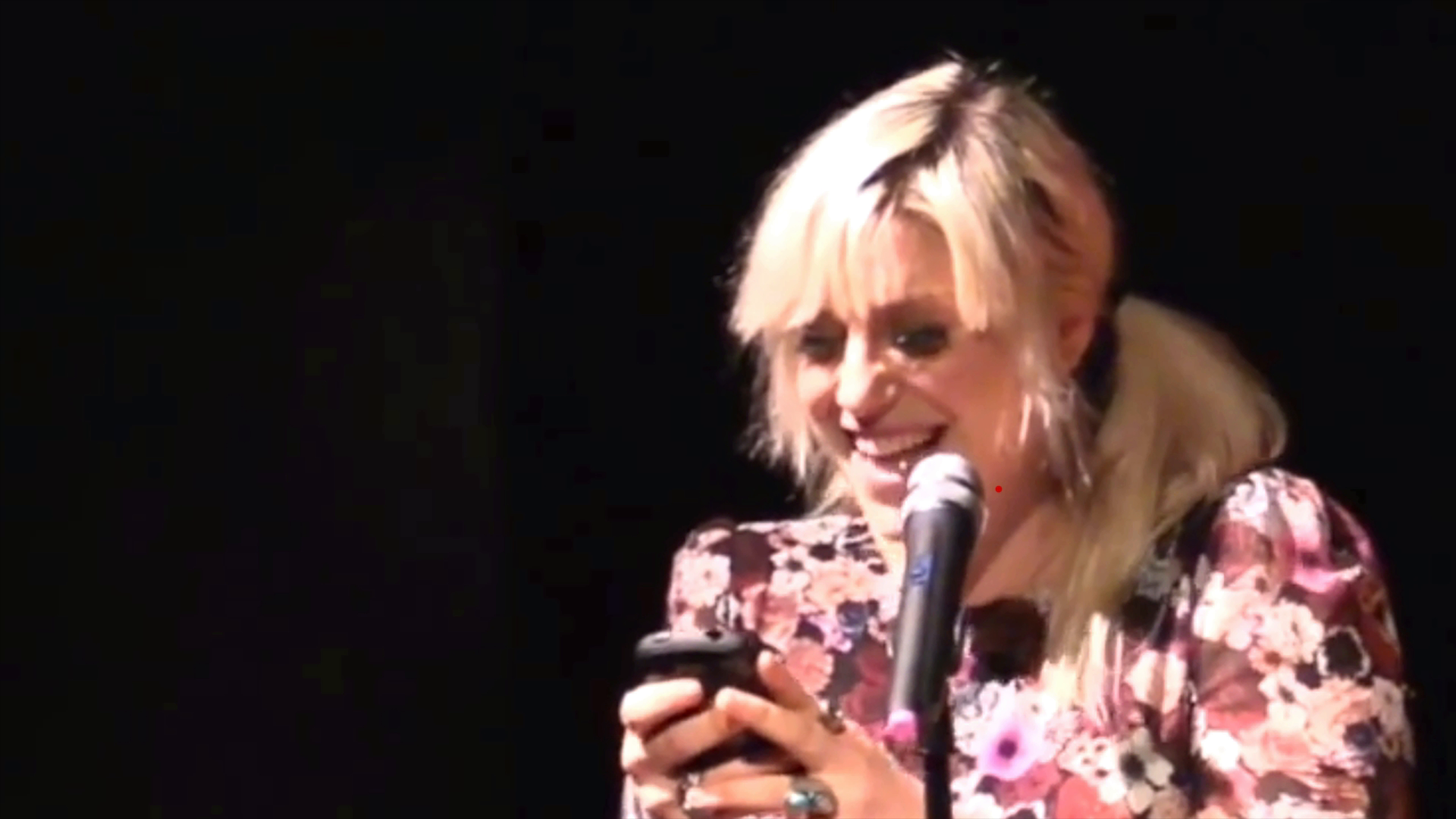
James Brusseau speech
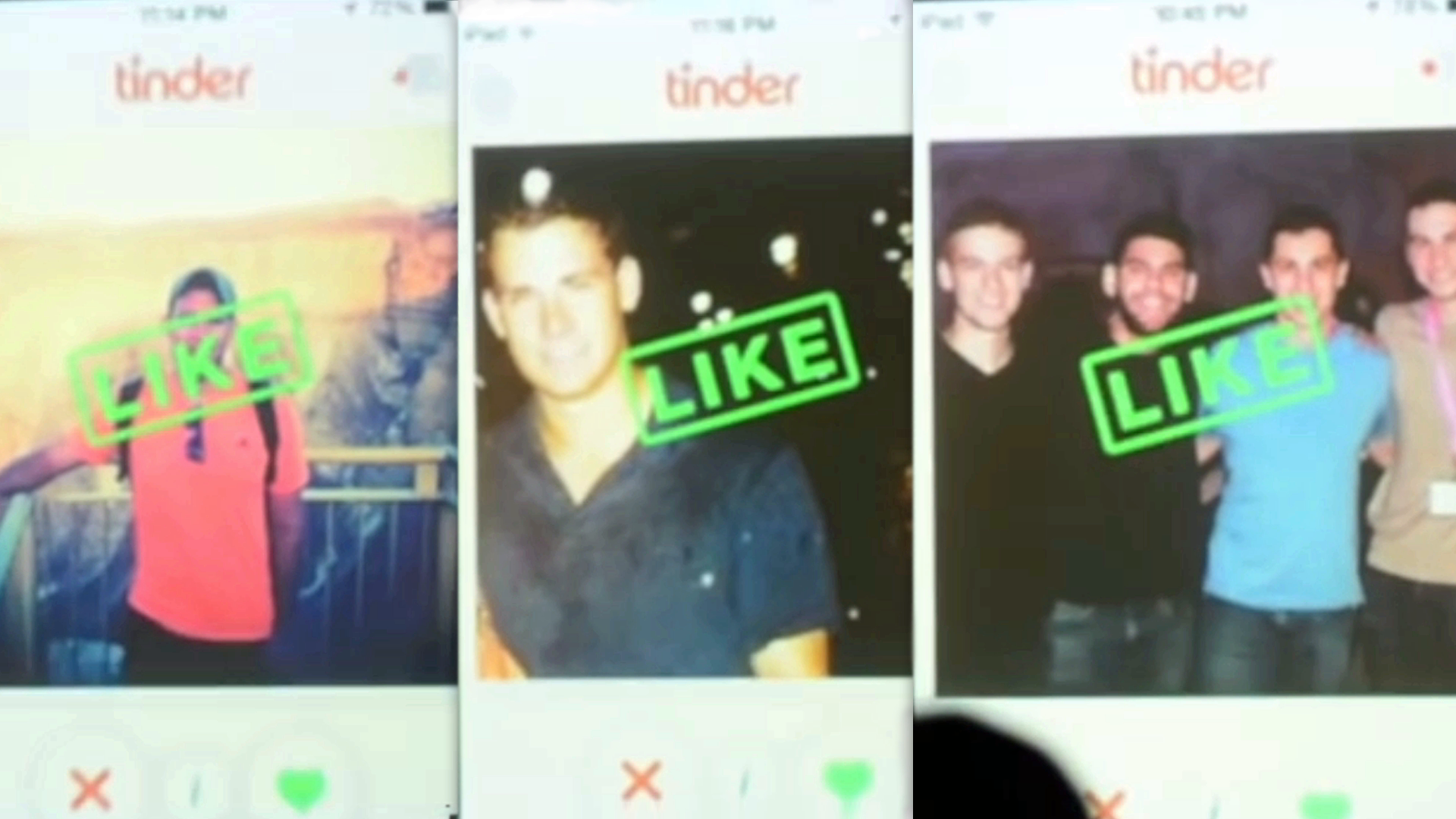
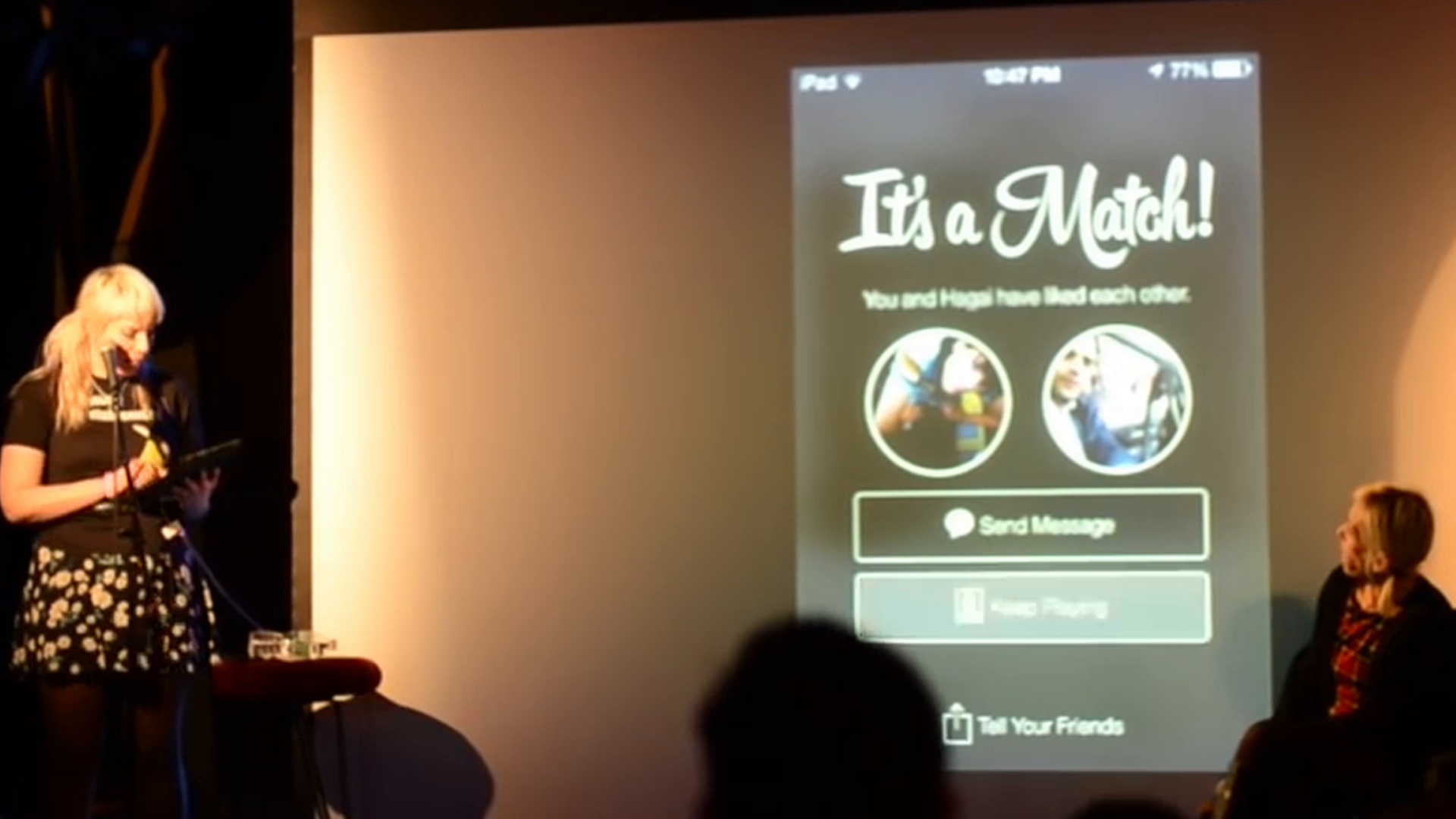
James Brusseau: This is Lane Moore, who runs a stage show called Tinder Live, where the audience watches and hears about her hookup dramas. What does the Tinder app do? It filters your personal information through giant datasets to find your perfect partner. That's the power of AI. Her proposed partners, they all start to look the same. And that's because once the platform identifies your taste, it will keep feeding versions of your model partner with different names. Which is good since that's what you like.
Source details — DISC-0067-FRAME-02
Source details — DISC-0067-FRAME-03
Frame 03 — A projected Tinder match screen
Observed at 00:39.973 in the original recording.
Visible slide text
It's a Match! You and Hugo have liked each other. Send Message Keep Playing Tell Your Friends
Editorial note: Projected app screen photographed on stage. Incidental device status indicators are preserved in the image.
James Brusseau speech
But you're also sacrificing the opportunity to meet anyone really different, which means you are confined in a strange way by the fact that you are getting what you want. And it's your own data creating the prohibition.
Source details — DISC-0067-FRAME-04
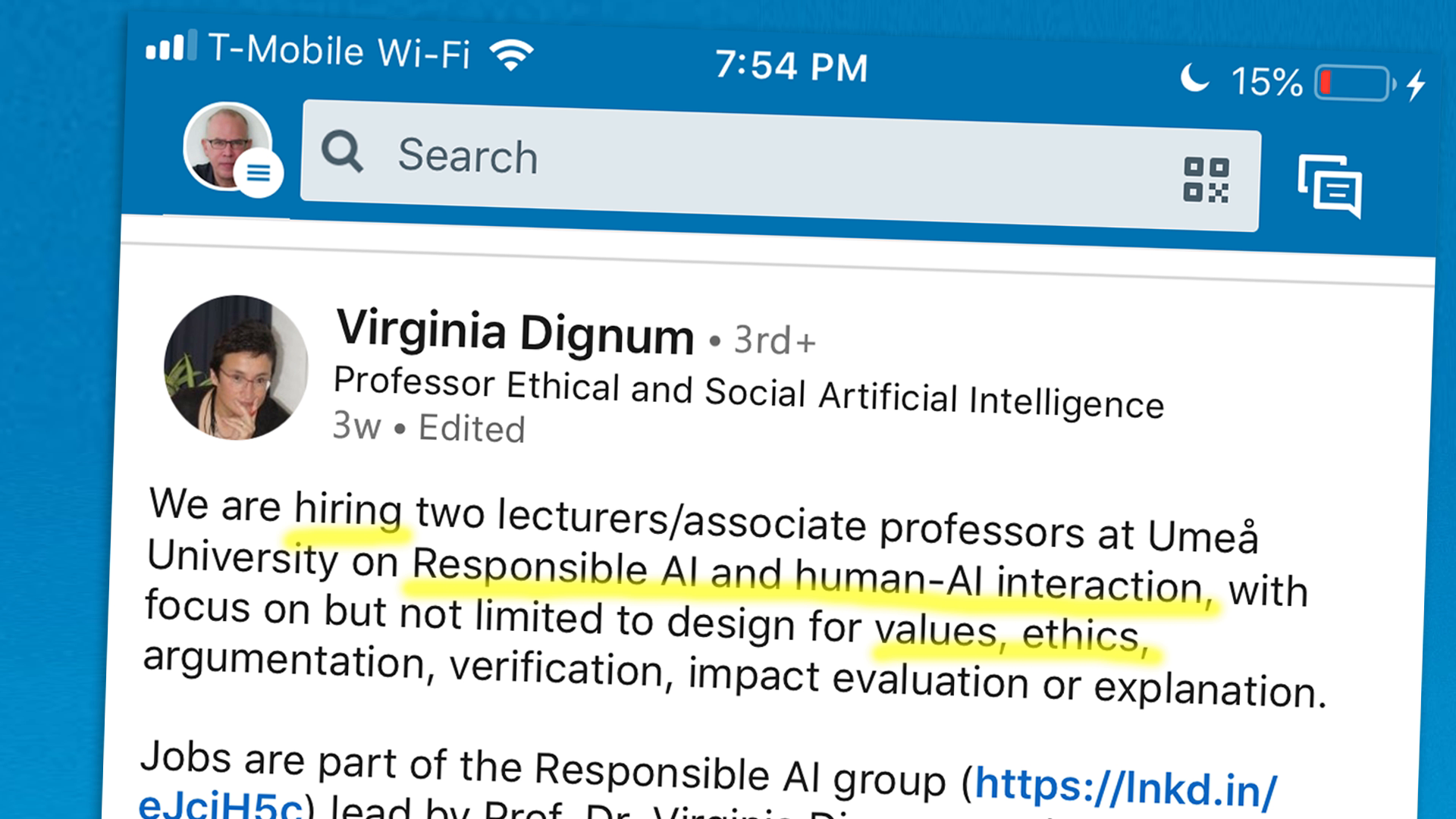
Frame 04 — Virginia Dignum's LinkedIn post
Observed at 00:59.960 in the original recording.
Visible slide text
Virginia Dignum · 3rd+ Professor Ethical and Social Artificial Intelligence 3w · Edited
We are hiring two lecturers/associate professors at Umeå University on Responsible AI and human-AI interaction, with focus on but not limited to design for values, ethics, argumentation, verification, impact evaluation or explanation.
Jobs are part of the Responsible AI group (https://lnkd.in/ eJcjH5c) lead by Prof. Dr. Virginia Di[remainder cropped]
Editorial note: Quotation attributed to the displayed Virginia Dignum account. The lower part of the post is cut off in the original video. Phone interface/status text remains in the full frame.

James Brusseau speech
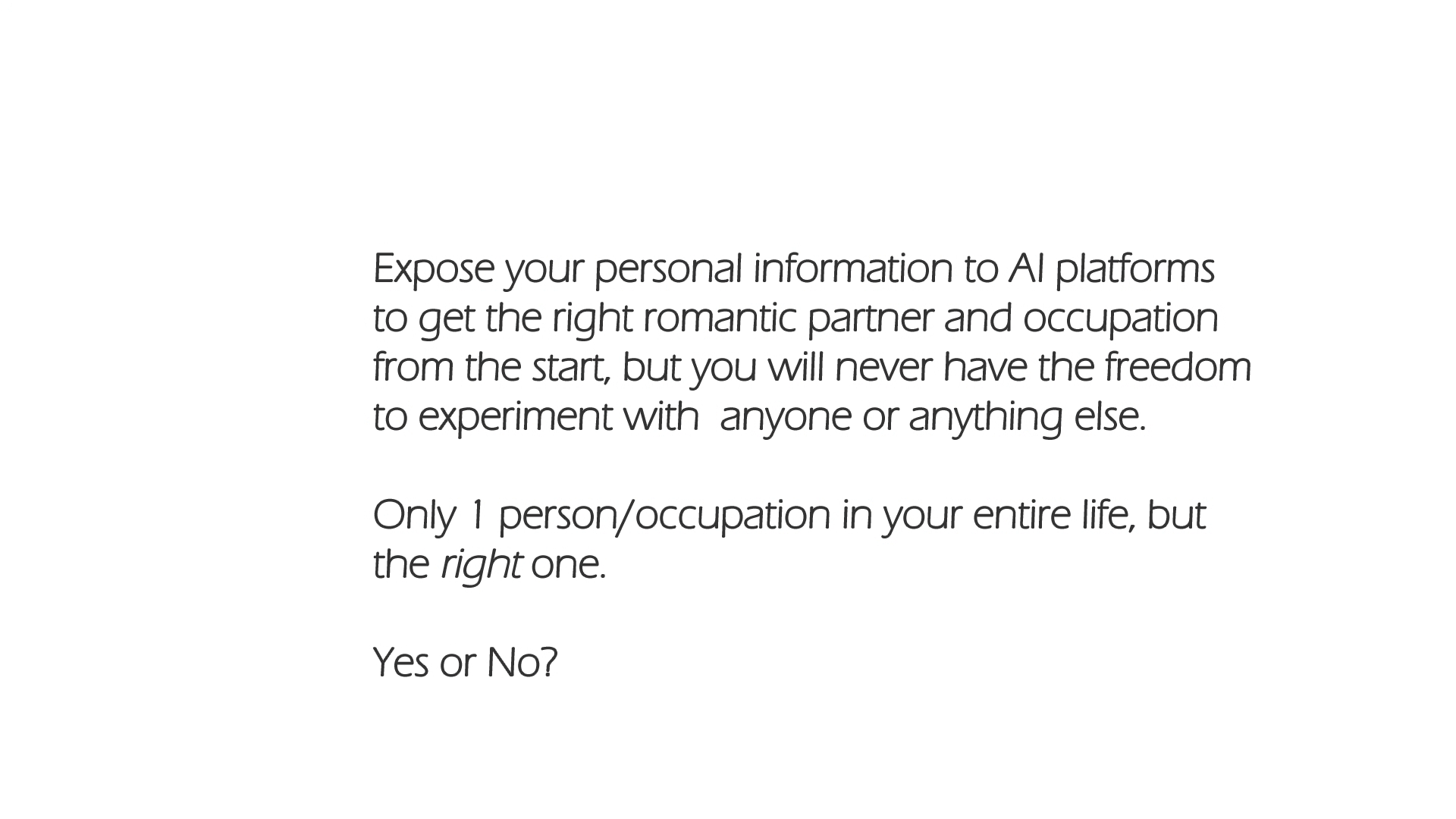
Here's another example. AI channeled me this job announcement by aligning my personal information, my education, career history, connections on the site, my comments, all of it to lock me on a career trajectory. But the better the machine works, the lower my exposure to jobs outside the parameters recommended by my own data. So again, I'm losing opportunities to experiment, to find new things to want, and I'm losing them because I'm always already getting what I want.
Source details — DISC-0067-FRAME-06
Frame 06 — Personal information, opportunity, and freedom
Observed at 01:39.933 in the original recording.
Visible slide text
Expose your personal information to AI platforms to get the right romantic partner and occupation from the start, but you will never have the freedom to experiment with anyone or anything else.
Only 1 person/occupation in your entire life, but the right one.
Yes or No?
Editorial note: Line breaks follow the slide; extra spacing between words is normalized.
James Brusseau speech
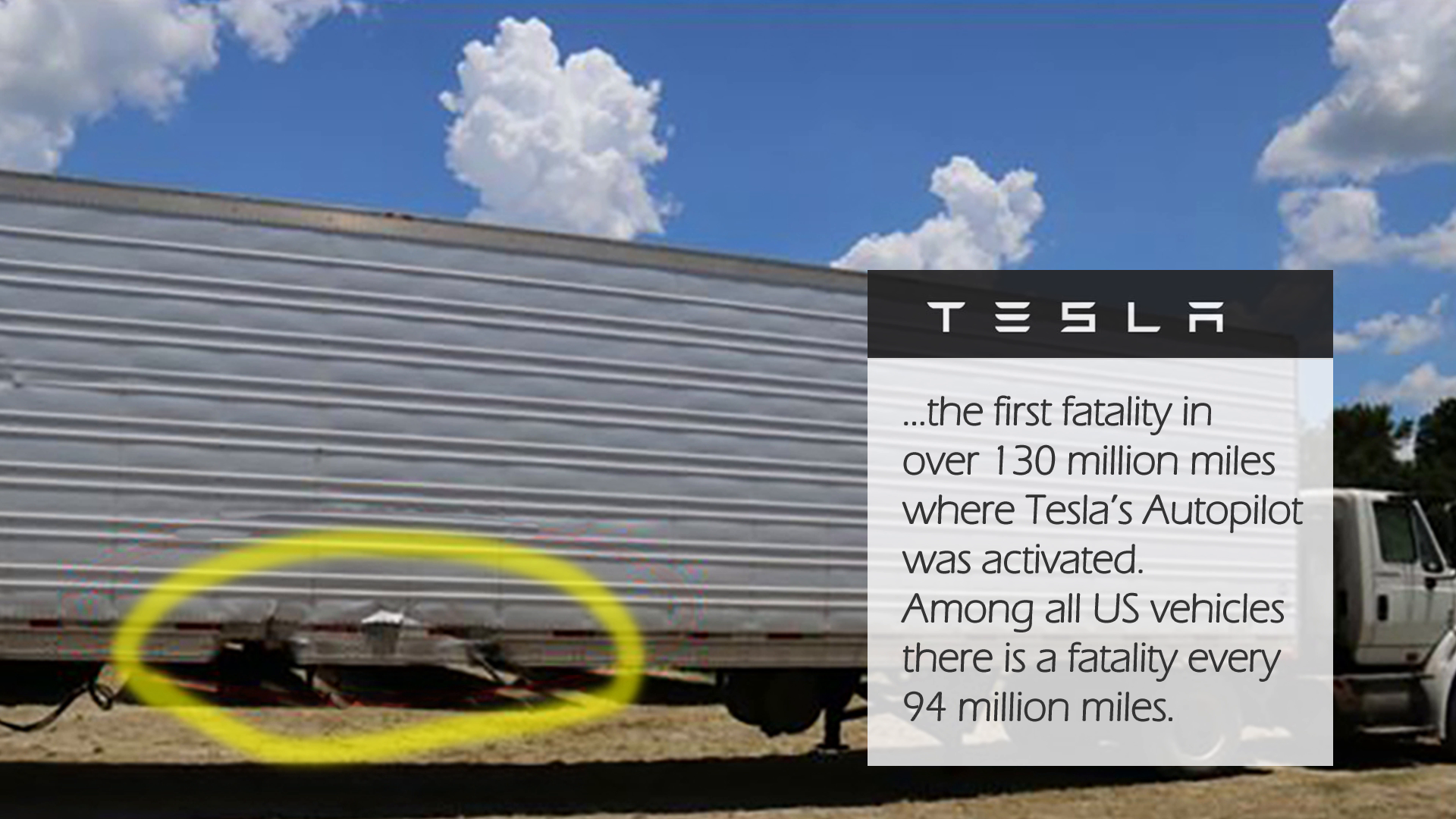
Let's put this theoretically. Tesla on autopilot was driving down this freeway when a white truck pulled across the road right in front. The AI read the truck's whiteness as a cloud in the blue sky, and the car did not even slow down.

Source details — DISC-0067-FRAME-08
Frame 08 — Tesla statement over a crash photograph
Observed at 02:19.906 in the original recording.
Visible slide text
TESLA
...the first fatality in over 130 million miles where Tesla’s Autopilot was activated. Among all US vehicles there is a fatality every 94 million miles.
Editorial note: Quotation is attributed on the slide by the TESLA wordmark. The crash photograph and yellow oval are preserved as image evidence.
Source details — DISC-0067-FRAME-09
Frame 09 — National Transportation Safety Board report excerpt
Observed at 02:39.893 in the original recording.
Visible slide text
NATIONAL TRANSPORTATION SAFETY BOARD OFFICE OF HIGHWAY SAFETY WASHINGTON, D.C.
TECHNICAL RECONSTRUCTION GROUP CHAIRMAN’S FACTUAL REPORT
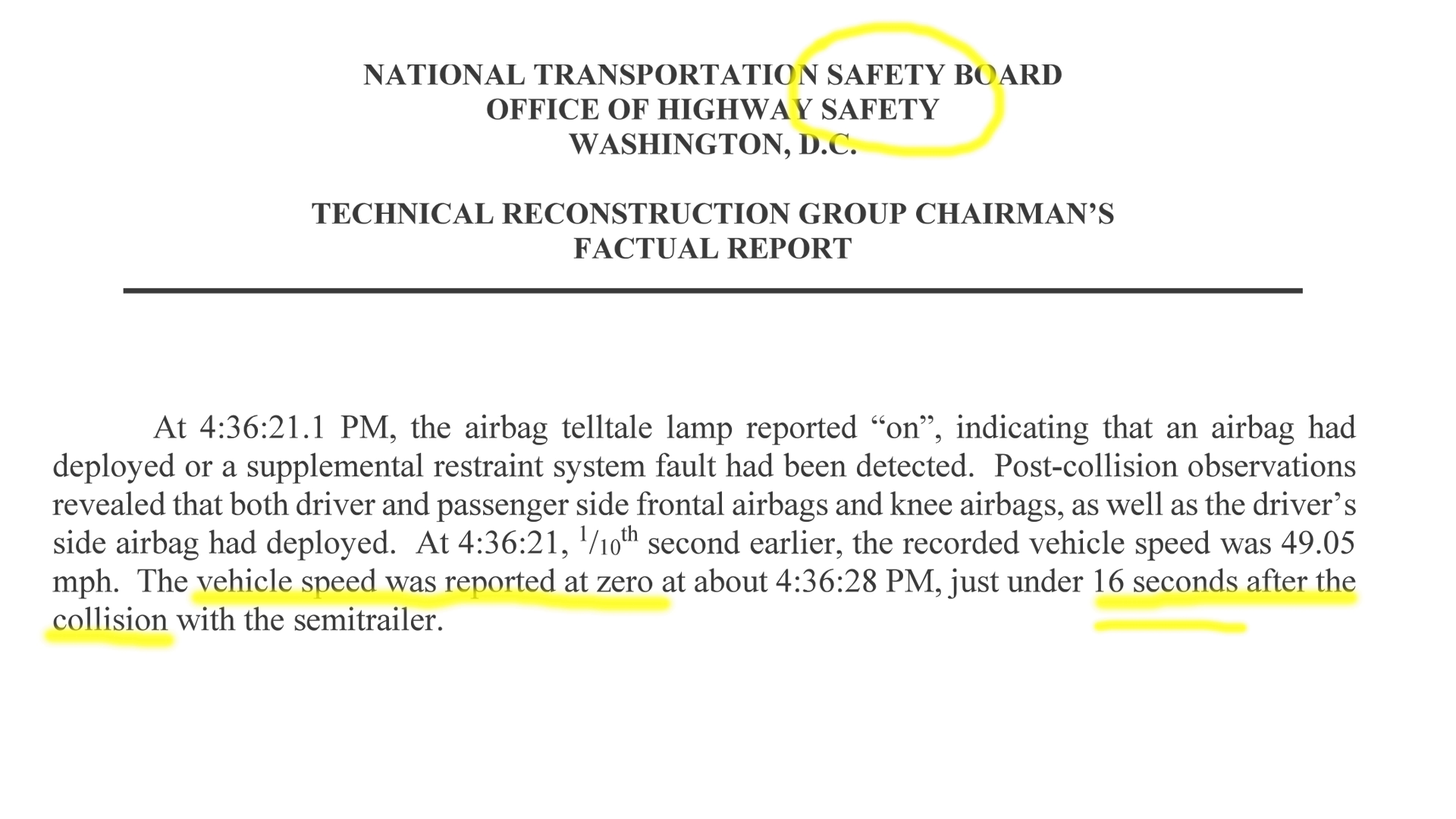
[…] The vehicle speed was reported at zero at about 4:36:28 PM, just under 16 seconds after the collision with the semitrailer.
Editorial note: Quoted report excerpt; the printed fraction is rendered as 1/10th. Yellow highlighting remains in the image.
James Brusseau speech
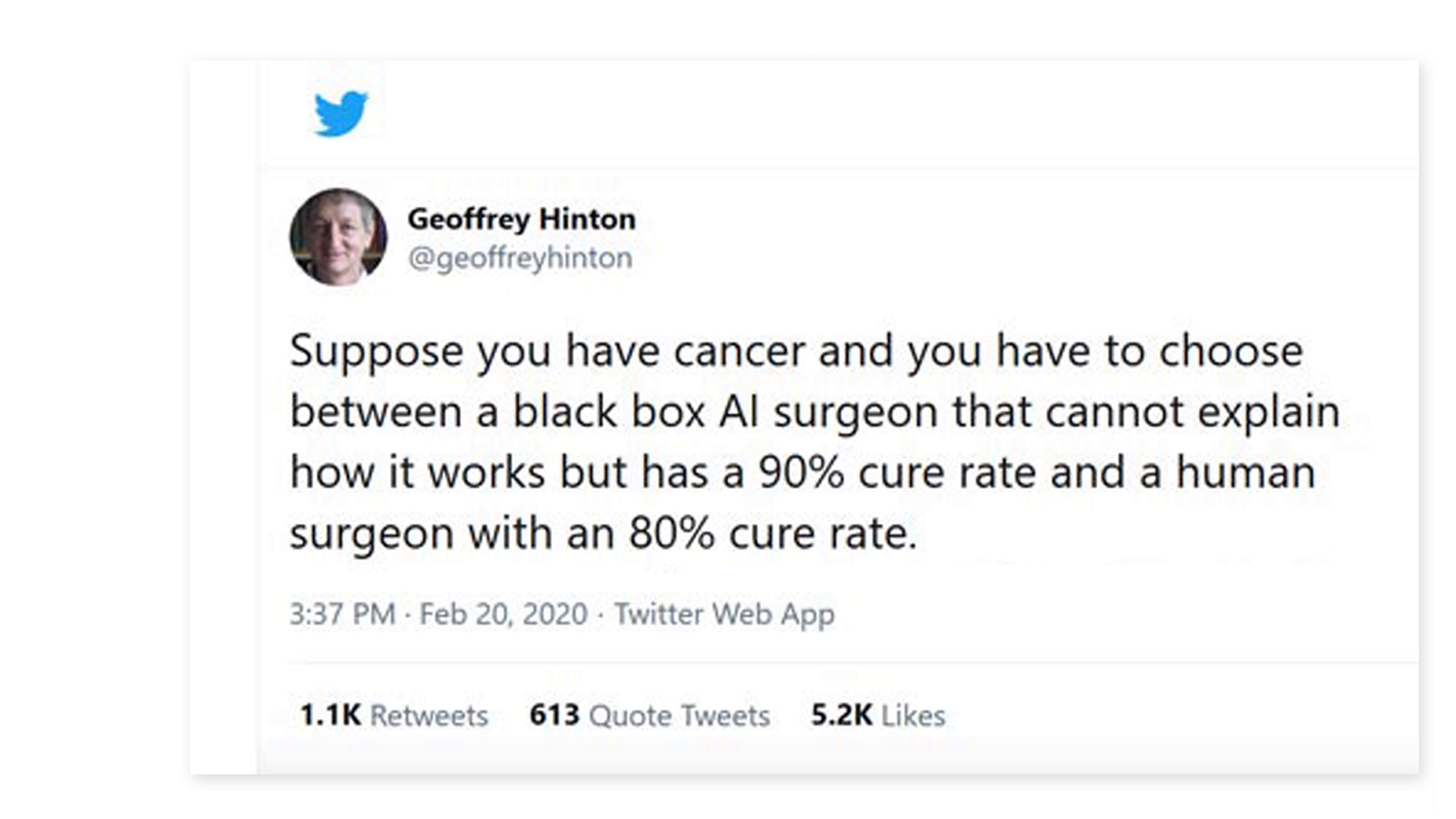
The driver was texting, and in the circle you can see where the trailer sheared off the Tesla top. Beside it, there's the Tesla statement correctly noting that the car is safe statistically. The problem with AI is intellectual schizophrenia. Sometimes superhuman performance but out of the blue there are catastrophic failures at even the most humanly obvious tasks. So faced with this unpredictable unpredictability what counts as safety? Here's another version of the safety dilemma. Would real patients choose the statistically superior AI knives in their own bodies, knowing they could go haywire at any moment like the Tesla crash?
Source details — DISC-0067-FRAME-10
Frame 10 — Geoffrey Hinton's displayed tweet
Observed at 02:59.880 in the original recording.
Visible slide text
Geoffrey Hinton @geoffreyhinton
Suppose you have cancer and you have to choose between a black box AI surgeon that cannot explain how it works but has a 90% cure rate and a human surgeon with an 80% cure rate.
3:37 PM · Feb 20, 2020 · Twitter Web App 1.1K Retweets 613 Quote Tweets 5.2K Likes
Editorial note: Quotation and attribution are copied from the displayed tweet, without external verification.
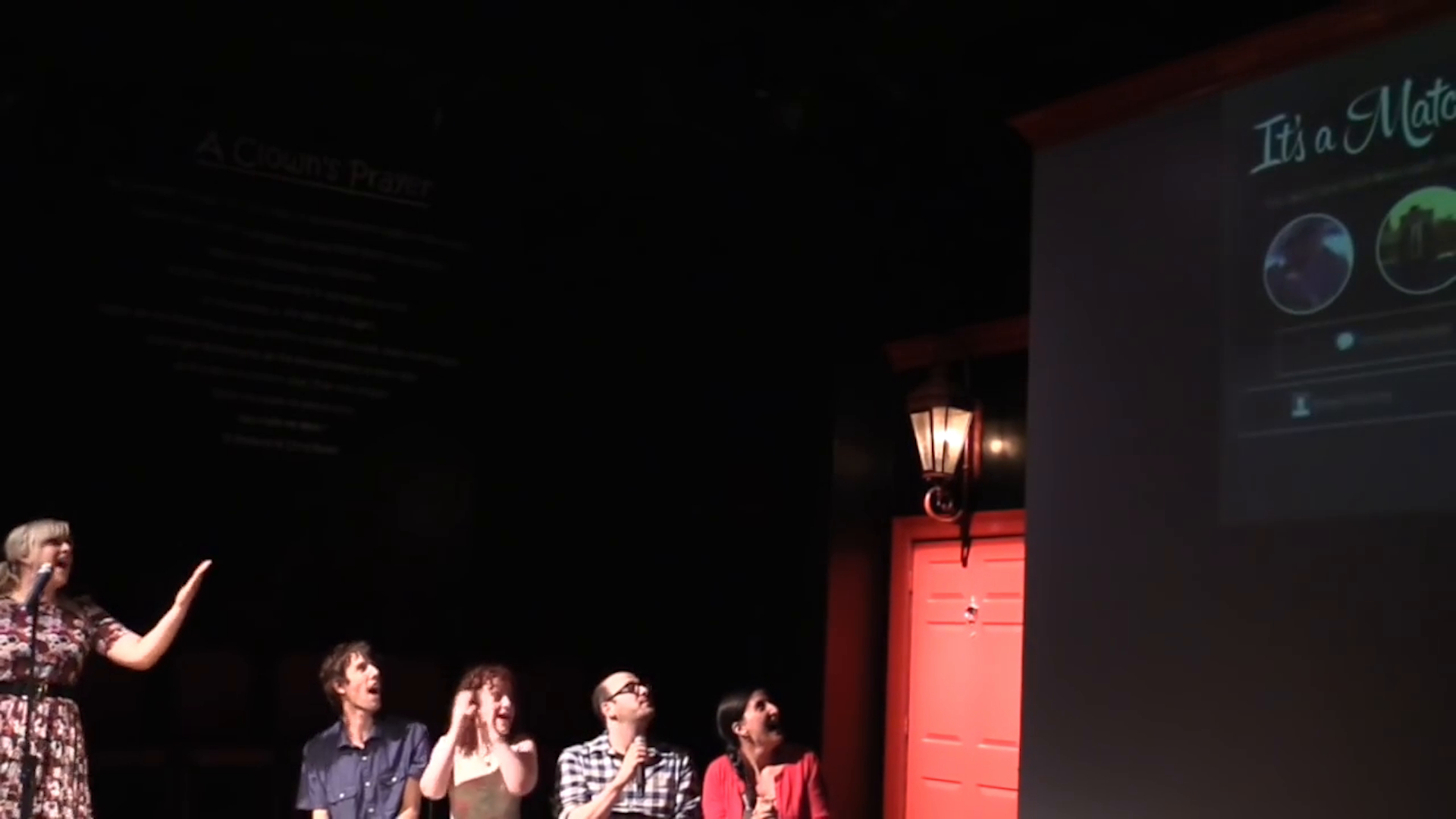
Source details — DISC-0067-FRAME-11
Frame 11 — A stage photograph with a projected match screen
Observed at 03:19.866 in the original recording.
Visible slide text
It's a [remainder of projected heading cropped/unreadable]
Editorial note: Photograph retained. Most projected app text and the background chalkboard are too dark, blurred, or cut off to transcribe confidently; wording is not borrowed from the earlier screen.
Source details — DISC-0067-FRAME-12
Frame 12 — Presentation title and author
Observed at 03:39.853 in the original recording.
Visible slide text
AI Human Impact Updating ESG Investing for AI-Intensive Companies
James Brusseau Philosophy Pace University, NYC jbrusseau@pace.edu
Editorial note: The background inkblot and binary digits are preserved in the image. Small-cap lettering is rendered in ordinary title case.
James Brusseau speech
Regardless, this is the point. Novel dilemmas are emerging between humans and AI, and we haven't developed tools to manage them. In fact, we're so far behind that the most penetrating explorations in AI ethics today are not being done in academic libraries but in noisy bars in Brooklyn.
The title of this presentation is AI Human Impact, and the proposal is that one way to develop an ethical response to AI is through financial investors. And we have a successful model which is environmental social and governance investing where companies are rated not only in terms of their financial strength, but in terms of their carbon footprint, their global effect on poverty and hunger, and similar human sustainability metrics.
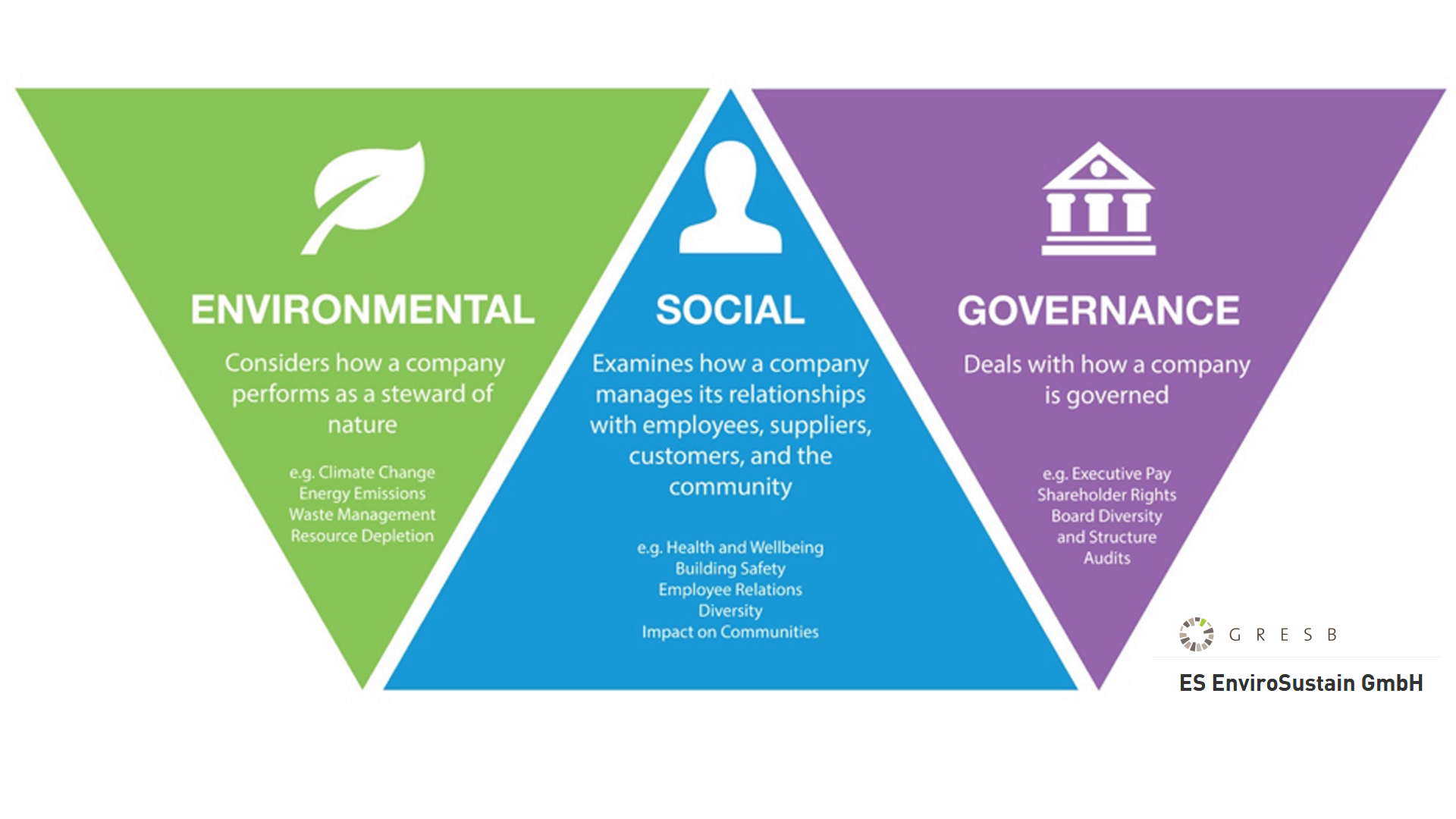
Source details — DISC-0067-FRAME-13
Frame 13 — Environmental, social, and governance diagram
Observed at 03:59.706 in the original recording.
Visible slide text
ENVIRONMENTAL Considers how a company performs as a steward of nature e.g. Climate Change Energy Emissions Waste Management Resource Depletion
SOCIAL Examines how a company manages its relationships with employees, suppliers, customers, and the community e.g. Health and Wellbeing Building Safety Employee Relations Diversity Impact on Communities
GOVERNANCE Deals with how a company is governed e.g. Executive Pay Shareholder Rights Board Diversity and Structure Audits
GRESB ES EnviroSustain GmbH
Editorial note: Diagram retained as an image; text is transcribed in left-to-right column order. Credit marks are preserved.
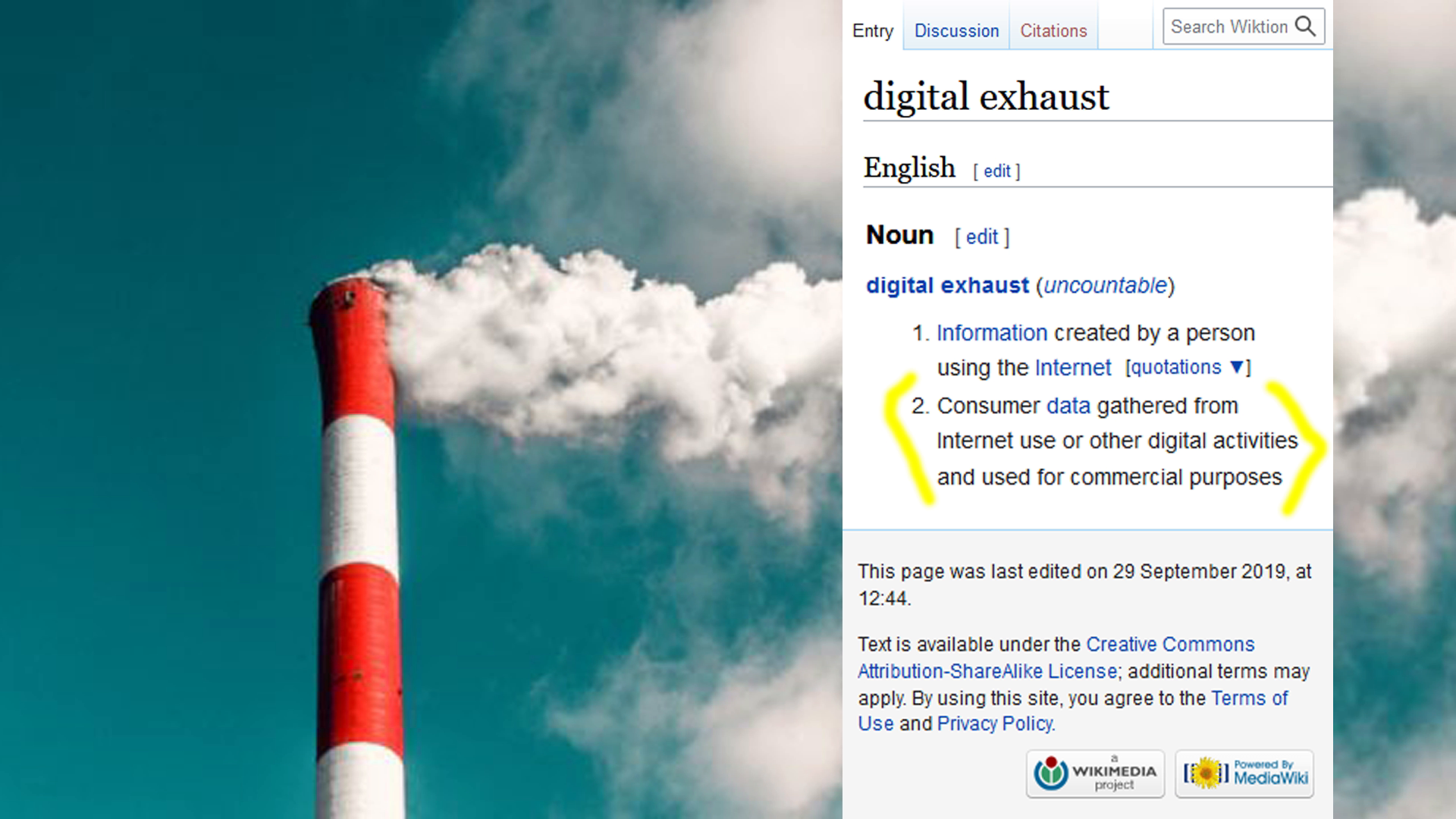
Source details — DISC-0067-FRAME-14
Frame 14 — Digital exhaust dictionary inset over a smokestack photograph
Observed at 04:19.693 in the original recording.
Visible slide text
[…] Search Wiktion[search box text cropped]
digital exhaust digital exhaust (uncountable)
[…]
- Consumer data gathered from
Internet use or other digital activities and used for commercial purposes
This page was last edited on 29 September 2019, at 12:44.
Text is available under the Creative Commons Attribution-ShareAlike License; additional terms may apply. […]
a WIKIMEDIA project […]
Editorial note: Dictionary text is quoted as displayed. Highlighting and the photograph remain in the original full frame.
James Brusseau speech
The problem is that ESG strategies were built for the industrial economy. The digital economy defines the words of human impact differently. The leading challenges are no longer about collectives and their well-being, but individuals wrestling for control of their own personal information and their own lives in the midst of big data machines. So, how would it work?
Source details — DISC-0067-FRAME-15
Frame 15 — Principles for evaluation: comparison table
Observed at 04:39.679 in the original recording.
Visible slide text
Set Principles for Evaluation
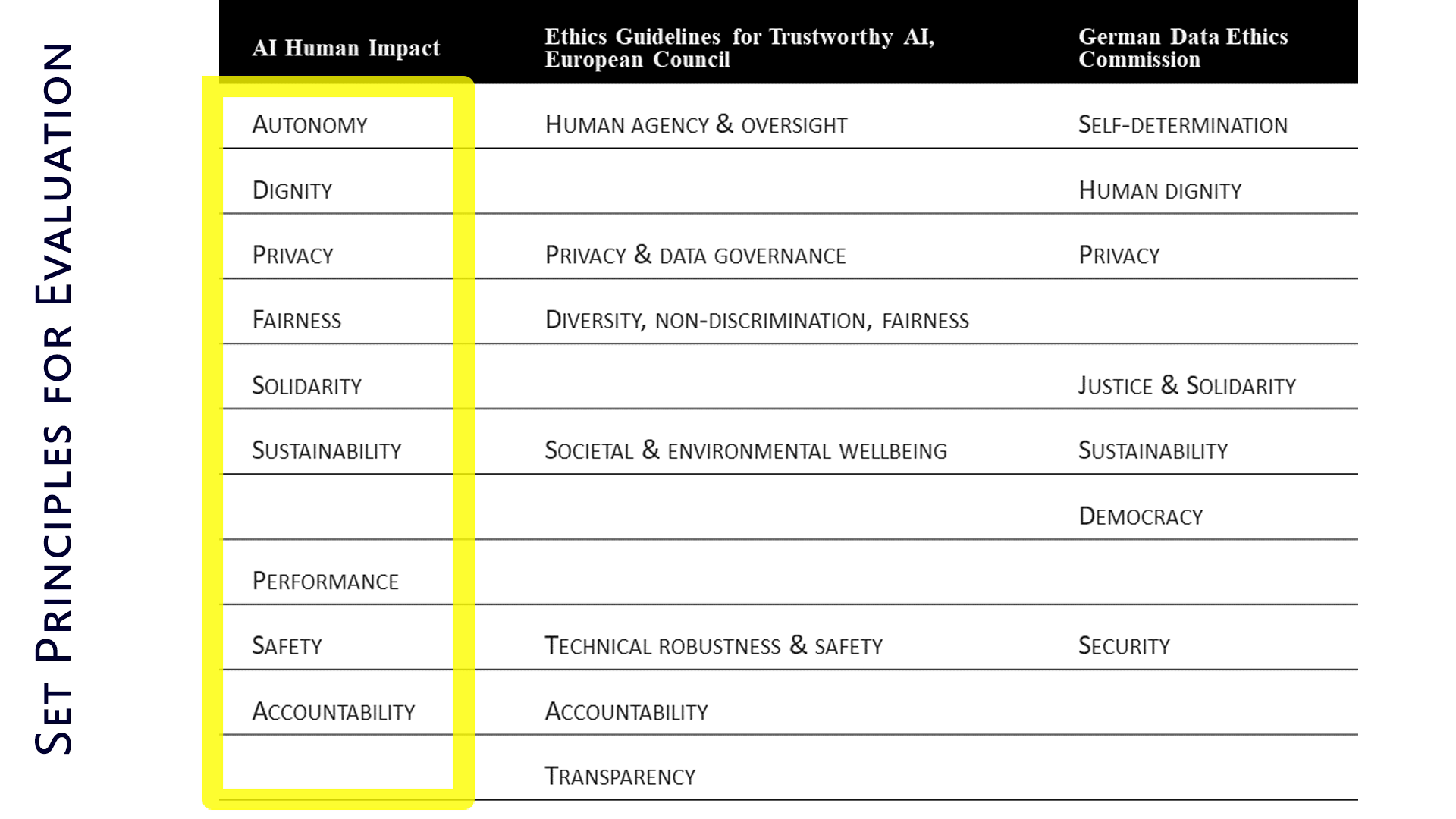
AI Human Impact Ethics Guidelines for Trustworthy AI, European Council German Data Ethics Commission Autonomy Human agency & oversight Self-determination Dignity Human dignity Privacy Privacy & data governance Privacy Fairness Diversity, non-discrimination, fairness Solidarity Justice & Solidarity Sustainability Societal & environmental wellbeing Sustainability Democracy Performance Safety Technical robustness & safety Security Accountability Accountability Transparency
Editorial note: Original table image retained, including blank cells and the highlighted first column. Small-cap words are rendered in ordinary case. The slide's European Council attribution is preserved as displayed.
James Brusseau speech
First, we need metrics customized to measure the human effects of AI. The set employed here is distilled from the European Council and also from academic ethics. Next, how could they be applied to an AI-intensive company?
Source details — DISC-0067-FRAME-16
Frame 16 — Facial-recognition paper inset and smart-glasses imagery
Observed at 04:59.666 in the original recording.
Visible slide text
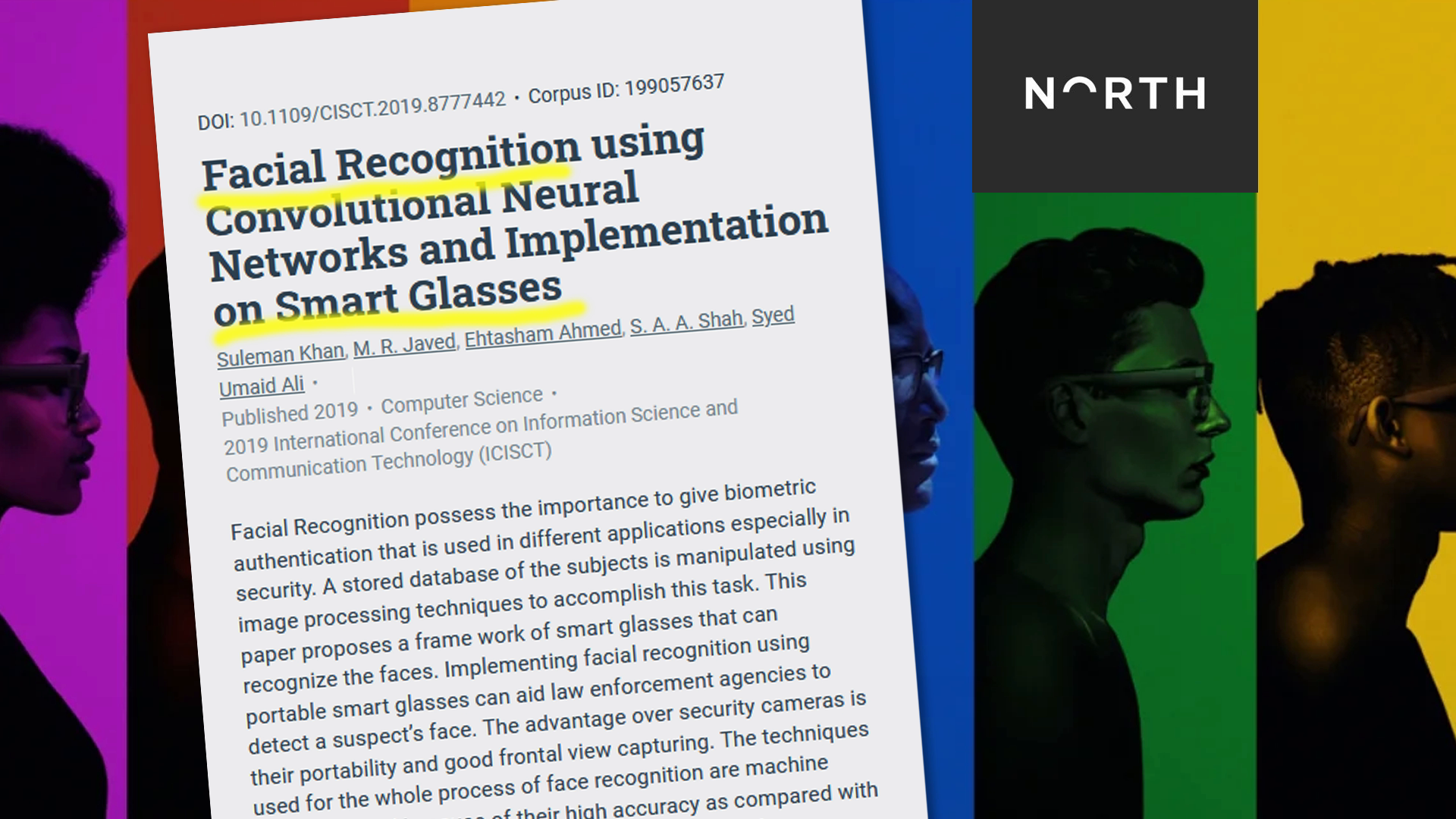
DOI: 10.1109/CISCT.2019.8777442 · Corpus ID: 199057637
Facial Recognition using Convolutional Neural Networks and Implementation on Smart Glasses
Suleman Khan, M. R. Javed, Ehtasham Ahmed, S. A. A. Shah, Syed Umaid Ali Published 2019 · Computer Science · 2019 International Conference on Information Science and Communication Technology (ICISCT)
[…]
NORTH
Editorial note: Paper quotation, title, byline, DOI, conference name, and NORTH wordmark are preserved as displayed. The inset runs beyond the bottom edge; the abstract is not completed from outside knowledge. Product photographs remain image assets.
James Brusseau speech
Say, one blending smart glasses and facial recognition. These glasses let you know about the person who just stepped into your elevator – a celebrity? Pickpocket? Potential client available? With the glasses, you'd know.

James Brusseau speech
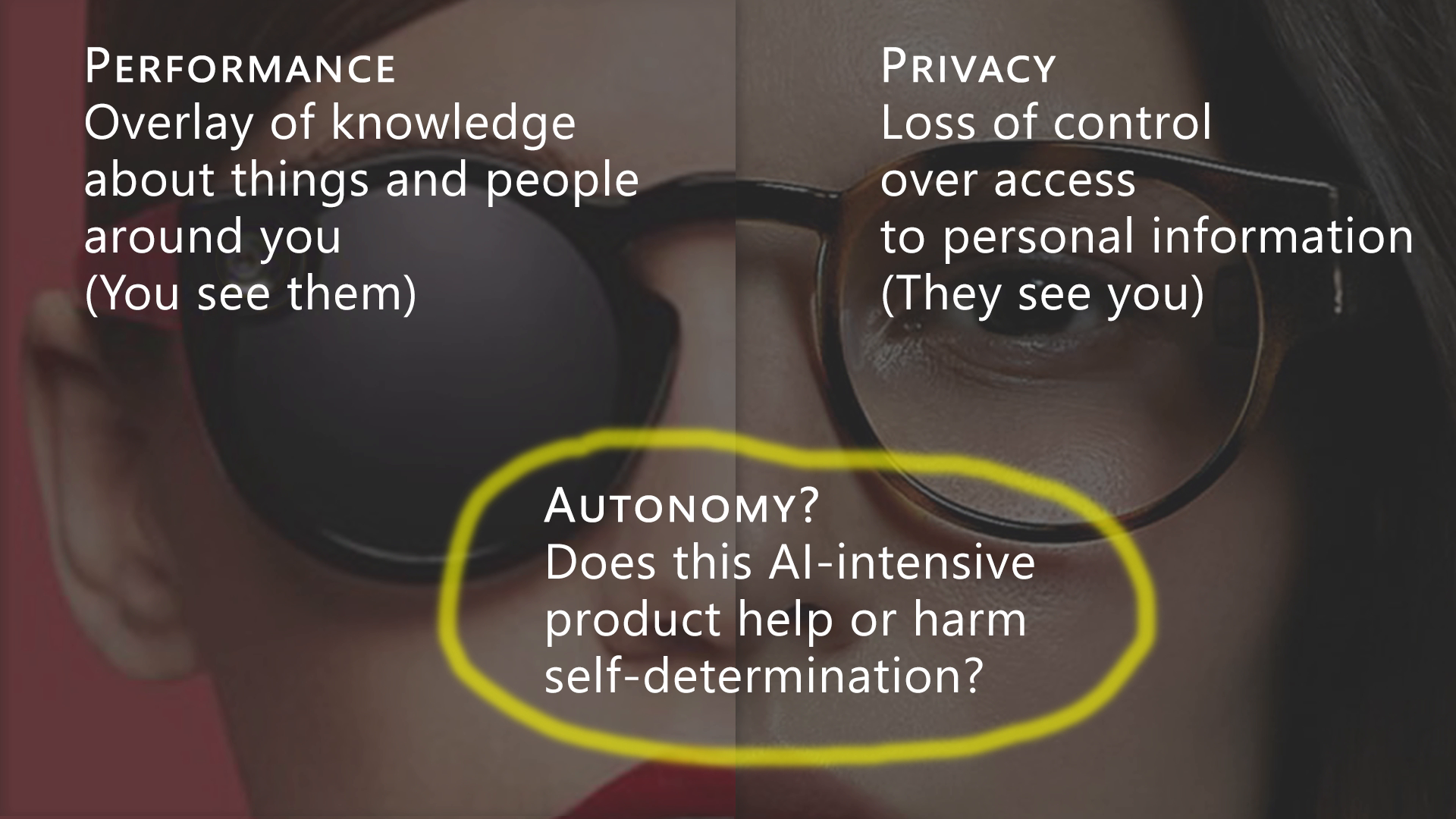
But there is a tension. On one side, there's performance – an overlay of knowledge about things and people around you. You see them. On the other side, there's privacy lost. They see you. The result is an AI dilemma about autonomy. Does this AI-intensive product help or harm self-determination? Investors will be able to decide for themselves, they even have a financial interest, if technology serving human autonomy is more likely to succeed in the marketplace.
Source details — DISC-0067-FRAME-18
Frame 18 — Performance, privacy, and autonomy overlay
Observed at 05:39.639 in the original recording.
Visible slide text
Performance Overlay of knowledge about things and people around you (You see them)
Privacy Loss of control over access to personal information (They see you)
Autonomy? Does this AI-intensive product help or harm self-determination?
Editorial note: Text overlay is transcribed separately from the speech. The photographs and yellow oval remain in the image.
Source details — DISC-0067-FRAME-19
Frame 19 — AI Human Impact scorecard
Observed at 05:59.626 in the original recording.
Visible slide text
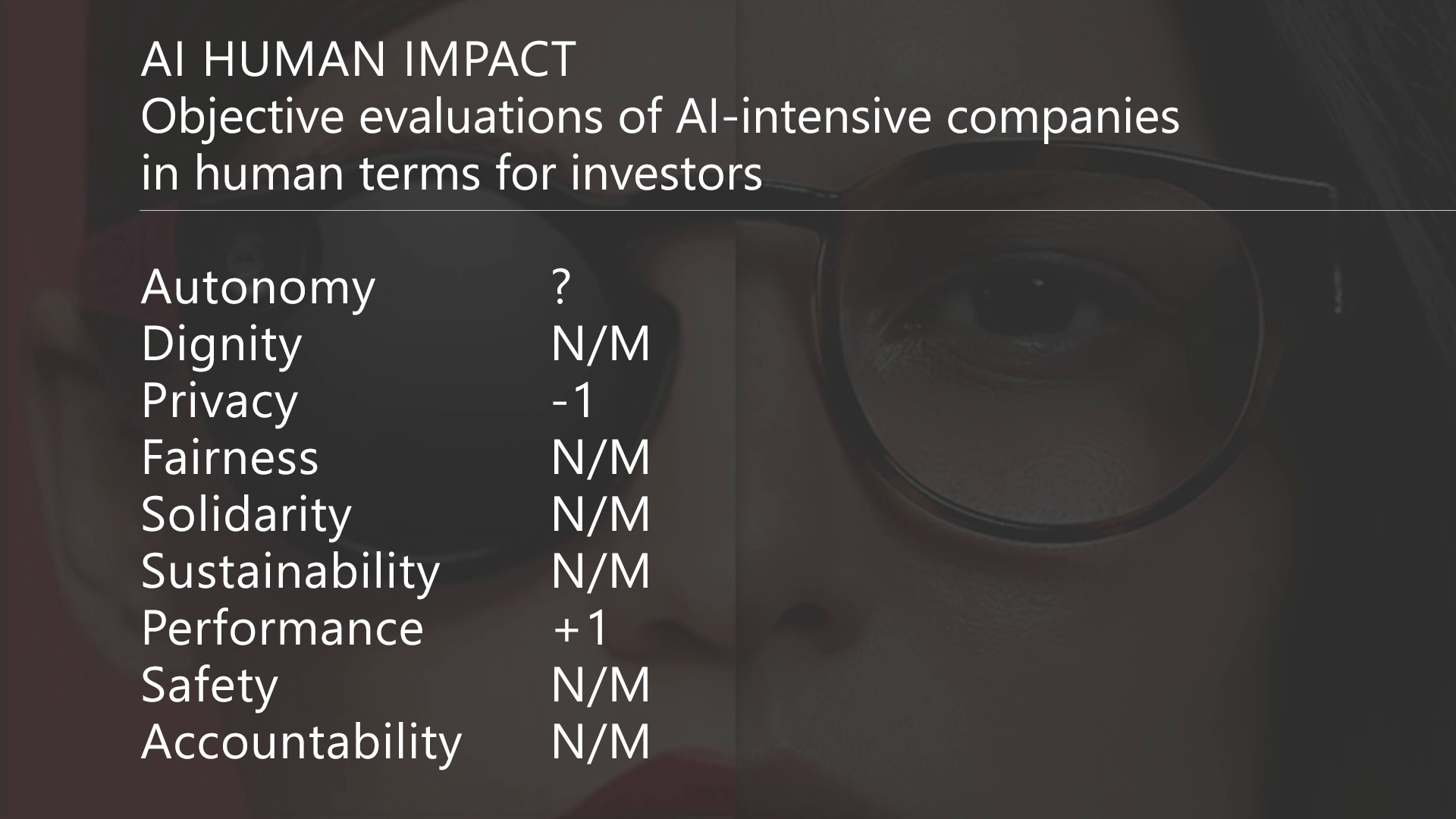
AI HUMAN IMPACT Objective evaluations of AI-intensive companies in human terms for investors
Autonomy ? Dignity N/M Privacy -1 Fairness N/M Solidarity N/M Sustainability N/M Performance +1 Safety N/M Accountability N/M
Editorial note: Scorecard retained as an image. Values are copied as displayed, without resolving the autonomy question mark.
James Brusseau speech
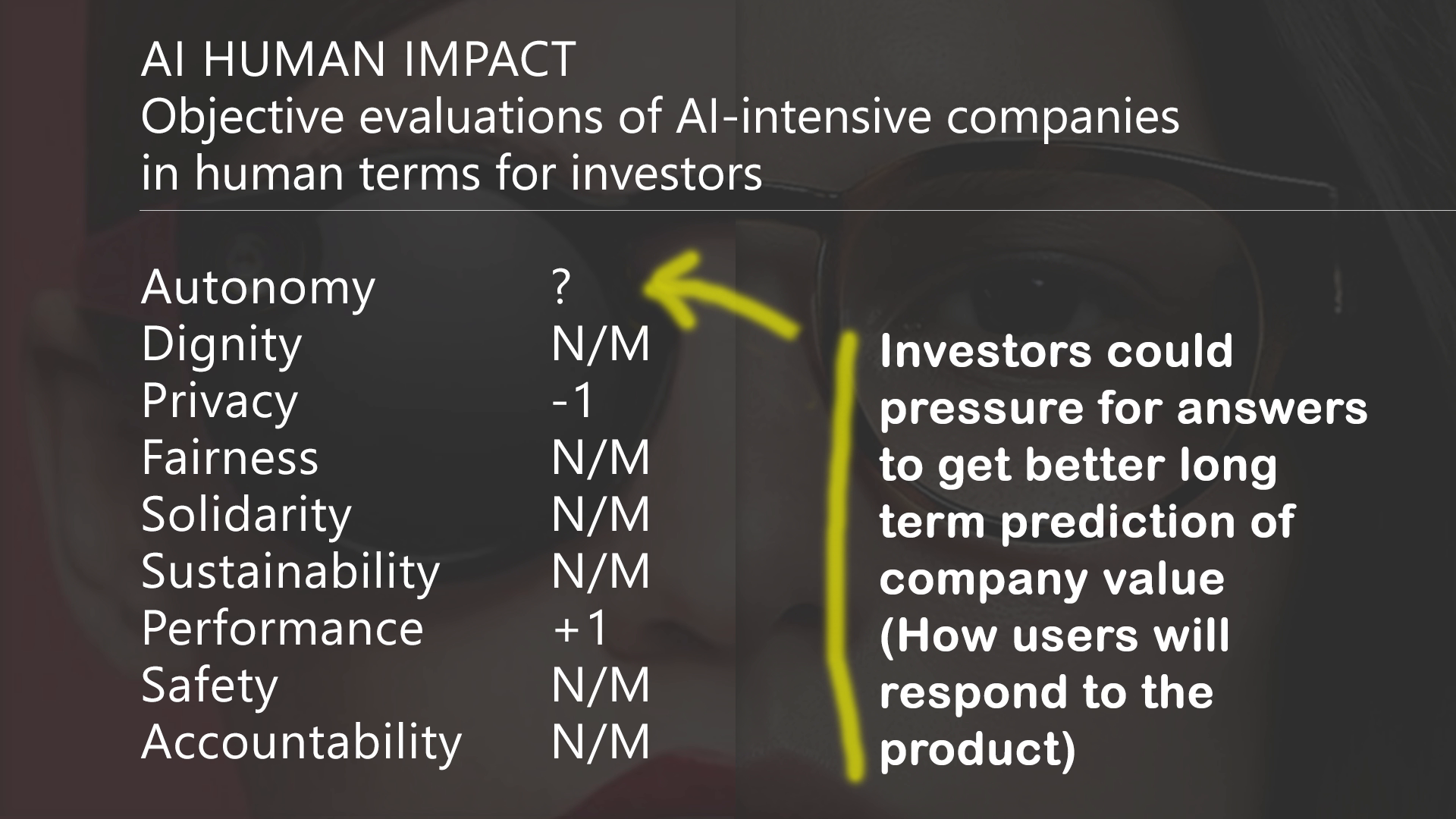
Here's the company scored ethically on a scale of negative 1-0-1. NM means not material and distinct products and companies will present different salient categories. The larger idea is to delineate the company's ethical profile so it can work alongside traditional financial information.
Source details — DISC-0067-FRAME-20
Frame 20 — Scorecard with investor annotation and arrow
Observed at 06:19.613 in the original recording.
Visible slide text
AI HUMAN IMPACT Objective evaluations of AI-intensive companies in human terms for investors
Autonomy ? Dignity N/M Privacy -1 Fairness N/M Solidarity N/M Sustainability N/M Performance +1 Safety N/M Accountability N/M
Investors could pressure for answers to get better long term prediction of company value (How users will respond to the product)
Editorial note: Meaningful build on the previous scorecard: the investor text and yellow arrow pointing toward the autonomy question mark are newly present.
James Brusseau speech
Finally, and besides helping investors make more informed and better decisions, AI human impact also isolates areas where activist investors may want to focus their attention. There remains a lot of work to do.