Inherited editorial introduction (source unchanged)
Acceleration is the Right Ethics for Web3
Accepted speech wording, attribution and paragraph presentation are preserved. The combined edition’s slide content and placements are accepted; stages 1–7 are complete in this edition’s selected scope. Stage 8 remains pending; retrieval is inactive. Visual text and AI-generated descriptions remain separate from speech. Paragraph placement is editorial; recording display times and exact frame timestamps are unchanged.
Source details — Visual — Overview
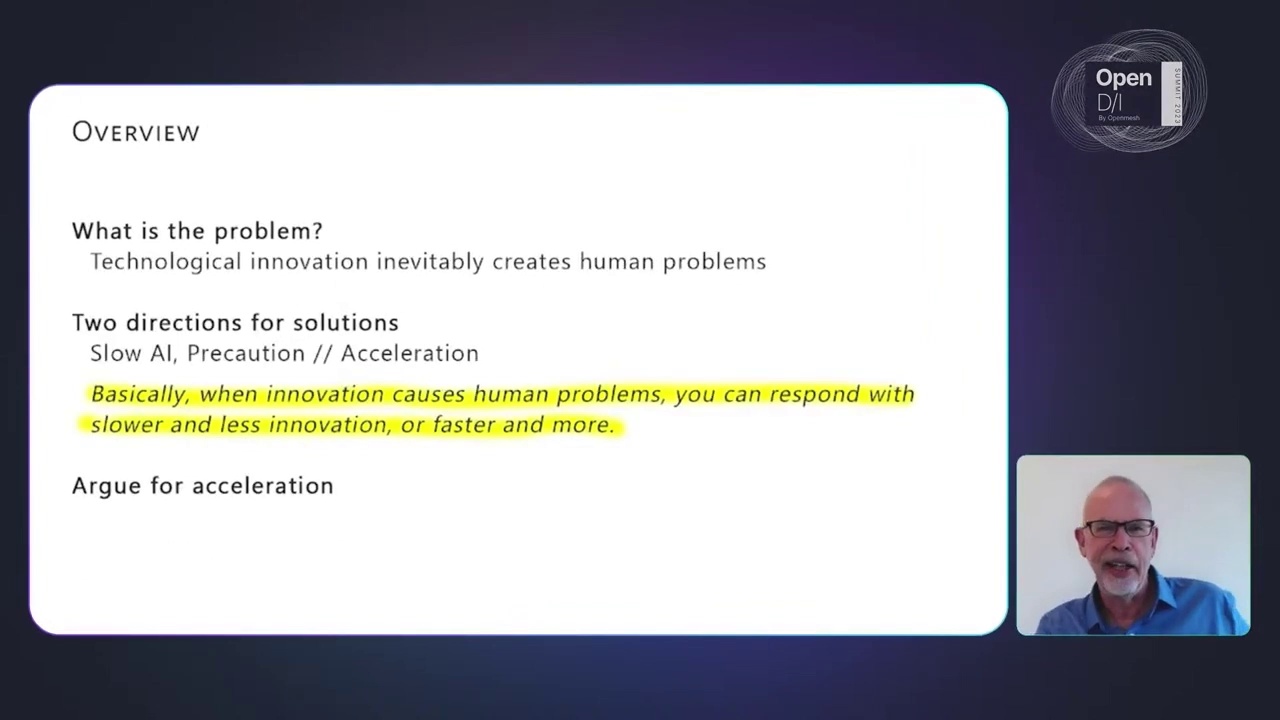
Visual — Overview
DISC-0074::VIS-001::OCC-01 · Display occurrence: approximately 60.000–152.000 seconds in the original video. Boundaries are estimated.
Exact frame PTS: 60.000000 seconds in original video.
Visible slide text — not speech
Overview
What is the problem?
Technological innovation inevitably creates human problems
Two directions for solutions
Slow AI, Precaution // Acceleration
Basically, when innovation causes human problems, you can respond with slower and less innovation, or faster and more.
Argue for acceleration
Visual limitations: Small-cap headings normalized; highlighted words represented as emphasis. Event branding and desktop/video chrome omitted. OCR used as local draft aid, corrected against saved source frame.
James Brusseau speech
James Brusseau: Perfect. So, thanks for having me at the Open Infrastructure and Open Data event. What I thought I would do is quickly talk about why I believe that acceleration ethics is a natural ethics for this community in this way of working in the technological space. So, the title of my presentation is Acceleration is the Right Ethics for Web 3. And what I will do is, first, just talk very briefly about what acceleration ethics is. And then I will give two examples to show how I believe that it fits almost organically with open data and open infrastructure. So let's go. So first, the problem that inevitably arises around technology is that almost every solution we have, almost everything we do which solves a problem also gives rise to some subsequent new problem. And the question is, well, how do we manage these problems which AI innovation or technological innovation is producing? There are two general responses. One is the so-called slow AI movement, which seeks to solve these problems by minimizing their existence by having to some extent less artificial intelligence innovation or less technological innovation, the idea being that if we move more slowly and not so ambitiously, the kinds of problems that arise will be fewer and more easily managed. That's one possibility.
By contrast, the possibility that I am going to advocate here is the acceleration possibility. And this approach starts with the idea that the best way to solve the kinds of problems that technological innovation creates is with more innovation. So in a certain sense, innovation solves innovation's own problems. That general approach is called acceleration ethics and that's what I'm going to talk about today briefly. These are the five elements that are normally attributed to acceleration ethics.
Source details — Visual — Five elements
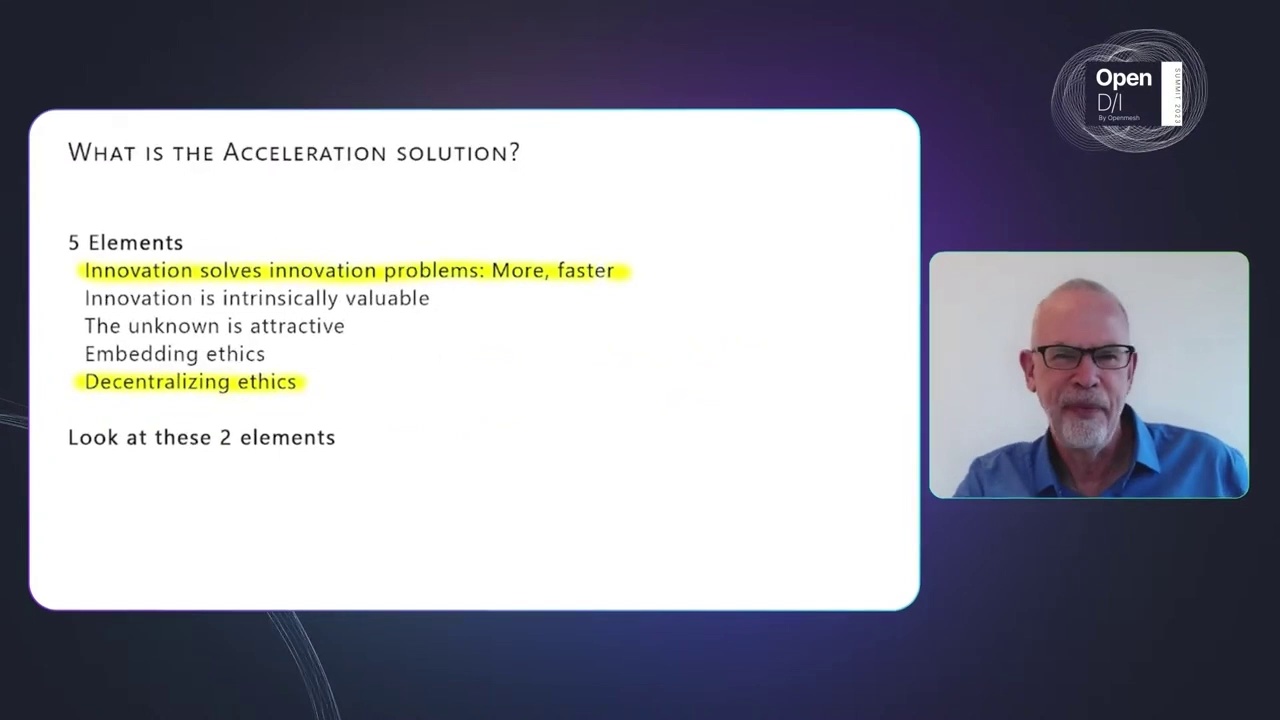
Visual — Five elements
DISC-0074::VIS-002::OCC-01 · Display occurrence: approximately 154.000–204.000 seconds in the original video. Boundaries are estimated.
Exact frame PTS: 154.000000 seconds in original video.
Visible slide text — not speech
What is the Acceleration solution?
5 Elements
- Innovation solves innovation problems: More, faster
- Innovation is intrinsically valuable
- The unknown is attractive
- Embedding ethics
- Decentralizing ethics
Look at these 2 elements
Visual limitations: Small-cap headings normalized; highlighted words represented as emphasis. Event branding and desktop/video chrome omitted. OCR used as local draft aid, corrected against saved source frame.
James Brusseau speech
The first is an overall approach. I've already begun to talk about that. The idea that innovation solves innovation problems. Then there is the idea that innovation is intrinsically valuable, the idea that the uncertainty in what is unknown is magnetic or attractive. There's the idea that ethics should be embedded in technological processes and there's the idea that ethics should be decentralized. We have limited time today so I thought I would just look quickly at the first and the last, as a way of giving an example of or a sense of the way that acceleration ethics works. So we'll just look at those two and I think we'll look at just one example from each of them. So in the first subject we're going to, or the first element of acceleration ethics that we're going to talk about is this idea that innovation solves innovation problems.
Source details — Visual — Digital redlining
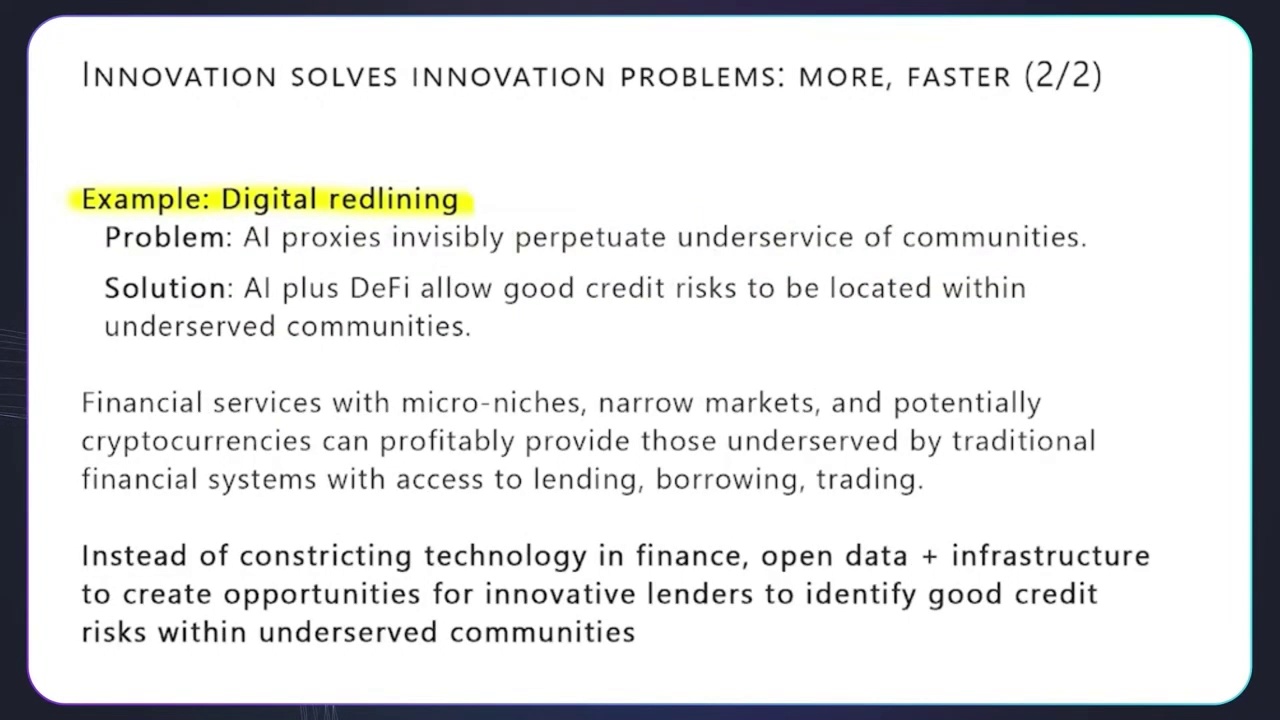
Visual — Digital redlining
DISC-0074::VIS-003::OCC-01 · Display occurrence: approximately 206.000–532.000 seconds in the original video. Boundaries are estimated.
Exact frame PTS: 206.000000 seconds in original video.
Visible slide text — not speech
Innovation solves innovation problems: more, faster (2/2)
Example: Digital redlining
Problem: AI proxies invisibly perpetuate underservice of communities.
Solution: AI plus DeFi allow good credit risks to be located within underserved communities.
Financial services with micro-niches, narrow markets, and potentially cryptocurrencies can profitably provide those underserved by traditional financial systems with access to lending, borrowing, trading.
Instead of constricting technology in finance, open data + infrastructure to create opportunities for innovative lenders to identify good credit risks within underserved communities
Visual limitations: Small-cap headings normalized; highlighted words represented as emphasis. Event branding and desktop/video chrome omitted. OCR used as local draft aid, corrected against saved source frame.
James Brusseau speech
And the example I have here is this question of digital redlining. That is, the idea that to begin with we prefer, we hope, that lending and finance and banking kind of services are distributed with equal opportunities across the population. However there are racial gender and other kinds of discrimination that have been historically cooked into the kind of data that banks and other lending institutions use when they decide things like loans. And a problem that we have with artificial intelligence, technology in general, when it's used as a tool to help us decide who does and who does not get loans, a problem we have is that sometimes those discriminatory traits get incorporated into the data through proxies, through things like the zip code where someone lives. And the result is that certain groups end up being adversely affected or discriminated against when it comes to loan technology. So, the basic situation is the following. On the surface, it looks like technology is in a sense better than human beings to decide who should get loans and who should not, because obviously a technology is not going to be in itself, in and of itself, racist or sexist or what have you. But as I say, what actually happens when you put this technology to work is that it learns from data that itself has been constructed on, at least to some extent, and in some cases, not always, not everywhere, but sometimes and in some places on foundations which are discriminatory. So at the end, the AI produces discriminatory outcomes when it comes to lending and other financial services.
And so going back to our original distinction, there are two ways to solve this problem. One is we can limit the power of the artificial intelligence. This is the so-called slow AI movement, what we try and do here is we say, look, we need to make sure that we understand why and how the AI makes its lending decisions so that we can screen out the discriminatory outcomes. And of course, this is a positive solution, but I don't think that it necessarily works better than the other solution, which is to say, instead of simplifying the artificial intelligence and instead of limiting its use, we should go the other way and we should let innovation try to solve this problem of discrimination. And one way it could do that, in one way that fits very well with open infrastructure and open data communities, is by allowing wide access to the kinds of technology which decide where loans go and wide access to the data, with the idea that new companies—say, decentralized finance companies or cryptocurrency kinds of companies, very agile, technologically oriented kinds of companies—can take this data and develop new ways of locating good credit risks in underserved communities. So instead of saying we're going to slow down the artificial intelligence and have less technology, now what we say is we're going to have more data, more open infrastructure, more technology. And we're going to use this to go in and, again, to find within generally underserved communities those risks which are good and those opportunities to lend within a kind of conventional structure—that is, lending for profit, but lending to communities which have been overlooked in the past.
So that's one example of what acceleration looks like when we have the fundamental problem. We all agree it's a problem: sometimes technological decisions about loans lead to discriminatory outcomes. Now we say that instead of slowing down the technology, making it more transparent and therefore less accurate, we go the other way. We say let's make technology more accurate. Let's hike or drive the technology further in order to use these, develop new tools to find good credit risks. So that's a little bit more in-depth look at what it means to say that innovation solves innovation's problems. So innovation begins, it creates this problem—but doesn't create the problem, but it perpetuates the problem of discrimination—and then more innovation can solve the problem. All right. So that's one example of what acceleration ethics looks like. And it's one case where I think this kind of ethics fits your open data and open infrastructure communities better than the other option, which is the slow AI movement.
Source details — Visual — Crypto exchanges and fraud
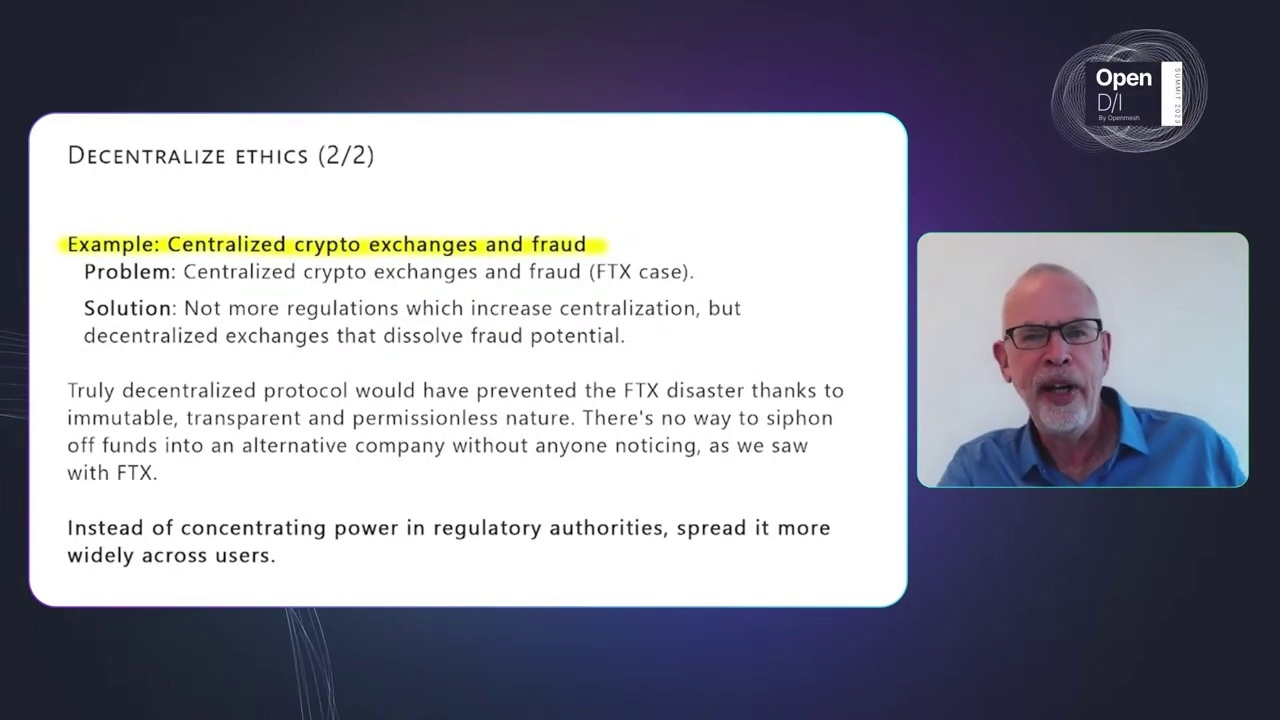
Visual — Crypto exchanges and fraud
DISC-0074::VIS-004::OCC-01 · Display occurrence: approximately 536.000–744.000 seconds in the original video. Boundaries are estimated.
Exact frame PTS: 536.000000 seconds in original video.
Visible slide text — not speech
Decentralize ethics (2/2)
Example: Centralized crypto exchanges and fraud
Problem: Centralized crypto exchanges and fraud (FTX case).
Solution: Not more regulations which increase centralization, but decentralized exchanges that dissolve fraud potential.
Truly decentralized protocol would have prevented the FTX disaster thanks to immutable, transparent and permissionless nature. There’s no way to siphon off funds into an alternative company without anyone noticing, as we saw with FTX.
Instead of concentrating power in regulatory authorities, spread it more widely across users.
Visual limitations: Small-cap headings normalized; highlighted words represented as emphasis. Event branding and desktop/video chrome omitted. OCR used as local draft aid, corrected against saved source frame.
James Brusseau speech
Then we'll quickly jump ahead to a second example. And this is the idea of decentralization in ethics. So this is the fifth element. The idea that innovation solves innovation problems is the first element of acceleration ethics, isn't the fifth element. And what I want to say here is that the idea of decentralization itself solves important contemporary problems. So just in the news, I've been watching now, just in these last few days, the trial of... The name of this specific character, excuse me, but the exchange was FTX and he was a criminal, just stealing money left and right from all these different exchanges. This is obviously a problem when financial institutions—in this case a cryptocurrency exchange—are stealing money from their clients. Again, here there are two kinds of solutions. One, we could look for more centralization. This would be more government laws and regulation. This would be greater government oversight. And of course these kinds of solutions have merit and they respond to a real problem. But acceleration ethics goes the other way. Acceleration ethics is the idea that we would use decentralized techniques to, in a certain sense, regulate or control the kinds of things that happen in the world. So as opposed to centralized regulation by the government, we want to aim for decentralized regulation as would be provided by users themselves, for example.
Now, we might see this in generative artificial intelligence and users' responses to the kinds of images that are produced or the kinds of texts that are produced by the recent generative technology. But here in this example, what we're thinking of would be a decentralized cryptocurrency exchange. The exchange obviously has the advantage that everyone can see where the money is coming from and going to, and so you're not going to have this kind of secret slippage or this kind of secret splicing out of some amount of money as we saw in the FTX exchange. So the idea of decentralization and again open data, open infrastructure, is the idea that within ethics we better regulate or, in a sense,, we better control the direction and the humanist uses of our technology by letting users themselves participate in the decisions about where money goes and where money doesn't go. So that's a second example of the way acceleration ethics works. In a world in which we all agree that there are people trying to do bad things, the kinds of controls or guidelines that we build in order to limit these bad things come from decentralized authorities. They come from users more than government. They come from what is actually happening and the way people are spending or moving their money within a network, as opposed to a set of rules which precede the network and try to preempt what I'm doing.
Source details — Visual — Overall conclusion
Visual — Overall conclusion
DISC-0074::VIS-005::OCC-01 · Display occurrence: approximately 748.000–772.000 seconds in the original video. Boundaries are estimated.
Exact frame PTS: 748.000000 seconds in original video.
Visible slide text — not speech
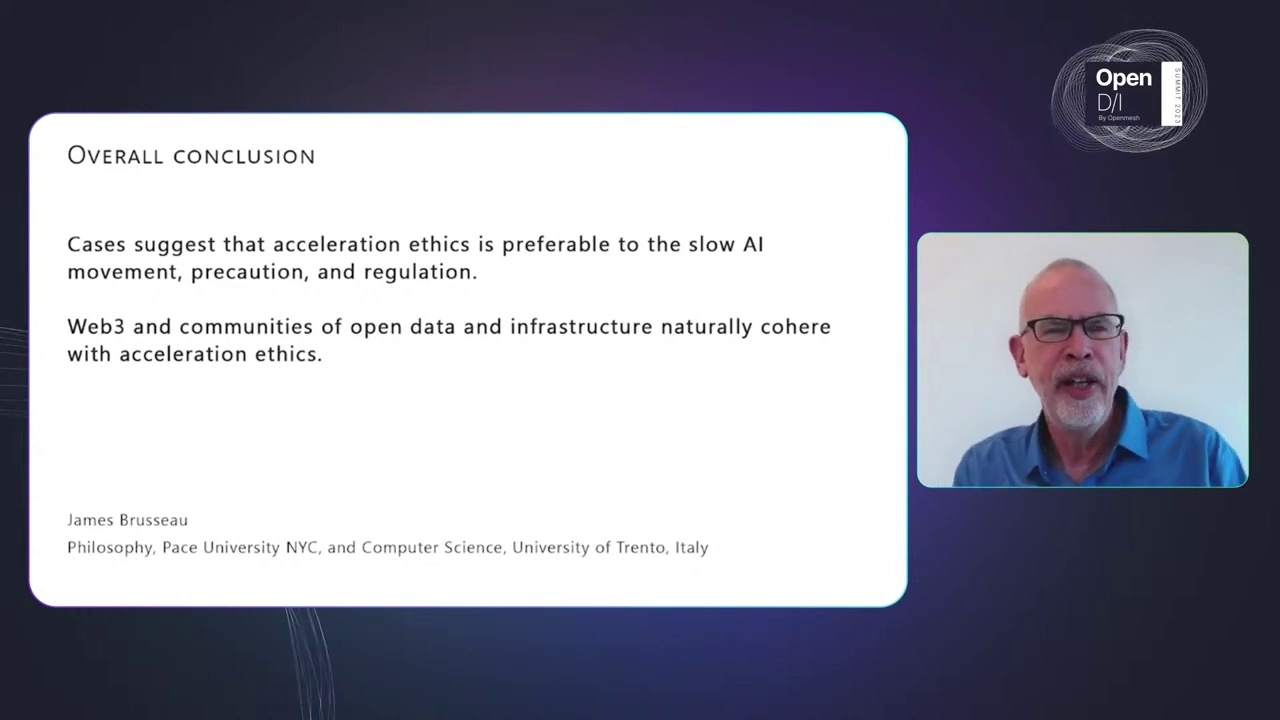
Overall conclusion
Cases suggest that acceleration ethics is preferable to the slow AI movement, precaution, and regulation.
Web3 and communities of open data and infrastructure naturally cohere with acceleration ethics.
James Brusseau
Philosophy, Pace University NYC, and Computer Science, University of Trento, Italy
Visual limitations: Small-cap headings normalized; highlighted words represented as emphasis. Event branding and desktop/video chrome omitted. OCR used as local draft aid, corrected against saved source frame.
James Brusseau speech
So that's the difference between centralization in regulation and in ethics and decentralization. And as I say, the idea is that acceleration ethics participates in decentralization. So that's just a quick example of why I believe that Acceleration Ethics works better for the community of people who are here gathered at this event. And I've given two fairly brief examples of two elements of Acceleration Ethics. There are other elements and a fuller picture that I would be happy to give if you would like to talk later. In any case, thanks for joining us in this brief presentation.