Inherited editorial introduction (source unchanged)
Brusseau Only Ital-IA 2023 - sessione plenaria- 31 maggio
Approved speech wording and attribution are preserved; paragraph formatting is awaiting review. Visual text and AI-generated descriptions remain separate from speech. Paragraph placement is editorial; recording display times and exact frame timestamps are unchanged.
Source details — Visual — Goal of the panel
Visual — Goal of the panel
DISC-0076-PLENARY::VIS-001::OCC-01 · Display occurrence: approximately 9.000–25.000 seconds in the original video. Boundaries are estimated.
Exact frame PTS: 12.000000 seconds in original video.
Visible slide text — not speech
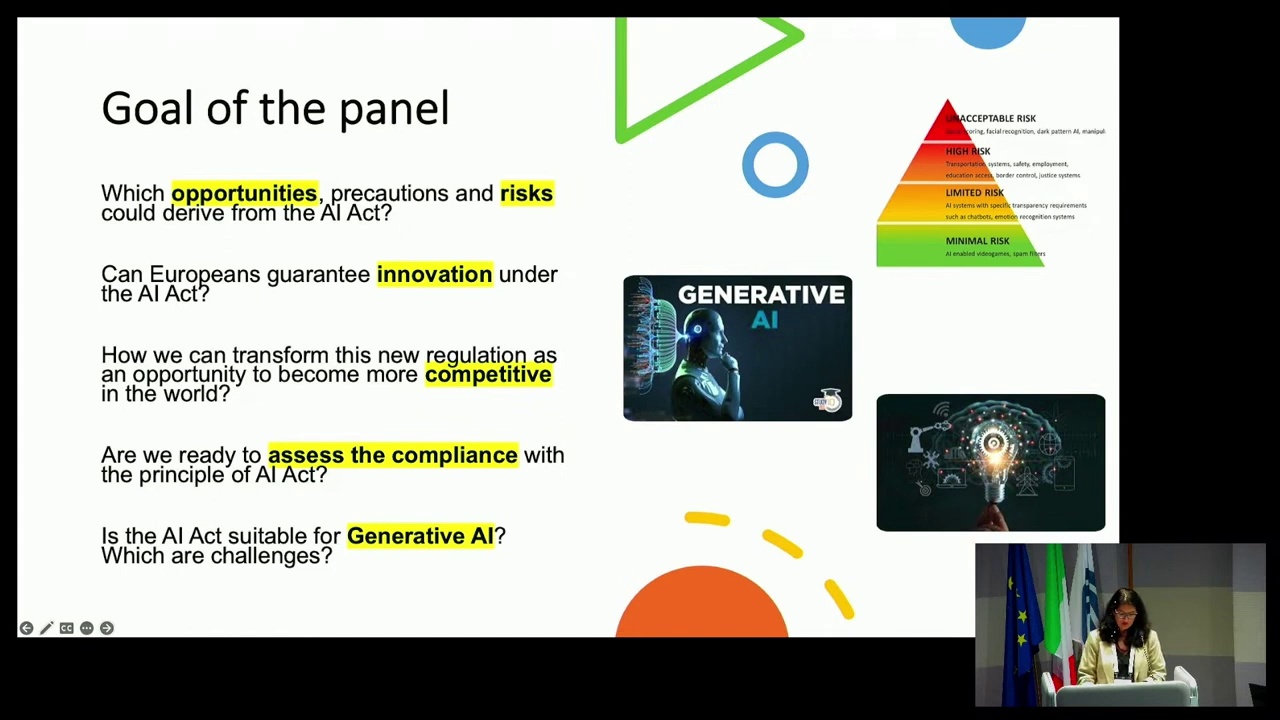
Goal of the panel
Which opportunities, precautions and risks could derive from the AI Act?
Can Europeans guarantee innovation under the AI Act?
How we can transform this new regulation as an opportunity to become more competitive in the world?
Are we ready to assess the compliance with the principle of AI Act?
Is the AI Act suitable for Generative AI?
Which are challenges?
Risk pyramid (embedded graphic)
- UNACCEPTABLE RISK
[Small explanatory wording partially unreadable; not reconstructed.]
- HIGH RISK
Transportation systems, safety, employment, education access, border control, justice systems
- LIMITED RISK
AI systems with specific transparency requirements such as chatbots, emotion recognition systems
- MINIMAL RISK
AI enabled videogames, spam filters
GENERATIVE AI
AI-generated visual description — not speech or approved wording
A four-level pyramid orders risk from green minimal risk at the base, through limited and high risk, to red unacceptable risk at the apex. Separate robot and light-bulb illustrations accompany the panel questions. No source credit for those embedded illustrations is legible.
Visual limitations: Second appearance is the same slide in the PowerPoint editor, not a new slide. The first continuous run exceeds five seconds. Second occurrence is retained as a reference to the included slide, with no added transcription; its duration is not combined with the first. Yellow highlights represented as bold; small-cap heading normalized. Tiny pyramid wording marked unreadable where needed.
Other speaker (context) speech
Other speaker (context): Welcome to the last day of Italia 2023. So, now I want to give the floor to James Brusseau that can come here. And again, in this context, given also your expertise in business ethics, I would like to know your, let me say, opinion about how to transform the regulation, this human regulation in innovation if there is some opportunity for that. So, if I remember well, you have one slide, right?
Repeated visual — Visual — Goal of the panel
Visual — Goal of the panel
DISC-0076-PLENARY::VIS-001::OCC-02 · Display occurrence: approximately 27.000–30.000 seconds in the original video. Boundaries are estimated.
Short-display inclusion exception: Repeat of already included substantive slide in editor; reference retained, not a newly included sub-five-second slide.
Repeated appearance of DISC-0076-PLENARY::VIS-001. See its first transcription.
Other speaker (context) speech
Other speaker (context): Okay, thank you.
James Brusseau: Very surprisingly, I have an answer to her question on a slide already. Amazing. So, it seems to me that there are two problems. One is, you pass a law in New York City, you pass a law in D.C., you pass a law in Rome, you pass a law in Brussels, and by the time the law is actually ready to go, the technology has already gone. It's already in front of that law. So you'll have to go back and try and do it again. So I think that's one problem.
Source details — Visual — Displayed document: AI innovation and regulation
Visual — Displayed document: AI innovation and regulation
DISC-0076-PLENARY::VIS-002::OCC-01 · Display occurrence: approximately 90.000–440.000 seconds in the original video. Boundaries are estimated.
Exact frame PTS: 90.000000 seconds in original video.
Visible slide text — not speech
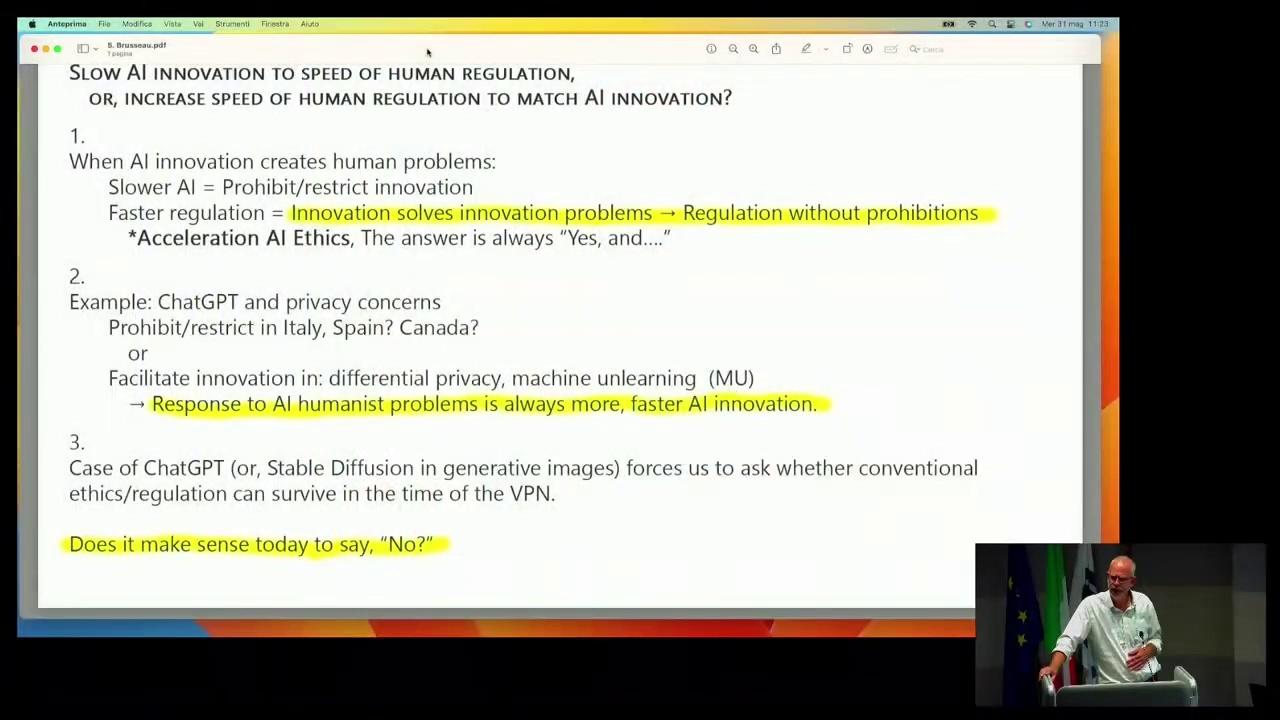
Slow AI innovation to speed of human regulation, or, increase speed of human regulation to match AI innovation?
- When AI innovation creates human problems:
- Slower AI = Prohibit/restrict innovation
- Faster regulation = Innovation solves innovation problems → Regulation without prohibitions
- Acceleration AI Ethics, The answer is always “Yes, and....”
- Example: ChatGPT and privacy concerns
- Prohibit/restrict in Italy, Spain? Canada?
- or
- Facilitate innovation in: differential privacy, machine unlearning (MU)
- → Response to AI humanist problems is always more, faster AI innovation.
- Case of ChatGPT (or, Stable Diffusion in generative images) forces us to ask whether conventional ethics/regulation can survive in the time of the VPN.
Does it make sense today to say, “No?”
Visual limitations: Displayed PDF filename is 5. Brusseau.pdf; document body transcribed from the video, not an external PDF. Desktop/menu chrome omitted. Yellow highlights represented as bold; typography and line breaks normalized.
James Brusseau speech
And then a second problem is that, especially amongst engineers, there is the fear that regulation is stifling innovation. It's not letting them make the advances they want to make. And I think that part of the reason for those two problems might be that we are thinking about regulation wrong. I think that what we've been trying to do so far, New York, D.C., Brussels, Rome, everywhere, what we've been trying to do is bring artificial intelligence down to the speed of conventional human ethics and conventional human regulation.
And what I want to propose instead is that we... Yes, first, yes. I'm used to being in my class and just wondering. I think that what we should do, what I'm going to propose that we do instead is that we try to increase the velocity of our ethics and our regulation to the speed of artificial intelligence. So that's the proposal. And what does that mean in practice? In practice, well it means a lot of things but I've got four minutes left so in practice one thing that it means is that when we have human problems that are created by artificial intelligence maybe it's a problem with privacy, maybe it's a problem with fairness, maybe it's a problem with explainability. When we have those kinds of problems, the solution is never to restrict the technology. The solution is never to say no to the technology.
Instead, if we're going to speed up or accelerate ethics, then I think what we need to do is use innovation itself to solve innovation problems. So AI innovation doesn't cause humanist problems, human problems? Yes, absolutely. But the solution then is not to restrict the AI, but instead to use the innovation itself, the same engine, to leap forward and solve those human problems. And then I think that the case of ChatGPT here in Italy and in Spain and in Canada is a really nice example of this. Clear human problems caused by this technology. Many problems. But let's just take a simple one, the privacy problem. So how do you manage that? It seems to me that when you're trying to slow AI down to human speeds, what you do is you say, okay, well, let's restrict this technology. Let's limit it. Let's slow it down. Let's stop it. Let's prohibit it.
But what I would say instead is we should take all that energy and instead apply it to innovation to advance things like differential privacy or machine unlearning. Differential privacy helps us to conceal the source of our personal information while allowing the usefulness of that information to continue for engineers. Or machine unlearning is the idea that we can use advanced programming, which is above my pay grade, to go back into big data processes and take out specific data points if we need to do that for personal reasons. The protection of copyright, protection of personal information. So these are just two examples of the way innovation can give us these kinds of values we're looking for and give us privacy, but it can do that without stifling innovation. And I think it can do that better than laws which try to restrict the use of innovation.
So fundamentally, the idea of AI ethics and the idea of AI regulation that I'm proposing is one where we use innovation to solve innovation's problems. And then, as a final point, it seems like it's just as a cultural note. I mean, as we all know, we were here. I was using ChatGPT for my classes. Suddenly one day I can't use it anymore, so what do I do? I hook up a virtual private network and get outside of Italy to use the technology. Yeah, I don't think that's a simple case. I think that's representative of what digital reality will look like. It's a place without geography, it's a place where the kind of rules that seek to limit based upon where you are will not work. So regardless of whether you prefer the conventional approach or the acceleration approach, I don't think there is any choice. I think the way digital reality works will require us to rethink what regulation is and as I say my proposal is that the best way to rethink that is to say let's use innovation to solve innovation problems instead of restrictions. Okay, that's my seven minutes I think. Thanks.