Inherited editorial introduction (source unchanged)
Predicting the unpredictable: re-engineering recommendation algorithms for freedom, society, and money
Approved speech wording and attribution are preserved; paragraph formatting is awaiting review. Visual text and AI-generated descriptions remain separate from speech. Paragraph placement is editorial; recording display times and exact frame timestamps are unchanged.
James Brusseau: I would like to start with a question, and I'm not sure what the answer to this is.
Source details — Visual — Pleasurable locked room
Visual — Pleasurable locked room
DISC-0083::VIS-001::OCC-01 · Display occurrence: approximately 16.000–84.000 seconds in the original video. Boundaries are estimated.
Exact frame PTS: 60.000000 seconds in original video.
Visible slide text — not speech
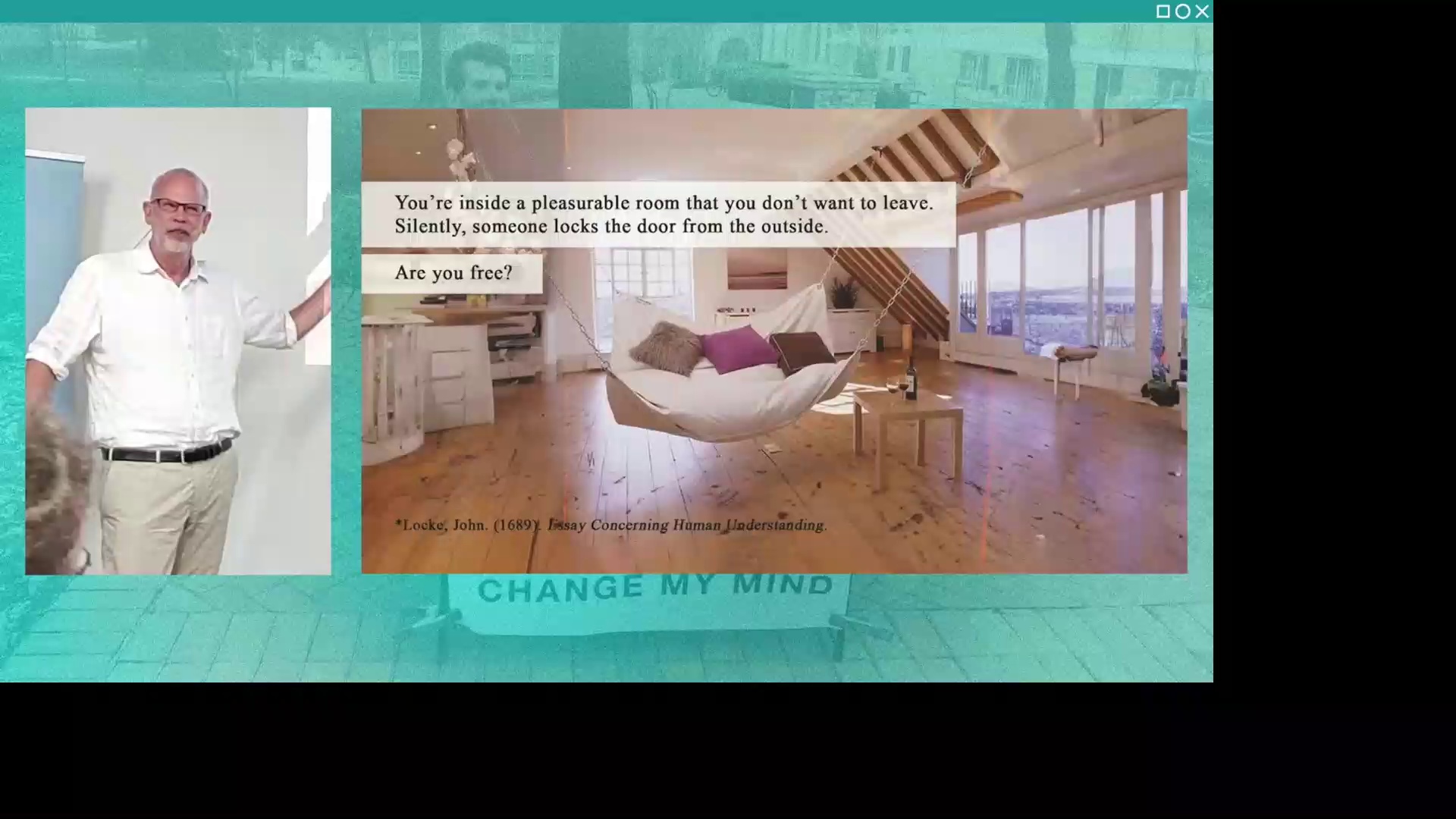
You’re inside a pleasurable room that you don’t want to leave. Silently, someone locks the door from the outside.
Are you free?
Locke, John. (1689). Essay Concerning Human Understanding.
AI-generated visual description — not speech or approved wording
A bright attic room with a hammock illustrates the thought experiment.
James Brusseau speech
So I'm imagining that you're in a perfect room doing exactly what you want with whatever supplies or people makes you happy. And while you're there, someone locks the room from the outside. You don't know that happened, so you just continue doing what you want to do. Now, the question I want to ask there is, okay, everything started out good. You were free. You decided to go into the room, do the things you wanted to do. But now you're trapped doing what you want to do. Are you still free?
Source details — Visual — Recommenders and locked rooms
Visual — Recommenders and locked rooms
DISC-0083::VIS-002::OCC-01 · Display occurrence: approximately 88.000–254.000 seconds in the original video. Boundaries are estimated.
Exact frame PTS: 100.000000 seconds in original video.
Visible slide text — not speech
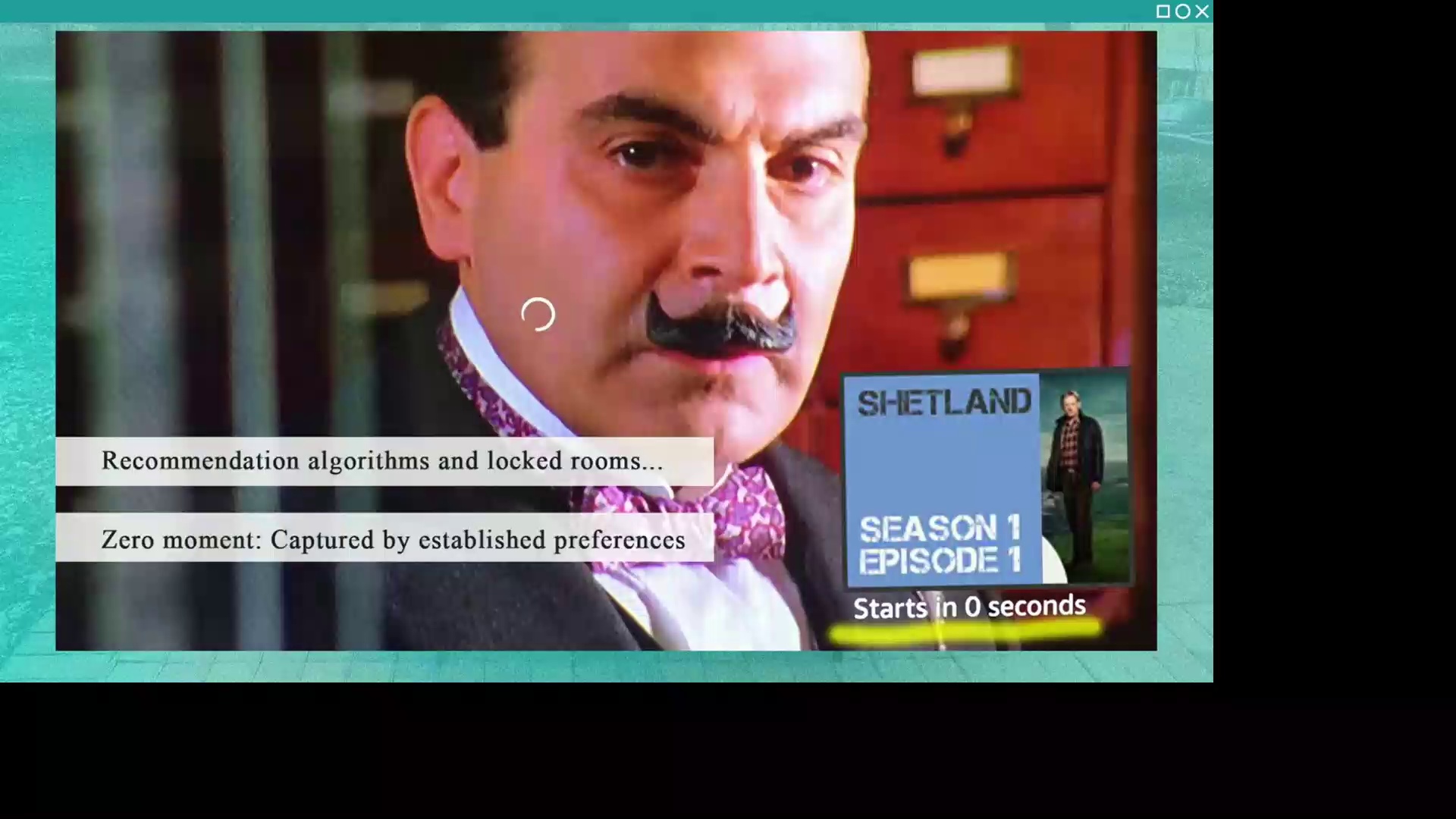
Recommendation algorithms and locked rooms...
Zero moment: Captured by established preferences
[Streaming screenshot] SHETLAND SEASON 1 EPISODE 1 Starts in 0 seconds
AI-generated visual description — not speech or approved wording
A close-up of a moustached character fills the background; a next-episode card sits at lower right. A yellow underline emphasizes the immediate start. Layout changes and brief camera views retain the same projected material.
James Brusseau speech
I'm not sure what the answer to that question is. But it's an old question from the 17th century from philosopher John Locke. I think it connects, though, with what I would like to talk about today, which is recommender algorithms. When I say recommenders, I mean the tool that decides who comes up on your Tinder screen or what job is flashed on your screen by LinkedIn din or what television show or series is queued up to run when you are just finishing a previous series. So there's this moment in Netflix, which I think all of us have experienced, where you're watching a series like this one and you've come to the last episode of the last season And just as it's ending, there is this. At the zero moment, a next series starts to play. And if they time it perfectly, and that's what they do. That's what they're paid to do. If they time it perfectly, then I think the experience you have here is just like the experience of the locked room. You're getting what you want. You chose this. But now it seems like in a sense you don't have a choice anymore. You can't stop and think well wait a minute do I want to watch another movie or do I want to do something like read a book? You can't stop and think you know what maybe instead of watching these crime dramas I would like to watch something else. It all happens so perfectly, so seamlessly that you get what you want before you even realize that you're asking for something. You're locked in your own preferences, your own interests, your own desires and wishes. So I think something like that is the way that recommendation algorithms connect with this old philosophical thought experiment. And what I want to talk about today a little bit, is how we can re-engineer recommendation algorithms to escape this problem. How we can refocus them to help us create new interests or generate new preferences instead of recycling those that we've already had.
Source details — Visual — Problem and solution
Visual — Problem and solution
DISC-0083::VIS-003::OCC-01 · Display occurrence: approximately 256.000–266.000 seconds in the original video. Boundaries are estimated.
Exact frame PTS: 260.000000 seconds in original video.
Visible slide text — not speech
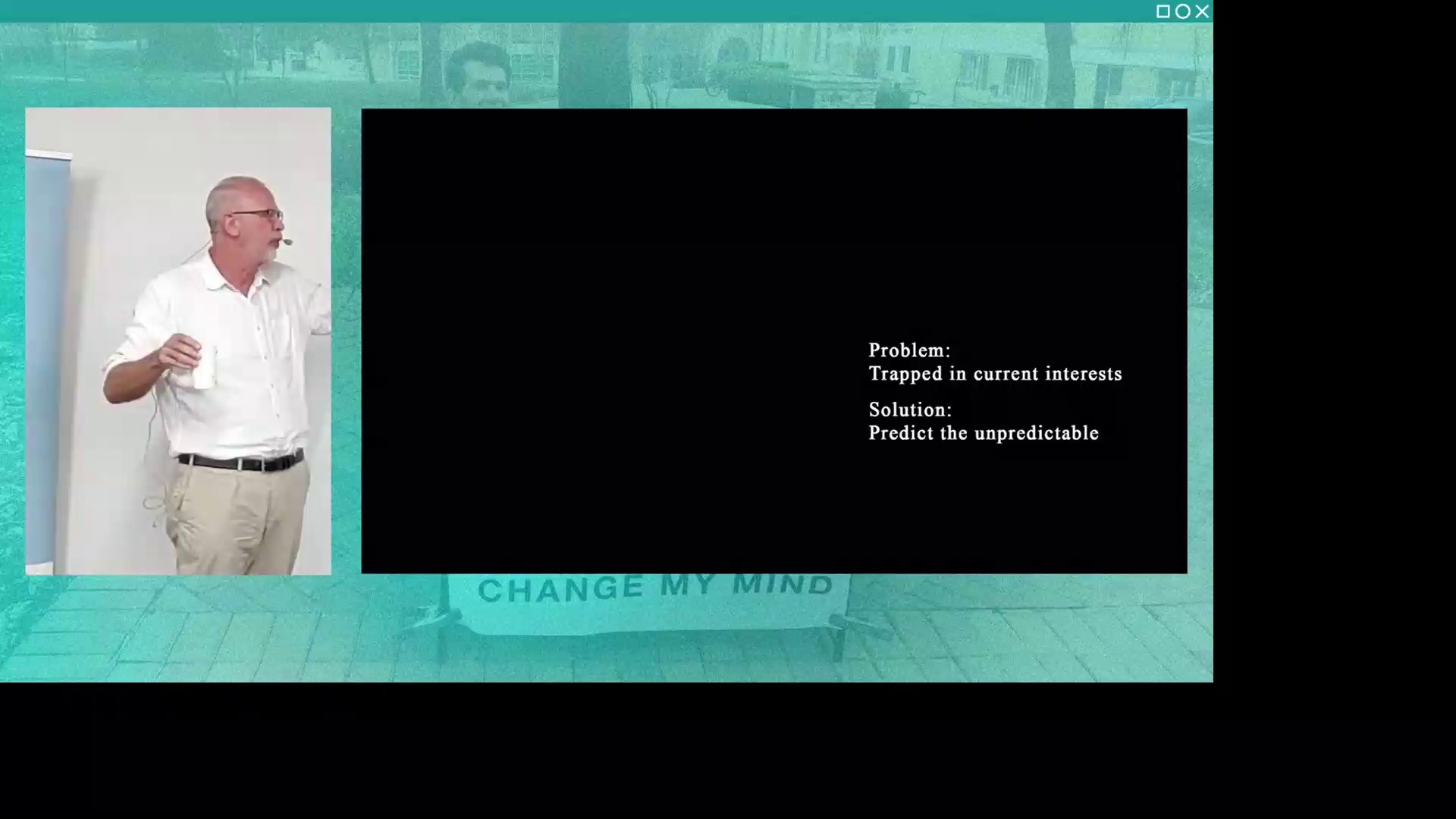
Problem: Trapped in current interests
Solution: Predict the unpredictable
Source details — Visual — Predict the unpredictable
Visual — Predict the unpredictable
DISC-0083::VIS-004::OCC-01 · Display occurrence: approximately 268.000–396.000 seconds in the original video. Boundaries are estimated.
Exact frame PTS: 280.000000 seconds in original video.
Visible slide text — not speech
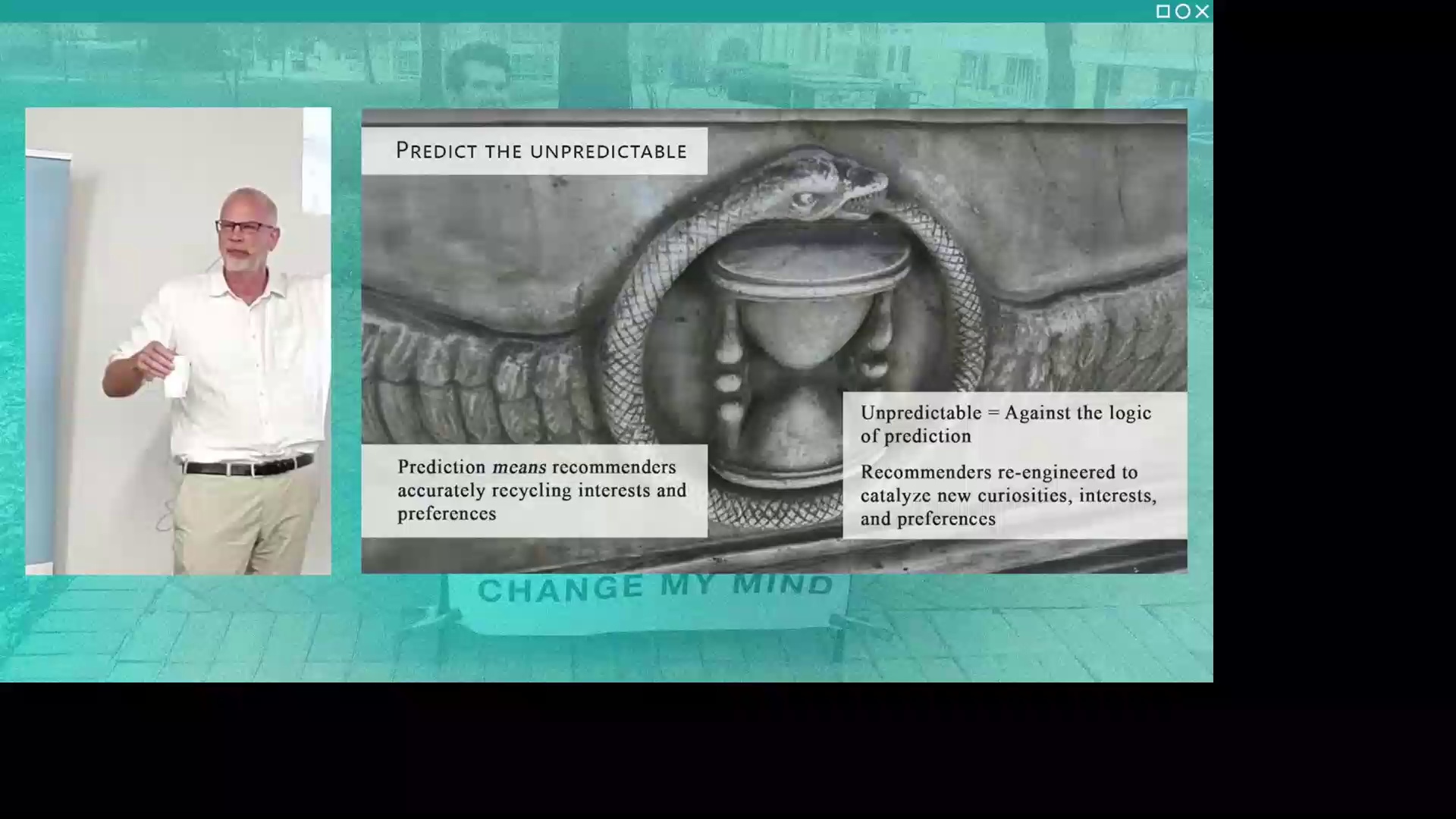
PREDICT THE UNPREDICTABLE
Prediction means recommenders accurately recycling interests and preferences
Unpredictable = Against the logic of prediction
Recommenders re-engineered to catalyze new curiosities, interests, and preferences
AI-generated visual description — not speech or approved wording
A snake curves around an hourglass in the grayscale background. No image credit is printed.
James Brusseau speech
So that's the subject for today. I want to say there's this problem with recommenders that were trapped in our current interests. And I want to say that the solution is, in some sense, to predict the unpredictable. Here's what I mean by that. The way prediction works for these recommenders is that it harvests your past. That's precisely what it does. The way the prediction for Netflix occurs is they know what you liked in the past and they just put it forward to you in the future again. So if that's what prediction is, and if we're trying to create a new kind of recommender that escapes your interests. We're not only redesigning from inside what the recommender does, we're in a sense redesigning what a recommender is. We're going all the way down, we're going to change the logic of recommendation algorithms. So that's the level on which I want to talk.
Now how am I going to talk about this? I'm gonna take two steps. The first step is really quickly, I'm going to look at Netflix and see how they do recommenders. For many people in this room, you already know how this works. So we'll rush through that pretty quickly. Then we'll come to the core of what I want to present, which is how can recommenders be re-engineered? And I'll talk about that in three ways. First, I'll give a kind of general picture of the way I think recommenders can be changed. Then, I'll give a set of philosophical concepts and ideas that I think underlie the way this kind of change could happen. And then finally at step three, I will look at some technical tools. So like vector embedding, that kind of stuff, your stuff. Look at some technical tools that I think give body to the kind of philosophical ideas that I'll talk about in the second part, okay? So that's the plan. First look how Netflix does it to get a sense of where we're at then try to think about a different way to do it in general conceptually and technically.
Source details — Visual — Logic of similarity
Visual — Logic of similarity
DISC-0083::VIS-005::OCC-01 · Display occurrence: approximately 400.000–456.000 seconds in the original video. Boundaries are estimated.
Exact frame PTS: 420.000000 seconds in original video.
Visible slide text — not speech
NETFLIX
Logic: Similar, Resemblance, Shared, Same
AI-generated visual description — not speech or approved wording
The four terms after “Logic” are highlighted in yellow.
James Brusseau speech
Okay so Netflix what I'm going to want to say fundamentally the key to everything I want to say is a philosophical distinction between—not going to spend too long on this—but between Plato, Aristotle, and the entire history of philosophy up until Hegel. They thought in terms of a logic of similarity and resemblance. What it meant to think for those philosophers was to locate and find how things were like other things. Then from Nietzsche and moving toward what we are in the period we're in today, post-modernism, that logic flipped. And we tried to think about how we can understand reality in terms of differences, how things are fundamentally other or distinct from each other. And that transformation in the history of philosophy is exactly what I'm going to try to reenact for you with recommendation algorithms. So Netflix. Netflix is an old school company. They work through the logic of similarity.
Source details — Visual — Content filtering shared vectors
Visual — Content filtering shared vectors
DISC-0083::VIS-006::OCC-01 · Display occurrence: approximately 458.000–498.000 seconds in the original video. Boundaries are estimated.
Exact frame PTS: 460.000000 seconds in original video.
Visible slide text — not speech
CONTENT FILTERING: SHARED KEYWORDS/VECTORS CONTENT NETFLIX
[Left poster] HARRISON FORD IS THE FUGITIVE
[Right poster] HARRISON FORD È BLADE RUNNER
?
AI-generated visual description — not speech or approved wording
The Fugitive and Blade Runner posters precede a question mark. “SHARED” is highlighted.
Visual limitations: Small poster text is marked unreadable where this source cannot support a reliable transcription; other recordings are not substituted.
James Brusseau speech
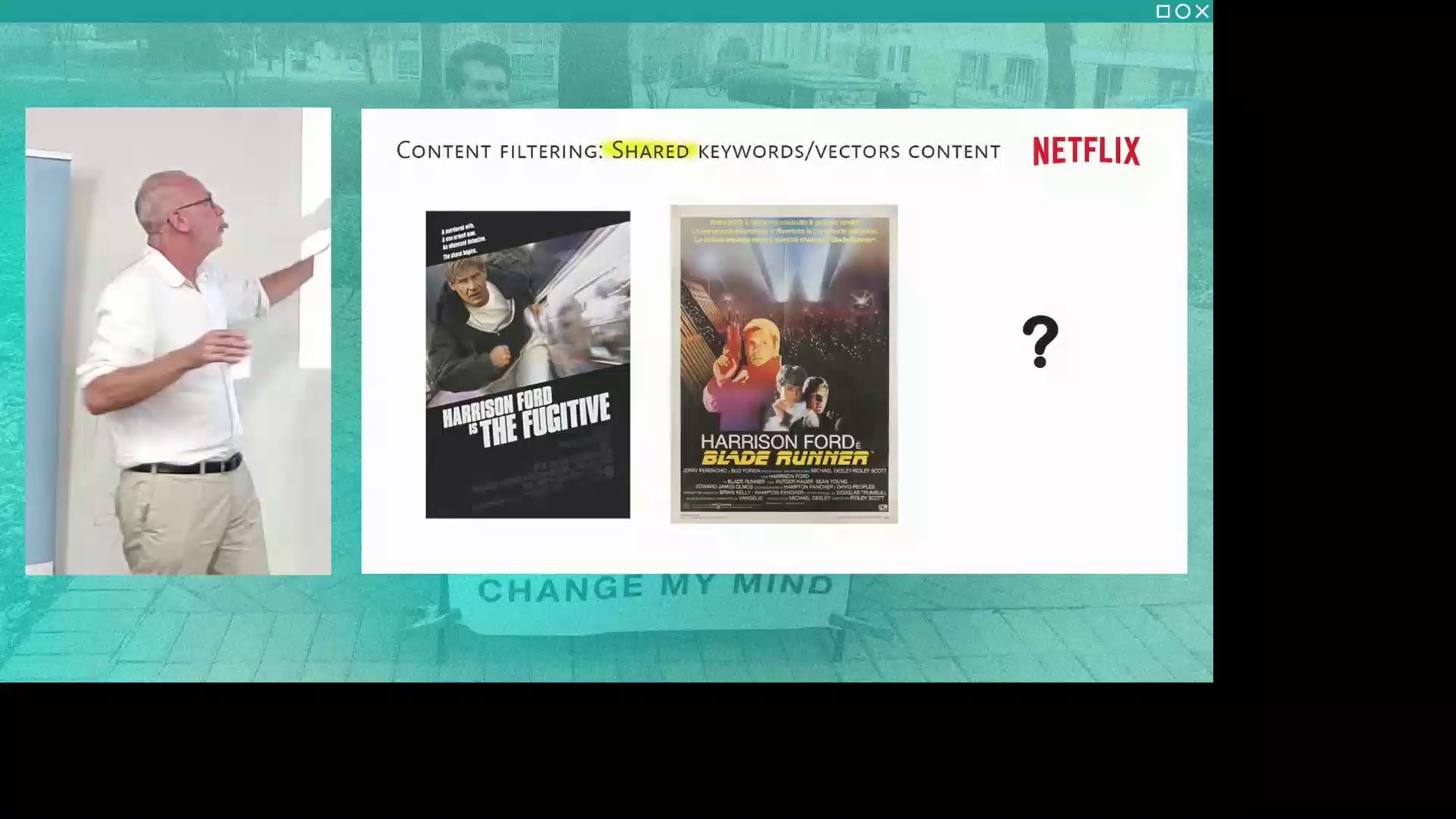
They do it in two ways. The first is called content filtering. What they do is they take a movie and just reduce it to keywords. The keywords here are Harrison Ford, action adventure, guy, middle-aged. Just about the same thing here. So how do you recommend a movie? You just add up all the keywords for this movie. Add up all the keywords for this movie that this person likes. And then just try to find the next movie that has the same keywords. That's it. Resemblance, similarity. Everything is the same. It's the way thought functions.
Source details — Visual — Collaborative filtering shared users
Visual — Collaborative filtering shared users
DISC-0083::VIS-007::OCC-01 · Display occurrence: approximately 500.000–566.000 seconds in the original video. Boundaries are estimated.
Exact frame PTS: 500.000000 seconds in original video.
Visible slide text — not speech
COLLABORATIVE FILTERING: SHARED KEYWORDS/VECTORS USERS NETFLIX
[Poster text] HARRISON FORD IS THE FUGITIVE BILL MURRAY ANDIE MACDOWELL GROUNDHOG DAY MARLON BRANDO The Godfather
?
AI-generated visual description — not speech or approved wording
Two user icons accompany two rows of movie posters. The first user has The Fugitive, Groundhog Day, and The Godfather; the second has the first two and a question mark.
James Brusseau speech
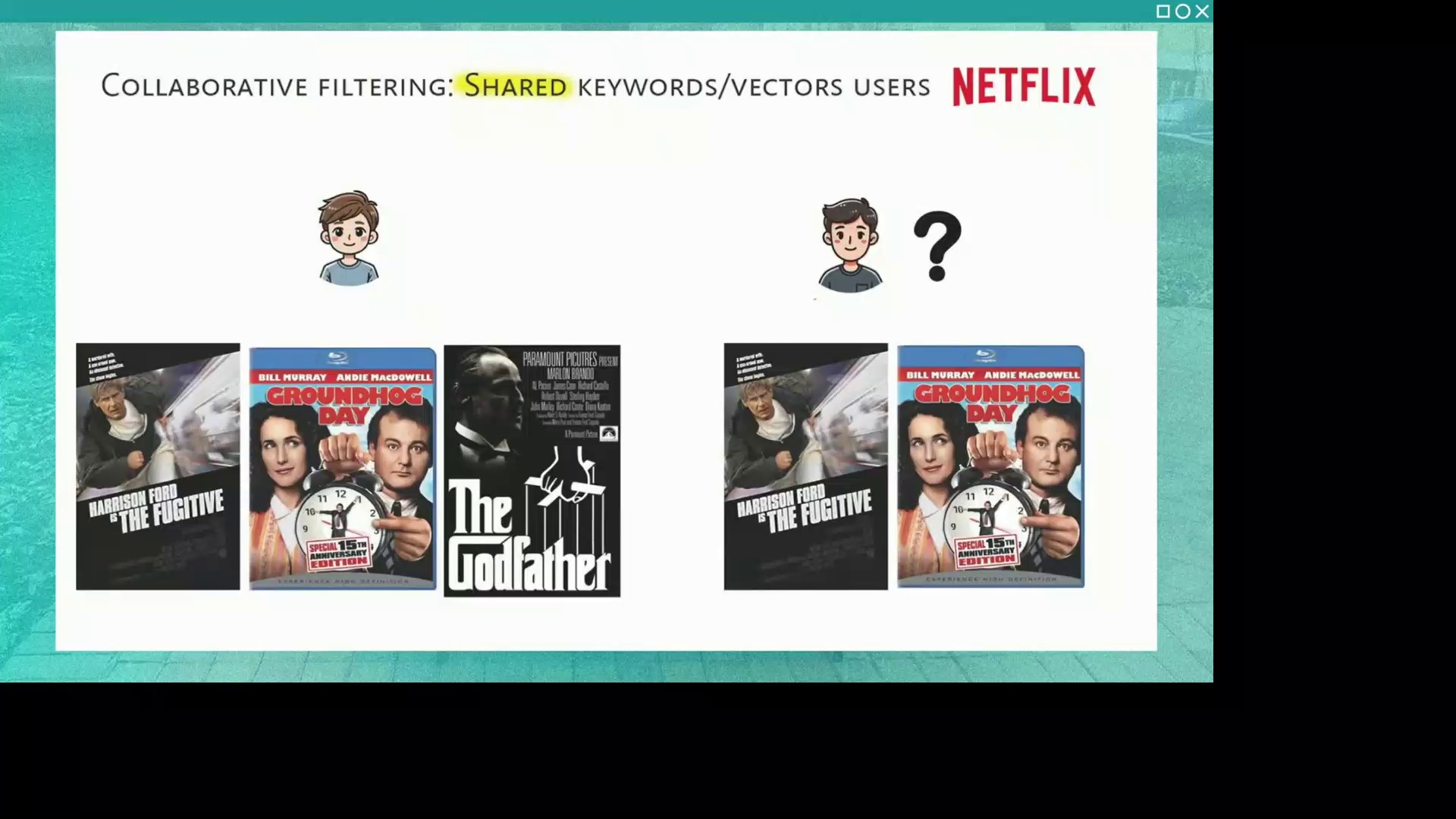
Now, there's a more sophisticated version, collaborative filtering, and what they try to do here is instead of looking for things that are identical in the movies themselves, they try to find people who are identical. Right so one way that you want to find identical people is they like the same movies. Good start. Then you find they're both males. You find they're both young males. They both look like they're from maybe near where I live, New York City. They both look like on and on you go if you can find people who are similar again Just it's the same logic. If you can find people who are similar almost the same You can line up the movies of one then you can suggest to the other So that's the way in Netflix does it now?
I mean other people at Netflix completely blind to the idea That they keep doing what all of us have felt so they keep recommending to us the same movies we've seen over and over again? No, of course not. They've tried to solve this problem. They're aware of the fact that they're caught in this logic of repetition. But the way they do it, the way they solve their problem just repeats the cause of the problem itself. They have two tools.
Source details — Visual — Serendipity and reduced similarity
Visual — Serendipity and reduced similarity
DISC-0083::VIS-008::OCC-01 · Display occurrence: approximately 568.000–640.000 seconds in the original video. Boundaries are estimated.
Exact frame PTS: 580.000000 seconds in original video.
Visible slide text — not speech
HOW DO PLATFORMS SEEK VARIETY? SERENDIPITY NETFLIX
- Random “Noise-based” injection
- Reduced similarity
“Anomalies and exceptions, partially implemented via poor similarity measures.”
E. Toms, “Serendipitous Information Retrieval”, Proc. of DELOS Workshop: Information Seeking, Searching and Querying in Digital libraries, 2000.
AI-generated visual description — not speech or approved wording
Two ten-item stacks contain cyan, orange, and green rounded bars. A vertical arrow marks the green item moving upward in the second ordering. Reduced similarity is highlighted.
James Brusseau speech
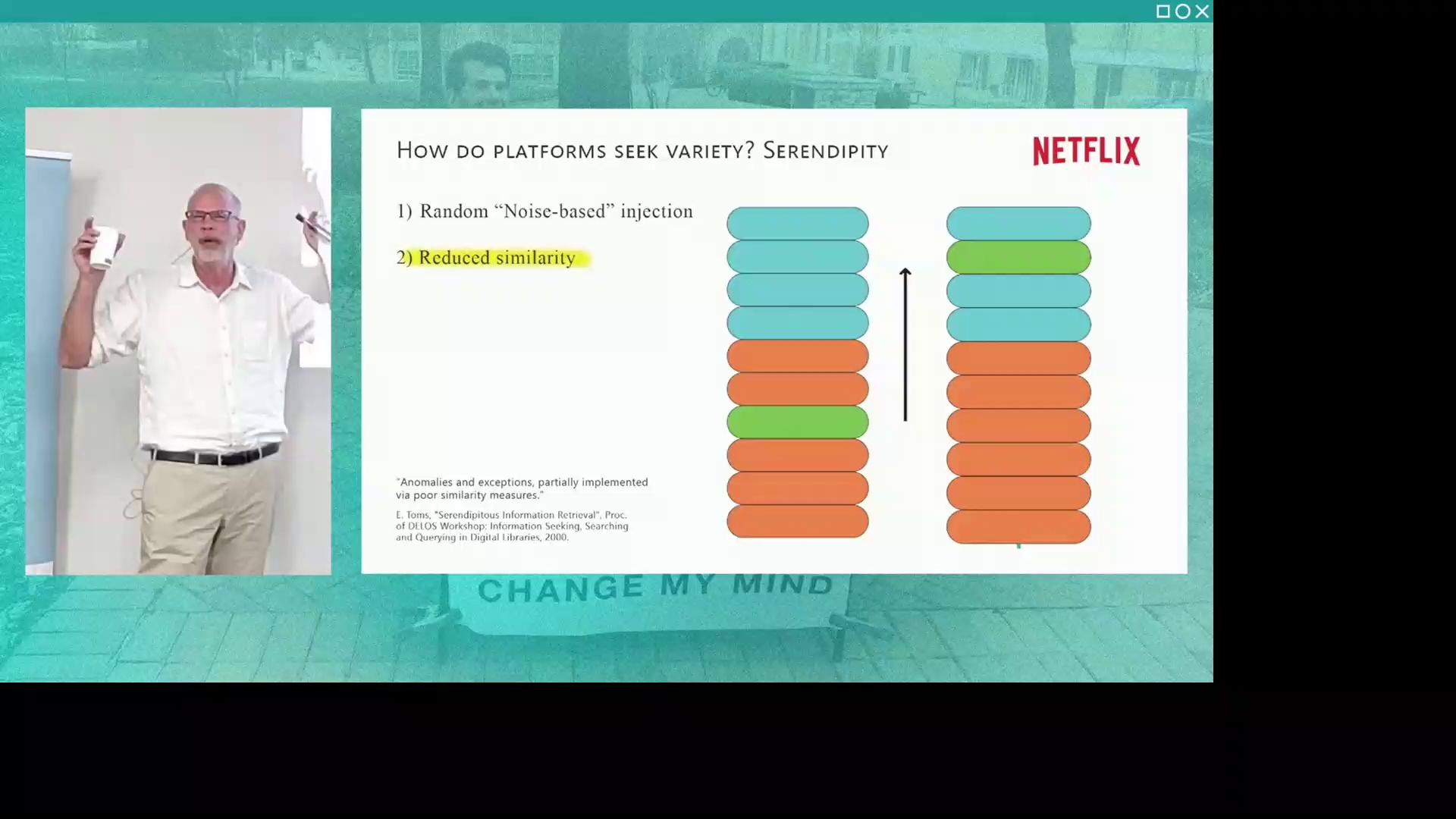
The first is what they call noise-based injection. I love the jargon. Noise-based injection means they just show you a random movie, right? They've been showing you too many action adventures so they just take a random thing from their catalog and put it in your list. The other thing they do is they say okay if we keep recommending these action-adventure, action-adventure... To recommend something new and different to a user like me, we will just go down the list to movies that are less like those that are on the top. And so they take one from down the list and push it up.
Source details — Visual — Antagonistic filtering proposal
Visual — Antagonistic filtering proposal
DISC-0083::VIS-009::OCC-01 · Display occurrence: approximately 642.000–646.000 seconds in the original video. Boundaries are estimated.
Short-display inclusion exception: Short substantive build, reference, or contact content; retained explicitly despite normal five-second threshold. No durations aggregated.
Exact frame PTS: 642.000000 seconds in original video.
Visible slide text — not speech
Antagonistic filtering: Logic of difference More effective serendipity
Visual limitations: Short substantive proposal retained as an explicit threshold exception.
James Brusseau speech
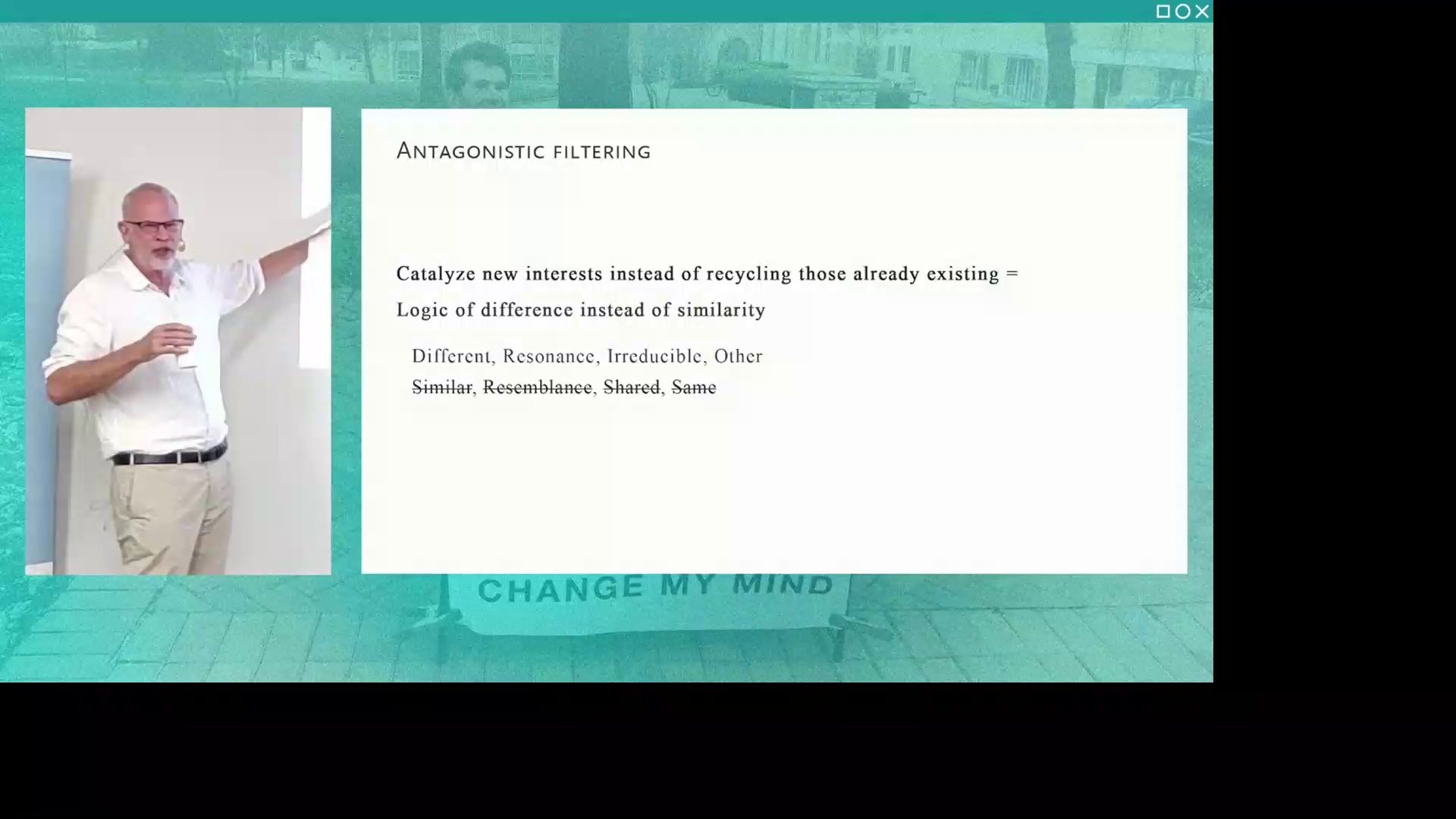
That might help, but it's the same logic. The way they find a movie is by thinking in terms of resemblance. What is it that is like those things he or she has seen before okay that's the logic we're trying to escape I call I'm calling this logic because what they have is collaborative filtering I'm gonna call this antagonistic filtering and as I said we're going to look at this in three different ways First kind of as an introduction as I've already introduced I want to try to think in terms of difference in terms of how things are other or separate or distinct.
Source details — Visual — Logic of difference
Visual — Logic of difference
DISC-0083::VIS-010::OCC-01 · Display occurrence: approximately 658.000–666.000 seconds in the original video. Boundaries are estimated.
Exact frame PTS: 660.000000 seconds in original video.
Visible slide text — not speech
ANTAGONISTIC FILTERING
Catalyze new interests instead of recycling those already existing =
Logic of difference instead of similarity
Different, Resonance, Irreducible, Other
~~Similar, Resemblance, Shared, Same~~
AI-generated visual description — not speech or approved wording
The similarity terms are struck through; the difference terms appear immediately above them.
Source details — Visual — Difference before similarity movie example
Visual — Difference before similarity movie example
DISC-0083::VIS-011::OCC-01 · Display occurrence: approximately 668.000–734.000 seconds in the original video. Boundaries are estimated.
Exact frame PTS: 700.000000 seconds in original video.
Visible slide text — not speech
ANTAGONISTIC FILTERING: DIFFERENCE BEFORE SIMILARITY
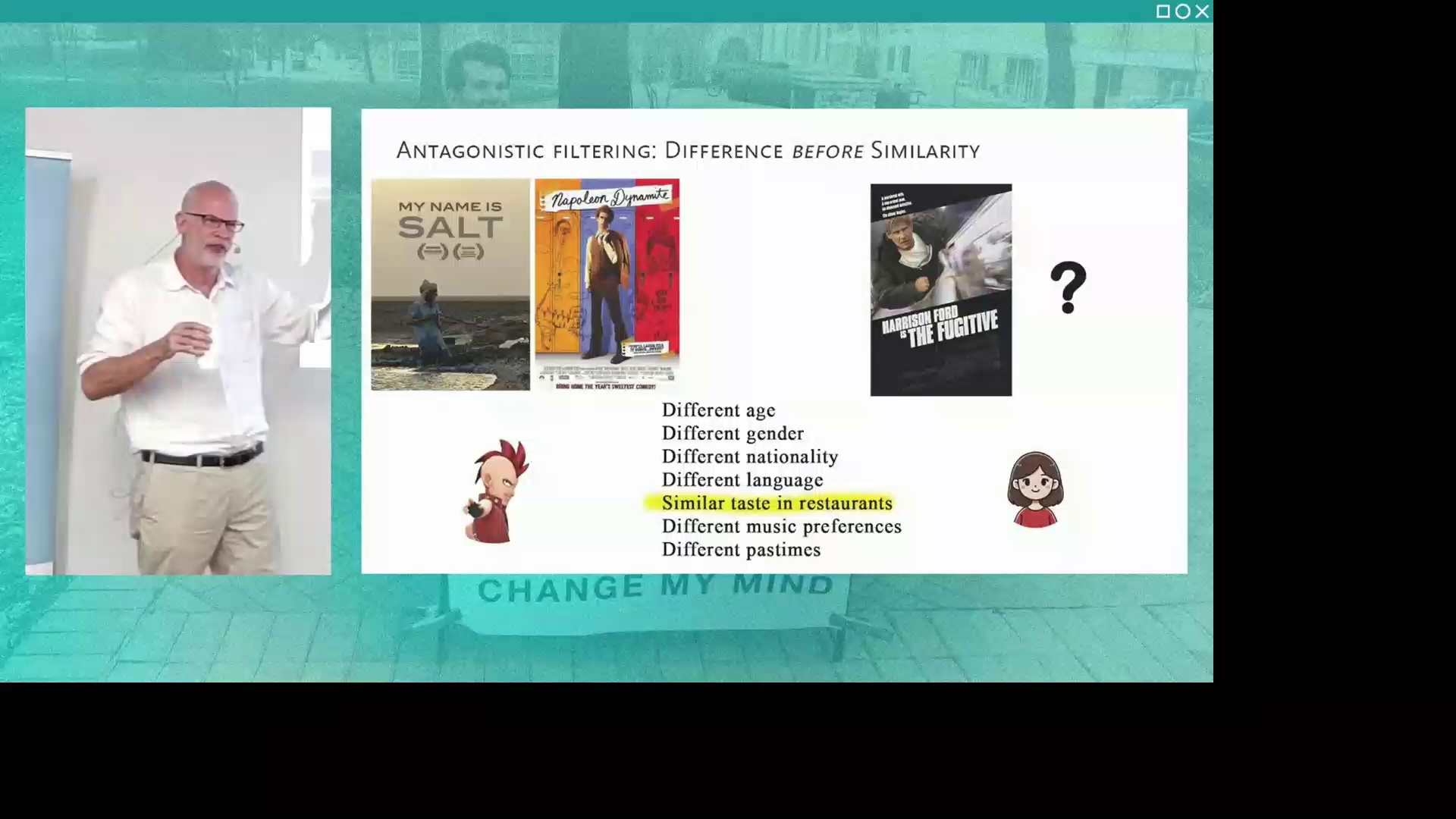
[Prominent poster text] MY NAME IS SALT Napoleon Dynamite BRING HOME THE YEAR’S SWEETEST COMEDY! HARRISON FORD IS THE FUGITIVE [Small poster credits unreadable]
- Different age
- Different gender
- Different nationality
- Different language
- Similar taste in restaurants
- Different music preferences
- Different pastimes
?
AI-generated visual description — not speech or approved wording
Two different cartoon people and different movie histories share a highlighted restaurant preference. The recommendation side shows The Fugitive and a question mark.
Visual limitations: Small award laurels and poster production credits are unreadable.
James Brusseau speech
Here's an example. We always, for this system, we always want to start from difference. So instead of having users that are similar, two guys who are the same age, man and woman, maybe from Europe and from New York, different tastes in movies. We try to get people who are as distinct and different and removed as possible. And then after the difference is established. Then we look for a kind of similarity. Like maybe these people who are so completely different in so many ways, they speak different languages, live in different continents, but maybe they both really like Japanese restaurants. Maybe. And maybe that one link is enough to indicate that there's something that resonates between them. And maybe some of the movies that this person likes will work for this person. It will work not because they're the same, but because in some sense, again, they resonate.
Source details — Visual — Conference analogy
Visual — Conference analogy
DISC-0083::VIS-012::OCC-01 · Display occurrence: approximately 746.000–820.000 seconds in the original video. Boundaries are estimated.
Exact frame PTS: 780.000000 seconds in original video.
Visible slide text — not speech
ANTAGONISTIC FILTERING: DIFFERENCE BEFORE SIMILARITY
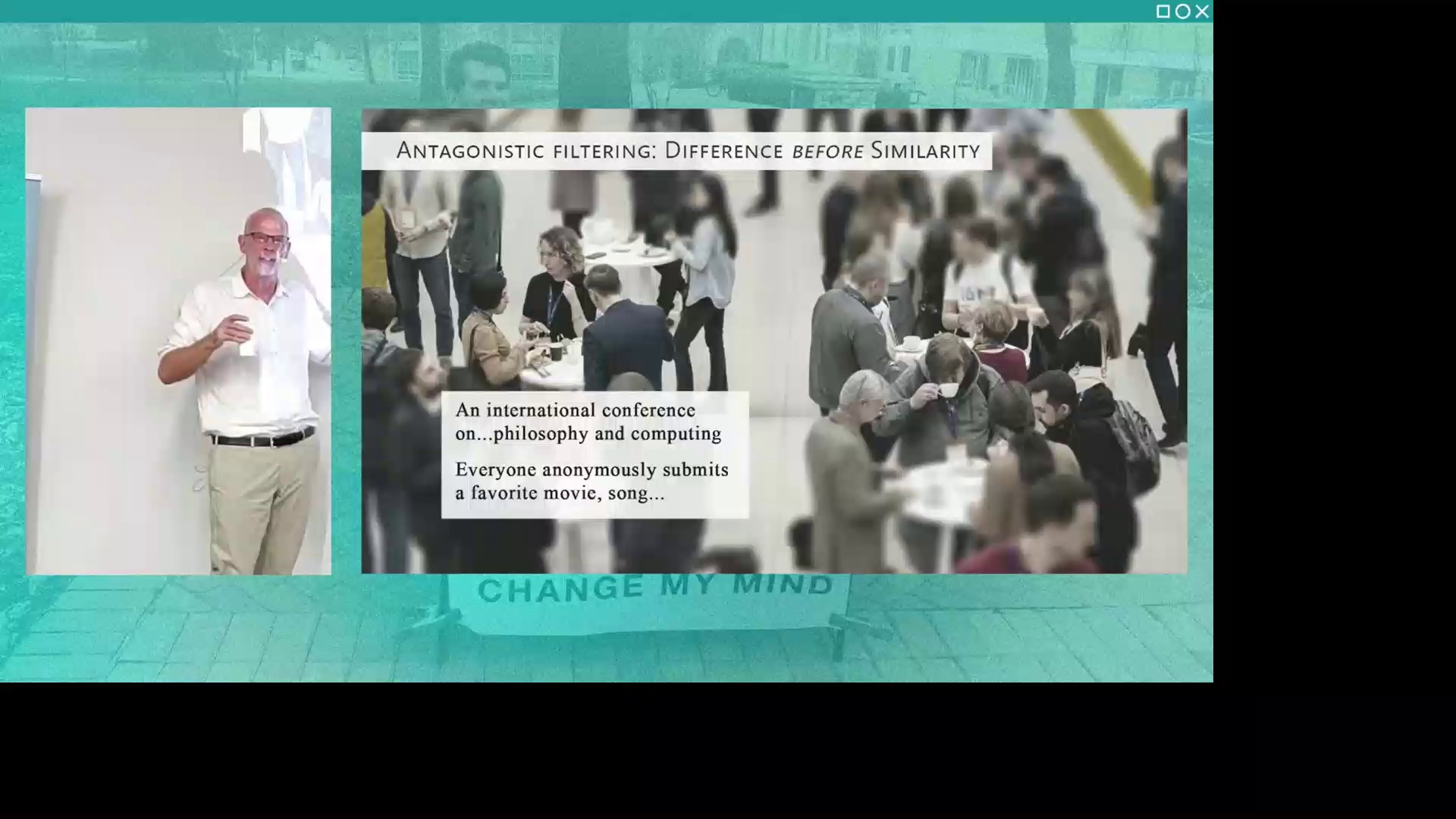
An international conference on...philosophy and computing
Everyone anonymously submits a favorite movie, song...
AI-generated visual description — not speech or approved wording
A photograph shows groups talking around tables at a conference break. No photo attribution is printed.
James Brusseau speech
Here's an example I just got last week from someone. I was at a conference on philosophy and computing. I gave a presentation very similar to this, and someone said, you know what you should do? You should use this conference as a test case because at this conference, it was an international conference, so we had people come from all over the world, all different ages, all different languages, but we had this one really intense similarity, is that we're all into philosophy and computing. So you wonder if maybe that would be a way for me to learn about new kinds of films that I had not been exposed to or new sorts of music that I had not heard before. I mean, of course, it's always easy. I mean, it's always easy to find something I haven't heard or known before. But what we're trying to do is we're trying to introduce something to me with a little better chance of random. We're trying to say, look there's a real reason to think that James Brusseau might like this movie or this music which is outside the scope of his usual interests. And so maybe something like this would be an example of how you could use difference before similarity. So what I'm proposing and this is the end of the first, I said they're gonna be three steps here, this is the end of the first step.
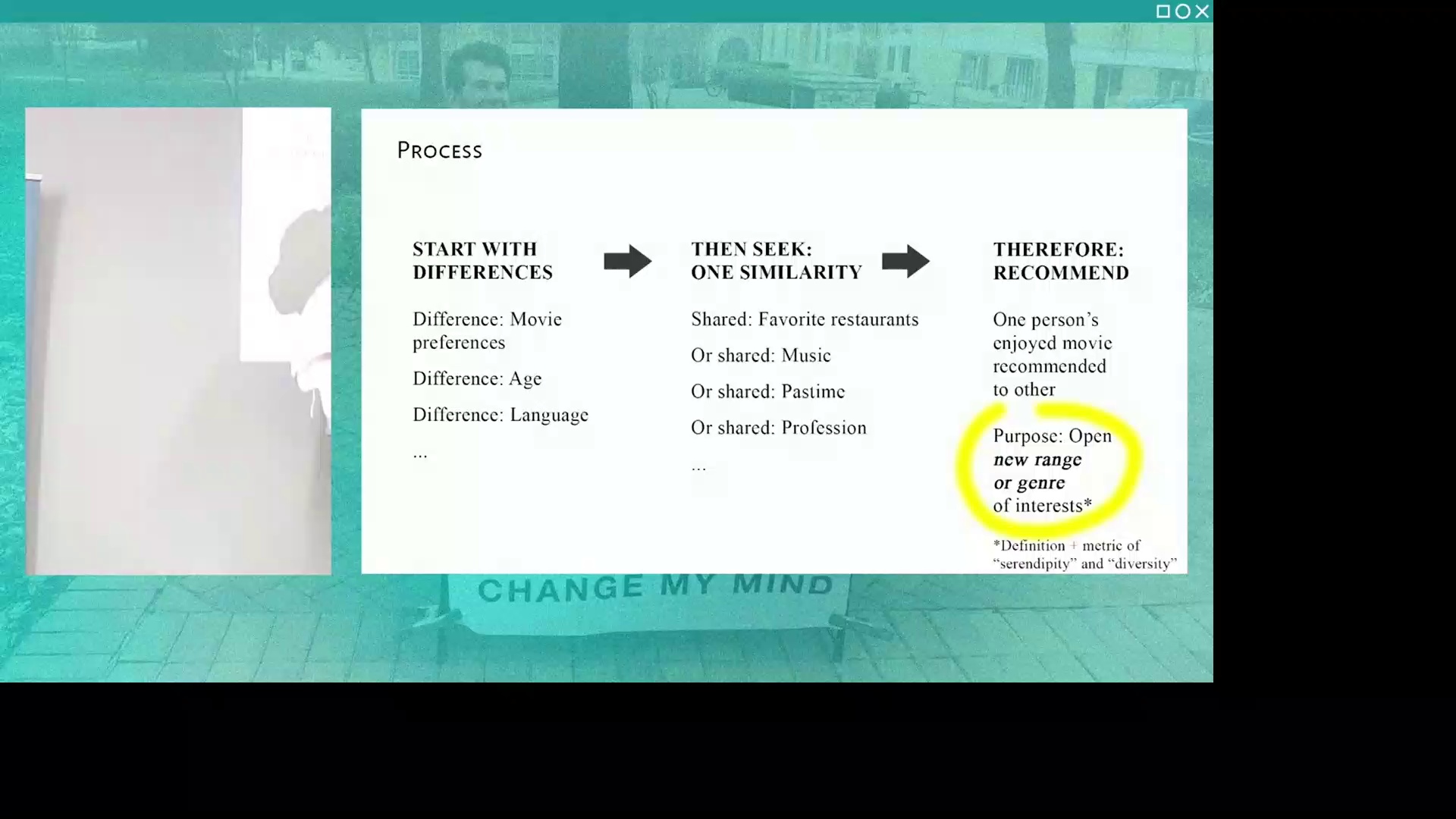
Source details — Visual — Recommendation process
Visual — Recommendation process
DISC-0083::VIS-013::OCC-01 · Display occurrence: approximately 822.000–882.000 seconds in the original video. Boundaries are estimated.
Exact frame PTS: 840.000000 seconds in original video.
Visible slide text — not speech
PROCESS
START WITH DIFFERENCES
- Difference: Movie preferences
- Difference: Age
- Difference: Language
- ...
THEN SEEK: ONE SIMILARITY
- Shared: Favorite restaurants
- Or shared: Music
- Or shared: Pastime
- Or shared: Profession
- ...
THEREFORE: RECOMMEND One person’s enjoyed movie recommended to other
Purpose: Open new range or genre of interests*
*Definition + metric of “serendipity” and “diversity”
AI-generated visual description — not speech or approved wording
Arrows connect the three columns. A yellow loop emphasizes the purpose.
James Brusseau speech
What I'm proposing is instead of starting with similarities start with differences between people. Then find some similarity and recommend between the people. And the purpose is to open up a new range of interests, to get someone involved in a different kind of music. You know, it's not just one new song, but a whole different genre of songs, a whole different kind of music that they would have not have thought of finding on their own.
Okay, so this is the process, this is the goal. All right, that's a big overall picture. The next two steps are let's look at some philosophical ideas underneath it and then some technical ideas that echo the philosophical ideas. So the philosophical ideas. What is the intuition here? Well, the intuition is opposites attract. We've all had that experience romantically or in some other way that you get invited into the life of someone whose life and background is completely different than yours.
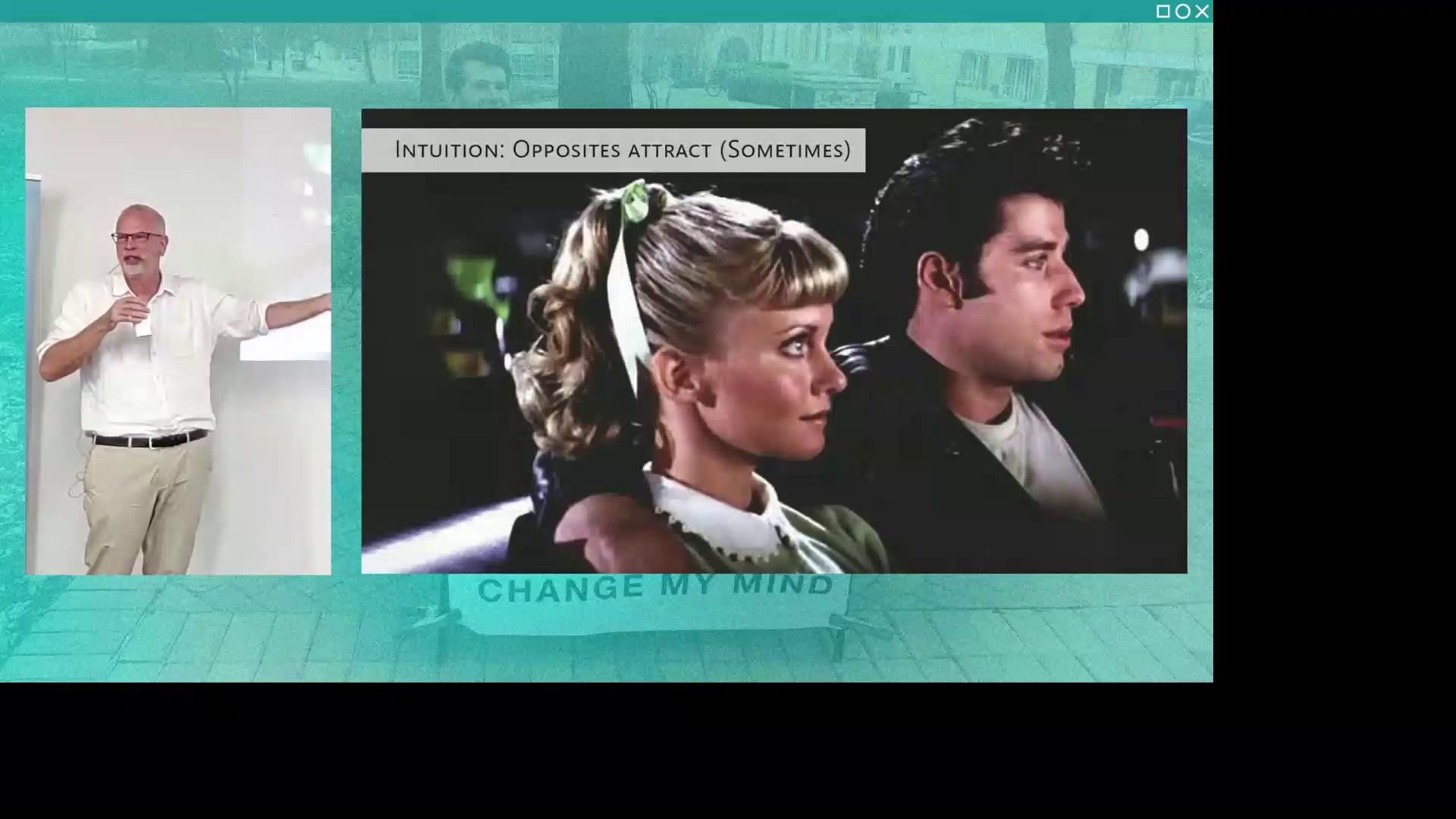
Source details — Visual — Opposites attract
Visual — Opposites attract
DISC-0083::VIS-014::OCC-01 · Display occurrence: approximately 886.000–922.000 seconds in the original video. Boundaries are estimated.
Exact frame PTS: 900.000000 seconds in original video.
Visible slide text — not speech
INTUITION: OPPOSITES ATTRACT (SOMETIMES)
AI-generated visual description — not speech or approved wording
A film still pairs a woman in a light cardigan with a man in a dark leather jacket. The slide prints no film title, actor names, or credit.
James Brusseau speech
But in my case, it would be this woman. She introduces me because her life is so different from mine. You know, she introduces me to whole new kinds of music or to whole new kinds of things to eat. So I think something like that human experience is what we're trying to get. That's the intuition here. That's what we're trying to get with these recommenders.
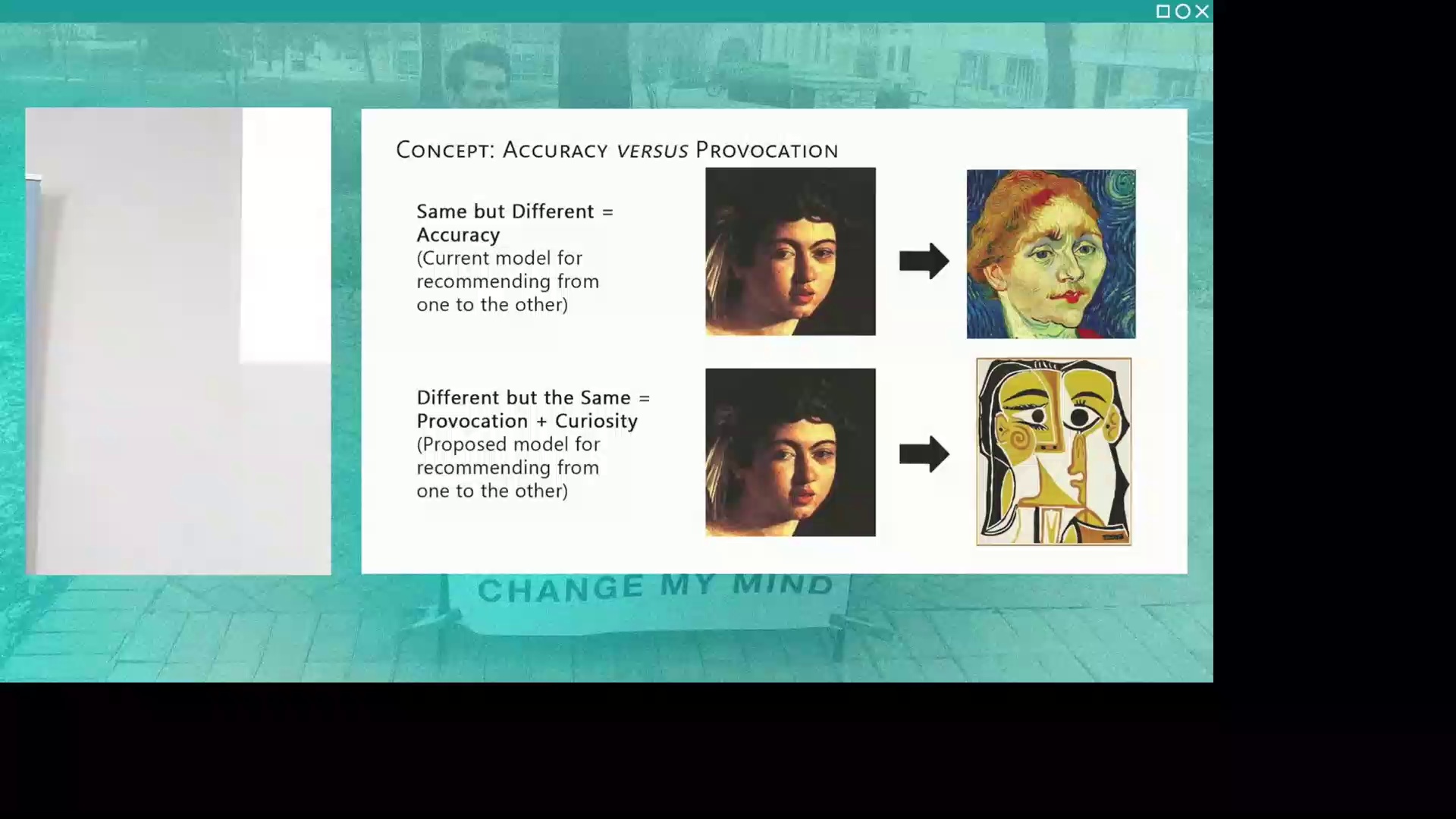
Source details — Visual — Accuracy versus provocation
Visual — Accuracy versus provocation
DISC-0083::VIS-015::OCC-01 · Display occurrence: approximately 924.000–1056.000 seconds in the original video. Boundaries are estimated.
Exact frame PTS: 940.000000 seconds in original video.
Visible slide text — not speech
CONCEPT: ACCURACY VERSUS PROVOCATION
Same but Different = Accuracy (Current model for recommending from one to the other)
Different but the Same = Provocation + Curiosity (Proposed model for recommending from one to the other)
AI-generated visual description — not speech or approved wording
Two rows begin with the same painted face. The top arrow leads to another figurative portrait; the bottom arrow leads to a face with displaced geometric features. No artist or painting titles are printed. Camera shots of the same projection are retained within this occurrence.
James Brusseau speech
Here's a different way of thinking about it in terms of this idea I was talking about earlier, similarity and difference. If you look at these two paintings, This is Netflix. This is the way Netflix works, right? From Caravaggio to Van Gogh is just a, they're just looking for the same, it's the same woman with slightly different coloring. This is like Indiana Jones and then Mission Impossible. You can see it's the same thing. Just slightly different actors, slightly different plot, slightly different place, but it's the same. Whereas by contrast, when you go from Caravaggio to Picasso, it's a completely different experience. I mean, maybe not for us because we've seen these paintings before, but if you show this to a child that the child will say wait a minute these things have nothing to do with each other they're completely different it's only later that the child will see oh wait a minute I see there are eyes and a nose right so this is a woman and this is a woman so something like this is a difference that you can feel I think in your own life that corresponds with this more technical difference that I'm talking about in recommender systems all right. There's recommending from one movie to another which is similar. And there's recommending from one to the other which starts from difference.
And the human sensation you have when that happens, this is like accuracy. This is how people in your world measure accuracy. Oh, it's very close to this one. These two paintings are very close. But this, this is something more like curiosity or provocation. So the kind of recommender system I'm talking about is not one that is going to be measured by accuracy. It doesn't have anything to do with it. It's going to be measured by the degree to which it is provocative, or the degree to which it stokes curiosity. So there are different ways of measuring the success of these two kinds of recommenders.
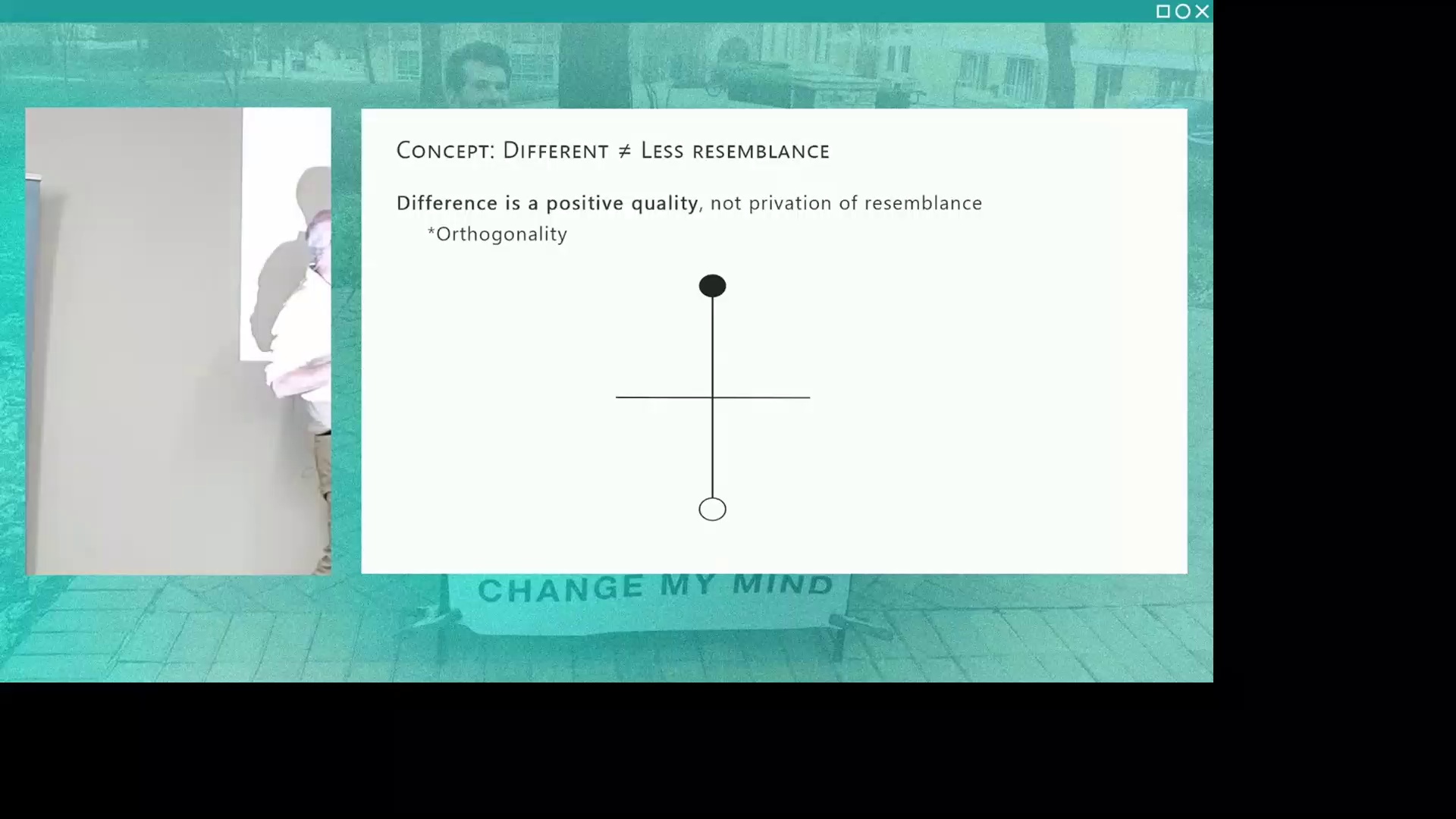
Source details — Visual — Difference as positive quality
Visual — Difference as positive quality
DISC-0083::VIS-016::OCC-01 · Display occurrence: approximately 1058.000–1164.000 seconds in the original video. Boundaries are estimated.
Exact frame PTS: 1080.000000 seconds in original video.
Visible slide text — not speech
CONCEPT: DIFFERENT ≠ LESS RESEMBLANCE
Difference is a positive quality, not privation of resemblance
*Orthogonality
AI-generated visual description — not speech or approved wording
An unlabelled cross has a filled circle at the top of the vertical axis and a hollow circle at the bottom. The horizontal axis has no endpoint symbols.
James Brusseau speech
Okay this is an important one. Here what I'm trying to show is an idea that I've spent many hours debating with computer scientists, trying to show that different is not the same as less resemblance. Those are two completely distinct concepts. So you can see going from here to here, there are degrees of difference like full, three quarters full, half full, one quarter full, empty. And anything that goes along this line, it's true that it moves along a line of similarity and resemblance. But there's also this other line. There's this line where things are different, they're moving, but their different distance between these two things doesn't change. That's critical because these are things which are different in the authentic sense. They're truly different. They're different in a way that does not mean less similar. They are other. They are unconnected with the movies you normally see. Then later when we get to the technical parts in about five minutes, ten, this is what we're going to be you looking for? These movies, not the ones that are more distant or less different. Let's say what you really like is Indiana Jones movies. So it's not that we're going to look for ones that are kind of different or a lot different or something like that. No, we're going to look for things on this line, things that have no relation with Indiana Jones. They're not more different or less different. They're just other. That's the aim of the kind of recommender system that I'm proposing.
Source details — Visual — Resonance replaces resemblance
Visual — Resonance replaces resemblance
DISC-0083::VIS-017::OCC-01 · Display occurrence: approximately 1178.000–1220.000 seconds in the original video. Boundaries are estimated.
Exact frame PTS: 1180.000000 seconds in original video.
Visible slide text — not speech
THEORY
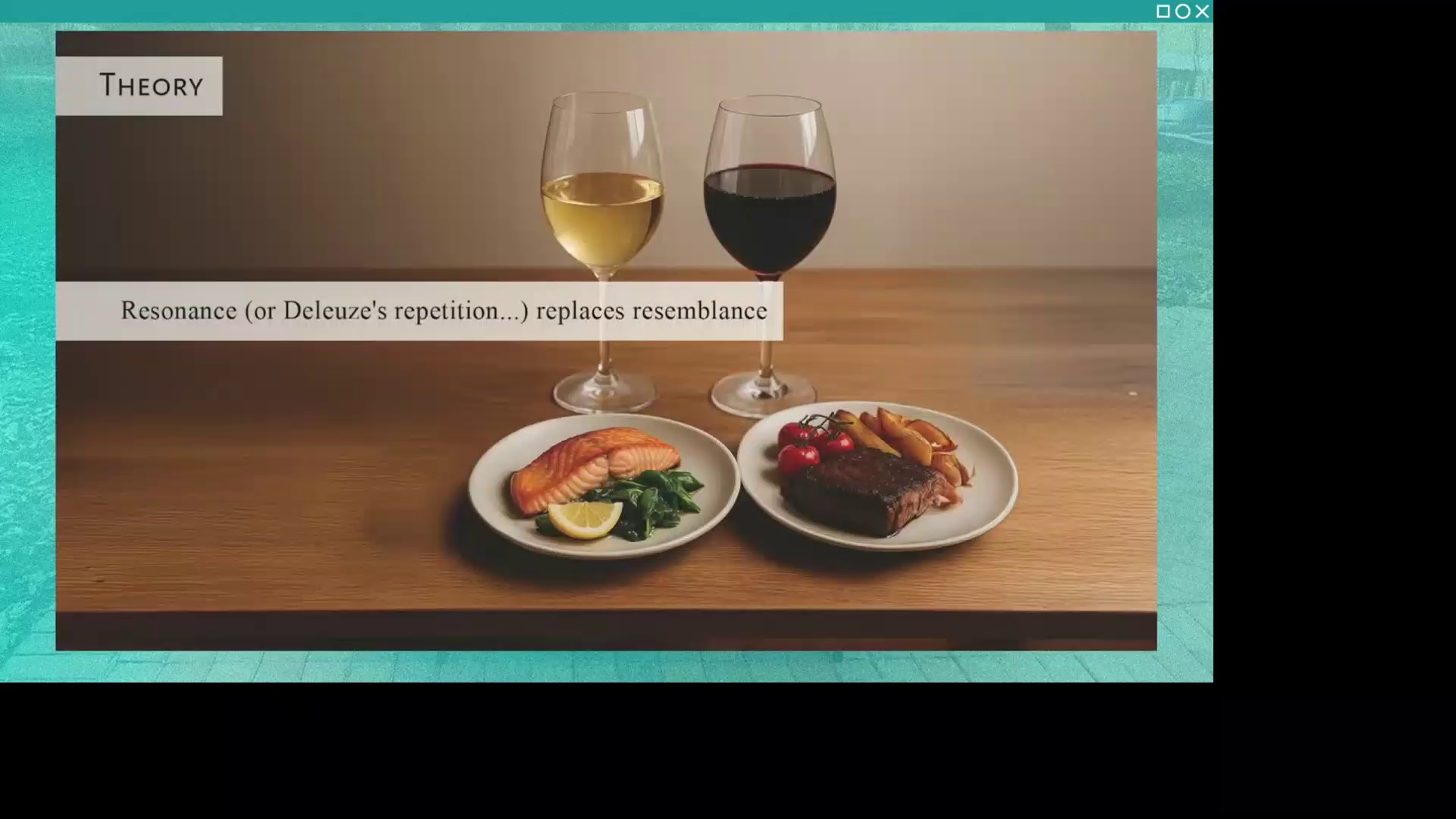
Resonance (or Deleuze’s repetition...) replaces resemblance
AI-generated visual description — not speech or approved wording
A meal photograph pairs salmon with white wine and steak with red wine. No photo credit is printed.
James Brusseau speech
Okay, I talked about this idea of resonance a little bit. Like I said, sometimes someone meets someone who's very different, but even though they have nothing in common, they still get along together, right? Well, I mean, the same thing happens with food. It's a common experience. I mean, we all know that white wine goes with fish and red wine goes with meat, but there's no logic to that. I mean, wine is not similar to food, but for some reason this resonates with this, even though they're completely different things. White wine does not resonate with this, even though they're different in the same way. Similar thing goes the other way. So the point I'm trying to make here is, here's a way you can see how things that are different can resonate with each other. Just like I talked about way back here, right? This idea like the similar taste in restaurants. Somehow, even though these are two completely different people, they have a resonance like white wine and fish. That's what tells you that there might be some connection. And that might be the reason to recommend this person's movies to that person's movies. Okay. Okay. So that was the philosophical part.
Repeated visual — Visual — Difference before similarity movie example
Visual — Difference before similarity movie example
DISC-0083::VIS-011::OCC-02 · Display occurrence: approximately 1228.000–1246.000 seconds in the original video. Boundaries are estimated.
Repeated appearance of DISC-0083::VIS-011. See its first transcription.
Source details — Visual — Four technical strategies
Visual — Four technical strategies
DISC-0083::VIS-018::OCC-01 · Display occurrence: approximately 1262.000–1272.000 seconds in the original video. Boundaries are estimated.
Exact frame PTS: 1262.000000 seconds in original video.
Visible slide text — not speech
TECHNICAL
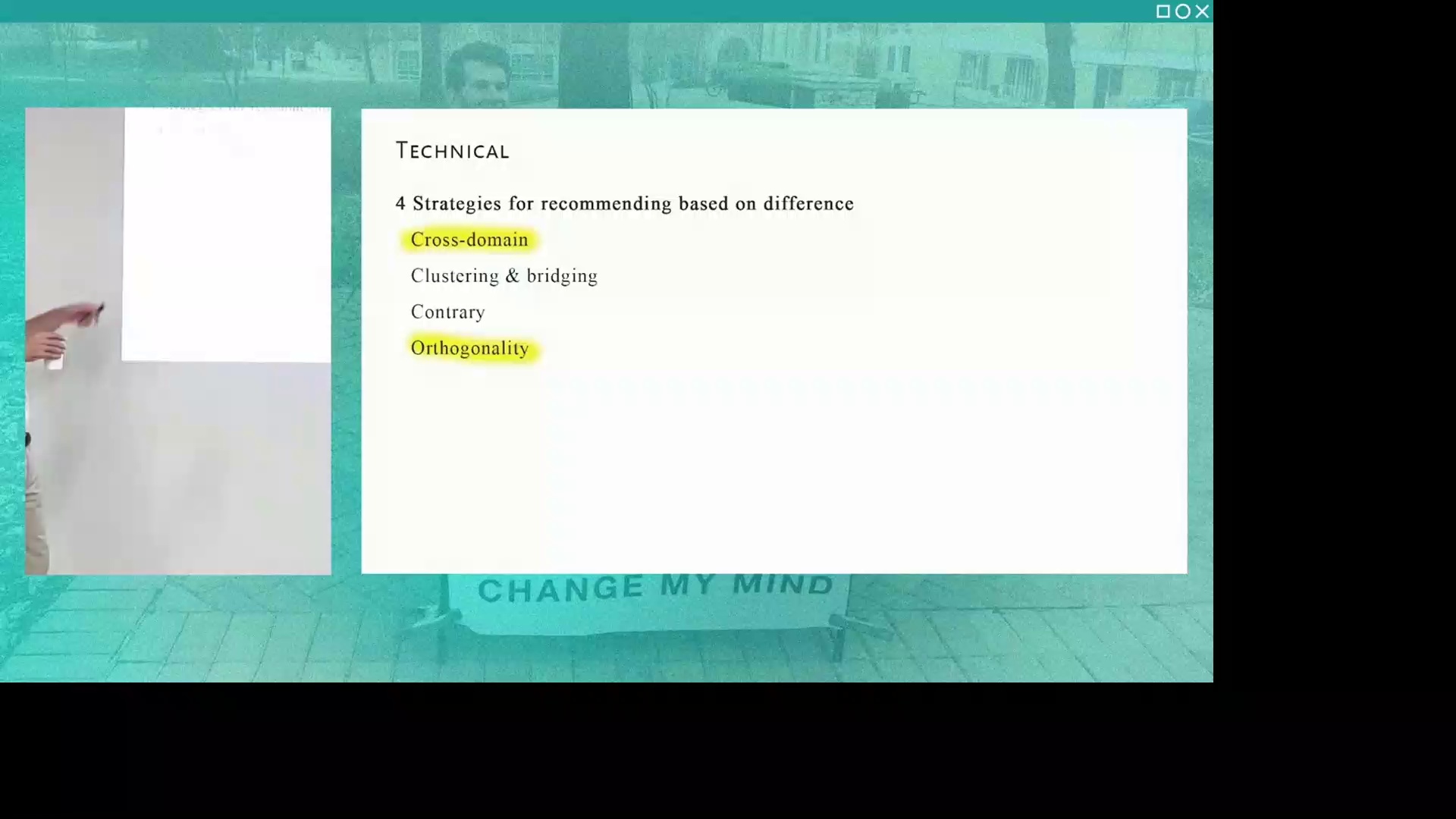
4 Strategies for recommending based on difference
- Cross-domain
- Clustering & bridging
- Contrary
- Orthogonality
AI-generated visual description — not speech or approved wording
Cross-domain and Orthogonality are highlighted in yellow.
James Brusseau speech
Now we're going to do the technical part. Four different strategies. The one I like, I think is the orthogonality strategy But we'll look at all of them quickly.
Source details — Visual — Cross-domain resonance
Visual — Cross-domain resonance
DISC-0083::VIS-019::OCC-01 · Display occurrence: approximately 1274.000–1346.000 seconds in the original video. Boundaries are estimated.
Exact frame PTS: 1274.000000 seconds in original video.
Visible slide text — not speech
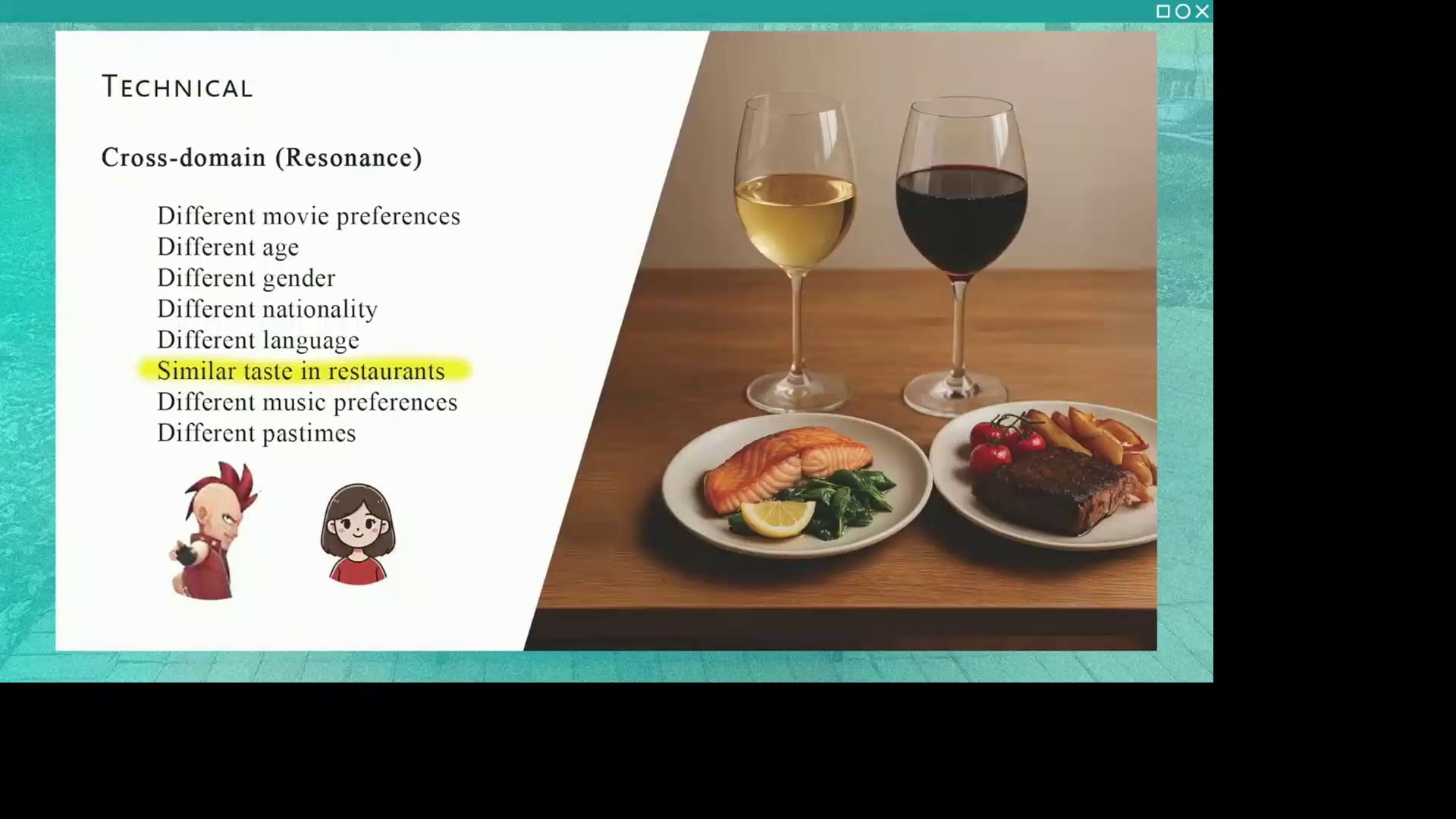
TECHNICAL Cross-domain (Resonance)
- Different movie preferences
- Different age
- Different gender
- Different nationality
- Different language
- Similar taste in restaurants
- Different music preferences
- Different pastimes
AI-generated visual description — not speech or approved wording
Different cartoon people appear beside two different meals and wines. Similar taste in restaurants is highlighted.
James Brusseau speech
Okay, so as I just said, like the resonance, I guess I could have just shown this slide. The resonance is this. Something more fits here, but it doesn't fit here, and there's no logic to that in terms of similarity. This is completely—it's not this, and this is not similar. But somehow it goes together in a way that this and this does not. That's what we're trying to find. When we say we recommend movies from her to him, we're trying to find who is the person who's different from her in the same way that white wine is different from fish. That's what we're looking for. That's what we want to find. And if we can find that person, then we can recommend back and forth between them. And if we can filter out the person, the two who are together like white wine and fish from all the other people who are together like white wine and red meat, then we can do what I'm calling cross-domain recommendation. Then we can create serendipity without using randomness or the logic of similarity.
Source details — Visual — Clustering and bridging
Visual — Clustering and bridging
DISC-0083::VIS-020::OCC-01 · Display occurrence: approximately 1348.000–1436.000 seconds in the original video. Boundaries are estimated.
Exact frame PTS: 1380.000000 seconds in original video.
Visible slide text — not speech
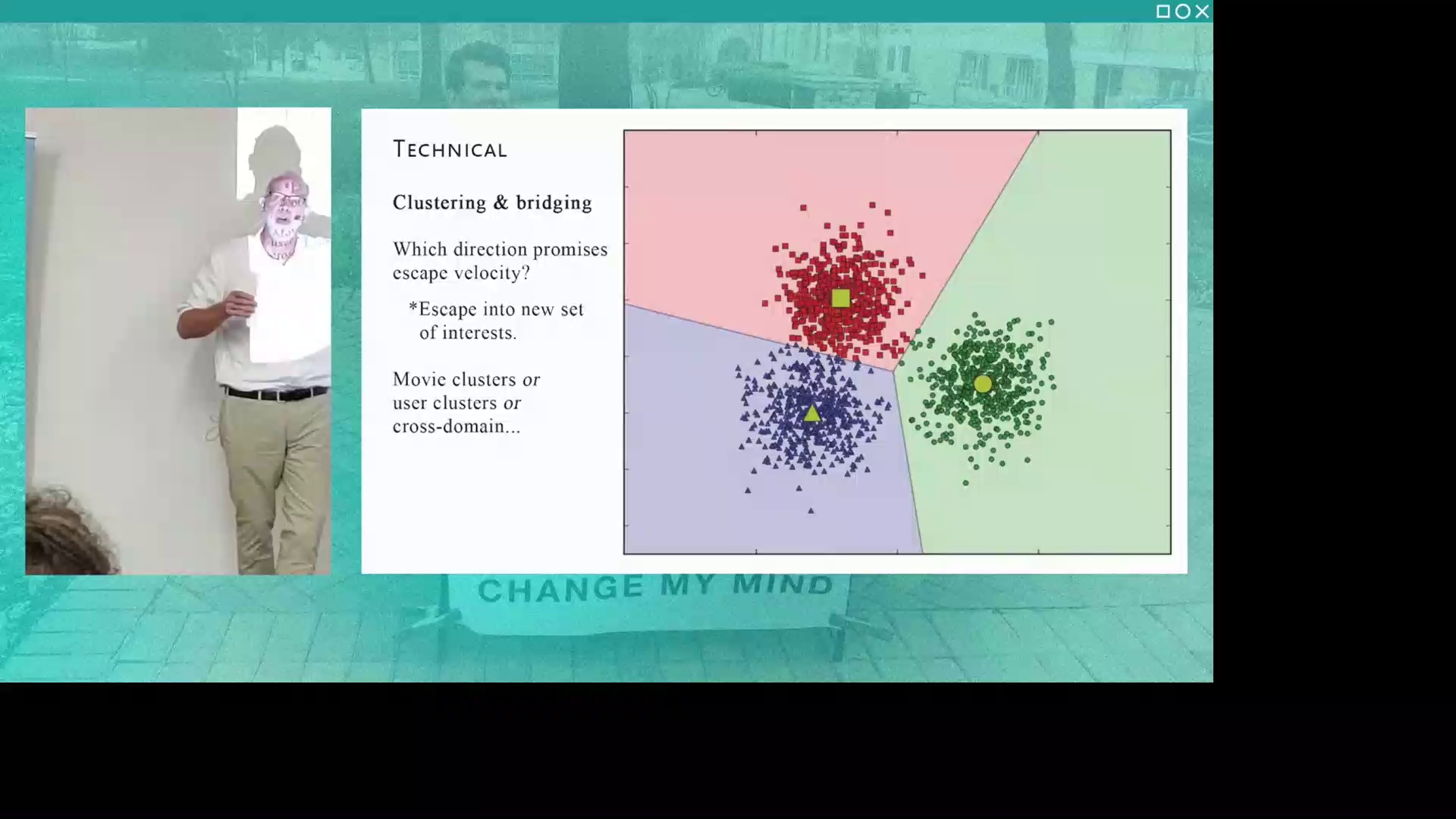
TECHNICAL Clustering & bridging
Which direction promises escape velocity?
*Escape into new set of interests.
Movie clusters or user clusters or cross-domain...
AI-generated visual description — not speech or approved wording
Three dense point clouds use red squares, purple triangles, and green circles. Matching colored regions partition the plane; larger yellow symbols mark the centers. No axis names or numeric values are printed.
James Brusseau speech
Okay so that's one technical way to think about it.
Second technical way to think about this. This is a technique which is used much more in the field of political science, people who are interested in filter bubbles especially. You were talking about that. People as you know recommender systems that have news frequently channel everyone into the pro-left, some pro-left candidate, everyone else into some pro-right candidate. How can you get people exposed to information from one to the other side? This technique is frequently used in that field, I think it can be adapted for the kind of recommendations that I'm talking about. So you could think this is a user or person with all his or her movies. This is another person with all his or her movies. You just cluster all the ones that appeal to this person and that person. You find that there's just nearest neighbor stuff. You find that there's these different clusters. And then you say, okay, if we're trying to introduce this person to new kinds of movies, then we've got to find someone like this or like this and share movies across from them. How do we do that? We would look for movies that are kind of in the bridge, kind of in between. So that's a second technical strategy for doing what I'm talking about.
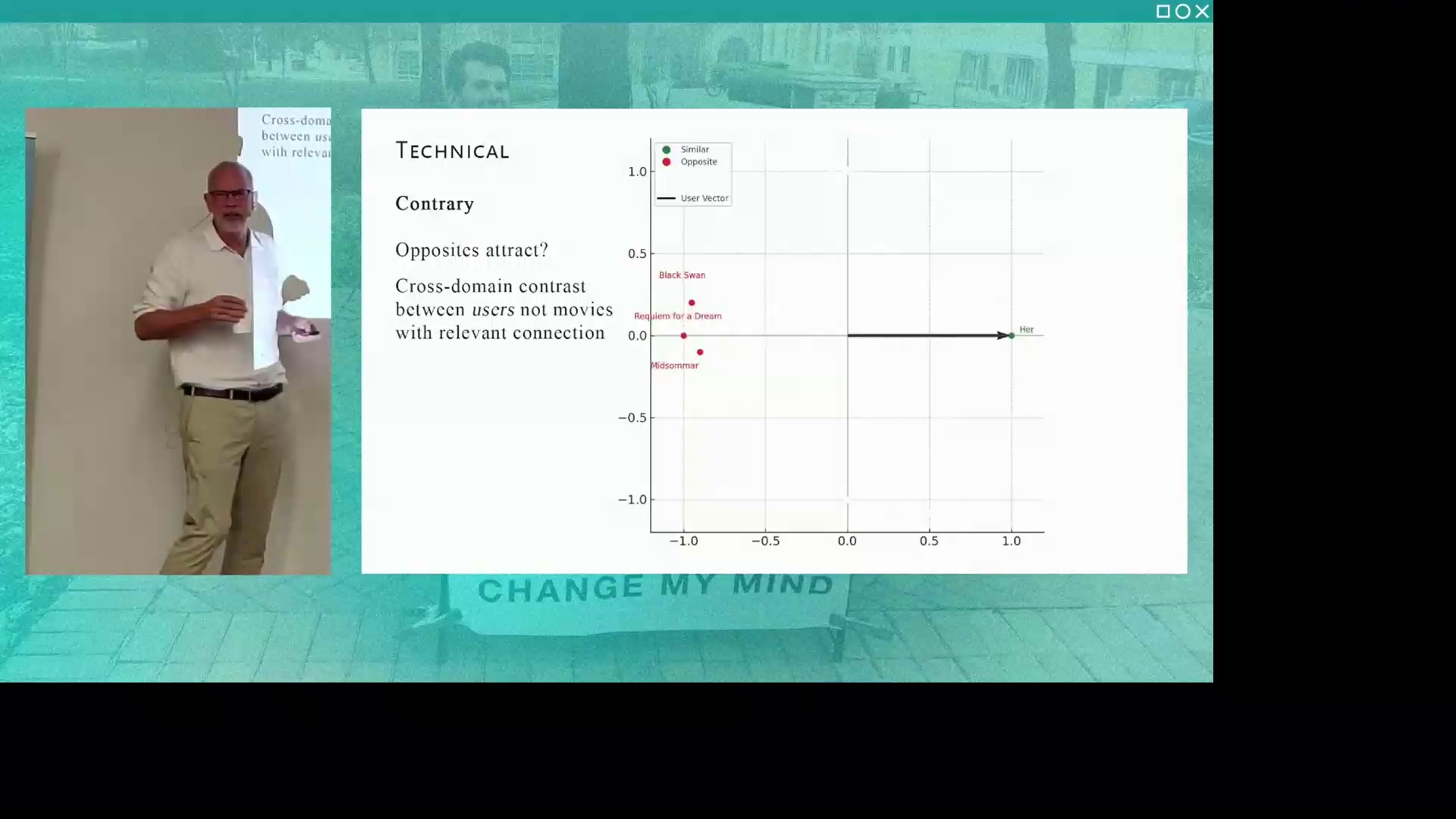
Source details — Visual — Contrary recommendation
Visual — Contrary recommendation
DISC-0083::VIS-021::OCC-01 · Display occurrence: approximately 1438.000–1480.000 seconds in the original video. Boundaries are estimated.
Exact frame PTS: 1440.000000 seconds in original video.
Visible slide text — not speech
TECHNICAL Contrary
Opposites attract?
Cross-domain contrast between users not movies with relevant connection
[Legend] Similar; Opposite; User Vector
[Film labels] Her; Black Swan; Requiem for a Dream; Midsommar
[Both axes] −1.0, −0.5, 0.0, 0.5, 1.0
AI-generated visual description — not speech or approved wording
The black vector points right toward the green Her point. Three red opposite items cluster on the left near the negative horizontal direction.
James Brusseau speech
Okay, third technical strategy. I don't love this one, so we're just going to kind of jump over it. I'm not sure I even believe in it. It would be the idea that first you get a vector that shows in your taste space the kinds of things that you like the kinds of movies that you like or people like you like if you want to expand it and then you look in the ones that are the opposite and you try and find something you would go back to the cross domain kind of example we had you would try and find something in these users which would indicate to you this would be a good choice I'm not sure this one really works it has to be there theoretically aesthetically, because if you think about that ones who are for you against you and orthogonal like we're going to do next, I have to cover this. But I don't think it works.
Source details — Visual — Orthogonal recommendation
Visual — Orthogonal recommendation
DISC-0083::VIS-022::OCC-01 · Display occurrence: approximately 1482.000–1586.000 seconds in the original video. Boundaries are estimated.
Exact frame PTS: 1500.000000 seconds in original video.
Visible slide text — not speech
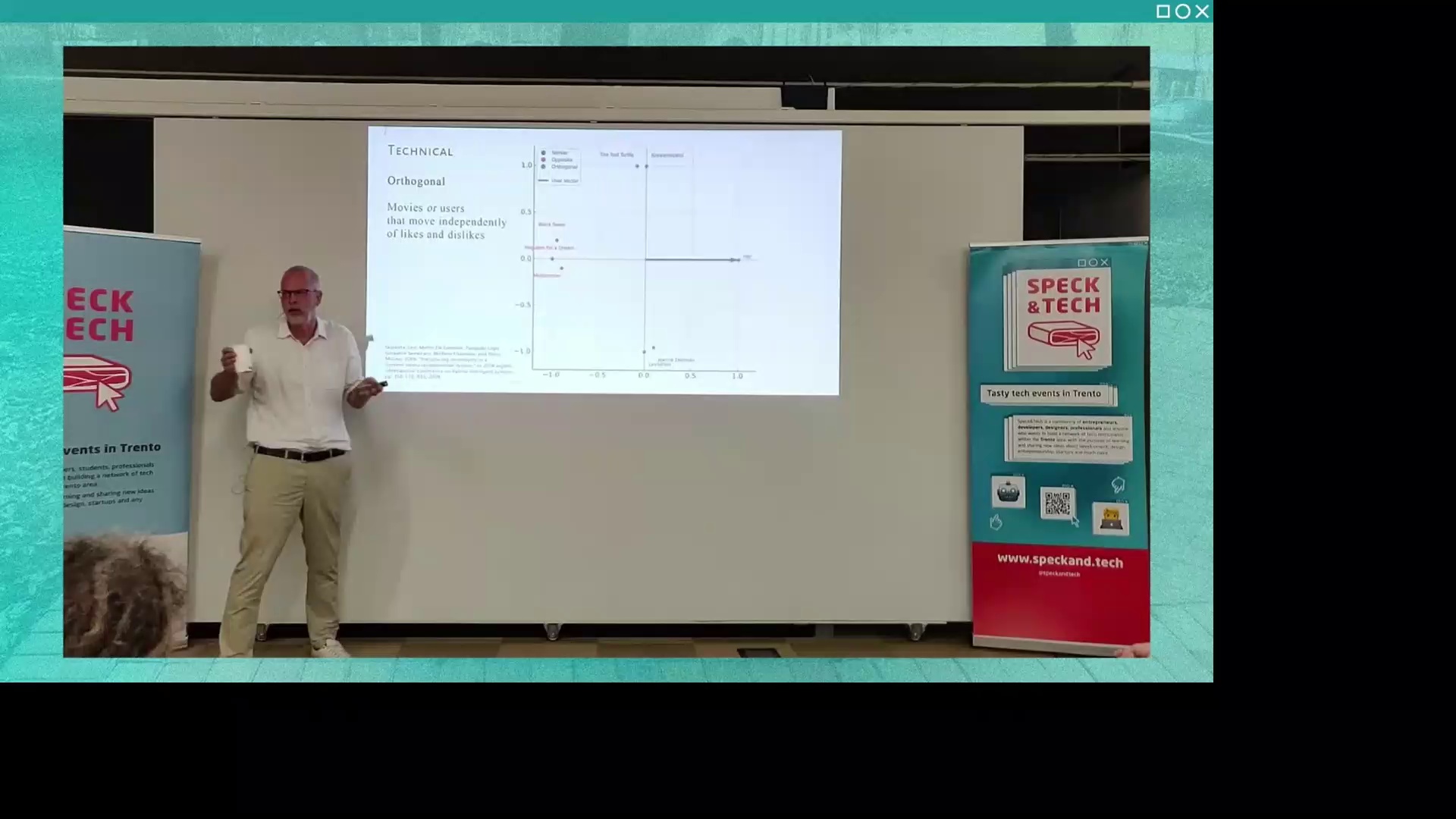
TECHNICAL Orthogonal
Movies or users that move independently of likes and dislikes
[Legend] Similar; Opposite; Orthogonal; User Vector
[Film labels, reconciled across frames] Her; Black Swan; Requiem for a Dream; Midsommar; The Red Turtle; Koyaanisqatsi; Jeanne Dielman; Leviathan
[Both axes] −1.0, −0.5, 0.0, 0.5, 1.0
[Small citation] Iaquinta, Leo; Marco De Gemmis; Pasquale Lops; [remaining author details unreadable] [Title partly readable: “Introducing serendipity in a content-based recommender system”] [Remaining publication details unreadable]
AI-generated visual description — not speech or approved wording
The user vector points right; opposite films lie left, while orthogonal films lie near the top and bottom of the vertical direction. The selected wide frame is unobstructed; the later closer 1584/1586-second frames clarify labels.
Visual limitations: The small citation is not fully readable even in closer views. Names and words are retained only where the recording supports them; no citation is completed from another deck.
James Brusseau speech
The one that I do like is this one. So this is the orthogonality answer. This is where you just map people's interests on taste space in a taste space, which is exactly what Netflix is already doing. So we don't need new technology. We don't need any new breakthroughs. We just take what we're already what are you doing? But instead of recommending people, let's say this is me, recommending movies that are out here in this area, in this area of taste space with other movies and other people who resemble this kind of enjoyment in movies. Instead of that, we map which are the kind of movies that I like. We map which are the kind of movies that I don't like. And then we map which are the kinds of movies that me and maybe we say people like me simply haven't been exposed to, which are the kinds of movies when we look out there don't appear in these vector representations of my taste or the tastes of people, if you want to go back to collaborative filtering, the tastes of people who are like me. I think that this is a way that you can graphically imagine the conceptual philosophical idea that I discussed earlier. If you can find these movies, the ones that are not attached to the things you like or the things you dislike, both for you and for those who are like you perhaps, then maybe those are the places we should look to make recommendations.
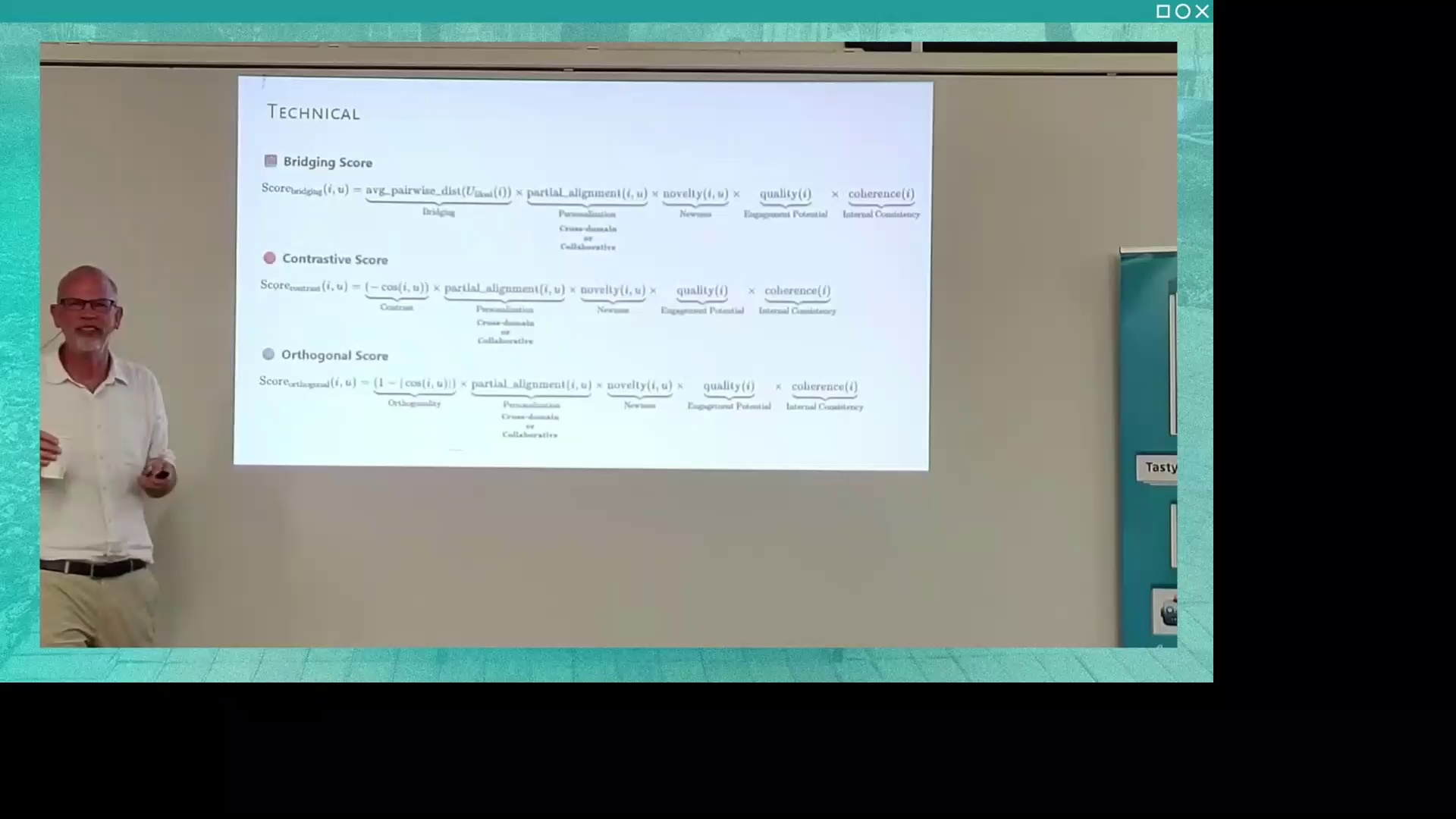
Source details — Visual — Three score formulas
Visual — Three score formulas
DISC-0083::VIS-023::OCC-01 · Display occurrence: approximately 1587.500–1593.750 seconds in the original video. Boundaries are estimated.
Exact frame PTS: 1590.000000 seconds in original video.
Visible slide text — not speech
TECHNICAL
Bridging Score
Score_bridging(i,u) = avg_pairwise_dist([unreadable subscripted argument]) × partial_alignment(i,u) × novelty(i,u) × quality(i) × coherence(i)
Contrastive Score
Score_contrast(i,u) = (−cos(i,u)) × partial_alignment(i,u) × novelty(i,u) × quality(i) × coherence(i)
Orthogonal Score
Score_orthogonal(i,u) = (1 − |cos(i,u)|) × partial_alignment(i,u) × novelty(i,u) × quality(i) × coherence(i)
[Underbrace labels] Bridges / Contrast / Orthogonality Personalization Cross-domain or Collaborative Newness Engagement Potential Internal Consistency
AI-generated visual description — not speech or approved wording
Three horizontally arranged multiplicative formulas are stacked vertically. Their first factors and labels differ; the remaining factor sequence repeats. These are displayed proposals, not independently validated algorithms.
Visual limitations: The bridging-distance argument contains a subscript that cannot be read reliably; it is explicitly unresolved. Fine mathematical glyphs warrant human review.
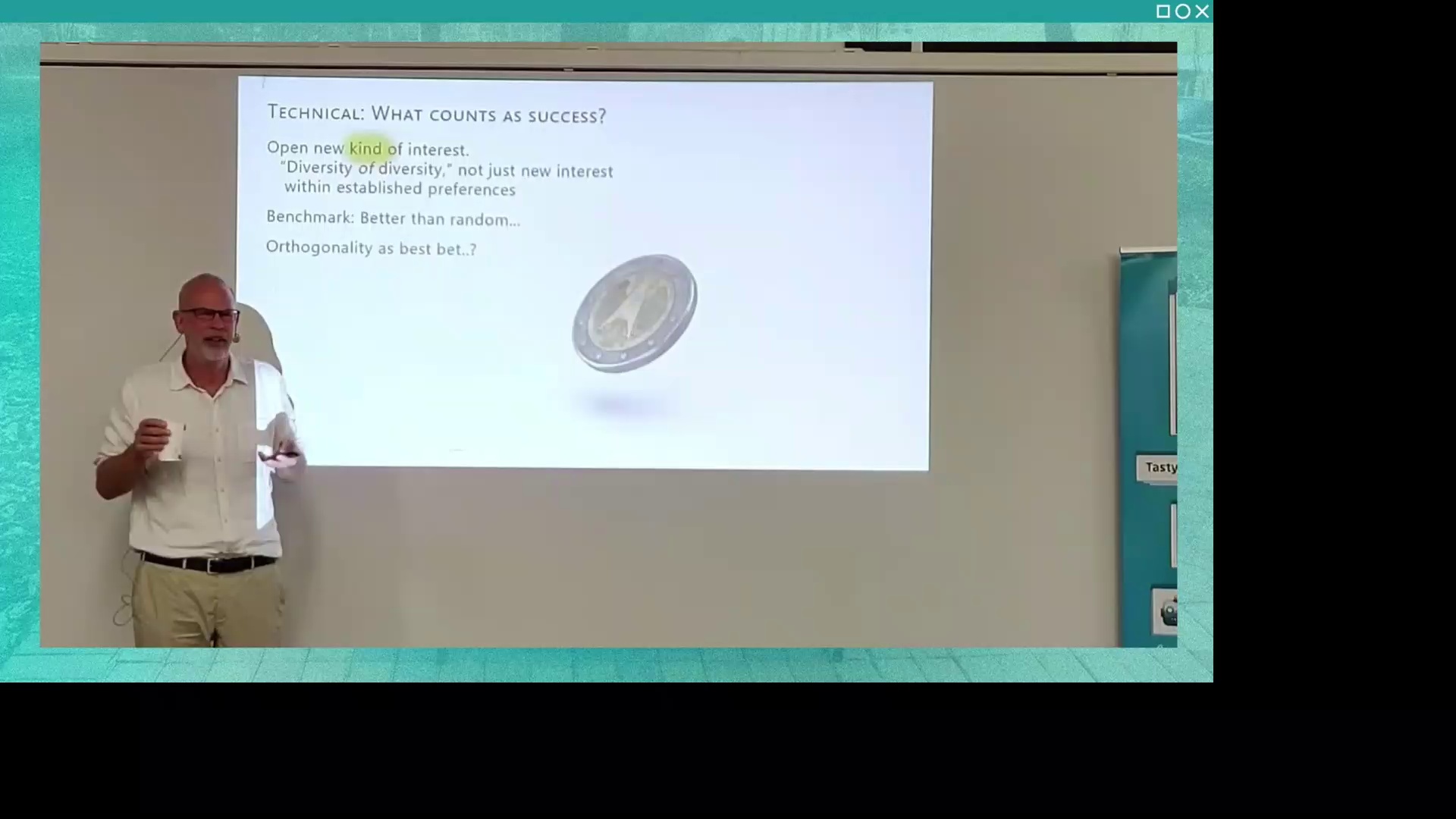
Source details — Visual — What counts as success?
Visual — What counts as success?
DISC-0083::VIS-024::OCC-01 · Display occurrence: approximately 1594.000–1702.000 seconds in the original video. Boundaries are estimated.
Exact frame PTS: 1640.000000 seconds in original video.
Visible slide text — not speech
TECHNICAL: WHAT COUNTS AS SUCCESS?
Open new kind of interest. “Diversity of diversity,” not just new interest within established preferences
Benchmark: Better than random...
Orthogonality as best bet..?
AI-generated visual description — not speech or approved wording
A tilted coin appears below the text. The word “kind” is highlighted.
James Brusseau speech
Okay, so for those of you who love formulas, there's some formulas. We're not going to go into them now.
Last thing on the technical question, for what I'm proposing, what counts as success? Well, first, I mean, obviously, I'm the first to admit 99% of the time when you crash down on your sofa, what you want is a movie which is just like all the other ones you've already liked. You're tired. You've had a long day. You don't want to deal with it, just give me something simple. So of course that's true. I'm only talking all this long discussion I've had is only for those few times, maybe in the month, when you say you know what, I really want to experiment and what I'm proposing is a way of thinking about how you can do that experimentation which is better than what we have because what we have is basically a coin flip. What we have is basically randomness. So if I can just beat that metric, if I can use these tools which I've discussed just to do a little better than a lottery selection, then I think that we can make progress and we can make progress in important ways, at least for philosophers. We can help people to go back to the start, to be more free, to open up new ways of existing for themselves, to discover new kinds of interests and new forms of living. Fundamental freedom. So I think that's what's at stake. And then we can just do conclusions quickly.
Source details — Visual — Conceptual and technical strategies
Visual — Conceptual and technical strategies
DISC-0083::VIS-025::OCC-01 · Display occurrence: approximately 1708.000–1760.000 seconds in the original video. Boundaries are estimated.
Exact frame PTS: 1730.000000 seconds in original video.
Visible slide text — not speech
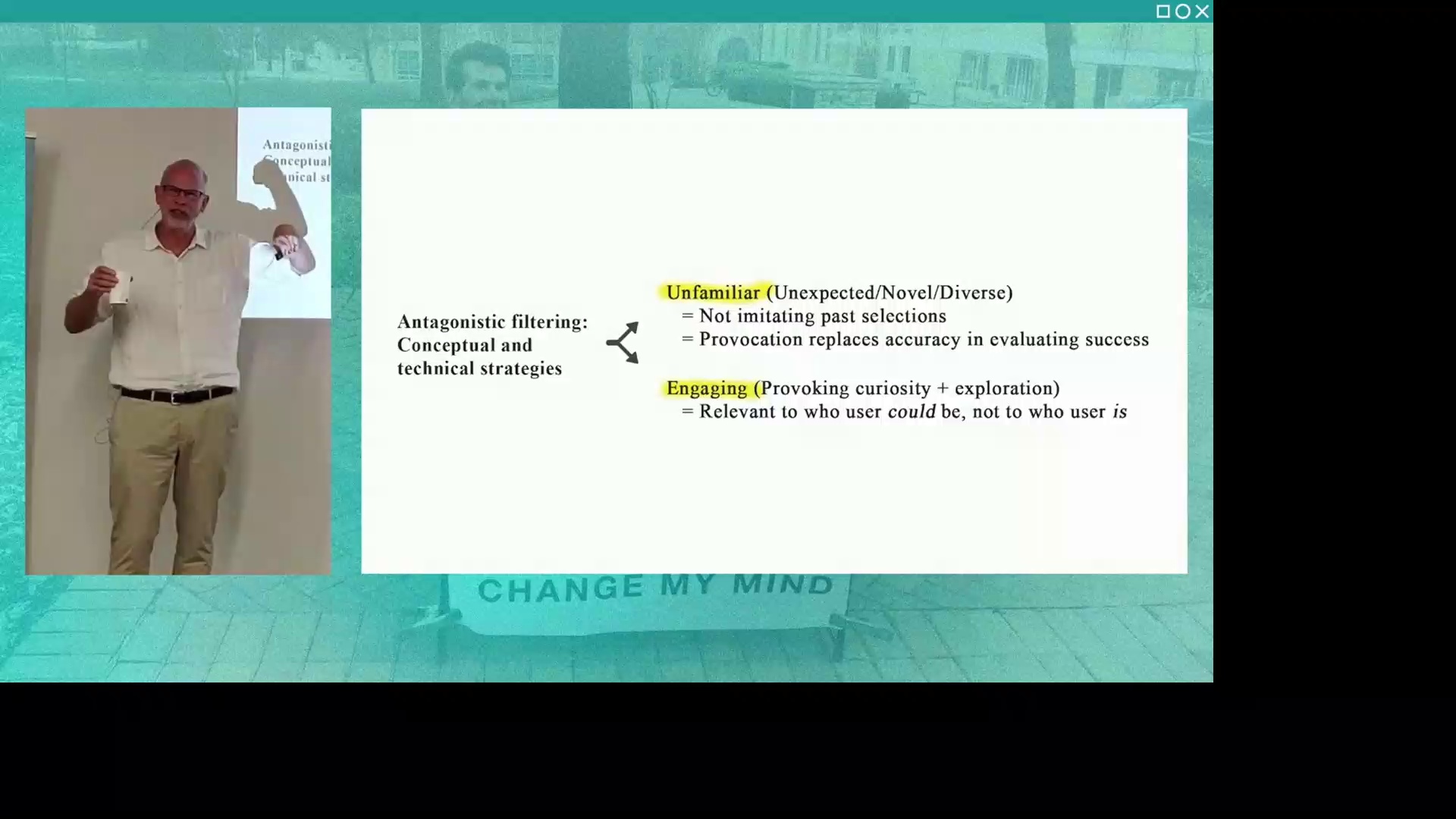
Antagonistic filtering: Conceptual and technical strategies
Unfamiliar (Unexpected/Novel/Diverse) = Not imitating past selections = Provocation replaces accuracy in evaluating success
Engaging (Provoking curiosity + exploration) = Relevant to who user could be, not to who user is
AI-generated visual description — not speech or approved wording
A branching arrow joins antagonistic filtering to the unfamiliar and engaging criteria. Those two words are highlighted.
James Brusseau speech
First, this is just a definitional conclusion. What we're looking for, what I've said is I'm looking for antagonistic filtering. I'm trying to get two things. I'm trying to get something which is unfamiliar, but which is also engaging, which you're curious about. In a certain sense, this goes back to the, going way back to the thought experiment at the start. When the person is in the locked room, there are basically two definitions of freedom. One definition of freedom is it's the ability to get what you want and you have that in the locked room. But the other definition of freedom is the ability to change what you want. That's what you lose in the locked room and that's what you lose with contemporary recommenders and that's what I'm trying to give back with antagonistic filtering. The ability to change who you are, change who you are.
Source details — Visual — Collaboration invitation
Visual — Collaboration invitation
DISC-0083::VIS-026::OCC-01 · Display occurrence: approximately 1762.000–1808.000 seconds in the original video. Boundaries are estimated.
Exact frame PTS: 1780.000000 seconds in original video.
Visible slide text — not speech
Colab
- 2 way street... are there other approaches or strategies?
James Brusseau speech
Second part of the conclusion, collaboration. You read a lot about how philosophy can help in the real world of computer coding but you very rarely read how that can happen. What I've tried to show today is real people, me, you; a real problem, recommender algorithms repeating, recycling what we've already seen; real ways you and I can actually work together in this world. So I think that's worth I personally I'm not sure if we did this in the introduction but I have not one but two jobs at the same time, so I'm sort of filled up. But there are a lot of other philosophers like me who can work with you in ways like this.
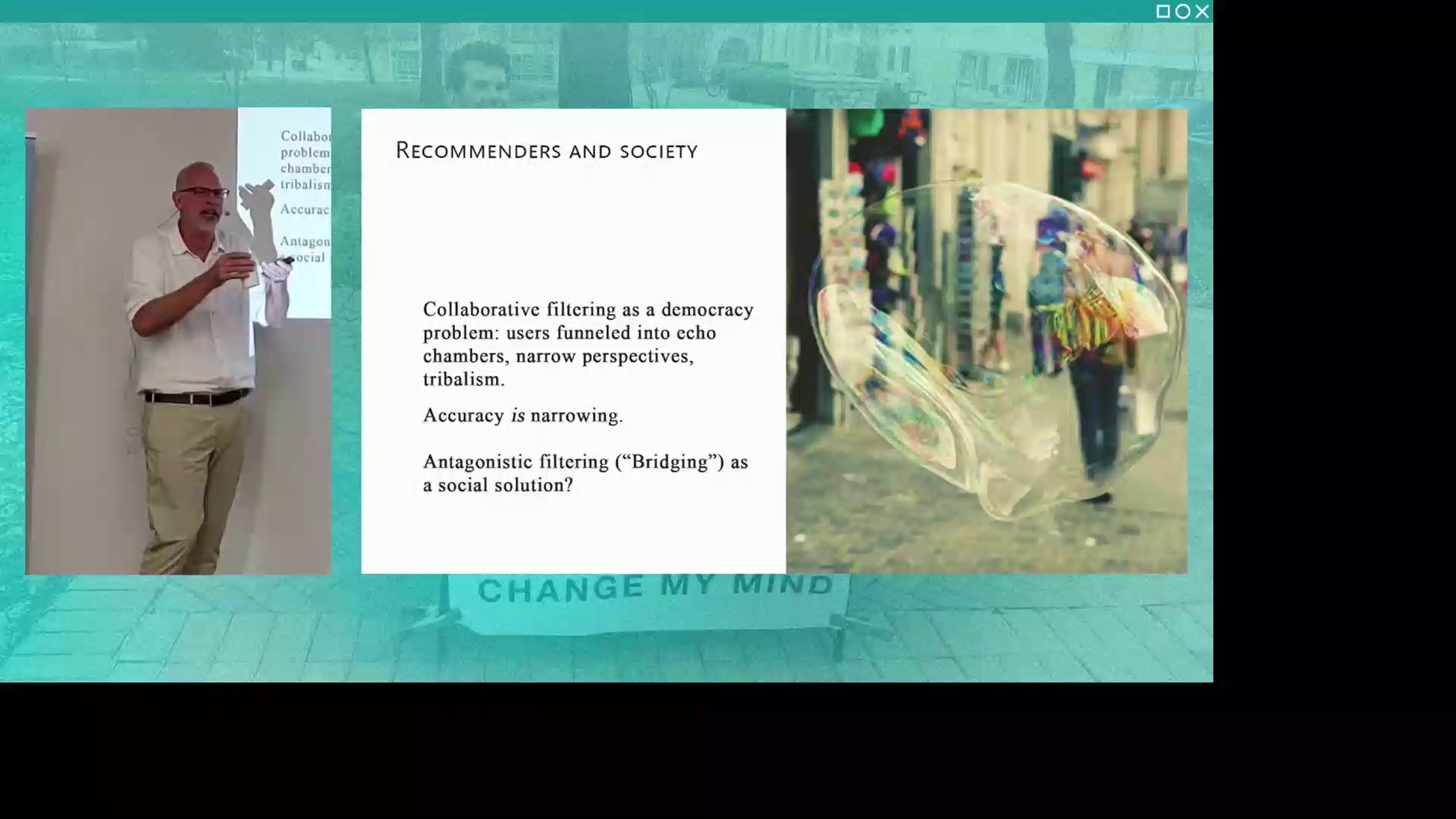
Then I've also briefly said that this is important not just on the individual level for freedom, but there are also questions here about filter bubbles and us being segregated into smaller and smaller groups. The question that arises is how can we escape these bubbles that we're in of support for one or another candidate or one or just like it's the same thing, one another kind of music.
Source details — Visual — Recommenders and society
Visual — Recommenders and society
DISC-0083::VIS-027::OCC-01 · Display occurrence: approximately 1810.000–1834.000 seconds in the original video. Boundaries are estimated.
Exact frame PTS: 1820.000000 seconds in original video.
Visible slide text — not speech
RECOMMENDERS AND SOCIETY
Collaborative filtering as a democracy problem: users funneled into echo chambers, narrow perspectives, tribalism.
Accuracy is narrowing.
Antagonistic filtering (“Bridging”) as a social solution?
AI-generated visual description — not speech or approved wording
A large transparent soap bubble occupies a street photograph on the right. No photo credit is printed.
Source details — Visual — Netflix boredom and business
Visual — Netflix boredom and business
DISC-0083::VIS-028::OCC-01 · Display occurrence: approximately 1836.000–1868.000 seconds in the original video. Boundaries are estimated.
Exact frame PTS: 1850.000000 seconds in original video.
Visible slide text — not speech
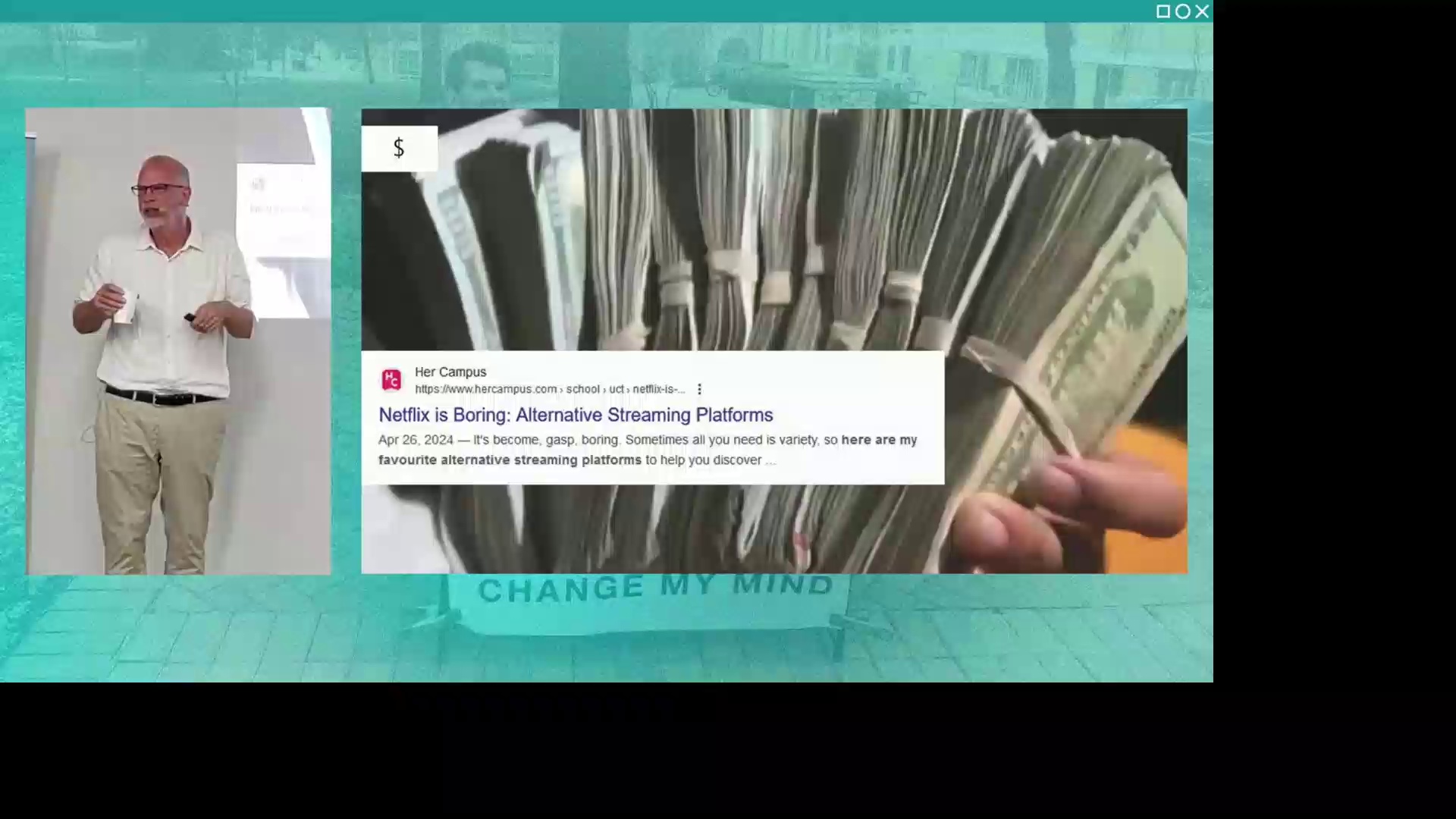
$
[Displayed search result] Her Campus https://www.hercampus.com › school › uct › netflix-is-...
Netflix is Boring: Alternative Streaming Platforms
Apr 26, 2024 — It’s become, gasp, boring. Sometimes all you need is variety, so here are my favourite alternative streaming platforms to help you discover ...
AI-generated visual description — not speech or approved wording
Bundles of banknotes form the background. The search-result excerpt is third-party material with its displayed publication and date; the truncated link is not reconstructed.
James Brusseau speech
And I think I've offered a tool to help do that.
And then last thing, there's money in this. Netflix knows that they are losing viewers because people get bored. They're looking for ways to turn users on to new parts of their catalog. Same goes for Spotify. Same goes for any kind of service which has a catalog to sell. So I think this kind of tool might be worth exploring simply on the economic level as well.
Source details — Visual — What is at stake?
Visual — What is at stake?
DISC-0083::VIS-029::OCC-01 · Display occurrence: approximately 1869.750–1871.000 seconds in the original video. Boundaries are estimated.
Short-display inclusion exception: Short substantive build, reference, or contact content; retained explicitly despite normal five-second threshold. No durations aggregated.
Exact frame PTS: 1870.000000 seconds in original video.
Visible slide text — not speech
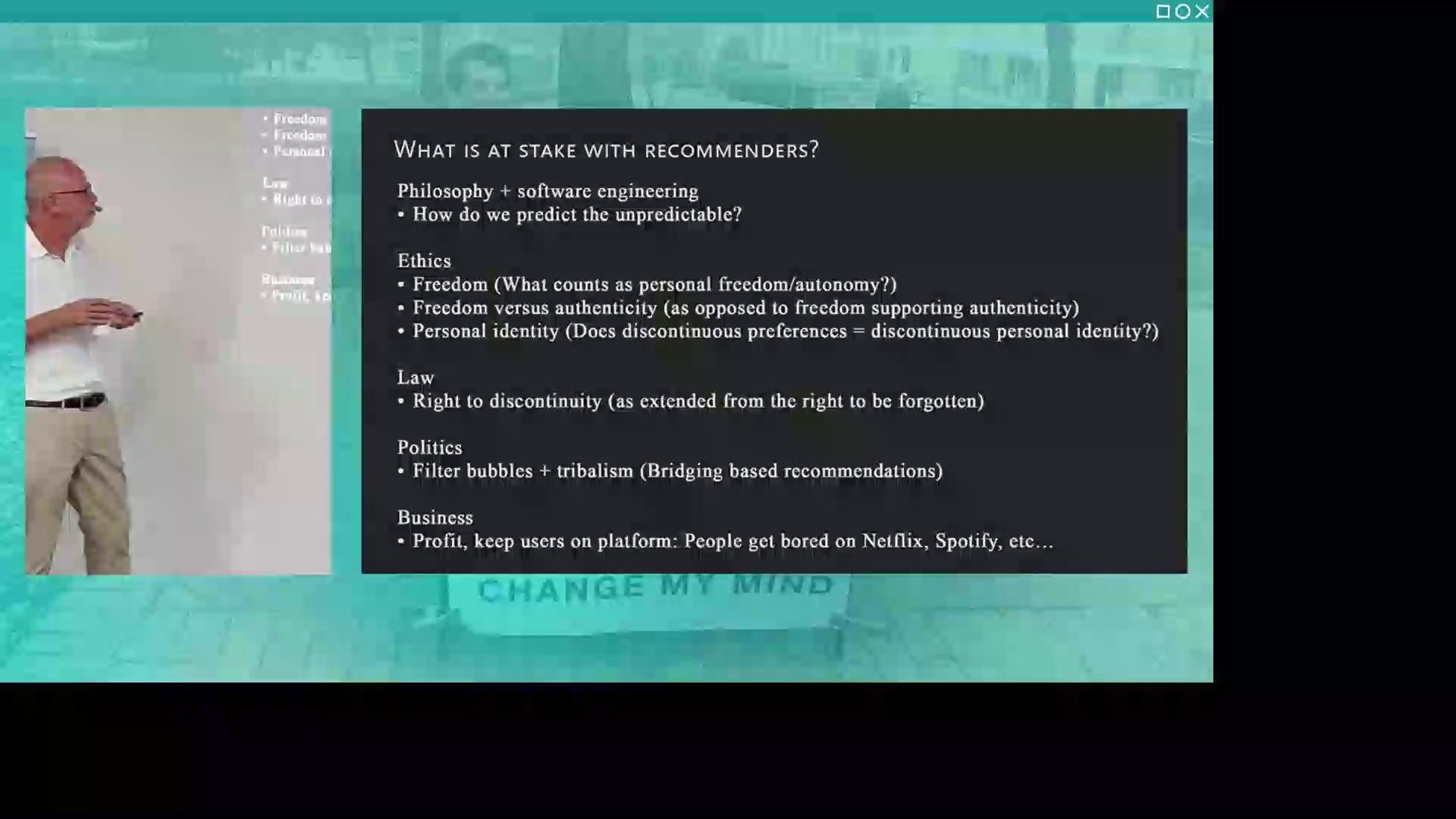
WHAT IS AT STAKE WITH RECOMMENDERS?
Philosophy + software engineering
- How do we predict the unpredictable?
Ethics
- Freedom (What counts as personal freedom/autonomy?)
- Freedom versus authenticity (as opposed to freedom supporting authenticity)
- Personal identity (Does discontinuous preferences = discontinuous personal identity?)
Law
- Right to discontinuity (as extended from the right to be forgotten)
Politics
- Filter bubbles + tribalism (Bridging based recommendations)
Business
- Profit, keep users on platform: People get bored on Netflix, Spotify, etc...
Visual limitations: Explicit short-display exception: this unique closing summary contains substantive claims across five domains. Quarter-second transition review confirms its brief display; included for its distinct content rather than duration.
Source details — Visual — Curiosity Engine project and contact
Visual — Curiosity Engine project and contact
DISC-0083::VIS-030::OCC-01 · Display occurrence: approximately 1871.250–2316.000 seconds in the original video. Boundaries are estimated.
Exact frame PTS: 2110.000000 seconds in original video.
Visible slide text — not speech
Predicting the Unpredictable
The Curiosity Engine is an NSF funded project in AI Contact: James Brusseau, Pace University NYC, jbrusseau@pace.edu
[QR center label] Curiosity Engine
AI-generated visual description — not speech or approved wording
A QR code accompanies the project statement and contact address. Its encoded destination is not inferred. The same card remains projected during discussion, with a clear digital composite at 2102–2134 seconds.
Visual limitations: Continuous occurrence includes camera views with washed-out or partially obscured projection; no camera change is treated as a new slide.
James Brusseau speech
Okay, that's enough. Thanks
Other speaker (context): Thanks, James, for your talk. A brief thing that is nice to mention as well is that James Brusseau sent us an email May or April last year, 2024, since he's a visiting professor here in Trento coming from New York. So, we waited until the very good moment to have you as a guest. Thank you for being here as well. A couple of questions. I would like to start from the previous one.
Other speaker (context): So, look, hold on. Other speaker (context): It seems that an informed human is less effective than an unbiased one. How is this possible? It seems that... And an informed human is less effective than an unbiased one. It's the one that was asked to, Ricardo.
James Brusseau: Can you fill me in a little bit? My short-term memory is as bad as my long-term memory.
Other speaker (context): All right, let's keep it for later. It was nice to restart. Let's go on. Can antagonistic filtering mitigate social media addiction, doom scrolling, for instance, while breaking the bubble created by recommender systems?
James Brusseau: The doom scrolling problem, I don't think so, no. I think that this is the opposite. I think this would make the doom scrolling problem worse. It depends on how you define doom scrolling, but the idea fundamentally is to open people up to new things that they're engaged with and interested in. So if doom scrolling just means you're just going randomly, well then yes, it solves that problem. So presumably it helps people engage with things that they want to be engaged in because it opens up their horizon. But it does keep them on the platform. There's no doubt about that.
Other speaker (context): This is totally on a philosophical level. But you haven't tested it, right?
James Brusseau: We've started some little tests in some cases, yes. All right. Keep us posted. I think it's interesting. How do you measure provocation and curiosity? Excellent questions. The only way that we have discovered to measure basically what is the success of the system so far is the degree to which it leads people to be interested in a new genre. So, let's say it doesn't work. Curiosity is not really being stimulated if I just watch one movie about Japanese cooking. But, if we can show that that leap to this new kind of movie for me which I never knew existed led to an interest in other movies about Japan or about cooking. That is, if it opened up a new vista of movies that I engaged with, then that would be the success. The success is not just that I see one movie which is different, but that I am tuned into a whole new way of thinking about or a whole new kind of movies that are interesting for me in my life. All right.
Other speaker (context): The audience is asking, how do you collect data about every person's cross domains? Doesn't it impact privacy? It does. Right.
James Brusseau: Right. So when I sent, Francesco will tell you that I sent an initial deck this morning which had like 500 slides or something and then a panic about two hours ago I sent a much shorter deck which you just saw but on the long deck that's one of the questions that comes up. There's no question about the fact that this is a giant privacy trade-off. You are giving up your privacy in order to get turned on to these new kinds of movies or songs or what have you. And so, also leading back to the presentation on manipulation, this is not... I am not claiming that this is some kind of salvation. I'm not claiming this is an unadulterated improvement. It's more of a change. You get some things, but you're going to lose some other things too. And privacy is one of them.
Other speaker (context): Here we get to the good question. Isn't changing what you recommend and still locking in the user in some way. I think the user is not going to choose freely as long as you recommend stuff to them. Right
James Brusseau: Right, so in a certain sense, here's another problem. Excellent question too. Another problem with the idea. If what I'm saying makes sense, then it's not enough to just say, okay, well one time I will get some new movies and be interested in that. That's not enough. As soon as I'm interested in those, then I have to go on and do the process again. So I'm kind of setting people up to be constantly changing, which leads back to a philosophical perspective that I actually share that what human existence is about is actually changing who we are constantly. So for me, the objection that is raised there is actually a solution. I like the objection. I think it's good, but the objection is correct.
Other speaker (context): I think you showed an example that was similar, but some people are asking if you think a similar approach could be applied to relationships between people, not necessarily romantic?
James Brusseau: Absolutely. I think that it happens all the time. One of the reasons I'm here, if you look at my biography somehow, you would find that I teach in all kinds of different universities all over the world with no particular reason. Well, there is a reason. The reason is because I think that these kinds of openings happen in personal relationships of all kinds. That's why I'm here. That's what I'm looking for, is to find new kinds of music in Italy, new kinds of food, of course, and so on. And so what I'm trying to do is replicate that human experience on the level of recommenders.
Thanks so much, James. Oh, okay. Yeah, right. So we were talking about his, the very interesting point that he made in his presentation about how the AI does better than humans because the AI personalizes better, no doubt about it. But it also just seems to me that when humans make arguments we try to convince someone of something, we just intrinsically try to not personalize. We think it's more noble or dignified to make an argument that convinces anyone whether it's a man or a woman or young or old. So I think I was trying to say that there's just this human intrinsic value in what is transcendent. And the machine doesn't care about that. It just goes straight to specific points where they can manipulate, yeah. All right,
Other speaker (context): Thanks so much for warm flows. All right, wrapping up the event, a couple of things before moving on. It's 9 48 and I don't know if you're hungry. We are somehow. There's going to be spec and